

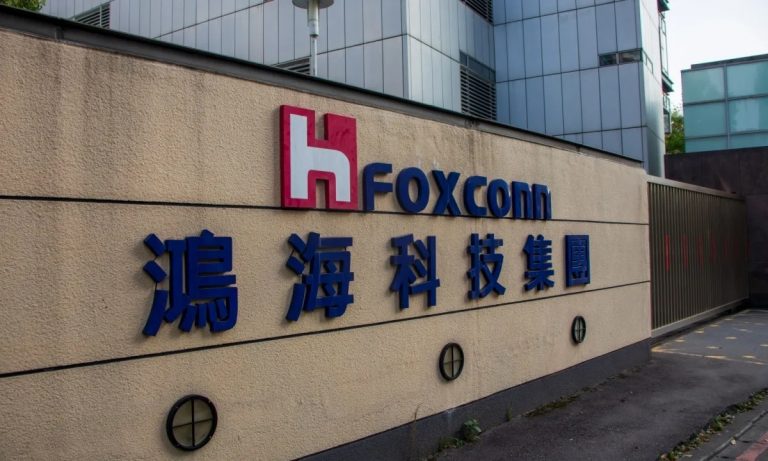
Foxconn says the artificial intelligence boom is reshaping the global electronics industry so profoundly that the traditional seasonal slowdown for technology manufacturers is effectively disappearing.
Speaking at the company’s annual shareholders meeting in New Taipei on Friday, Chairman Young Liu projected strong growth through the second half of the year, citing surging capital expenditure by the world’s largest cloud computing companies and relentless demand for AI infrastructure.
“Unless a highly severe ‘black swan’ event occurs, which I haven’t seen, and there are currently no signs of, based on what we see now, the second half of the year looks very good,” Liu said.
Register for the next Tekedia Mini-MBA.
Register for Tekedia AI in Business Masterclass.
Join Tekedia Capital Syndicate and co-invest in great global startups.
The comments provide one of the clearest signals yet that major manufacturers at the heart of the AI supply chain expect the current spending cycle to intensify rather than cool.
Foxconn, formally known as Hon Hai Precision Industry, occupies a critical position in the global technology ecosystem. The company is the world’s largest contract electronics manufacturer, the leading assembler of Apple’s iPhones, and the biggest server manufacturer for NVIDIA, whose AI chips have become central to the generative AI boom.
That positioning has transformed Foxconn into one of the biggest industrial beneficiaries of the AI arms race underway among hyperscale cloud providers, governments, and enterprises globally.

Liu revealed that capital expenditure by major cloud service providers has already surpassed $700 billion this year and could approach $1 trillion next year.
“Their capital expenditure is our market,” he said, underscoring how deeply Foxconn’s outlook is now tied to AI infrastructure investment.
The spending surge denotes the extraordinary scale of data center expansion underway globally as companies deploy increasingly powerful AI systems requiring massive computational capacity. AI servers, high-bandwidth networking equipment, advanced cooling systems, and memory infrastructure have become among the fastest-growing segments of the technology industry.

Foxconn’s aggressive move is understood to be aimed at capturing that demand. The company said earlier this month that it expects capital expenditure to rise 30% this year from T$174 billion ($5.6 billion) in 2025 as it expands manufacturing capacity for AI servers and related infrastructure.
The upbeat outlook from Foxconn follows a wave of bullish commentary from major AI infrastructure players. Dell Technologies recently projected AI-related revenue of $60 billion next year, while Nvidia CEO Jensen Huang has repeatedly described AI infrastructure spending as being in the early stages of a long-term industrial buildout.
Investors responded strongly to Foxconn’s comments. Shares closed nearly 10% higher on Friday after Dell’s earnings and guidance fueled optimism across AI hardware stocks. Still, Foxconn’s 25% share gain this year has lagged the broader Taiwan stock index, which has surged 55% amid investor enthusiasm surrounding semiconductor and AI-related companies.
Taiwan’s market rally underpins the island’s central role in global AI infrastructure production. Companies such as Taiwan Semiconductor Manufacturing Company, MediaTek, and Delta Electronics have all benefited from growing expectations that AI demand could drive a multiyear investment cycle across chips, networking, power management, and advanced manufacturing.
Backing A Glorious Future for AI
Foxconn’s stance also indicates that AI may be changing long-established patterns in the consumer electronics industry. Historically, hardware manufacturers experienced predictable mid-year slowdowns between product cycles. But Liu indicated that constant AI infrastructure demand from enterprise and cloud customers is helping smooth out those seasonal fluctuations.
The shift highlights how the center of gravity in technology spending is moving away from purely consumer-driven cycles toward continuous enterprise and cloud infrastructure expansion.
Foxconn’s optimism comes even as parts of the semiconductor industry grapple with component shortages and supply constraints. Liu acknowledged that the global shortage of memory chips has affected some high-end customers, though he said the impact remains manageable for now.
“If the high-end market is impacted, the entire world will feel it,” he said. “For us, the current situation is that the impact on our clients through the end of the year is limited.”
The comments have caught the tech industry’s attention because memory chips have emerged as one of the biggest bottlenecks in AI infrastructure deployment. Advanced AI servers require large quantities of high-bandwidth memory, where suppliers such as SK Hynix, Samsung Electronics, and Micron Technology are struggling to keep pace with demand.
That shortage has intensified concerns that AI infrastructure deployment could become constrained by supply chain limitations even as spending accelerates.
Foxconn’s confidence nevertheless signals that manufacturers at the core of the AI ecosystem still see years of expansion ahead. The company’s position as both a consumer electronics assembler and an AI server manufacturer also gives it a unique view into how the global technology industry is evolving. While smartphone and PC markets have matured, AI infrastructure has emerged as a powerful new growth engine capable of offsetting weakness in traditional hardware segments.
With the scale of projected hyperscaler spending, analysts are seeing a broader transformation in global capital allocation. Technology giants are increasingly directing enormous sums toward building AI capacity, effectively creating a new industrial spending cycle centered on semiconductors, data centers, networking systems, and power infrastructure.