

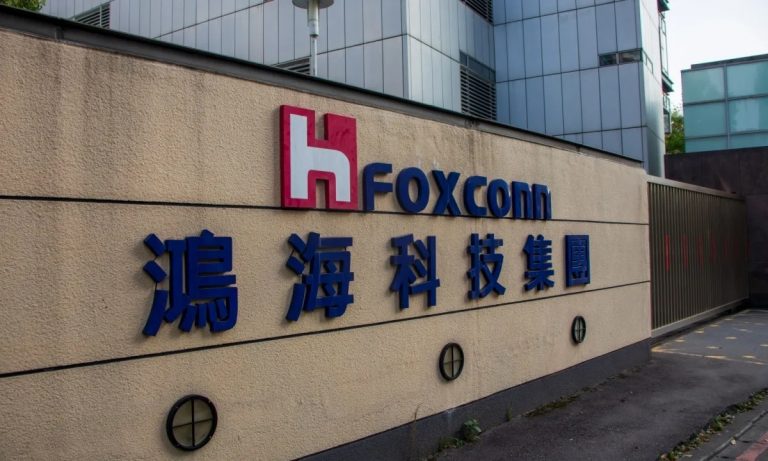
Foxconn said on Friday that the $1.4 billion supercomputing center it is building with Nvidia will be ready in the first half of 2026, signaling its tightening grip on the AI hardware world.
When completed, it will stand as Taiwan’s largest advanced GPU cluster, underscoring just how fast the AI race is turning into a full-blown infrastructure sprint.
The 27-megawatt facility will run on Nvidia’s new Blackwell GB300 chips. Neo Yao, who leads Visonbay.ai — Foxconn’s newly created unit for AI supercomputing and cloud operations — said the center will also become Asia’s first GB300 AI data facility. The announcement was made at Foxconn’s tech day, attended by key partners including Nvidia, OpenAI, and Uber.
Register for Tekedia Mini-MBA edition 20 (June 8 – Sept 5, 2026).
Register for Tekedia AI in Business Masterclass.
Join Tekedia Capital Syndicate and co-invest in great global startups.
Register for Tekedia AI Lab.
At the event, Nvidia vice president Alexis Bjorlin pointed to an accelerating shift in how companies use AI infrastructure.
“As GPU technology accelerates, building individual facilities may no longer make economic sense,” she said.
Renting compute power, according to her, could offer a stronger return by letting organizations scale usage based on product cycles and business demands.

Foxconn already plays a central role in the industry as Nvidia’s main manufacturer of AI racks — the server assemblies that house GPUs, cabling, and other specialized equipment needed for high-intensity AI workloads. This positioning has made the iPhone assembler one of the prime beneficiaries of the global boom in data center construction, as cloud firms funnel extraordinary amounts of money into AI research and infrastructure expansion.
The momentum inside the sector is unmistakable. Foxconn issued a positive outlook last week, saying AI orders will be a major driver of growth heading into 2026. In an interview with Reuters published earlier on Friday, Chairman Young Liu said Foxconn plans to invest $2 billion to $3 billion each year in AI. He added that the company now has the ability to produce 1,000 AI racks per week, a number that is expected to rise sharply next year.
The tech day also featured an appearance by Foxconn founder Terry Gou and by Spencer Huang, a product line manager in Nvidia’s robotics division, and the son of Nvidia founder Jensen Huang. He said Nvidia is working with Foxconn to bring AI into factories and manufacturing lines, a partnership that ties directly into Foxconn’s ambition to broaden its industrial footprint.

The wide-ranging event included a push into electric vehicles, a sector Foxconn sees as another pillar of its transformation. Liu said EV volumes are reaching the threshold where automakers can now outsource more production to Foxconn. The company showcased its “Model A” electric vehicle on stage, with Chief Strategy Officer Jun Seki explaining that the EV was designed by Japanese engineers.
Foxconn intends to create a dedicated unit in Japan for customers there, and production of the Model A will move to Japan in the future, Liu added.
Across the tech world, the speed of investment has raised discussion about whether an AI-driven infrastructure bubble is forming. The race to build ever-larger GPU clusters is pushing companies to spend at levels rarely seen in such a short period. Investors are piling in with the hope of catching the next frontier of computing, while cloud providers and enterprises are scrambling to secure enough capacity to stay competitive. Analysts say the mismatch between projected long-term AI demand and the near-term flood of spending is stirring familiar questions about sustainability.
Foxconn, like several others, is sprinting ahead, positioning itself right at the center of the global buildout. The company has moved far beyond its identity as Apple’s top iPhone assembler, recasting itself as a heavyweight in AI infrastructure, EV manufacturing, and industrial automation.