

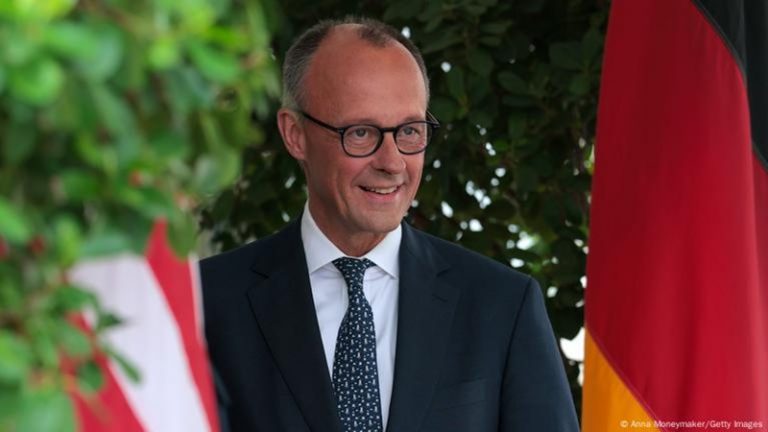
Chancellor Friedrich Merz’s upcoming trip to China. Hildegard Müller, president of the VDA; Verband der Automobilindustrie, Germany’s key auto industry association, told Welt am Sonntag that Merz should clearly outline areas where China distorts competition through subsidies, overcapacities, and other practices.
She emphasized that talks should aim to open markets mutually on both sides, rather than leading to isolation, and that China has an obligation to propose ways to reduce these distortions. This comes amid severe challenges for German automakers like Volkswagen, BMW, and Mercedes-Benz in China—the world’s largest auto market and a longtime profit driver: German brands have seen sharp sales declines and lost market share to local EV giants like BYD, Geely fueled by aggressive state support, price wars, and rapid innovation in electric vehicles.
Exports and local sales have “fallen off a cliff” in some views, with Chinese overproduction and subsidies creating intense rivalry both in China and globally including Europe via cheap imports.
The German side views this as unfair competition, prompting calls for Merz to push for fairer, more liberalized market access—meaning reduced barriers, less state intervention distorting the playing field, and reciprocal openness. This aligns with Merz’s tougher stance on China compared to predecessors like Merkel or Scholz.
Register for Tekedia Mini-MBA edition 20 (June 8 – Sept 5, 2026).
Register for Tekedia AI in Business Masterclass.
Join Tekedia Capital Syndicate and co-invest in great global startups.
Register for Tekedia AI Lab.
He has highlighted risks from overdependencies, overcapacities, and the need for “fair competition” during the visit, while still seeking “strategic partnerships” and dialogue. However, views within the sector vary: BMW CEO Oliver Zipse stressed that German carmakers need China for global scale, innovation, and competitiveness—ignoring it risks long-term economic harm.
Broader industry and political voices including machinery lobbies urge addressing subsidies and export controls more forcefully, potentially via EU-level tools like tariffs or anti-dumping measures. Merz’s trip occurs against strained EU-China relations, including ongoing EV tariff debates and U.S. trade pressures.
The auto sector hopes for progress on leveling the playing field, but expectations are tempered by the deep entanglements that make full decoupling unrealistic. In short, the demand is for Merz to advocate strongly for reciprocal liberalization to counter perceived distortions and help revive German firms’ position in China.

Whether this yields concrete results remains to be seen, as Beijing has shown willingness to offer perks to German brands amid tariff risks, but systemic changes in its industrial policies are harder to achieve.
The EU’s tariffs on Chinese electric vehicles (EVs) remain in place but the situation has evolved significantly toward a more negotiated, flexible approach rather than rigid enforcement. In October 2024, the European Commission imposed definitive countervailing duties on imports of new battery electric vehicles (BEVs) from China following an investigation into unfair state subsidies.
These duties range from 7.8% to 35.3%; model- and company-specific, e.g., lower for Tesla’s Shanghai-made vehicles, higher for some Chinese firms like SAIC, on top of the standard 10% EU import duty for cars. The goal was to counter subsidized overcapacity and protect the EU auto industry from injury caused by low-priced Chinese imports.
China challenged these at the WTO, and retaliated with probes and duties on EU products like dairy, pork, and brandy—though some retaliatory tariffs have since been reduced. The EU has shifted toward alternatives to full tariffs, driven by pressure from German automakers with heavy China exposure—they produce and sell China-made EVs in Europe and fear retaliation hurting their China market access.

The Commission issued guidance in January 2026 on “price undertakings”, allowing case-by-case exemptions from the extra duties in exchange for: Minimum import prices to prevent dumping/under-cutting EU producers. Sales quotas or export caps. Commitments on sales channels, no cross-compensation, and potentially EU investments.
This is seen as a pragmatic truce to avoid escalation amid global trade tensions including U.S. tariffs under Trump 2.0 and to maintain dialogue with China. Landmark precedent: In February 2026, the Commission approved the first such exemption—for Volkswagen Group’s Cupra Tavascan.
It faces no extra countervailing duty previously ~20.7% if sold at or above an agreed minimum price and within quotas. This required strict compliance. Chinese EV makers via the China Chamber of Commerce to the EU are now pursuing similar individual deals for their models.
Chinese brands have adapted by absorbing costs, shifting to hybrids and plug-ins not fully covered initially, localizing production in Europe or pushing exports despite duties—leading to record Chinese car penetration in Europe in 2025.
The EU is also proposing complementary measures, like requiring 70% local/EU content for EVs to qualify for state subsidies and incentives, to bolster domestic manufacturing.
Merz visiting China soon, around late February 2026 is likely to address trade fairness, including EV market access and subsidies, amid calls from the German auto sector for reciprocal liberalization—while balancing dependencies and U.S. tariff pressures.
The tariffs haven’t been scrapped but are increasingly bypassed or mitigated via negotiations, reflecting a de-escalation phase. This helps German firms but raises concerns about higher consumer prices, lost EU tariff revenue ~€2B/year estimates, and limited protection against Chinese competition.
Manfred Weber Calls for Greater German Commitment to European Defence
Manfred Weber, a prominent EU lawmaker and leader of the European People’s Party (EPP) group in the European Parliament. He is calling for greater commitment from Germany to European defence efforts.
In comments reported, Weber urged Germany to step up significantly, noting that if the EU were to reach a target of spending 5% of GDP on defence, “we Europeans” would achieve a major strategic boost. This comes amid broader discussions on enhancing Europe’s defence capabilities, particularly in light of uncertainties in transatlantic relations, ongoing support for Ukraine, and initiatives like joint procurement and the activation of the EU’s mutual defence clause (Article 42.7).
Weber’s remarks align with a push from figures like European Commission President Ursula von der Leyen, who recently emphasized making the EU’s mutual defence obligations more operational, and German Chancellor Friedrich Merz, who has committed to making Germany the strongest conventional army in Europe and investing hundreds of billions in defence.
Germany has already taken steps, such as exempting much defence spending from debt limits and planning over €500 billion in defence outlays from 2025–2029, but critics argue more coordinated European-level action is needed to close longstanding gaps.
This reflects heightened urgency in European security debates following the Munich Security Conference and related developments, where leaders across the continent stress the need for greater self-reliance and collective investment in defence.
Manfred Weber’s call for greater German commitment to European defence—particularly pushing for higher spending toward a hypothetical 5% of GDP level for Europe collectively and stronger integration—has direct implications for sustained support to Ukraine.
This comes amid a broader European push for strategic autonomy, heightened by uncertainties in U.S. commitments under the current administration, Russia’s ongoing aggression, and discussions at forums like the Munich Security Conference in February 2026.
Weber’s advocacy aligns with NATO’s 2025 agreement for allies to aim for 5% of GDP on defence by 2035 split into ~3.5% core defence and 1.5% for resilience and infrastructure. Some frameworks allow military aid to Ukraine to count toward these targets. Increased European and especially German defence budgets could free up or expand dedicated aid channels without direct trade-offs against domestic military modernization.
For instance, Germany’s 2026 budget already allocates around €11.5 billion in aid to Ukraine including artillery, drones, armoured vehicles, and air defence, up from prior years, with recent additions of €3 billion. Weber’s pressure could accelerate this trend, as Germany positions itself as Europe’s leading conventional military power under Chancellor Merz.
Calls to operationalize the EU’s mutual defence clause— emphasized by figures like Ursula von der Leyen at Munich — aim to make it more actionable for hybrid or below-threshold threats. While not directly triggered by Ukraine’s situation, this could strengthen indirect support mechanisms, such as joint procurement, industrial ramp-up, and resilience against Russian hybrid attacks.
Weber has tied this to pro-Ukraine stances, criticizing parties or governments less committed to Kyiv. Higher EU-wide defence investment (projected to reach hundreds of billions extra annually) focuses on scaling production of weapons, drones, and ammunition—lessons from Ukraine’s war.
This benefits Kyiv through sustained supply lines, as seen in recent Ramstein commitments totaling $38 billion in military aid for 2026 across partners, with Germany contributing significantly. Weber’s vision emphasizes building a stronger, more integrated European defence including ideas like a European army or peacekeeping role post-ceasefire.
German Chancellor Merz has downplayed some of Weber’s bolder proposals, like deploying European troops in Ukraine for peacekeeping, prioritizing current tasks like capability improvements over speculative deployments. This could divert resources toward EU and NATO internal gaps rather than immediate frontline aid if not carefully balanced.
Germany’s aid increases are substantial, but critics argue they fall short of Ukraine’s estimated needs ~$120 billion for defence in 2026. Weber’s push counters domestic hesitancy from rising right-wing parties like AfD, which he links to the need for stronger integration, but implementation depends on coalition politics and budget trade-offs.
Weber’s statements build on existing momentum. They reinforce rather than radically alter the trajectory, where support remains strong but increasingly framed around long-term European self-reliance. Weber’s urging strengthens the case for Germany—and Europe—to treat Ukraine support as integral to continental security.
It promotes a “more, together, and European” approach that could sustain or even grow aid volumes in 2026 and beyond, especially if tied to counting Ukraine assistance toward higher defence targets. This reflects a consensus at recent high-level meetings that Europe’s security future is tied to Ukraine’s resilience against Russia.