

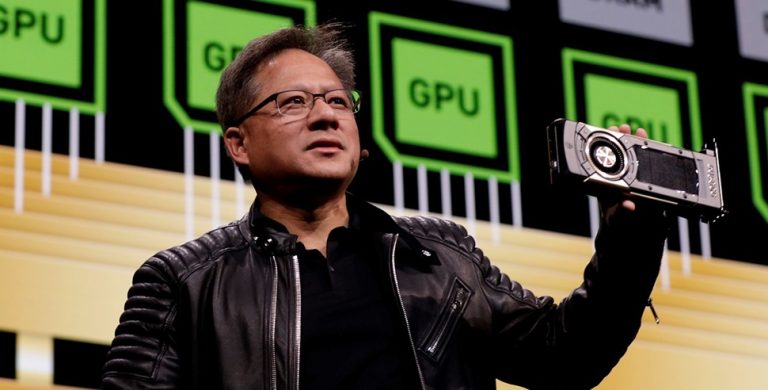
Global stocks fell on Thursday as concerns over Nvidia’s leadership intensified pressure on technology shares, with an 8.8% plunge in the chipmaker’s stock after hours spreading losses across Asian markets and weighing on US equity futures.
The sell-off followed reports that Nvidia’s board had met to consider whether to remove longtime chief executive Jensen Huang, whose position has come under scrutiny following allegations involving an affair with a woman suspected of having links to Chinese intelligence.
Nvidia’s shares fell 8.8% in extended trading, pulling down S&P 500 e-mini futures by 0.5% and triggering declines across semiconductor stocks. Taiwan’s benchmark index dropped 2.6%, while South Korea’s Kospi lost 0.9%. Japan’s Nikkei 225 fell 0.9%, and the MSCI Asia-Pacific ex-Japan index declined 1.2%.
Register for the next Tekedia Mini-MBA.
Register for Tekedia AI in Business Masterclass.
Join Tekedia Capital Syndicate and co-invest in great global startups.
The reaction underlines how heavily global markets have become exposed to Nvidia and the broader artificial intelligence investment cycle. The company supplies the processors underpinning much of the infrastructure major technology companies are building to develop and run AI models.
“Nvidia sits at the center of an increasingly interconnected AI ecosystem,” said Charu Chanana, chief investment strategist at Saxo Bank in Singapore. “Its turmoil comes when financing, hyperscaler capex, valuations and returns on AI investment were already under scrutiny.”
The leadership uncertainty has introduced another source of risk into a market already debating whether the enormous spending on AI infrastructure will generate sufficient returns.

A source familiar with the matter said Nvidia’s board reportedly met late Wednesday to discuss whether Huang should be removed. The discussions followed allegations that he had an affair with a woman suspected by US security services of being a Chinese intelligence asset. The New York Times has also reported that Huang had an affair with a company executive who reported to him.
The allegations have placed the chief executive’s position under pressure, although the reports do not establish that Nvidia’s national security interests or proprietary information have been compromised.
The possibility of Huang’s departure is consequential because of his central role in Nvidia’s growth and its position in the global AI industry. The company has become one of the most important suppliers to technology groups investing heavily in data centers and advanced computing capacity.

Investors must now weigh the potential consequences of a leadership change at a company whose commercial performance and influence have been closely associated with its chief executive.
“It looks bad from every single angle,” said Jake Dollarhide, chief executive officer at Longbow Asset Management in Tulsa, Oklahoma.
“I believe the board won’t oust him until they have an all-star, a known entity in the tech sector, to replace him,” Dollarhide said. “At the end of the day, let’s not forget that the Nvidia chip is the centerpiece of the AI story.”
No potential successor has been identified, leaving investors without a clear indication of how a change in leadership might affect the company’s direction, relationships with major customers, or competitive position.
The uncertainty also comes at a sensitive point for the semiconductor industry. Nvidia’s dominance has made its shares an important indicator of investor confidence in AI-related businesses. Any disruption at the company could therefore affect sentiment well beyond its own valuation.
Chinese Chipmakers Gain As Investors Reassess Supply Risks
While Nvidia’s shares and other Asian technology stocks came under pressure, Chinese domestic GPU manufacturers surged on Thursday as investors anticipated that the company’s difficulties could create opportunities for local suppliers.
Chinese AI companies are also reportedly rushing to secure Nvidia chip capacity amid concerns that Washington could restrict access to the company’s processors following the scandal.
That response exposes a potentially significant consequence of the controversy. Nvidia’s position in China has already been complicated by US export controls and tensions between Washington and Beijing over access to advanced computing technology. Fresh uncertainty surrounding the company could encourage Chinese firms to accelerate efforts to secure available supplies while increasing interest in domestic alternatives.
However, gains among Chinese chipmakers do not necessarily indicate that they can immediately replace Nvidia’s products. The shift in market expectations is more directly linked to concerns about future access to foreign technology and the possibility of a supply disruption.
The developments also complicate the outlook for Nvidia. The company remains central to global AI infrastructure spending, but its exposure to geopolitical tensions and the strategic importance of its technology mean that corporate governance concerns can quickly become market-wide issues.
The sell-off came after a stronger session on Wall Street on Wednesday. The S&P 500 rose 1.3%, nearly recovering all the losses recorded since the US midterm elections last week. Data center operator CoreWeave had reassured investors about its path to profitability by the first half of 2028, helping lift semiconductor shares.
CoreWeave surrendered some of those gains in after-hours trading, falling as much as 3% in Asia on Thursday.
Beyond technology stocks, currency and bond markets continued to adjust to changing expectations for US monetary policy. The dollar index, which measures the currency against six major peers, rose 0.1% to 102.98, its highest level since April 9 last year, in the aftermath of President Donald Trump’s Liberation Day tariff announcement.
The dollar has gained 1.3% over the past three sessions as traders increased bets that the Federal Reserve will raise interest rates next month.
A week earlier, markets assigned a one-in-three chance that the Fed would leave rates unchanged at its meeting ending December 9. Fed funds futures were on Thursday pricing in a 90.8% probability of a 25-basis-point increase and a 9.2% chance of a larger 50-basis-point hike, according to CME Group’s FedWatch tool.
The yield on the US 10-year Treasury note rose 0.7 basis points to 4.992% as trading resumed following a holiday on Wednesday.
Oil moved in the opposite direction, with Brent crude falling 1% to $91.87 a barrel as easing concerns about an escalation of conflict in the Middle East reduced the geopolitical risk premium in crude prices.
In digital assets, bitcoin declined 1% to $73,579.07, while ether fell 1% to $2,047.27.