

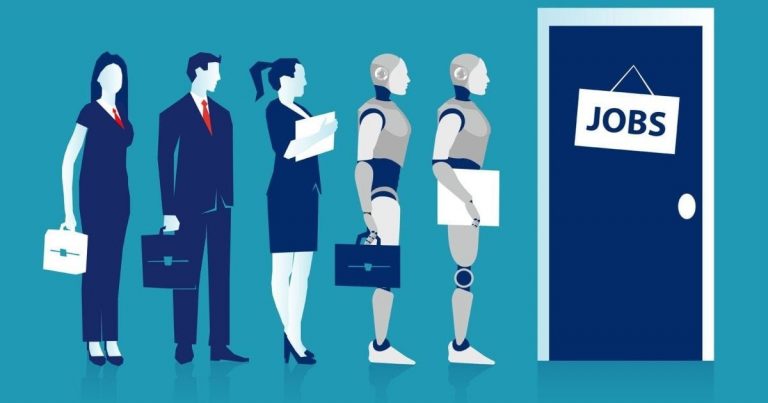
The rapid acceleration of artificial intelligence is no longer a theoretical discussion confined to research labs or science fiction. It is becoming a defining force in the global economy, reshaping industries, labor markets, and the very nature of professional work. Recent comments from leaders in technology and finance have intensified this debate.
The CEO of Microsoft AI suggested that virtually all white-collar jobs could be fully automated within the next eighteen months, while the CEO of Citadel revealed that AI systems are already completing complex financial tasks in hours that once required weeks or even months of work from highly trained PhD-level professionals. Together, these statements reflect a dramatic shift in how corporations perceive productivity, expertise, and the future of human labor.
For decades, automation primarily affected blue-collar and repetitive factory work. Machines replaced physical labor in manufacturing, logistics, and industrial production. White-collar professionals, however, were generally considered protected because their roles relied on creativity, judgment, communication, and advanced analytical thinking.
Artificial intelligence is now challenging that assumption. Modern AI models can draft legal contracts, write software code, analyze financial markets, summarize research papers, generate marketing campaigns, and even assist in medical diagnostics with remarkable speed and accuracy. The implications are profound. In finance, for example, hedge funds and investment firms increasingly rely on AI-driven systems for market analysis, risk modeling, and portfolio management.
Register for the next Tekedia Mini-MBA.
Register for Tekedia AI in Business Masterclass.
Join Tekedia Capital Syndicate and co-invest in great global startups.
Tasks that once demanded teams of quantitative analysts and economists can now be performed in a fraction of the time. Citadel’s CEO emphasized this transformation by noting that AI can accomplish in hours what elite finance professionals would previously spend months completing. This is not merely an incremental productivity improvement; it represents a structural redefinition of knowledge work itself. Technology companies are equally aggressive in deploying AI across operations.
From customer service chatbots to AI-assisted programming tools, businesses are discovering that automation dramatically reduces costs while increasing efficiency. AI systems do not sleep, take vacations, or require the same operational overhead as human employees. For corporations under pressure to maximize margins and remain competitive, the incentive to automate is overwhelming.
However, the prediction that all white-collar jobs could disappear within eighteen months may be overly aggressive. While AI capabilities are advancing rapidly, many professions still require emotional intelligence, human trust, ethical accountability, and nuanced decision-making. Lawyers, doctors, educators, consultants, and executives often operate in environments where interpersonal relationships and contextual understanding are essential.
AI can augment these professions, but fully replacing them remains significantly more complex than automating repetitive administrative work. Instead of outright elimination, a more realistic scenario may involve workforce compression. Companies may require fewer employees to achieve the same output because AI enhances the productivity of existing workers.

One software engineer equipped with advanced AI coding tools may accomplish the work that previously required an entire team. One analyst supported by AI research systems may outperform several traditional researchers. This creates economic pressure that could reduce hiring across many professional sectors, particularly for entry-level workers.
The social consequences of such disruption could be enormous. White-collar employment has long been associated with economic stability, middle-class growth, and professional identity. If AI reduces demand for millions of office-based jobs, governments and institutions may face rising unemployment, widening inequality, and political instability. Education systems may also need radical restructuring, as traditional career pathways become less reliable in an AI-dominated economy.
History suggests that technological revolutions also create new industries and opportunities. The internet destroyed certain jobs but gave birth to entirely new sectors, from digital marketing to app development and creator economies. AI could similarly generate demand for new professions centered around AI supervision, ethics, cybersecurity, human-machine collaboration, and creative direction.

The rise of artificial intelligence signals that the global workforce is entering one of the most transformative periods in modern economic history. Whether AI becomes a tool that empowers humanity or a force that displaces millions will depend on how governments, businesses, and societies adapt to the unprecedented speed of technological change.