

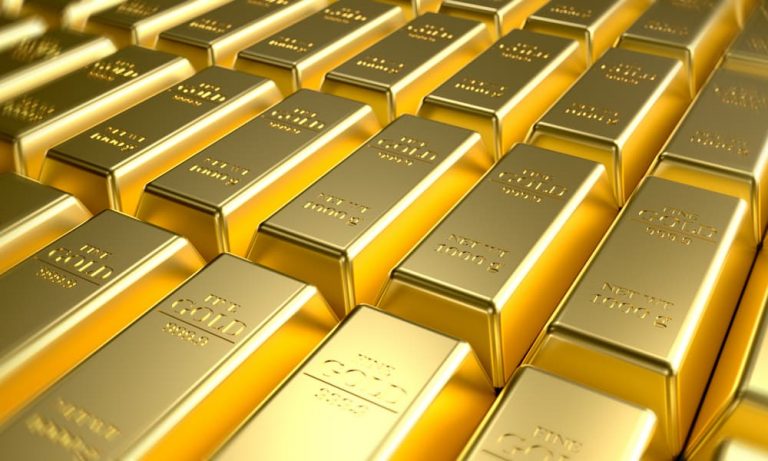
Gold prices continued their slide on Wednesday, extending a brutal run that has seen the precious metal post its worst quarterly performance in more than a decade, as easing geopolitical tensions between the United States and Iran reduced demand for traditional safe-haven assets.
Gold futures opened the second half of 2026 on the defensive, falling 1.24% in early trade to $3,989.00 per ounce. Spot prices were also lower, declining 0.82% to $3,974.51. Having reached an all-time high of $5,586.20 on January 29, bullion has since given up substantial ground as investors reassess the metal’s appeal in an environment of potentially higher interest rates.
The three-month period ending June 30 saw gold lose about 16% of its value — its worst quarter since the second quarter of 2013. Year-to-date, the metal is down 7.76%. Despite the sharp decline, gold retains an important role in diversified portfolios, particularly as traditional correlations between asset classes break down, according to analysts at Amundi Investment Institute.
Register for the next Tekedia Mini-MBA.
Register for Tekedia AI in Business Masterclass.
Join Tekedia Capital Syndicate and co-invest in great global startups.
In its mid-year Global Investment Outlook, the institute argued that a more challenging monetary policy backdrop, combined with high public debt levels and central banks’ efforts to diversify away from dollar-based assets, should continue to support demand for gold and other precious metals in the second half of the year.
“Investors face a world in which the independence of central banks is being tested, inflation is more volatile, and concentration risks are growing,” said Monica Defend, head of Amundi Investment Institute. “The best portfolios for this new regime can withstand different scenarios: they need to be diversified across currencies, invested in real assets and gold, and explore equity sectors and structural themes with discipline.”
The World Gold Council’s latest annual survey of central bank gold reserves found that more institutions globally are planning to increase their holdings over the next year, reinforcing the metal’s strategic importance even amid short-term price weakness.

Silver also came under pressure, with futures sliding 3.34% to $57.49 per ounce and spot prices falling 1.31% to $57.80.
Oil Market Holds Cautious Course as Ceasefire Fragility Persists
Oil prices were slightly lower on Wednesday after Iran indicated it would not meet directly with U.S. delegates for talks in Qatar, amplifying concerns about the durability of the peace process.
International benchmark Brent crude futures for September delivery traded 0.8% lower at $72.36 per barrel. The contract dropped roughly 21% in June, recording its largest monthly decline since March 2020. U.S. West Texas Intermediate futures for August delivery fell 1% to $68.84, erasing earlier gains. The contract dropped more than 20% last month, marking its worst monthly performance since late 2021.

The moves come after Iranian officials said Tehran and Washington still needed to finalize the terms of the interim peace deal signed last month before addressing more complex issues, such as potential limits on its nuclear program, Reuters reported.
President Donald Trump’s son-in-law Jared Kushner and U.S. special envoy Steve Witkoff arrived in Doha on Tuesday, though a Qatari government spokesperson clarified they would meet with mediators rather than directly with Iranian representatives.
The U.S. and Iran reached a 14-point memorandum of understanding on June 17 to pause fighting that had severely disrupted global oil flows through the strategically vital Strait of Hormuz.
Located between Oman and Iran in the Persian Gulf, the strait is one of the world’s most critical energy chokepoints, typically handling around 20% of global oil traffic.
ING strategists Warren Patterson and Ewa Manthey noted in a research report published Wednesday that while the oil market continues to take an optimistic view on supply recovery in the Middle East despite recent flare-ups, tanker vessel movements in the strait still appear limited.
“Admittedly, there has been a slight pickup in inbound tanker traffic, suggesting that shipowners are becoming increasingly confident about moving vessels into the Persian Gulf,” they wrote. “If this trend accelerates, it becomes a clear headwind — and potentially a direct challenge — to our view that oil prices should rise from current levels.”
Bond Yields and Fed Expectations in Focus
U.S. Treasury yields rose on Wednesday as investors awaited further economic data and clues on the Federal Reserve’s monetary policy path ahead of Chair Kevin Warsh’s appearance at the European Central Bank’s annual policy forum in Sintra, Portugal.
The yield on the benchmark 10-year Treasury note rose 4 basis points to 4.461% at 4:45 a.m. ET. The shorter-term 2-year note added 3 basis points to trade around 4.17%, while the 30-year bond yield increased by 5 basis points.
Warsh is also scheduled to join a panel discussion at the conference alongside the governors of the Bank of England, European Central Bank, and Bank of Canada.
Markets are currently pricing in a 66.3% chance of the Fed holding rates steady at its July meeting and a 66.9% probability of at least a quarter-point hike at the subsequent FOMC meeting in September, according to the CME’s FedWatch tool.
Investors will also monitor ISM Manufacturing PMI data due at 10 a.m. ET, as well as ADP employment figures later in the morning.
The combination of easing geopolitical risks and persistent inflation concerns is creating a complex environment for investors. While lower oil prices offer some relief on the inflation front, the prospect of higher interest rates continues to pressure non-yielding assets like gold. At the same time, equity markets are attempting to find their footing as the AI-driven rally shows signs of fatigue and broader economic data takes center stage.
Currently, markets appear to be cautiously pricing in a period of reduced immediate geopolitical risk, while remaining vigilant about the potential for renewed tensions and their impact on energy prices and global growth. Analysts are expecting further clarity on both the durability of the U.S.-Iran ceasefire and the trajectory of U.S. monetary policy in the coming days.