

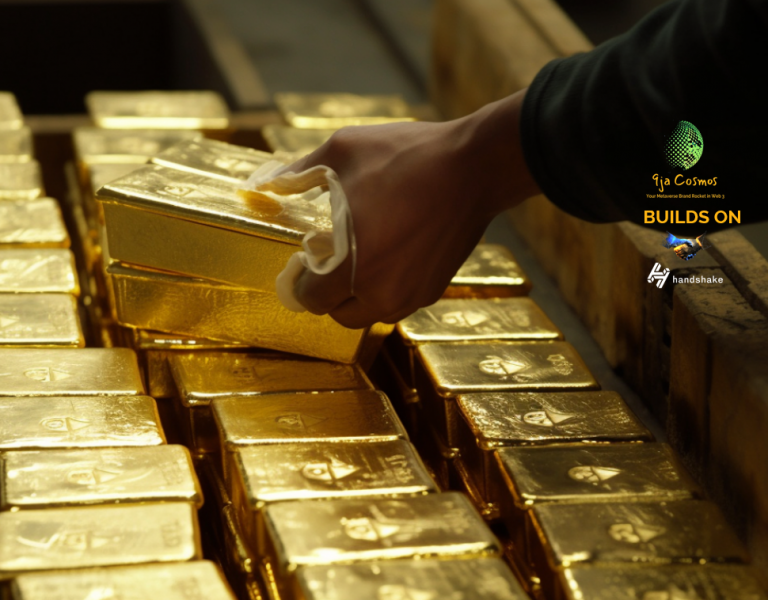
Gold surged past $4,000 per ounce for the first time on Tuesday, underscoring the rush by investors worldwide toward safe-haven assets as economic turbulence, geopolitical risk, and sticky inflation continue to erode confidence in traditional markets.
Gold futures traded at $4,005.80 per ounce in early deals, marking an extraordinary 51 percent gain since the start of the year. The rally reflects a confluence of global factors—from heightened geopolitical risk and monetary uncertainty to growing skepticism about the U.S. dollar and government debt.
The surge comes as President Donald Trump’s trade policies and attacks on the independence of the Federal Reserve unsettle investors already grappling with a volatile global economy. Washington’s stiff sanctions on Russia have further accelerated a global diversification away from U.S. Treasurys, with China and other countries aggressively stockpiling gold to shield their reserves from potential financial sanctions.
Register for Tekedia Mini-MBA edition 20 (June 8 – Sept 5, 2026).
Register for Tekedia AI in Business Masterclass.
Join Tekedia Capital Syndicate and co-invest in great global startups.
Register for Tekedia AI Lab.
Central banks have remained some of the most aggressive buyers in recent quarters, collectively accumulating hundreds of tons of gold as part of a long-term shift toward de-dollarization. Goldman Sachs projects that central banks will continue to purchase an average of 80 metric tons in 2025 and 70 tons in 2026, particularly among emerging markets seeking to reduce exposure to Western currencies.
Retail investors, meanwhile, have joined the stampede. With inflation showing no signs of cooling, and following the Federal Reserve’s rate cut in September that made bonds less attractive, gold has become the preferred hedge. The market is anticipating at least two additional rate cuts before year-end, adding further momentum to the metal’s rally.
“Debt instruments are not an effective store of wealth,” said Ray Dalio, founder of Bridgewater Associates, at the Greenwich Economic Forum in Connecticut. He advised investors to allocate “something like 15% of your portfolio in gold,” calling it “the one asset that does very well when the typical parts of your portfolio go down.”

Even with gold’s dazzling rise, analysts remain divided on whether the momentum can last. Bank of America urged caution, warning that prices could be approaching “uptrend exhaustion,” potentially leading to a short-term correction in the fourth quarter.
Still, others see more upside. Goldman Sachs raised its December 2026 forecast to $4,900 per ounce, up from $4,300, citing robust Western exchange-traded fund (ETF) inflows and sustained central bank demand.
“We see the risks to our upgraded gold price forecast as still skewed to the upside on net, because private sector diversification into the relatively small gold market may boost ETF holdings above our rates-implied estimate,” Goldman said.

Spot gold was trading around $3,960 per ounce as of 1:30 a.m. GMT after hitting a new high of $3,977.19 earlier in the day. Western ETF holdings, according to Goldman, have “fully caught up” with rate-driven expectations, indicating steady rather than speculative inflows.
The metal’s meteoric climb this year has been fueled by four reinforcing forces: unrelenting central bank buying, a weaker U.S. dollar, booming ETF inflows, and heightened demand from investors seeking insulation from rising trade and geopolitical tensions.
“In contrast, noisier speculative positioning has remained broadly stable. Following the large September increase, the level of Western ETF holdings has now fully caught up with our U.S. rates-implied estimate, suggesting the recent ETF strength is not an overshoot,” Goldman said.
With the global economy entering a period of elevated uncertainty and investors bracing for further monetary easing, gold once again has become a darling store of value.