

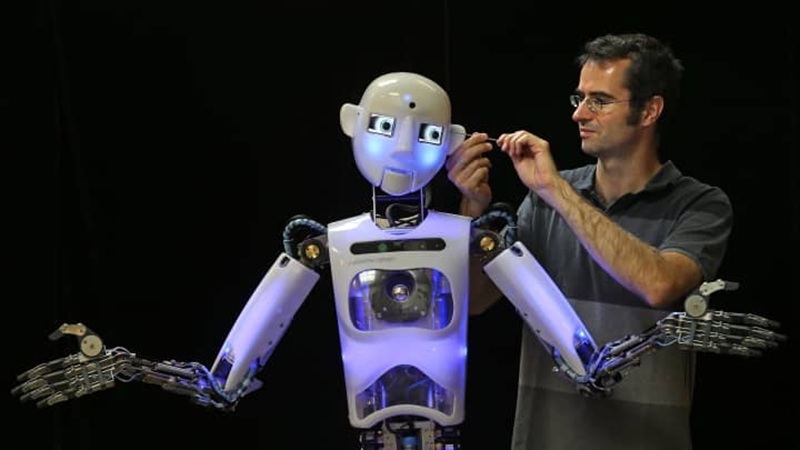
Google is repositioning itself at the frontier of embodied artificial intelligence by moving Intrinsic—its robotics software unit—out of Alphabet’s experimental “Other Bets” division and into the heart of the company.
The shift signals that robotics is no longer a peripheral moonshot but a strategic pillar alongside search, cloud computing, and AI model development.
The decision echoes Google’s most consequential platform move: Android. By building a mobile operating system and distributing it freely to hardware manufacturers seeking an alternative to Apple’s iPhone, Google built a global ecosystem without dominating device manufacturing itself. Intrinsic is designed to apply that same horizontal platform logic to robotics.
Register for Tekedia Mini-MBA edition 20 (June 8 – Sept 5, 2026).
Register for Tekedia AI in Business Masterclass.
Join Tekedia Capital Syndicate and co-invest in great global startups.
Register for Tekedia AI Lab.
Just as Android runs across devices made by Samsung, Motorola, and Xiaomi, Intrinsic aims to provide a common software foundation for robots produced by industrial manufacturers such as FANUC, Universal Robots, and KUKA. These companies dominate factory automation but historically rely on proprietary software stacks that can be complex, rigid, and expensive to integrate.
Intrinsic’s core thesis is that robotics suffers from fragmentation. Every machine, arm, or mobile unit typically requires specialized programming, middleware, and hardware-specific tuning. By abstracting that complexity into a unified operating layer, Intrinsic seeks to lower development friction and accelerate deployment cycles.
The company says it is building an operating system that allows manufacturers to focus on solving industrial problems rather than managing infrastructure. Developers can access prebuilt capabilities, reducing the need to write extensive low-level code. Its web-based platform, Flowstate, allows users to build robotic applications without manually stitching together thousands of lines of control logic.

Chief executive Wendy Tan White has emphasized interoperability.
“It doesn’t matter what the hardware is and it doesn’t matter what the AI model is. We will help you put that together so you can have access to it,” she said in an earlier interview.
That hardware-agnostic approach is critical because robotics markets are fragmented across arms, humanoids, autonomous mobile robots, and custom manufacturing systems. A unifying software layer could enable a broader developer ecosystem, similar to what Android achieved in mobile computing.

The renewed robotics push points to a technological inflection point. Until recently, robots were primarily deterministic machines: highly precise but limited to predefined environments and repetitive tasks. Advances in generative AI and multimodal models have expanded what machines can interpret and execute.
In mid-2025, Google introduced Gemini Robotics and Gemini Robotics-ER (extended reasoning), adapting its Gemini models to translate high-level language instructions into physical action sequences. That capability narrows the gap between cognitive AI and actuation—allowing robots to interpret instructions, adapt to environmental variability, and refine task execution in real time.
Last month, Google partnered with Boston Dynamics to integrate Gemini into Atlas humanoid robots designed for manufacturing contexts. Earlier, it announced a collaboration with Apptronik to build humanoid systems powered by Gemini 2.0. DeepMind also hired Boston Dynamics’ former chief technology officer, reinforcing technical integration between AI research and robotics engineering.
By bringing Intrinsic into Google’s core structure, the robotics unit will operate closer to DeepMind’s model development pipeline and Google Cloud’s infrastructure stack. Intrinsic’s technology chief Brian Gerkey has said the company benefits from building atop DeepMind’s models and layering in domain-specific data to adapt AI for real-world manipulation tasks.
Learning from a complex past
Google’s relationship with robotics has been uneven. In 2013, Alphabet acquired Boston Dynamics and Schaft, seeking a foothold in advanced mobility and humanoid systems. After struggling to identify a commercial path, it sold those assets to SoftBank in 2017.
The current push differs structurally. Rather than owning high-cost hardware development programs, Google is emphasizing software orchestration and AI enablement—areas that align more closely with its existing strengths. The company appears intent on avoiding vertically integrated manufacturing while positioning itself as the enabling intelligence layer.
This strategy also mitigates capital intensity. Robotics hardware manufacturing requires heavy investment, supply chain management and physical distribution networks. A platform approach allows Google to monetize through software, cloud services, and AI integration while partners absorb hardware risk.
Manufacturing is the first proving ground
Intrinsic’s partnership with Foxconn to deploy AI-powered robots in U.S. electronics assembly plants offers insight into the commercialization roadmap. Electronics manufacturing—particularly for AI servers—combines rigid automation with labor-intensive processes. As AI-driven compute demand surges, manufacturers face pressure to scale quickly while managing labor constraints and quality standards.
Flexible robotics powered by adaptive AI models could improve throughput, reduce defect rates, and shorten reconfiguration cycles. Tan White has highlighted electronics as a sector experiencing heavy capital investment due to growing demand for computing infrastructure.
Google itself is expanding data center capacity aggressively to meet AI usage growth. According to internal comments reported previously, Google’s AI infrastructure leadership has said serving capacity must double roughly every six months to keep pace. The feedback loop is notable because AI demand drives hardware production, which in turn creates opportunity for AI-enhanced robotics to automate that production.
A 2025 Deloitte survey of 600 manufacturing executives found that 80% plan to devote at least one-fifth of improvement budgets to smart manufacturing technologies. That spending environment supports the adoption of software platforms capable of integrating robotics, data analytics, and AI inference at scale.
Pushing Through a Competitive Ecosystem
Amazon and Tesla represent potential competitors in robotics. Amazon has deployed extensive robotics across logistics operations, while Tesla is developing its Optimus humanoid robot. However, both companies emphasize vertically integrated systems within their own ecosystems.
Google’s differentiator lies in neutrality. By positioning Intrinsic as an open software layer—supported by open-source tools similar to Android—it aims to attract a broad base of hardware partners rather than building exclusive hardware platforms.
If successful, the model could generate network effects. More hardware integrations attract more developers; more applications increase platform value; increased adoption strengthens data collection and model refinement. In robotics, where data from physical interactions is essential to improving AI performance, platform scale may confer significant advantages.
Despite momentum, robotics remains a challenging domain. Physical environments introduce unpredictability absent in digital systems. Safety requirements are stringent, particularly in manufacturing and logistics contexts where human workers and heavy machinery coexist.
Latency, reliability, and edge computing constraints also complicate deployment. Unlike cloud-based chatbots, robots must operate in real time with high availability. Integration with existing factory control systems—often legacy infrastructure—adds complexity.
Regulatory frameworks for autonomous systems are still evolving, especially for humanoid robots operating beyond controlled industrial settings. Liability, safety certification, and labor implications could shape adoption trajectories.
The long-term platform bet
McKinsey estimates that general-purpose robotics could become a $370 billion market by 2040. That forecast captures industrial automation, logistics, healthcare, agriculture, and service robotics. If AI significantly lowers programming barriers, the addressable market may expand further.
Google CEO Sundar Pichai, who previously led Chrome and Android initiatives, has reportedly drawn parallels between Intrinsic and Android. The analogy suggests a belief that robotics represents a foundational computing shift rather than a niche industrial category.
Google is attempting to establish itself not as a robot manufacturer but as the intelligence layer for machines by consolidating Intrinsic within the main company and linking it tightly to Gemini, DeepMind, and Google Cloud. If AI’s next frontier is physical action, the contest will revolve around who controls the software substrate connecting models, infrastructure, and hardware.
In that context, the move is less about robotics as a standalone business and more about extending Google’s AI platform into the tangible economy—factories, warehouses, and supply chains—where digital intelligence begins to move steel, silicon, and circuit boards.