

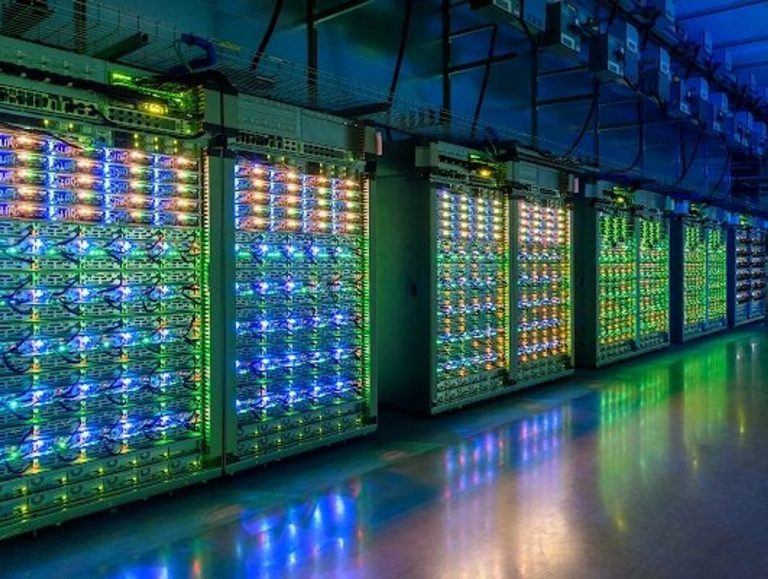
Alphabet’s Google on Friday announced a sweeping $40 billion investment to build three new data centers in Texas through 2027, marking one of the company’s largest-ever infrastructure commitments and intensifying the high-stakes battle among U.S. technology giants to secure the computing power needed for advanced artificial intelligence.
The investment underscores how fiercely competitive the AI arms race has become. Companies including OpenAI, Microsoft, Meta Platforms, and Amazon are pouring billions into AI-focused data centers across the country, driven by unprecedented demand for training and deploying frontier AI models.
Google’s latest move places Texas at the heart of this new infrastructure surge. According to the company, one of the new facilities will be located in Armstrong County in the Texas Panhandle, while the other two will rise in Haskell County, a stretch of West Texas near Abilene. The tech company will also pump fresh capital into its existing Midlothian campus and the Dallas cloud region, both of which anchor its global network of 42 cloud regions.
Register for Tekedia Mini-MBA edition 20 (June 8 – Sept 5, 2026).
Register for Tekedia AI in Business Masterclass.
Join Tekedia Capital Syndicate and co-invest in great global startups.
Register for Tekedia AI Lab.
“This investment will create thousands of jobs, provide skills training to college students and electrical apprentices, and accelerate energy affordability initiatives throughout Texas,” Alphabet CEO Sundar Pichai said in a statement.
Texas Governor Greg Abbott welcomed the announcement, saying, “Google’s $40 billion investment makes Texas Google’s largest investment in any state in the country and supports energy efficiency and workforce development in our state.”
The company’s Texas plan lands during a period of rapid industrial expansion across the cloud and AI sectors. Big tech firms have announced massive new spending in 2024 and 2025, particularly within the U.S., as President Donald Trump pushes for major domestic investment to maintain the country’s advantage in the global AI contest. Google’s move aligns closely with that policy direction.

Earlier this month, Anthropic announced its own $50 billion plan to build data centers across the United States—including in Texas and New York—highlighting how capital expenditure is accelerating beyond long-established giants and into the broader AI startup ecosystem.
Google’s investment in Texas also complements its growing commitments in Europe. Just days earlier, the company said it would invest €5.5 billion ($6.41 billion) in Germany over the coming years, dedicated to expanding infrastructure and data-center capacity in Europe’s largest economy.
The latest Texas investment follows Google’s recent upgrade of its AI capabilities and expansion of cloud services, both of which depend heavily on computing infrastructure. As more enterprises migrate toward AI-driven processes—and as model sizes balloon—hyperscale data centers have become essential to meeting demand.

Still, analysts are warning that the current AI spending boom bears echoes of past tech cycles where capital outpaced returns. Some investors have cautioned that valuations and expenditure growth may prove difficult to sustain if AI adoption does not rise at the same explosive pace as infrastructure deployment.
Even so, with rivals racing to secure land, power, and long-term access to advanced chips, Google’s Texas expansion signals that the company is unwilling to lose ground in one of the most consequential technology competitions in modern history. The data centers—spanning workforce development, energy infrastructure, and regional economic gains—are both a strategic and symbolic marker of where the AI race is headed next.
Google says the investment will expand its cloud footprint, add significant capacity for AI workloads, and prepare the company for the next phase of rapid model development and deployment. The project is set to roll out through 2027.