

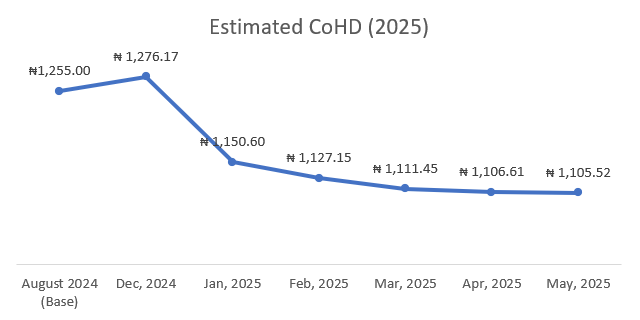
Between December 2024 and May 2025, the Cost of a Healthy Diet (CoHD) in Nigeria dropped by 13.36% from N1,276.17 to N1,105.52. On the surface, it looks like a win, prices are falling, and for many households, it feels like a step toward relief, a chance to put healthier food on the table without breaking the bank.
But behind the numbers lies a different story. In Northern Nigeria, where hunger cuts deeper and recovery is slower, falling prices don’t always lead to full plates. The barriers go beyond economics, they’re built into the land, the systems and the daily lives of those who still struggle to access even the most basic nutrition.
The CoHD, tracked by the National Bureau of Statistics, measures the minimum cost to meet daily nutritional needs. It’s not just another statistic. Our analyst notes that it’s a direct reflection of whether people can afford food that nourishes. And while the trend suggests progress, the reality on the ground tells us there’s more to uncover.
Register for Tekedia Mini-MBA edition 20 (June 8 – Sept 5, 2026).
Register for Tekedia AI in Business Masterclass.
Join Tekedia Capital Syndicate and co-invest in great global startups.
Register for Tekedia AI Lab.
Why Are Prices Dropping?
The decline in CoHD stems largely from seasonal abundance. In the first quarter of 2025, prices for staples like yams, maize, soybeans, and sorghum fell significantly due to post-harvest supply surges. Yam, in particular, emerged as a key driver, with its price movements closely tied to CoHD trends (correlation: 0.954). This aligns with a dip in the Food Consumer Price Index (CPI), reflecting broader food price relief.
National averages blur the truth. A N100 drop in yam prices may sound like progress, but what it means depends entirely on where you live and how much you earn. For a family in Katsina, Kebbi, or Jigawa, scraping by on the bare minimum, it could mean an extra meal, a small but meaningful relief. For a household in Lagos, it may barely register.

These numbers don’t tell the full story. They hide the deep, daily inequalities in food access, income, and opportunity. In Northern Nigeria, the challenge isn’t just about rising prices, it’s about barriers that go far beyond cost. Because when roads are broken, markets are closed, and incomes are stretched to the limit, even the cheapest food can remain out of reach.
The Northern Nigeria Challenge
In Northern Nigeria, access to healthy food remains constrained by more than just prices. Insecurity has crippled farming and market systems, making food supply chains unreliable.

“Bandits are not allowing us to go to the farms. If you go to the farm, you will be kidnapped, and we don’t have the capacity to pay ransom. That is why we are avoiding our farm. Those who go to the farm are more vulnerable,” said a farmer in Plateau State, highlighting how bandit attacks have disrupted agriculture in the region (Daily Post, July 29, 2025).
Even when food is available, poor roads and lack of storage cause spoilage and price swings. For families earning under N1,000 daily, small price drops offer little relief. Worse still, entire markets are now inaccessible. In some communities across Zamfara, Kaduna, and Niger states, residents are not just facing high prices, they’re being cut off from food altogether. Bandits have seized control of key areas, turning once-bustling markets into ghost towns. Movement is restricted. Trade is stalled. Hunger deepens.
“The bandits have barred them from accessing the only market… and threatened to kill anyone who violates the instruction,” reported The Sun in July 2025, describing the situation in Zumba, Niger State, where the Saturday market, a vital economic lifeline for the region, remains closed under threat of violence.
For these communities, it’s not a matter of whether food is affordable; it’s whether it’s even reachable. When markets vanish, so does the possibility of feeding a household, no matter how low the prices may fall. In this context, a national drop in the Cost of a Healthy Diet offers limited hope. Without addressing insecurity and access, affordability gains will remain out of reach for millions in the North.
What Should Be Done
The 13.36% drop in the Cost of a Healthy Diet is encouraging, but for millions in Northern Nigeria, it’s not a breakthrough. The dream of a nutritious meal remains painfully out of reach, held back by the heavy weight of poverty, insecurity, and broken systems. Because food security isn’t just about lower prices, it’s about real access, for every Nigerian, in every region, every day.
To make that possible, we need more than policy. We need purposeful action. Our analyst notes that starting with the safety of farmers, especially in rural areas, is important because without security, there’s no farming, no trading, no food. Then, support local production, invest in resilient crops, smart irrigation, and the farmers who know how to turn dry land into abundance. Let them grow, even in the face of conflict or climate.
And don’t stop at supply, equip communities with knowledge. Sometimes, better nutrition starts with knowing the value of what’s already growing in your backyard. A healthy diet shouldn’t be a privilege. With the right choices, it can become a guarantee, no matter where you live or how much you earn.
Editor’s Note: Abdulazeez Sikiru Zikirullah, a Data Analyst Intern at Infoprations, led the team that conducted analysis for this article.