

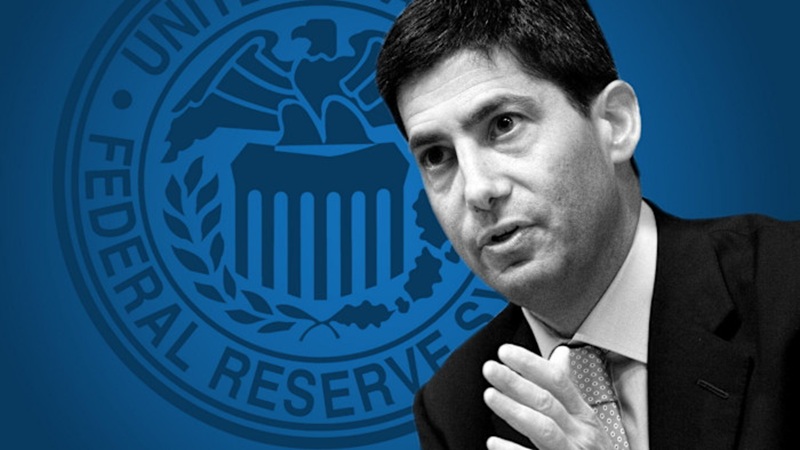
Federal Reserve Chairman Kevin Warsh entered his first policy meeting promising change. By the time the meeting ended, Wall Street had received a clear signal that the era of easy assumptions about interest-rate cuts may be over.
The Fed left its benchmark interest rate unchanged at 3.5% to 3.75%, a decision markets had largely anticipated. What investors did not fully expect was the distinctly hawkish tone that emerged from the meeting, the committee’s updated projections, and Warsh’s debut press conference.
The result was swift. Stocks sold off sharply, Treasury yields surged, and traders began reassessing expectations for monetary policy over the remainder of 2026.
Register for the next Tekedia Mini-MBA.
Register for Tekedia AI in Business Masterclass.
Join Tekedia Capital Syndicate and co-invest in great global startups.
The S&P 500 fell 1.2%, marking the worst first “Fed day” market performance under a newly installed central bank chairman since formal rate announcements began in the modern era. The Dow Jones Industrial Average shed roughly 500 points, while the two-year Treasury yield jumped more than 14 basis points as investors priced in a growing possibility that the next Fed move could be a rate increase rather than a cut.
At the center of the market reaction was a message that differed significantly from expectations that Warsh, nominated by President Donald Trump, would quickly pivot toward looser monetary policy.
Instead, his emphasis was on inflation.

Throughout the press conference, Warsh repeatedly stressed the importance of “price stability,” using the phrase roughly a dozen times. The repeated focus suggested a chairman determined to establish anti-inflation credibility at a time when markets had been expecting a more accommodative stance.
For investors who entered the meeting anticipating discussions around future rate cuts, the shift was loud.
“New Fed Chair Warsh sounded a bit like old hawkish Fed governor Warsh,” Evercore ISI’s Krishna Guha noted, highlighting the chairman’s repeated commitment to restoring price stability.

The policy outlook itself also surprised markets.
While rates remained unchanged, the Fed’s closely watched “dot plot” showed policymakers becoming more cautious about easing. Officials were evenly divided between those expecting rates to remain unchanged or fall modestly and those projecting at least one rate increase before year-end. The median forecast pointed to a quarter-point hike.
That projection immediately altered market expectations.
Fed funds futures, which only months ago were heavily tilted toward rate cuts, began reflecting growing odds that borrowing costs could actually rise later this year if inflation remains stubborn.
DoubleLine Capital Chief Executive Jeffrey Gundlach said Warsh’s message was unambiguous.
“He is absolutely telling you that he plans on delivering on price stability,” Gundlach said. “That means we’re not going to have such easy money policy as everybody thought maybe Chairman Warsh would do.”
Beyond rates, the meeting offered the first detailed glimpse into how Warsh intends to reshape the Federal Reserve itself. One of the most notable developments was the announcement of five task forces designed to review key aspects of the central bank’s operations.
The groups will examine Fed communications, balance sheet strategy, economic data collection, productivity and labor-market measurements, artificial intelligence and other transformative technologies, as well as the central bank’s broader inflation framework.
The move signals that Warsh is pursuing institutional reform alongside monetary policy. Analysts say the reviews could eventually influence how the Fed communicates with markets, measures economic activity, and evaluates inflationary pressures in an economy increasingly shaped by AI and technological disruption.
Jason Pride, chief investment strategist at Glenmede, said the task forces indicate an institution undergoing active reassessment rather than maintaining the status quo.
“The operating framework of the Fed could look meaningfully different over Warsh’s tenure than it did under his predecessor,” he said.
Perhaps the most symbolic change came in the Fed’s communications. The post-meeting statement was dramatically shortened to just 130 words, compared with the more than 300-word statements typically issued under previous Fed leadership.
Warsh has long criticized excessive forward guidance, arguing that detailed projections can limit policymakers’ flexibility and encourage markets to become overly dependent on Fed signals. In keeping with that philosophy, he also confirmed that he did not submit his own economic projections to the Summary of Economic Projections, breaking with a tradition followed by most Fed chairs.
“It has been the practice of this committee for participants to submit these projections, and I have encouraged my colleagues to continue to do so,” Warsh said. “I, however, have refrained from offering any projections of my own.”
The decision reflects his longstanding skepticism toward the Fed’s forecasting culture and signals a potential move away from the highly transparent communication style that characterized the Bernanke, Yellen, and Powell eras.
For investors, however, the increased uncertainty may complicate the task of interpreting future policy moves.
“Fed watching just got harder,” said Dario Perkins of TS Lombard.
The broader significance of Warsh’s first meeting extends beyond financial markets. The chairman is taking office at a critical moment for the U.S. economy.
Artificial intelligence investment is driving unprecedented capital spending across corporate America. Companies including Microsoft, Oracle, Amazon, Meta, and numerous AI startups are pouring hundreds of billions of dollars into data centers, chips, and digital infrastructure. At the same time, inflation remains above the Fed’s target, labor markets remain relatively resilient, and geopolitical developments continue to create uncertainty around commodity prices and global trade.
Warsh’s decision to create a dedicated task force focused on AI and transformative technologies suggests the Fed increasingly views artificial intelligence as a factor that could influence productivity, employment, wage growth, and inflation in ways traditional economic models may not fully capture.
That focus could become one of the defining themes of his tenure.
Rick Rieder, BlackRock’s head of fixed income, described Wednesday’s developments as the beginning of a new monetary policy era.
Markets appear to agree.
Investors entered the meeting focused on whether rates would change. They left debating whether the Fed under Warsh is becoming more hawkish, less predictable, and more willing to tolerate market discomfort in pursuit of inflation control.
For now, one conclusion is becoming clear: the central bank under Kevin Warsh may look very different from the Fed investors had grown accustomed to over the past decade. And judging by Wall Street’s reaction, markets are only beginning to adjust to that reality.