

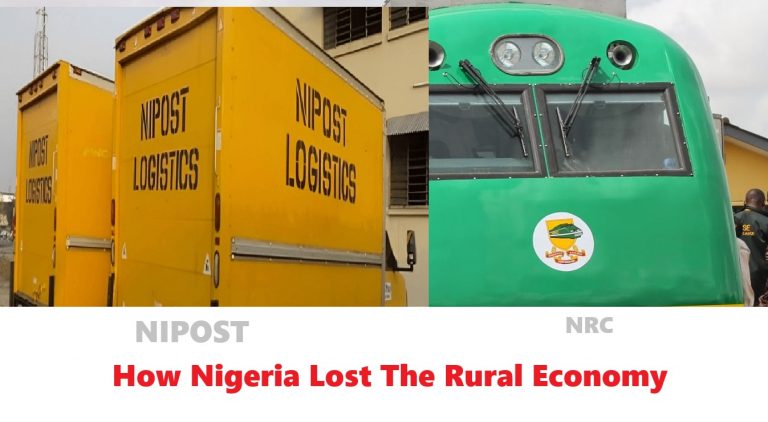
In OA Lawal’s O’Level Economics textbook, he wrote about localization of industries, explaining factors that could facilitate the growth of firms. Extrapolate his thesis, and you could model how rural Nigeria was developing until 1998. My village of Ovim was bubbling with development. But it was not just Ovim. Yes, every village within the railway track from Maiduguri/Kano via Enugu to Port Harcourt was developing faster than other villages with no track passing through them.
With the railway track, human mobility was easier; people could travel easily from Makurdi to Ovim. And traders could do trading because the supply chain system was there; the trains powered businesses. Oriendu Market Ovim was growing because people would come to buy garri, yam, etc and enter trains to deliver to the big cities. And with the best road network in the area, the market assumed the #1 position, serving Eziukwu, Acha, Nkpa, Ozara, and other neigbouring villages.
Men and women saw investment opportunities around the railway station, and buildings like Isaac Obineche House came along. Even the schools benefitted as my alma mater, Secondary Technical School, and Ovim Girls Model Secondary School, had many non-Ovim students. Check all: the railway was directly or indirectly facilitating those indicators.
Register for Tekedia Mini-MBA edition 20 (June 8 – Sept 5, 2026).
Register for Tekedia AI in Business Masterclass.
Join Tekedia Capital Syndicate and co-invest in great global startups.
Register for Tekedia AI Lab.
Then the train system faded and the oxygen went out from all those villages along the train track. When the railway system collapsed, the villages became farther away from the cities. But hold on; there was still the post office which enabled us to have correspondence with Americans, British, etc via pen pal. Then that one went down, and everything closed! Nigeria has lost the rural economy!
So when I read that Amazon wants to invest $4 billion in rural America, my mind flashed back to how it used to be in Nigeria when the postal service was still serving everyone in everywhere: “Amazon intends to spend over $4 billion on expanding its delivery network across rural America by 2026. The e-commerce giant says the investment will create over 100,000 jobs and add more than 200 new delivery stations to its sprawling network. The company has been focused on building its presence in rural regions with optimized warehouses and contracted drivers.”
When a nation’s past seems more memorable than the present, you will agree that there is a problem. What happened to Nigeria’s railways (NRC)? What destroyed the amazing NIPOST? Did they know that by destroying those things, the Oriendu Market would struggle? Did they know that you do not have to actually have a profitable post office or railway system to keep them going?

In the US for example, Amtrak has not made a single profit since about 1971 it was founded. And in the last 20 years, the US Postal service has not recorded a profit. Simply, Nigeria could have kept the NRC and NIPOST running using the One Oasis Strategy as both enabled the development of the economy in many ways, and when those economic activities are taxed, whatever we lost in NRC and NIPOST, we would recover.
If elections in Nigeria are FREE and Fair, I will pick a ticket for the Presidency, and run with a slogan “A Greater Nation”. I will build my campaign on four pillars: Security, People, Economy & Electricity, and Diasporas. This is the SPEED Agenda. And if we understand that commerce is nothing but supply chain, you can agree that we must transform NRC and NIPOST.
We developed fastest under regional governments. Now, with NDIC, NEDC, SEDC, etc, evolving, these commissions must partner with private capital for Southeast Post, Northeast Post, Northcentral Railways, etc, even as we enshrine fiscal federalism in the Constitution. The goal? Provide PLATFORMS upon which companies of the future could be planted by innovators in Nigeria.

---
Connect via my
LinkedIn |
Facebook |
X |
TikTok |
Instagram |
YouTube