

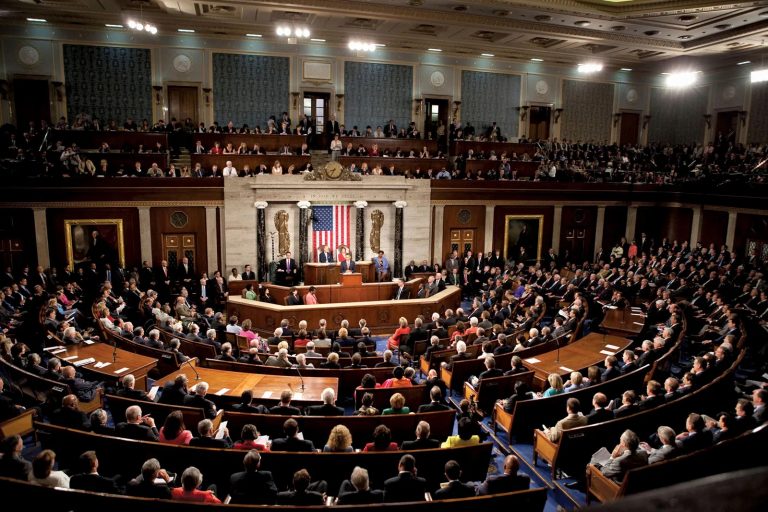
The US House of Representatives passed a major spending package, to end a partial government shutdown that had lasted about four days.
The bill, a roughly $1.2 trillion appropriations measure, passed the House by a narrow bipartisan vote of 217-214. It included: Full-year funding through September 30, 2026 for most federal agencies and departments, such as Defense including a military pay raise, Labor, Health and Human Services, Education, Transportation, and Housing and Urban Development.
A short-term continuing resolution providing funding for the Department of Homeland Security (DHS) only through February 13, 2026 (about two weeks), to allow further negotiations.
This short-term DHS extension was a key compromise, driven by Democratic demands for restrictions or accountability measures on immigration enforcement operations (including ICE actions), amid recent controversies like reported incidents involving federal agents. The package had previously passed the Senate (in a 71-29 vote on January 30, 2026).
Register for Tekedia Mini-MBA edition 20 (June 8 – Sept 5, 2026).
Register for Tekedia AI in Business Masterclass.
Join Tekedia Capital Syndicate and co-invest in great global startups.
Register for Tekedia AI Lab.
After House approval, President Donald Trump signed it into law later on February 3, 2026, in the Oval Office, officially ending the partial shutdown and reopening affected federal operations. Furloughed federal employees are expected to receive back pay for the affected period.
The deal resolves funding for the vast majority of the government but sets up a new potential funding cliff for DHS in mid-February, where further talks over immigration policy “guardrails” such as body camera requirements for agents will be needed to avoid another lapse.
This marks the second partial government shutdown in recent months, highlighting ongoing partisan divides, particularly around immigration and enforcement under the current administration.

The spending package signed into law by President Trump on February 3, 2026, explicitly includes provisions guaranteeing retroactive pay for both furloughed employees (those placed on unpaid leave) and excepted employees (those required to work without immediate pay during the lapse).
This aligns with the 2019 Government Employee Fair Treatment Act (GEFTA), which requires retroactive compensation at the standard rate of pay once funding is restored.
The recent bill reiterated this requirement, directing agencies to provide back pay “as soon as possible” despite earlier administration guidance from the Office of Personnel Management (OPM) and Office of Management and Budget (OMB) that had removed automatic back pay assurances and suggested it depended on specific congressional action in each funding measure.
This covers civilian federal workers in agencies impacted by the lapse e.g., parts of Defense, Labor, HHS, Education, Transportation, HUD, and others funded in the bill. Estimates during similar short lapses suggest hundreds of thousands were furloughed or worked without pay, though the brief duration about four days, including a weekend limited widespread hardship.

Agencies are reopening operations. Back pay is typically processed in the next regular paycheck or shortly thereafter, with payroll systems adjusting for the furlough/excepted periods. Employees should receive full compensation for the shutdown days as if they had worked normally (for furloughed) or for actual hours worked for excepted, including any overtime.
No major deductions or losses — Benefits like health insurance, retirement contributions, and leave accrual continue uninterrupted or are retroactively credited. No reports indicate otherwise for this short partial shutdown.
This outcome resolves uncertainty raised by the Trump administration’s prior positions. By including explicit language in the funding bill, Congress ensured compliance with existing law and avoided any denial of retroactive pay.
For the Department of Homeland Security (DHS) — funded only through February 13, 2026 — employees there remain under a short-term continuing resolution. If no further deal is reached, another lapse could occur, potentially triggering similar back pay provisions in any resolution. But for the resolved portion, federal workers are fully protected and compensated.