

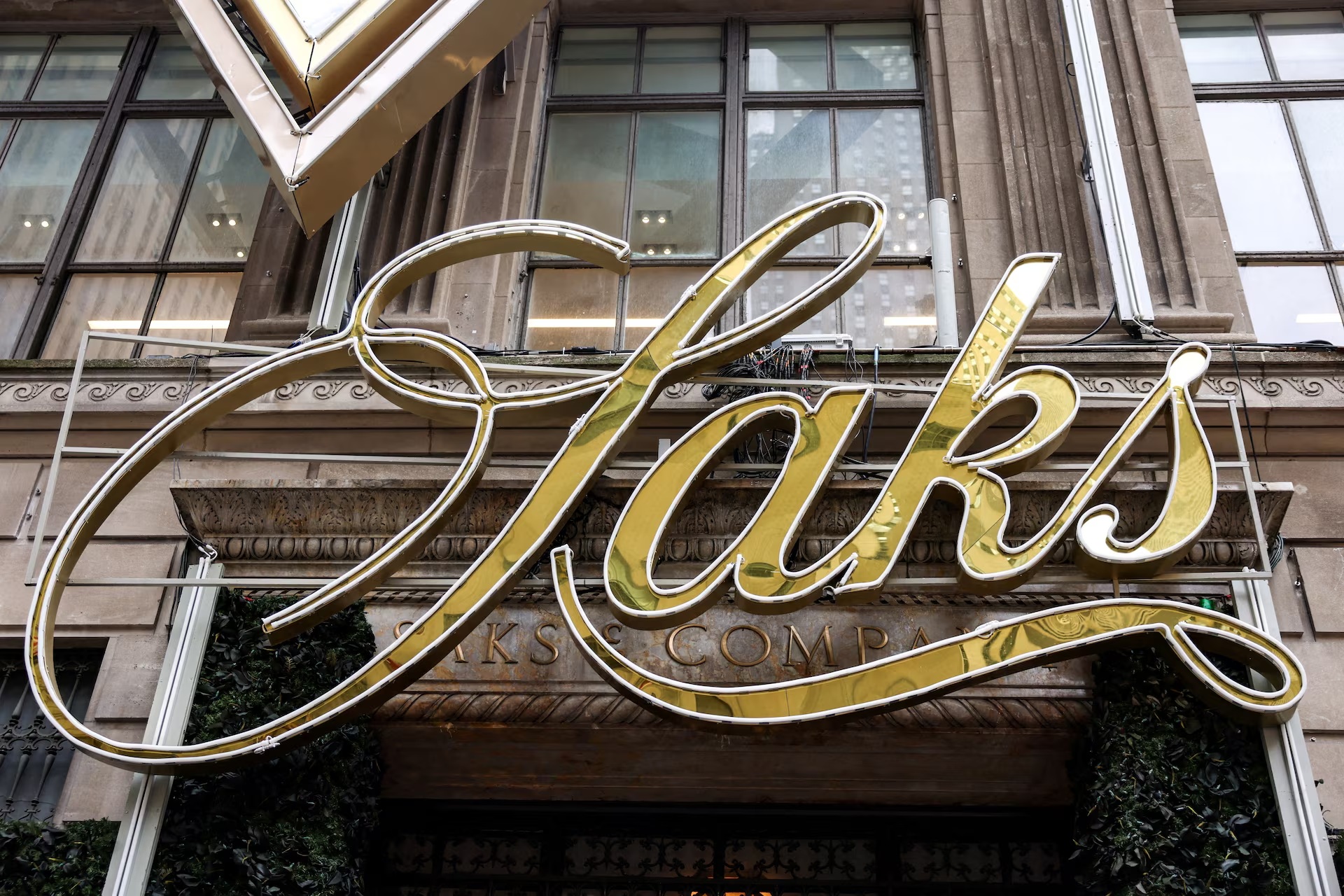
Saks Global, the owner of some of the most storied names in American luxury retail, has entered Chapter 11 bankruptcy protection, marking a dramatic fall for a business that once symbolized stability and prestige at the top end of the fashion market.
The filing, made after the company ran out of cash and failed to secure fresh investor backing, gives Saks Global breathing room to restructure its balance sheet, renegotiate debts and possibly find a buyer willing to keep the business alive. Without that protection, the company was edging dangerously close to a Chapter 7 liquidation that would have meant shutting down operations entirely.
As part of the restructuring effort, Saks announced an abrupt leadership change. Former Neiman Marcus chief executive Geoffroy van Raemdonck has been appointed CEO with immediate effect, replacing Richard Baker, who had held the role for just two weeks. The company also said it has secured about $1.75 billion in financing commitments aimed at stabilizing operations during the bankruptcy process.
Register for Tekedia Mini-MBA edition 20 (June 8 – Sept 5, 2026).
Register for Tekedia AI in Business Masterclass.
Join Tekedia Capital Syndicate and co-invest in great global startups.
Register for Tekedia AI Lab.
The announcement follows weeks of mounting distress. Late last month, Saks missed an interest payment to bondholders, a red flag that made a bankruptcy filing increasingly inevitable. As recently as last week, the retailer was struggling to line up even $1 billion in debtor-in-possession financing, the lifeline that allows companies to keep paying staff and suppliers while they restructure. Failure to secure that funding would likely have forced a liquidation.
What remains unresolved is the fate of Saks Global’s nearly 200 stores across its portfolio, which includes Saks Fifth Avenue, its off-price chain Saks Off 5th, Neiman Marcus, and Bergdorf Goodman. Chapter 11 opens several paths. A well-capitalized buyer could acquire the entire group as a going concern. Alternatively, the company could be broken up, with premium assets such as Bergdorf Goodman sold separately. In a more drastic scenario, Saks could follow the path of Lord & Taylor, closing physical stores and pivoting to an online-only model.
The roots of the crisis run deeper than the bankruptcy filing itself. Saks had been under financial strain even before its ambitious 2024 acquisition of longtime rival Neiman Marcus in a $2.7 billion deal largely financed with debt. That transaction was meant to be transformative. Management pitched it as a way to create a luxury department store heavyweight with greater scale, stronger negotiating power with brands, and a more efficient cost structure.

The deal also brought in high-profile investors from the technology sector, including Amazon and Salesforce, injecting new capital and raising expectations that the combined group would finally turn the corner. At the time, Saks said the merger would provide “significant liquidity” and reduce leverage over time.
Instead, the opposite happened. While the acquisition briefly improved vendor payments, Saks soon imposed 90-day payment terms, a move that infuriated brands already wary of the retailer’s finances. Many suppliers said the conditions were too burdensome, particularly for smaller luxury labels that rely on faster cash cycles. As relationships frayed, Saks again fell behind on payments, prompting brands to cut back deliveries or pull out altogether.
That breakdown in supplier trust quickly showed up on the sales floor. With fewer products available, assortments thinned, customer traffic suffered, and revenue weakened further. Meanwhile, the company’s heavy debt load became increasingly visible in the bond market, where its notes began trading well below face value, signaling growing doubts about its ability to meet interest obligations.

Management tried to buy time. Over the summer, Saks raised $600 million in new financing and sold valuable real estate assets to shore up liquidity. Those moves delayed the reckoning but did not address the underlying problem: a highly leveraged business struggling to generate enough cash in a luxury retail environment that has become less forgiving, even for brands catering to wealthy shoppers.
Now, the future of Saks Global rests on whether the bankruptcy process can succeed where previous efforts failed. Van Raemdonck’s return to the helm suggests a renewed focus on operational discipline and repairing relationships with brands. The secured financing provides a runway, but it does not guarantee survival.
In the coming weeks, creditors, potential buyers, and suppliers will determine whether Saks Global can be reshaped into a leaner luxury retailer or whether one of America’s most iconic department store groups will be dismantled, asset by asset, marking the end of an era for brick-and-mortar luxury retail.