

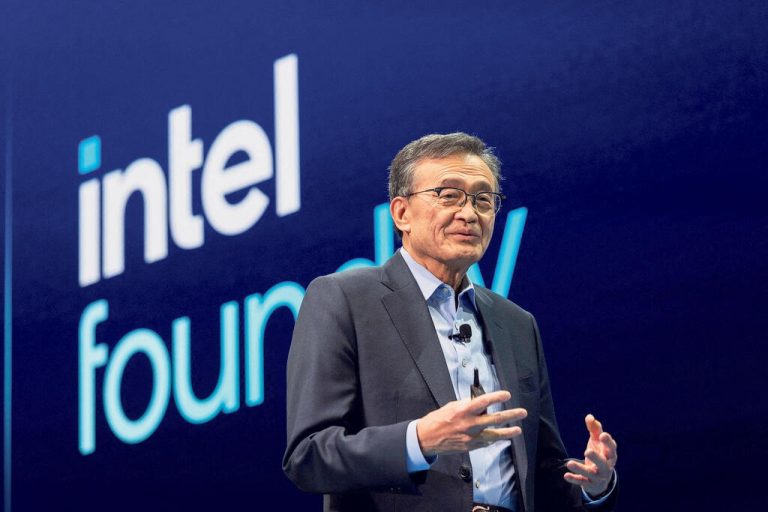
Intel has signed its first external customer for its 18A semiconductor manufacturing process, marking a significant step in chief executive Lip-Bu Tan’s effort to turn the struggling chipmaker into a serious competitor to Taiwan Semiconductor Manufacturing Co. (TSMC).
Tan disclosed the agreement on Wednesday at the TomorrowX Summit in Austin, Texas, but did not identify the customer. The deal gives Intel an important commercial milestone after years of manufacturing setbacks, as it seeks to attract companies that currently rely heavily on external foundries to produce their processors.
“Resilient supply on the foundry is very important,” Tan said. “And then 18A, I’m involved in production and we just signed the first customer.”
Register for the next Tekedia Mini-MBA.
Register for Tekedia AI in Business Masterclass.
Join Tekedia Capital Syndicate and co-invest in great global startups.
Intel technology chief Pushkar Ranade later clarified on X that the customer had signed up for Intel’s 18A-P process node, which entered risk production in June.
The announcement is notable because Intel has struggled to secure a high-profile outside customer for its foundry business. The company has primarily used its manufacturing facilities to produce chips for its own products, limiting its ability to establish itself as a credible alternative to TSMC for other semiconductor companies.
Creative Strategies analyst Ben Bajarin described the agreement as “a huge win for foundry” in an interview with CNBC.

Intel has spent about five years trying to rebuild its manufacturing capabilities and compete with TSMC, which dominates advanced contract chip production. Its 18A technology has been central to that effort, with the company presenting the process as a foundation for improving manufacturing performance and attracting external customers.
The identity of the new customer remains undisclosed, leaving investors to assess the potential commercial significance of the agreement. Bajarin suggested possible candidates include Nvidia, Apple and major cloud computing companies that design their own processors.
“Amazon, Microsoft and Google are struggling to get capacity for their CPU ambitions at TSMC,” he said. “So it makes sense that you go somewhere for at least some capacity.”

Reports in May indicated that Apple and Intel were approaching an agreement for Intel to manufacture some chips used in Apple devices. However, Intel has not confirmed that Apple is the customer behind Wednesday’s announcement.
18A Deal Tests Intel’s Manufacturing Ambitions
The agreement gives Intel an early opportunity to demonstrate that its manufacturing technology can attract business beyond its own product portfolio. But securing a customer is only the first stage of establishing a successful foundry operation.
Intel must still demonstrate that it can manufacture chips at the required quality, yield, and volume while meeting delivery schedules and controlling costs. Semiconductor customers typically require extensive qualification before committing significant production to a new manufacturing partner.
Intel’s previous manufacturing problems have damaged confidence in its ability to compete at the leading edge. Low yields and production delays have contributed to years of setbacks, while TSMC has strengthened its position as the preferred manufacturer for many major chip designers.
A sustained improvement in Intel’s manufacturing performance could give customers another source of advanced production capacity at a time when demand for processors is rising. It could also support the US government’s objective of expanding domestic semiconductor manufacturing and reducing reliance on production concentrated in Taiwan.
Tan said in late October that he expects the global market for server processors to expand as much as fivefold over the next five years, reaching approximately $200 billion. He also acknowledged that Intel cannot currently meet customer demand.
The growth opportunity is linked to expanding data center investment and demand for processors used in cloud computing and AI infrastructure. Major technology companies are developing their own server CPUs to complement the accelerators used to train and run AI models. Access to manufacturing capacity has therefore become an important consideration for companies seeking to expand their processor businesses.
Attracting those customers could create a more diversified revenue base and improve utilization of Intel’s factories. However, the company will need more than a single customer agreement to establish a sustainable foundry business. Analysts say it must secure additional orders and prove that its manufacturing operations can deliver consistently at commercial scale.
Microsoft Adds Advanced Packaging Deal
Tan also announced that Microsoft is the first publicly named customer for Intel’s most advanced packaging technology, known as EMIB.
Advanced packaging connects individual semiconductor components into larger systems, allowing chipmakers to combine different components within a single package. The technology has become more important as processor designs grow more complex and manufacturers seek ways to improve performance without relying exclusively on larger individual chips.
Microsoft’s agreement gives Intel another external customer for a manufacturing-related technology, although it is separate from the unnamed customer signed for 18A-P.
The two announcements strengthen Intel’s case that its business can extend beyond supplying processors under its own brand. Its foundry strategy includes both manufacturing silicon and providing packaging capabilities that other chip designers can use.
Intel’s stock has lost more than half its value since the end of September. Much of the decline followed its warning late last month that quarterly revenue would fall at least $1 billion short of analysts’ expectations, citing weaker PC sales and supply-chain challenges.
The shares had previously become a popular investment as optimism grew around the company’s turnaround. The US government acquired a 10% stake in Intel in August 2025, followed by a $5 billion investment from Nvidia, strengthening expectations that Intel could play a larger role in US semiconductor production.
Those investments provided financial and political support, but they did not resolve Intel’s central manufacturing challenge: proving that outside customers would trust its factories with commercially important products.
Wednesday’s announcements offer evidence of progress, but the commercial test is only beginning. The 18A-P customer agreement gives Intel an opening to compete for external manufacturing contracts, while Microsoft’s EMIB deal adds credibility to its advanced packaging business.