

Intel shares surged in premarket trading Thursday after President Donald Trump announced that the chipmaker had reached an agreement with Apple to design and manufacture chips in the United States, a development that could mark a major turning point in the company’s years-long effort to regain relevance in the global semiconductor industry.
The stock climbed nearly 9% before the opening bell, extending a remarkable recovery that has transformed Intel from one of the market’s biggest laggards into one of its strongest-performing technology stocks. Over the past year, Intel shares have soared more than 460%, lifting the company’s market capitalization to approximately $609 billion.
Trump framed the agreement as part of a broader effort to rebuild America’s semiconductor manufacturing base and reduce dependence on Asia, particularly Taiwan, which remains the center of global advanced chip production.
Register for the next Tekedia Mini-MBA.
Register for Tekedia AI in Business Masterclass.
Join Tekedia Capital Syndicate and co-invest in great global startups.
“Apple has agreed to work with Intel to design and build its Chips in America,” Trump wrote on Truth Social.
The president also said that Nvidia had agreed to manufacture advanced chips through Intel’s foundry operations and said Elon Musk’s planned TerraFab facility would be developed in partnership with Intel’s technology teams.
Even so, the market reaction highlights how dramatically investor sentiment toward Intel has shifted over the past year.

For much of the previous decade, Intel was viewed as a symbol of missed opportunities in the semiconductor sector. The company lost technological leadership to Taiwan Semiconductor Manufacturing Company (TSMC), ceded market share in processors to Advanced Micro Devices (AMD), and largely missed the first wave of the artificial intelligence boom that propelled Nvidia into one of the world’s most valuable companies.
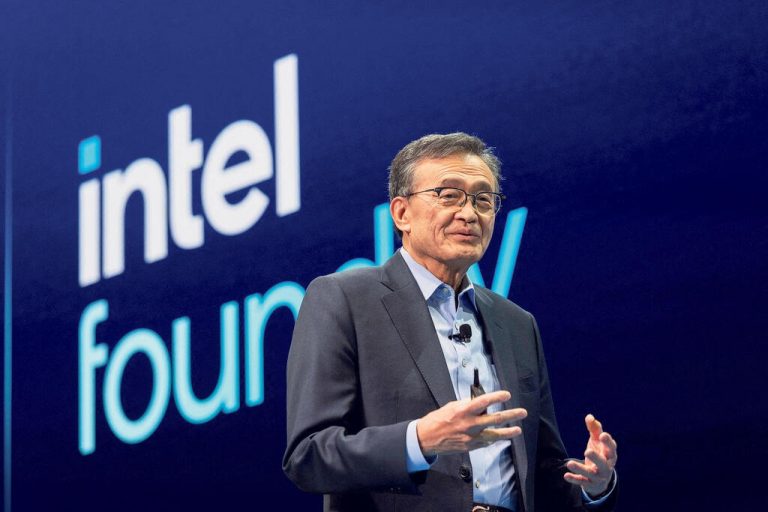
That narrative has changed significantly under Chief Executive Lip-Bu Tan.
Since taking over, Tan has focused aggressively on transforming Intel into a contract manufacturer capable of competing with TSMC, a strategy widely viewed as essential to restoring the company’s long-term growth prospects.

However, the importance of an Apple partnership goes far beyond the immediate revenue opportunity. The iphonemaker has historically relied heavily on TSMC to manufacture its custom-designed chips for iPhones, iPads, and Macs. Securing even a portion of Apple’s production would represent one of the strongest endorsements yet of Intel’s foundry ambitions. Such a move would also align closely with Washington’s broader push to localize semiconductor manufacturing amid escalating geopolitical tensions and supply-chain concerns.
The announcement emerges when artificial intelligence has transformed chipmaking from a cyclical technology business into a strategic national priority. Governments around the world increasingly view semiconductor production as critical infrastructure, while companies are spending hundreds of billions of dollars on AI-related hardware.
That spending has created enormous demand for advanced chips, data centers, and manufacturing capacity. Intel’s resurgence is therefore occurring against the backdrop of what many analysts describe as a new industrial arms race centered on AI.
Trump’s comments suggest that Intel may be evolving into a key beneficiary of that trend. The company has spent years investing tens of billions of dollars in new fabrication facilities across the United States, betting that governments and customers would eventually prioritize domestic production. For much of that period, investors questioned whether those investments would generate sufficient returns.
However, recent developments have begun to change that perception.
Nvidia’s reported manufacturing commitments, the potential Apple partnership, and the Trump administration’s public backing collectively strengthen Intel’s argument that its foundry strategy is gaining traction.
Industry analysts believe that if Apple shifts a meaningful portion of its chip manufacturing to the United States, it could accelerate broader efforts to diversify semiconductor supply chains away from Taiwan. That would represent one of the most consequential changes in the global technology industry in decades.
But Taiwan currently produces the overwhelming majority of the world’s most advanced semiconductors. Any disruption to production there, whether from military tensions or natural disasters, could have severe consequences for global technology markets.
Successive U.S. administrations have sought to reduce that dependence through subsidies, industrial policy, and incentives for domestic manufacturing.
Intel’s foundry expansion has become a centerpiece of that strategy.
The timing is also notable because the semiconductor sector remains one of the biggest winners from the AI investment boom.
While conflicts in the Middle East and broader economic uncertainty have weighed on parts of the market, AI-related stocks have continued to attract investor capital.
The Nasdaq PHLX Semiconductor Index has risen roughly 90% this year, reflecting expectations that AI infrastructure spending will remain elevated for years.
Investors increasingly view semiconductor manufacturers as the foundation of the AI economy, much as cloud providers became the backbone of the internet era.
For Intel, the challenge now shifts from attracting customers to executing on its promises.
Building cutting-edge chips for companies such as Apple and Nvidia requires manufacturing precision that rivals or exceeds TSMC’s capabilities. Any delays or technical setbacks could undermine confidence in the foundry strategy.
Still, the market’s reaction suggests investors believe Intel is closer than it has been in years to achieving a turnaround.
If the company successfully converts high-profile partnerships into long-term manufacturing contracts, Intel’s recovery could evolve from a stock-market comeback story into one of the most significant industrial revivals in modern American technology history.
More broadly, the developments underscore how the AI boom is reshaping the semiconductor landscape. What began as a race to build better AI models has become a competition to control the infrastructure that powers them, and Intel is positioning itself as a central player in that contest.