

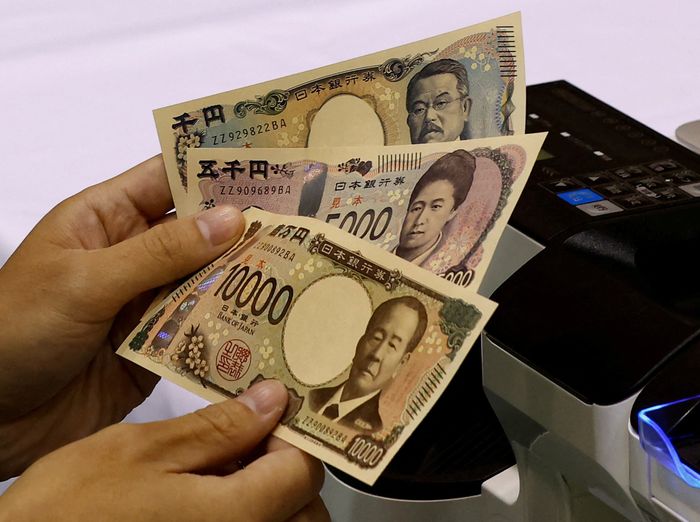
Japan’s currency has fallen to its weakest level in four decades, reviving speculation that authorities could once again intervene in foreign exchange markets. However, economists and investors warn that even another multi-billion-dollar intervention is unlikely to reverse the yen’s decline unless the gap between U.S. and Japanese interest rates narrows.
The yen weakened to 162.83 per U.S. dollar on Tuesday, its lowest level in 40 years, according to LSEG data. The slide has renewed expectations that Japanese authorities could step back into the market after spending a record 11.7 trillion yen ($73.5 billion) in April and May buying their own currency.
The renewed weakness illustrates the difficult position confronting Tokyo. While Japan has both the financial firepower and political willingness to intervene, market participants say currency intervention cannot fundamentally alter the economic forces driving investors away from the yen.
Register for the next Tekedia Mini-MBA.
Register for Tekedia AI in Business Masterclass.
Join Tekedia Capital Syndicate and co-invest in great global startups.
At the heart of the problem is the widening monetary policy divergence between the Bank of Japan (BOJ) and the U.S. Federal Reserve.
Although the BOJ has begun moving away from years of ultra-loose monetary policy and recently raised its benchmark interest rate to 1%, Japanese borrowing costs remain far below those in the United States. The higher returns available on dollar-denominated assets continue to encourage investors to sell yen and buy dollars.
Christy Tan, global investment strategist at Franklin Templeton Institute, said market intervention has clear limitations.

“Intervention can slow a fall, punish speculative excess and signal official discomfort. But it cannot repeal arithmetic,” she said.
She explained that the interest-rate differential remains the dominant force weighing on Japan’s currency.
“As long as investors can borrow cheaply in yen and earn more in dollars, the carry trade will keep carrying the yen away,” she added.

The carry trade, in which investors borrow in low-yielding currencies such as the yen to invest in higher-yielding assets elsewhere, has become one of the principal drivers of the currency’s prolonged weakness. The challenge has intensified as investors increasingly believe the Federal Reserve could keep interest rates elevated for longer.
Persistent inflationary pressures and resilient U.S. economic growth have led markets to scale back expectations for aggressive rate cuts, with some investors even leaving room for the possibility of additional tightening if inflation remains stubborn.
Tan said markets increasingly see the policy gap as the core issue.
“It appears that investors identify the core problem as the widening credibility gap between the Federal Reserve and the Bank of Japan,” she said.
Currency markets appear to support that assessment.
While the yen has depreciated sharply against the U.S. dollar, it has remained relatively stable against the euro, suggesting that the recent weakness reflects broad dollar strength as much as concerns about Japan itself. According to LSEG data, the yen has fallen roughly 3.9% against the dollar this year, compared with only 0.9% against the euro.
Martin Schulz, chief economist at Fujitsu, said the divergence highlights the dominant role of the stronger U.S. dollar.
“If we look at the yen-euro, for example, it is more stable,” he said.
He added that investors continue to view the BOJ as moving more cautiously than other major central banks.
That dynamic significantly reduces the effectiveness of unilateral intervention. Several market participants believe Japanese authorities may intervene if the currency weakens further.
Vincent Chung, co-portfolio manager for the diversified income bond strategy at T. Rowe Price, said traders are closely watching the 162-163 per dollar range.
“If intervention comes only from Japan while the dollar remains broadly strong, I think it may have limited effectiveness,” he said, then added, “Historically, coordinated intervention involving other central banks, particularly the U.S., has tended to create a much stronger reaction in the yen.”
Alexandre Drabowicz expressed a similar view, suggesting that another intervention threshold could emerge around 164-165 yen per dollar, while cautioning that previous operations have produced only temporary relief.
“To be really effective, you need coordination between the U.S. and Japan.”
Such coordination, however, appears unlikely in the current environment. The United States has generally favored allowing market forces to determine exchange rates unless currency movements threaten global financial stability.
For Japan, the weak yen presents both opportunities and risks.
Export-oriented manufacturers continue to benefit because overseas earnings become more valuable when converted back into yen. The currency’s depreciation also improves the international competitiveness of Japanese exports.
That helps explain why Japanese equities have remained relatively resilient despite the currency’s decline. Schulz noted that Japanese manufacturers continue to benefit from the exchange rate, while the BOJ’s latest Tankan business sentiment survey showed stronger-than-expected confidence among large manufacturers.
The benefits for exporters, however, come at a growing cost to households.
A weaker yen raises the price of imported fuel, food, and raw materials, increasing living costs for consumers and putting additional pressure on household budgets. Higher import prices also risk entrenching inflation at a time when policymakers are attempting to support economic growth.
The situation creates a delicate balancing act for Prime Minister Sanae Takaichi’s government.
Tokyo wants to sustain export competitiveness and corporate investment while protecting households through subsidies aimed at cushioning higher energy and food prices. At the same time, officials are increasingly uncomfortable with the pace of the yen’s depreciation.
Tan summarized the dilemma facing Japanese policymakers.
“Tokyo wants a stronger yen without fully accepting the policy costs of one,” she said.
Those costs would likely include substantially higher domestic interest rates, which could slow economic growth, increase government borrowing costs and weigh on corporate investment.
Currently, analysts broadly agree that while intervention may slow speculative selling and temporarily stabilize the currency, a sustained recovery in the yen will ultimately depend on a narrowing of the U.S.-Japan interest-rate differential.