

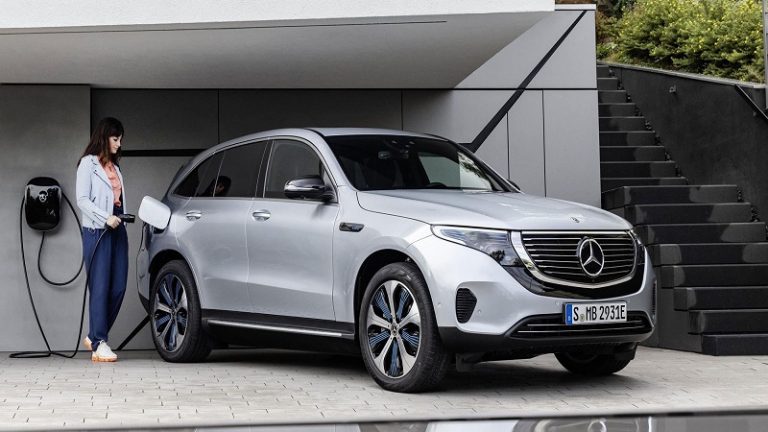
Mercedes-Benz could be barred from manufacturing, importing, or selling new vehicles in the United States under bipartisan legislation advancing in Congress, unless the bill is amended or the German automaker’s largest shareholder divests its stake.
CNBC reports that the Motor Vehicle Modernization Act of 2026, sponsored by House Energy and Commerce Committee Chairman Brett Guthrie (R-Ky.), aims to prevent Chinese automakers from gaining a foothold in the U.S. market. It would prohibit any automaker with “any direct or indirect equity interest” by a foreign-adversary government, including China, Russia, and North Korea, from operating in the United States.
Mercedes-Benz’s largest individual shareholder is the state-owned Chinese automaker BAIC, which holds a 9.98% stake. The company’s second-largest shareholder is Chinese billionaire Li Shufu, founder and chairman of Geely, with a 9.69% stake through his investment firm. Combined, these two Chinese-linked shareholders own approximately 19.67% of Mercedes-Benz Group AG.
Register for the next Tekedia Mini-MBA.
Register for Tekedia AI in Business Masterclass.
Join Tekedia Capital Syndicate and co-invest in great global startups.
Several people familiar with the legislation, speaking on condition of anonymity, told CNBC that gray areas in the bill’s language could, depending on interpretation, effectively ban Mercedes-Benz from the U.S. market. A former automotive policy advisor and lobbyist, who consulted on the bill, described the language as “unambiguous.”
Daniel Kelly, press secretary for the Energy and Commerce Committee, confirmed the details of the legislation but declined to comment on its potential impact on specific companies.
Mercedes’ Substantial U.S. Footprint at Risk
A ban would have major consequences. Mercedes-Benz operates two large assembly plants in the United States — a massive facility in Tuscaloosa, Alabama, that has produced more than 5 million vehicles since 1997, and a van production plant in South Carolina that began operations in 2006. The company employs more than 10,000 people in the U.S. and has long positioned America as a key manufacturing and sales hub.

A Mercedes-Benz spokesman declined to comment on the legislation but highlighted the company’s deep U.S. investments and workforce.
The bill includes exemptions for automakers that have manufactured passenger vehicles in the U.S. for at least five years before January 1, 2026. However, this exemption explicitly does not apply to companies with ownership ties to foreign-adversary governments.
A separate but related bill, the Connected Vehicle Security Act of 2026, was introduced by Sens. Bernie Moreno (R-Ohio) and Elissa Slotkin (D-Mich.) and Reps. John Moolenaar (R-Mich.) and Debbie Dingell (D-Mich.) also include a 15% ownership threshold for restrictions on connected vehicles with Chinese software or hardware. Exemptions under that legislation are still being determined.

Broader Push to Block Chinese Influence in U.S. Autos
The legislation follows growing bipartisan concern in Washington over Chinese involvement in the U.S. auto sector, driven by national security risks, data privacy fears, and economic competition. It builds on previous restrictions banning connected vehicles with Chinese-linked software starting with 2027 models and hardware from 2030 models.
Stephen Ezell, vice president for global innovation policy at the Information Technology and Innovation Foundation, said Mercedes-Benz poses a smaller national security risk than fully Chinese-controlled automakers, calling any inclusion an “unintended consequence” that could result in job losses and reduced profits.
John Bozzella, CEO of The Alliance for Automotive Innovation, praised the bill’s overall direction in a letter to committee leaders but stressed that “details matter.” The group, which represents nearly every major automaker in the U.S., including Mercedes-Benz, declined to comment specifically on potential impacts to individual companies.
Autos Drive America, a lobbying group for foreign automakers that includes Mercedes-Benz, also declined to comment on the potential impact but reiterated support for the goals of related legislation while warning against unintended consequences for U.S. manufacturing.
Potential Impact on Other Automakers
The 15% ownership threshold is expected to also affect other companies with Chinese ties, such as Volvo (majority-owned by Geely), and smaller manufacturers like Faraday Future, Lotus, and Karma Automotive. Volvo recently received specific authorization from the U.S. government to bypass certain federal bans on connected vehicle technology linked to China.
However, exclusion from the U.S. market, one of its most important and profitable regions, would be a severe blow for Mercedes-Benz. The company has invested heavily in American manufacturing to serve both domestic and export markets. A ban would disrupt supply chains, threaten thousands of jobs, and force a painful strategic rethink.
While the bill targets Chinese state influence, its broad language risks collateral damage to established international automakers with legitimate minority stakes from Chinese entities.
As the legislation moves forward, lobbying efforts are expected to intensify. Mercedes-Benz and its allies will likely push for clarifications or exemptions to protect their U.S. operations. The bill is currently a House-only initiative with no Senate companion, but its strong bipartisan support on the committee suggests it has momentum.