

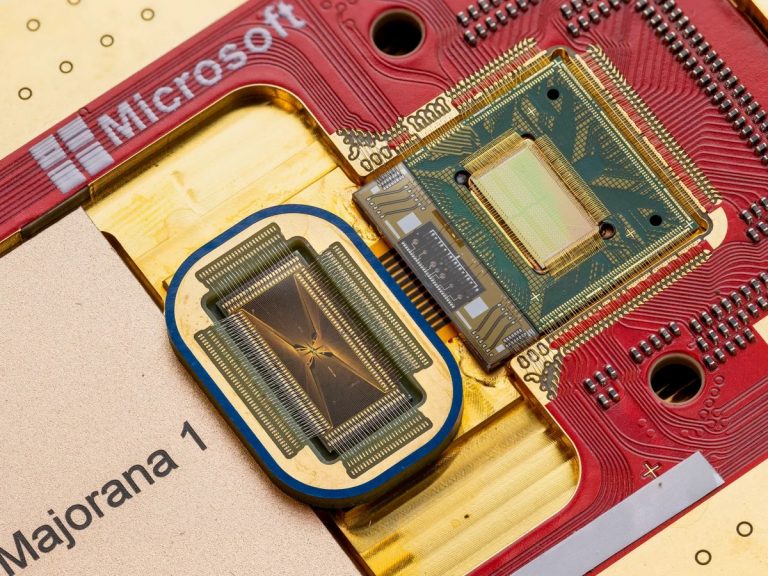
Microsoft has sharpened the timeline in the global quantum computing race, unveiling a new quantum chip developed with the aid of artificial intelligence and declaring that commercially useful quantum computers could arrive by 2029.
The announcement places Microsoft alongside rivals racing to turn quantum computing from a scientific experiment into a commercially viable technology. The company now expects practical quantum machines to emerge within three years, matching a timetable recently outlined by IBM and intensifying competition with Alphabet, Amazon, and a growing number of Chinese quantum research initiatives.
At stake is a technology that could fundamentally alter computing. Quantum systems are expected to solve problems involving molecular simulations, drug discovery, advanced materials, logistics optimization, and cryptography at speeds unattainable by conventional computers. Governments and corporations view quantum computing as a strategic technology with implications for economic competitiveness and national security.
Register for the next Tekedia Mini-MBA.
Register for Tekedia AI in Business Masterclass.
Join Tekedia Capital Syndicate and co-invest in great global startups.
The centerpiece of Microsoft’s latest push is Majorana 2, a successor to the company’s first Majorana chip introduced last year. Unlike many competitors that rely on aluminum-based superconducting materials, Microsoft’s new chip uses lead, a material the company says delivers dramatic performance improvements.
According to Microsoft executive vice president Jason Zander, AI-powered materials science tools played a critical role in identifying and engineering the new approach. The company says the redesign generated a thousand-fold improvement in certain performance metrics compared with the previous generation.
“The reason why people don’t use it to build chips is it requires an incredibly specialized process to be able to go figure that out. And we figured it out,” Zander said.

Currently, AI is increasingly being used not only to develop software but also to accelerate scientific discovery and engineering. Technology companies are investing heavily in AI-driven materials research, hoping to shorten development cycles for semiconductors, batteries, pharmaceuticals, and next-generation computing systems.
For Microsoft, the development also strengthens a broader strategy that combines leadership in artificial intelligence with ambitions in quantum computing. If successful, the company could eventually integrate quantum capabilities with its cloud and AI platforms, creating a powerful competitive advantage in enterprise computing.
Yet Microsoft’s announcement also revives long-running scientific disputes surrounding its quantum research. The company’s quantum architecture relies on exotic quasiparticles known as Majoranas. Microsoft has long argued that these particles could enable more stable quantum computers that are less prone to errors than competing approaches.

However, the existence and practical implementation of Majorana-based quantum systems have remained subjects of intense debate within the scientific community. Microsoft previously faced scrutiny over research related to Majorana particles, and some physicists continue to question whether the company has provided sufficient evidence to support its claims.
Henry Legg, a lecturer in quantum physics at the University of St. Andrews, challenged the company’s latest announcement.
“Microsoft can use as much lead as they like – it is not going to shield them from the basic scientific principle that your results need to be reproducible,” he said.
Critics argue that independent researchers need access to more experimental data to verify Microsoft’s findings. Some have pointed to concerns surrounding earlier studies and say similar questions remain unresolved.
Microsoft counters that much of the underlying data cannot be publicly released because of intellectual property concerns. Company executives say detailed information has been shared with the U.S. Defense Advanced Research Projects Agency (DARPA), which is evaluating multiple quantum computing approaches.
“We’ve done enough of the physics to really have great data,” Zander said. “Believe me, I would not spend the money on the engineering if I felt like we were still off on the physics.”
As billions of dollars flow into quantum research, companies face pressure not only to demonstrate scientific progress but also to convince investors, customers, and governments that practical systems are within reach.
Just weeks ago, IBM announced plans to invest $10 billion in quantum computing and outlined its own roadmap toward fault-tolerant systems. Meanwhile, China continues to pour resources into quantum research as part of its drive to achieve technological self-sufficiency and reduce dependence on Western technologies.