

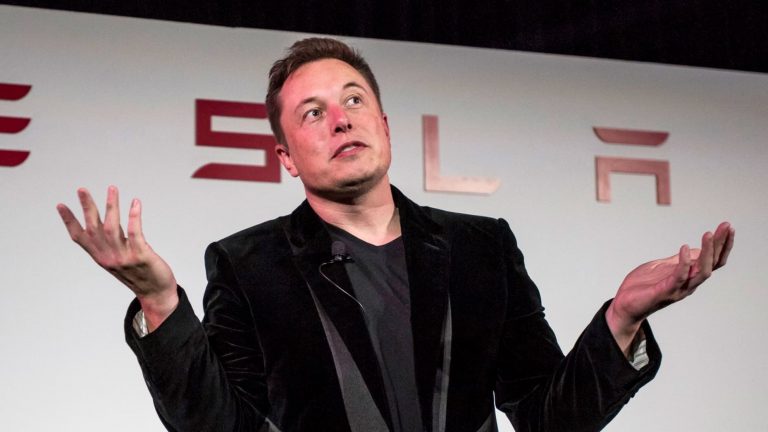
Elon Musk has confirmed that SpaceX and Tesla have established special committees to explore a potential merger, giving the first official indication that the billionaire’s two companies are formally considering a combination that could unite electric vehicles, space infrastructure, artificial intelligence, chip manufacturing and robotics under one corporate structure.
Musk said on Tuesday that combining the companies would be “a good idea,” although he cautioned that a transaction remains uncertain because the committees have yet to agree on terms. SpaceX shares rose 8% in extended trading following the announcement, while Tesla shares gained 1.8%.
The disclosure came as SpaceX reported its first profit as a public company, alongside Musk’s forecast that annual recurring revenue could reach between $500 billion and $1 trillion by the end of 2027. He attributed the company’s growth prospects partly to rising demand for data-center capacity amid the artificial intelligence boom.
Register for the next Tekedia Mini-MBA.
Register for Tekedia AI in Business Masterclass.
Join Tekedia Capital Syndicate and co-invest in great global startups.
The proposed merger would bring together businesses with increasingly overlapping ambitions in AI computing, semiconductor development, autonomous systems and advanced manufacturing. It could also concentrate a substantial range of Musk’s commercial interests within a single corporate entity, potentially reshaping how investors value the companies and their exposure to the AI economy.
“I think it would be a good idea, but it’s really up to the special committees of both companies,” Musk told investors on a conference call. He added that, because he has conflicting interests, he could not participate directly in the committees’ discussions.
Musk said the committees consist of independent directors and were formed at shareholders’ request. Shareholders would ultimately need to approve a transaction.

Despite the formal discussions, Musk stressed that a merger should not be treated as inevitable. The committees have not agreed on transaction terms, he said, and may never reach an agreement.
Musk’s argument for combining the companies rests on the potential to coordinate technologies and investments that currently sit across separate businesses.
“I do think there’s a lot of merit to combining the companies as we are pretty much in the superintelligence singularity, and there’s a lot to be gained from cooperating on developing superintelligence software, chip design, the Terafab obviously, robotics, mass-to-orbit with the Starmind constellation, connectivity,” he said.

The list spans several areas in which Musk has pursued ambitious development plans. Tesla has invested in autonomous driving, robotics and AI systems, while SpaceX operates launch services and satellite infrastructure. A combined company could potentially coordinate investment across these activities, particularly where AI computing, specialized chips and space-based connectivity support multiple business lines.
The rationale is that some of the largest opportunities in AI may depend on more than software development alone. They also require computing capacity, advanced semiconductors, power, physical infrastructure, and systems capable of operating at scale. Combining the companies could give Musk greater flexibility to coordinate those investments.
However, greater corporate integration would not automatically produce better financial results. The companies have different operating models, capital requirements and sources of revenue. A merger would need to demonstrate that the benefits of combining their resources outweigh the costs and complexity of bringing their businesses together.
One important component of the proposed industrial strategy is Terafab, the chip manufacturing joint venture between SpaceX and Tesla. Musk said the facility should produce its first test chip around May or June next year, with volume production targeted for the third quarter of 2028.
The project could give the companies a more direct role in semiconductor development and supply, an important consideration as demand for AI computing expands. But the stated timeline also illustrates the scale of the undertaking: producing test chips is an early milestone, while reaching volume production requires further technical development and manufacturing execution.
The proposed combination could make it easier to coordinate such projects, although it would not remove the technological and operational challenges involved in building advanced chip manufacturing capacity.
Ownership, Valuation and Governance Questions Remain
A merger could also have significant implications for Musk’s control over his business empire. He owns nearly a fifth of Tesla and just under half of SpaceX, and analysts have said a combination would give him control of the merged entity.
The precise ownership structure would depend on the transaction’s terms, including the relative valuations assigned to each company, the consideration offered to shareholders and the governance arrangements established after a deal.
Those questions are especially relevant because a merger could affect investors differently. Tesla shareholders would need to assess the value of exchanging exposure to an electric-vehicle and AI business for a combined company with substantial space and data-center operations. SpaceX investors, meanwhile, would have to weigh the prospects of its existing businesses against the capital requirements and risks associated with Tesla’s operations.
The independent committees are intended to evaluate the potential transaction while accounting for the conflicts created by Musk’s leadership and ownership stakes in both companies. Their work will be key to determining whether the proposed deal offers sufficient value to shareholders.
Reuters reported, citing a person familiar with the matter, that discussions began in recent weeks and could result in SpaceX acquiring Tesla. The person also said Tesla had been working with an investment bank to advise on the discussions.
That possibility would make the transaction more than a straightforward combination of equals. An acquisition by SpaceX could alter the strategic and financial framework through which Tesla’s shareholders participate in Musk’s broader AI and infrastructure ambitions. However, no agreed transaction structure has been announced.
Revenue Ambitions Raise The Stakes
SpaceX’s reported first profit as a public company and Musk’s ambitious revenue forecast provide important context for the discussions. His projection of $500 billion to $1 trillion in annual recurring revenue by the end of 2027 signals expectations of rapid growth, driven in part by surging demand for data-center space.
The forecast is substantial, but the distinction between projected revenue and realized earnings remains notable. Revenue growth does not necessarily translate into equivalent profit or cash flow, particularly in businesses requiring heavy investment in infrastructure, manufacturing and technology development.
For a potential merger, investors would need to assess how much of the anticipated growth is supported by existing operations and how much depends on projects that have yet to reach commercial scale. The costs of chip manufacturing, robotics development and other initiatives could also influence the financial returns available to shareholders.
Musk has previously raised the possibility of combining SpaceX and Tesla, pointing to their growing technological overlap. Speculation intensified recently after Barclays suggested that a deal could be announced before Tesla’s annual meeting in December. That was an analyst view, not confirmation of a timetable agreed by the companies.
The formal creation of special committees marks a concrete development beyond earlier speculation. Yet the process remains at an exploratory stage, with no agreed terms and no guarantee of a transaction.
That brings the question: would bringing the companies together create enough operational and financial value to justify the complexity of combining businesses with different markets, assets and investment needs?
Musk sees opportunities in coordinating AI software, chips, robotics, satellite infrastructure and connectivity. But it’s up to the independent committees to determine whether those potential advantages translate into a deal that serves shareholders’ interests.