

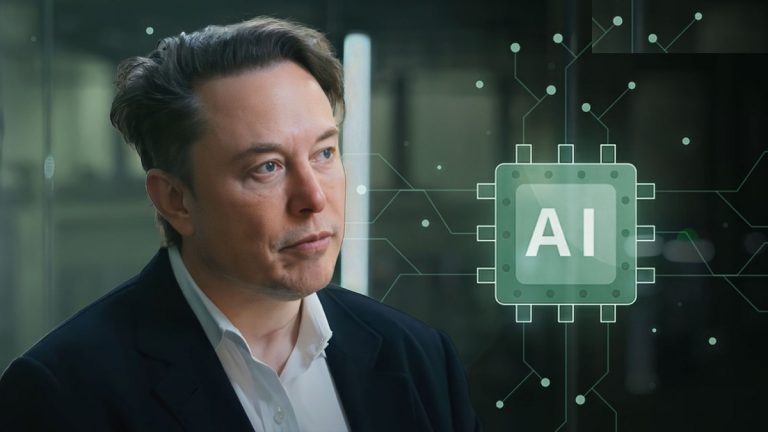
Elon Musk has raised the stakes on one of the decade’s boldest economic forecasts, predicting that the rapid advancement of artificial intelligence and robotics could more than double the global economy within the next decade.
The Tesla and SpaceX CEO believes increasingly capable AI systems and humanoid robots could reshape how goods and services are produced, potentially driving economic growth at a pace far beyond historical norms.
In a post on X, he wrote,
Register for the next Tekedia Mini-MBA.
Register for Tekedia AI in Business Masterclass.
Join Tekedia Capital Syndicate and co-invest in great global startups.
“AI+robots will more than double the global economy in less than 10 years.”
Musk’s comment came as a direct upgrade to his earlier prediction that artificial intelligence alone could expand the world economy significantly. Just days earlier, speaking remotely to the G20 Innovation Ministerial in Chapel Hill, North Carolina, he had offered a more measured projection.
He estimated that sophisticated AI would boost global GDP by 20 to 30 percent, adding roughly $20 trillion to $30 trillion in annual economic output. He added that AI would soon handle virtually any digital task that does not require physically shaping atoms, potentially by the end of 2027, and that human competition in software development would become effectively impossible as AI reached “Stockfish-level” performance.

Musk has repeatedly forecasted that humanoid robots such as Tesla’s Optimus will number at least one billion within ten years. Tesla’s Optimus is being developed as a general-purpose, bipedal humanoid robot designed to operate in environments built for humans.
Tesla says its long-term goal is for Optimus to handle work that is unsafe, repetitive, or boring, using AI systems for balance, navigation, perception, and interaction with the physical world.
Each of those robots, Musk argues, will deliver roughly five times the productivity of a human worker because they can operate around the clock without fatigue. Once robots begin manufacturing other robots, he expects a recursive, explosive scaling effect.

At that point, the combined output of a billion humanoids would exceed the productivity of all humanity. The arithmetic is striking. Global GDP currently sits near $100–110 trillion.
A full doubling in under a decade would require sustained growth rates far above historical norms, closer to 7–10 percent compound annual growth or higher, depending on the exact timeline.
Musk has previously suggested even more ambitious multiples, including the possibility that AI and robotics could expand the economy by a factor of ten or more over a longer horizon, leading to what he calls “universal high income” rather than mere basic income.
In that scenario, goods and services become so abundant that traditional employment becomes optional for many people. Supporters of the vision point to real momentum already visible in the humanoid robot sector. Shipments have been rising sharply, and Chinese manufacturers currently dominate early volumes.
Advances in AI software, specialized chips, and electromechanical dexterity especially in robot hands are improving simultaneously, and Musk frames usefulness as the product of those three factors multiplying together.
Tesla’s own roadmap envisions Optimus moving from factory tasks to broader commercial availability in the coming years.
Yet the path is far from guaranteed. Energy stands out as a critical bottleneck. AI data centers and large-scale robot fleets will demand enormous amounts of electricity, and Musk has warned that power constraints outside China could limit progress as early as 2027.
Regulatory environments also matter. Musk has urged policymakers to treat new technologies as “default legal” rather than “default illegal,” arguing that heavy regulation, particularly in places like the European Union, slows deployment.
Questions about job displacement, wealth distribution, and the social effects of widespread automation remain unresolved. While Musk frames the outcome as abundance that can eliminate poverty, critics note that transitions of this speed and scale have historically created significant short-term disruption.
Musk has described the coming period as the most interesting time in history. Whether AI and robots deliver a doubling of the global economy inside a decade will depend on continued exponential progress in software, hardware, energy, and manufacturing.
The prediction is characteristically ambitious, but it rests on trends that are already measurable. The next several years will test how quickly those trends can compound into the kind of transformative growth Musk now projects.