

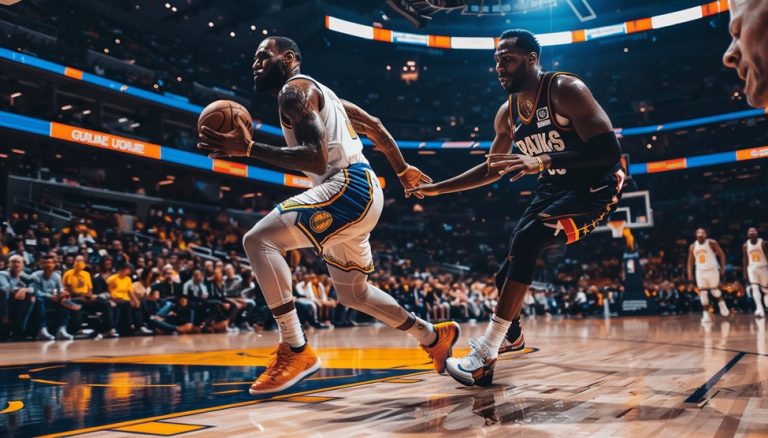
The National Basketball Association is preparing for one of the most significant officiating changes in modern professional sports, with Commissioner Adam Silver confirming that artificial intelligence will soon automate a category of referee decisions currently responsible for some of the league’s most disruptive stoppages.
Speaking on ESPN’s The Pat McAfee Show, Silver said the NBA plans to introduce an AI-powered camera system capable of instantly determining possession calls such as out-of-bounds rulings, removing those judgments from on-court referees and sharply reducing replay reviews.
The shift mirrors the adoption of Hawk-Eye technology in professional tennis, where electronic line-calling has largely replaced human judges in determining whether balls land in or out. Silver suggested the NBA envisions a similar model for objective calls.
Register for the next Tekedia Mini-MBA.
Register for Tekedia AI in Business Masterclass.
Join Tekedia Capital Syndicate and co-invest in great global startups.
“We’re going to move to a system like that where that whole category of calls will be automatic,” Silver said. “It’s going to be Laker ball, Knick ball, whatever it is.”
The planned system would rely on cameras positioned throughout arenas to track player movement and ball contact in real time. Instead of referees huddling around replay monitors for several minutes while fans wait, possession rulings could be delivered almost instantly by the automated system.
The NBA has spent years trying to balance officiating accuracy with entertainment flow. Expanded replay review and coach’s challenges have improved precision in some areas, but they have also lengthened games and generated mounting frustration among viewers, broadcasters, and teams over repeated interruptions.

Silver’s comments indicate that the league now sees AI not merely as a support tool, but as a direct replacement for human judgment in narrowly defined categories where machine vision can outperform referees in speed and consistency.
The league appears to be drawing a sharp distinction between objective and subjective officiating. Out-of-bounds calls, goaltending reviews, and timing determinations can be measured through tracking systems and visual analysis. Fouls, however, remain more complicated because they involve context, intent, positioning, and varying levels of contact.
Silver emphasized that referees would still be essential for interpreting physical play.

“There’s often contact on every play, but that doesn’t mean there’s a foul on every play,” he said. “That’s something that can’t just be done on camera.”
That distinction is important because officiating crews remain central to how the NBA manages game flow, player conduct, and competitive balance. Fully automating foul decisions would likely trigger major resistance from players, coaches, and fans who already debate the consistency of officiating standards across games and playoff series.
A broader transformation is going on across global sports, where AI and computer vision are increasingly being integrated into officiating and performance analysis.
Professional tennis has already normalized automated line calling. Soccer has introduced semi-automated offside technology. Baseball continues experimenting with automated strike zones in the minor leagues. Cricket, Formula One, and the NFL have all expanded their use of real-time tracking and replay systems.
For the NBA, the technology push comes at a time when the league is also investing heavily in data analytics, player tracking, and media innovation as it competes for younger audiences accustomed to faster digital experiences.
But reducing replay interruptions carries commercial implications as well. Faster games improve broadcast pacing, reduce viewer fatigue, and help streaming partners retain audiences in an increasingly fragmented media environment.
Silver did not provide a launch date, but his comments suggest implementation may come sooner rather than later.
“It will be fairly quickly,” he said.
The challenge for the NBA will be ensuring that the technology is trusted by teams and fans during high-pressure moments, particularly in playoff games where possession rulings can decide outcomes.
Even if AI removes some of the league’s most controversial replay reviews, it is unlikely to eliminate debates over officiating entirely. In basketball, the most contentious decisions are often not whether the ball touched a player’s fingertip, but whether contact warranted a whistle in the first place.
That means the next era of NBA officiating may involve a hybrid model: machines handling precision, humans handling interpretation.