

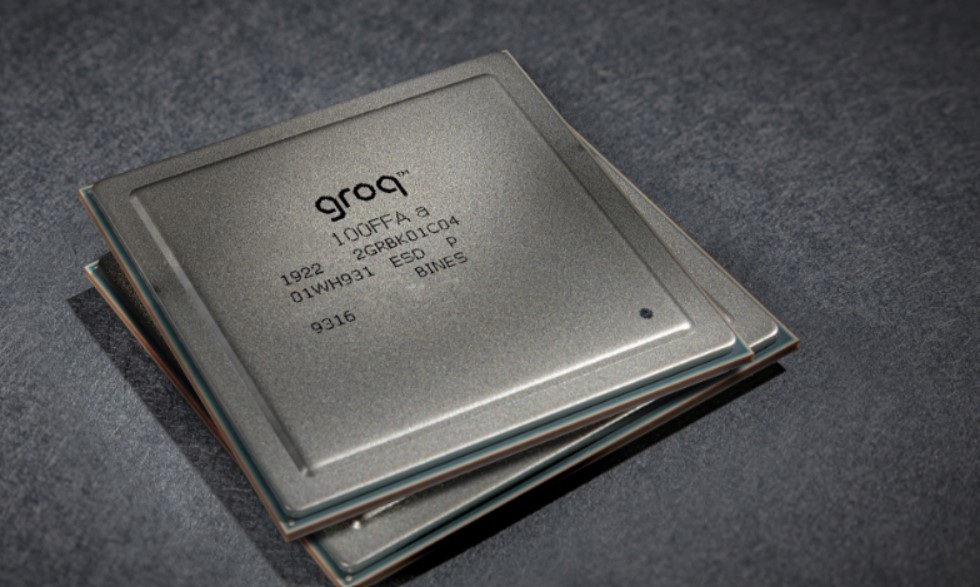
Nvidia has agreed to acquire Groq, a fast-rising designer of high-performance artificial intelligence accelerator chips, in a $20 billion all-cash deal that would rank as the largest acquisition in the chipmaker’s history, according to Alex Davis, chief executive of Disruptive, which led Groq’s most recent funding round.
Davis said the transaction came together rapidly, catching even long-time backers by surprise. Groq raised $750 million just three months ago at a valuation of about $6.9 billion, underscoring both the pace of capital inflows into the AI hardware space and the sharp premium Nvidia is now willing to pay to lock in strategic assets.
Investors in that September round included BlackRock, Neuberger Berman, Samsung, Cisco, Altimeter, and 1789 Capital, where Donald Trump Jr. is a partner. Groq is expected to formally notify its investors of the agreement later on Wednesday. The deal covers Groq’s core assets, though its early-stage Groq Cloud business is excluded, Davis said.
Register for Tekedia Mini-MBA edition 20 (June 8 – Sept 5, 2026).
Register for Tekedia AI in Business Masterclass.
Join Tekedia Capital Syndicate and co-invest in great global startups.
Register for Tekedia AI Lab.
For Nvidia, the scale of the acquisition marks a clear departure from its historical playbook. The company’s biggest prior deal was the $7 billion purchase of Israeli networking specialist Mellanox in 2019. Since then, Nvidia’s balance sheet has ballooned alongside the AI boom. At the end of October, the company reported $60.6 billion in cash and short-term investments, up from $13.3 billion in early 2023, giving it the financial firepower to pursue transformative acquisitions without tapping the debt markets.
Groq, founded in 2016, has positioned itself as a specialist in inference-focused AI accelerators, chips designed to speed up the process by which large language models generate outputs once they are trained. With demand for inference capacity surging as AI systems move from experimentation to deployment, Groq has been targeting revenue of $500 million this year. Davis said the company was not seeking a buyer when Nvidia made its approach.
Groq’s roots trace back to Google’s internal AI hardware efforts. The company was founded by a group of former engineers, including chief executive Jonathan Ross, one of the creators of Google’s tensor processing unit, or TPU. TPUs have emerged as one of the few credible alternatives to Nvidia’s graphics processing units for certain AI workloads, particularly within Google’s own ecosystem.

In its initial SEC filing in late 2016, announcing a $10.3 million fundraising, Groq listed Ross alongside Douglas Wightman, an entrepreneur and former engineer at Google X, the company’s “moonshot factory.” Since then, Groq has steadily built a reputation for architectural efficiency and performance, attracting attention from both hyperscalers and investors hunting for ways to reduce reliance on Nvidia’s dominant GPU platform.
The proposed acquisition would therefore carry strategic weight beyond pure scale. By absorbing Groq, Nvidia would be neutralizing a potential rival in inference acceleration while folding its technology and talent into Nvidia’s own roadmap. It would also strengthen Nvidia’s grip on a market that is shifting from training-heavy workloads to inference at scale, a transition expected to define the next phase of AI infrastructure spending.
The deal also fits into a broader pattern of aggressive ecosystem investment by Nvidia. As its cash pile has grown, the company has backed a range of AI-linked ventures, from energy and data-center specialist Crusoe to model developer Cohere. It has also expanded its stake in CoreWeave, the AI-focused cloud provider that has been preparing for a public listing this year.

In September, Nvidia said it intended to invest up to $100 billion in OpenAI, with the startup committing to deploy at least 10 gigawatts of Nvidia products. While a formal agreement has yet to be announced, the scale of the proposed investment highlighted Nvidia’s willingness to anchor itself at every layer of the AI stack. That same month, Nvidia disclosed plans to invest $5 billion in Intel as part of a partnership, an unexpected alignment between two long-time rivals amid intensifying competition with Asian chipmakers.
Groq’s sale also comes as other AI chip startups reassess their paths. Cerebras Systems, another high-profile player known for its wafer-scale processors, pulled its planned initial public offering in October after raising more than $1 billion in a private funding round. In an SEC filing, Cerebras said it did not intend to proceed with the offering “at this time,” without giving a reason, though the company later told CNBC it still aims to list when conditions allow.
Taken together, these moves point to a market entering a new phase. The early wave of AI chip startups promised alternatives to Nvidia’s hardware dominance. Now, with Nvidia’s valuation, cash reserves, and strategic urgency at record levels, consolidation is accelerating.
If completed, the Groq acquisition would send a message that Nvidia is no longer content to simply supply the picks and shovels of the AI gold rush. It is increasingly intent on owning the mine.