

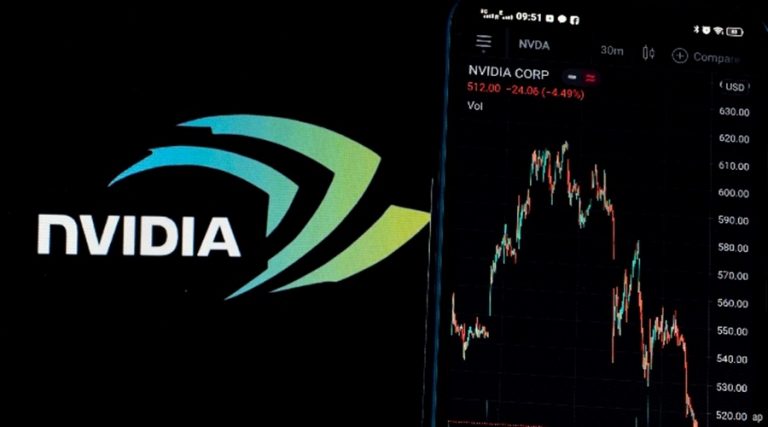
Nvidia shares are heading towards their longest weekly losing streak in more than a decade, with a sudden leadership crisis accelerating a sell-off that had already erased about $1.6 trillion from the chipmaker’s market value.
The stock has fallen for six consecutive weeks, its longest such run since 2012, losing 29% of its value as of Thursday’s close. The decline has pushed Nvidia below Apple in market capitalization, ending much of the advantage it built during the artificial intelligence boom, when it spent most of the year as the world’s most valuable publicly traded company.
The latest pressure followed the resignation of co-founder and Chief Executive Jensen Huang on Thursday, after reports of two separate extramarital affairs, one involving an alleged Chinese spy and another involving a company employee, became public. Nvidia’s board appointed Chief Financial Officer Colette Kress as interim chief executive while it searches for a permanent successor.
Register for the next Tekedia Mini-MBA.
Register for Tekedia AI in Business Masterclass.
Join Tekedia Capital Syndicate and co-invest in great global startups.
Nvidia fell 4.3% on Thursday, taking its weekly decline to 11%. The first report of an affair emerged over the weekend, prompting Huang to send employees a letter apologizing for being “unfaithful to my wife.” The company’s board convened late Wednesday after The New York Times reported a separate alleged relationship involving Nvidia’s vice president of health care.
Huang’s departure marks a significant change for a company he co-founded and led for 33 years. His position had extended beyond Nvidia’s executive leadership, as he became one of the most prominent corporate figures in the global AI industry and an important ally of President Donald Trump in the technology sector.
Analysts say the leadership change could weigh on the stock even if Nvidia delivers strong financial results in the near term.

“With the unfortunate departure of CEO Jensen Huang we expect a challenging transition for NVIDIA over the next few months,” Gil Luria, an analyst at D.A. Davidson, wrote in a report on Thursday.
Luria lowered his price target on Nvidia to $200 from $300 but maintained a buy rating. He said the market had appropriately adjusted for the leadership transition.
The latest sell-off did not begin with the reports surrounding Huang. Nvidia shares had already fallen about 9% in the previous week, as investors reassessed the outlook for AI-related stocks and the financing conditions supporting the sector’s expansion.

Much of that decline followed the US midterm elections, which delivered sweeping victories for Democrats and the passage of dozens of ballot measures that could slow the construction and expansion of AI infrastructure. The results added another source of uncertainty for companies investing heavily in data centers, energy supply and computing capacity.
Before the elections, Nvidia had also been caught in a broader retreat across AI stocks. Investors were increasingly concerned that higher interest rates could raise borrowing costs for companies financing large-scale technology infrastructure projects.
Although Nvidia generates substantial profits, some of its major customers, particularly specialized cloud computing providers known as neoclouds, depend heavily on debt markets to fund purchases of expensive processors and expand data-center capacity.
Demand for Nvidia’s chips is tied not only to the long-term adoption of AI but also to the ability of customers to finance their infrastructure spending. If borrowing becomes more expensive or access to credit tightens, some customers could delay purchases or moderate expansion plans, potentially affecting the pace of orders.
The recent decline therefore combines two separate pressures: concerns about the sustainability and financing of the AI infrastructure boom, and uncertainty over Nvidia’s leadership following Huang’s exit.
Nvidia is scheduled to report quarterly results on Tuesday, placing Kress in the spotlight just days after taking over as interim chief executive.
Analysts surveyed by LSEG expect revenue to increase 91% year over year to $108.9 billion. That would represent an 18-fold increase from the comparable quarter in 2022, before OpenAI launched ChatGPT and accelerated commercial demand for generative AI.
The scale of the expected growth points to how much Nvidia has benefited from the expansion of AI computing. Its processors have become central to the development and deployment of advanced models, while major technology companies continue to invest billions of dollars in computing infrastructure.
However, the immediate challenge for Nvidia may be less about demonstrating strong earnings than reassuring investors that its operations, customer relationships and long-term growth strategy will remain stable during the leadership transition.
Oppenheimer analysts said in a Thursday report that they expect Nvidia to deliver solid earnings but warned that financial performance may have limited influence on the share price in the near term.
“Even though we see the company reporting solid earnings, we expect fundamentals to take a backseat near term,” the analysts wrote.
They added that Huang’s departure could create a prolonged source of pressure on the stock.
“The departure of Mr. Huang could, in our view, translate to a lingering share overhang,” they said.
The timing leaves Nvidia facing a difficult combination of challenges. The company must deliver results that support expectations for continued AI spending while convincing investors that its leadership transition will not disrupt execution.
Kress has served as Nvidia’s finance chief for more than a decade and has been closely involved in its financial management during its expansion into one of the world’s most valuable technology companies. However, the board’s search for a permanent successor means questions about the company’s longer-term leadership structure are likely to remain.