

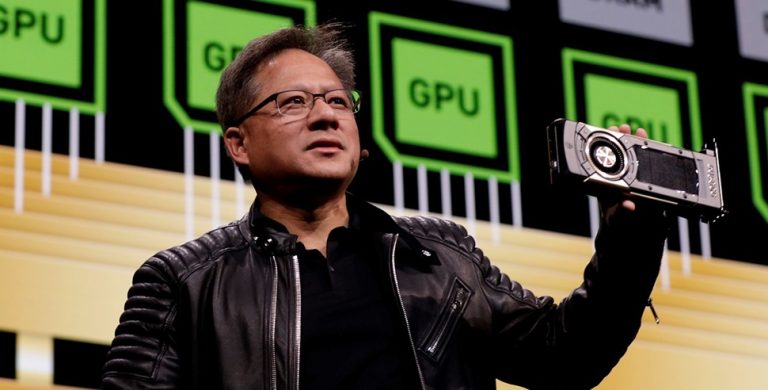
Nvidia’s leadership crisis has reached a decisive point, with co-founder Jensen Huang resigning as president and chief executive just days after admitting to an extramarital affair that triggered questions about corporate governance, national security and the company’s dependence on its long-serving leader.
The chipmaker said in a regulatory filing on Thursday that its board accepted Huang’s resignation on Wednesday. Huang will also leave the board, ending a tenure that began when he co-founded Nvidia in 1993 and oversaw its transformation from a graphics hardware manufacturer into the dominant supplier of processors powering the artificial intelligence industry.
Nvidia shares fell nearly 10% on Thursday, pushing the company’s market capitalization below $4 trillion. The decline added to a loss of more than 20% over the previous month, as investors reassessed the leadership risks surrounding a company whose commercial success and long-term direction have been closely associated with one individual.
Register for the next Tekedia Mini-MBA.
Register for Tekedia AI in Business Masterclass.
Join Tekedia Capital Syndicate and co-invest in great global startups.
Chief Financial Officer Colette Kress will serve as interim chief executive while Nvidia searches for a permanent successor. She will retain her finance responsibilities during the transition. The company also appointed Harvey C. Jones, the former chief executive of Synopsys, as chairman of the board, creating a new leadership structure as it attempts to manage the departure of its most prominent executive.
The immediate challenge is finding someone capable of maintaining Nvidia’s position in the AI semiconductor market while reassuring investors that its product strategy, customer relationships and financial commitments can continue without Huang.
Huang’s resignation follows revelations about his personal relationships and the questions they raised about the company’s governance. On Sunday, he acknowledged having an affair, although he did not provide details to Nvidia employees.

The Financial Times reported that Huang had been romantically involved with Alice Huang, an executive at cloud company Megaspeed. US intelligence officials reportedly believe she is a Chinese intelligence asset. The allegations have not been established as fact, and China has rejected the broader spy narrative as baseless.
The New York Times subsequently reported that Huang had another extramarital relationship with Kimberly Powell, Nvidia’s vice president of healthcare, who reports directly to him. The reported relationship with a direct subordinate introduced a separate corporate governance issue, placing the board under pressure to examine the boundaries between Huang’s personal conduct and his executive responsibilities.
Bernstein analyst Stacy Rasgon told CNBC that the reported relationship with a direct report made it more difficult for the board to retain Huang.

The allegations also attracted attention in Washington, where lawmakers had called for his resignation and sought further explanations from Nvidia. The national security dimension adds another layer of uncertainty because Nvidia operates at the center of US efforts to maintain an advantage in advanced computing while restricting China’s access to high-performance AI chips.
For the board, the decision was no longer limited to protecting the reputation of a highly successful chief executive. It also involved addressing questions about oversight, internal reporting relationships and the potential consequences of Huang’s departure for Nvidia’s dealings with government officials.
The company has not disclosed the findings of any internal investigation or explained the full circumstances surrounding the resignation. Its immediate priority will be to demonstrate that the board can exercise effective oversight and that management responsibilities are not concentrated around a single executive.
Nvidia Faces a Difficult Test of Its Leadership Model
Huang’s departure presents an unusual succession challenge because his influence extended well beyond the conventional responsibilities of a chief executive. He helped define Nvidia’s shift from gaming graphics into accelerated computing and made long-term investments in technologies that later became central to the generative AI boom.
That history has made investors especially sensitive to the question of who will determine the company’s next phase of development. Nvidia’s competitors are expanding their AI chip businesses, while major technology companies are investing in their own processors to reduce reliance on external suppliers. The next chief executive will have to manage those competitive pressures while sustaining the company’s relationships with customers and its position in the AI infrastructure market.
Rasgon said he could not readily identify an obvious successor with Huang’s ability to shape the company’s long-term direction.
“Jensen is Nvidia, right? He is the visionary. The reason they’re in the position that they’re in today is because he made decisions 10 years ago,” he told CNBC. “Who is the right person now to make the decisions for the next 10 years? I don’t intuitively know who that person would be.”
The concern is not necessarily that Nvidia’s chip business will immediately deteriorate. Its products remain central to AI development, and demand for computing capacity is driven by spending decisions across a broad group of technology companies. A change in leadership does not automatically remove those commercial requirements.
The greater uncertainty concerns the company’s ability to preserve its investment priorities, product roadmap and relationships with customers over several years. Huang’s experience and authority helped Nvidia commit to a direction before the scale of the current AI boom became apparent. A successor will have to establish credibility with employees, customers and investors while making decisions about a market that is still developing rapidly.
Bernstein responded to the resignation by cutting its Nvidia price target by half, from $400 to $200, signaling a sharp reassessment of the company’s valuation risk. The reduction comes as investors consider how much of Nvidia’s premium valuation was tied to confidence in Huang’s leadership rather than only its earnings and chip demand.
Richard Reyle, chief investment officer at Questar Capital Partners, said Nvidia’s failure to have an obvious successor in place made the shares difficult to value. He argued that retaining Huang could have exposed the company to prolonged congressional scrutiny, while his departure created uncertainty over who would lead the business.
Reyle told CNBC that the succession gap made Nvidia’s stock “uninvestable”, while distinguishing the company’s problems from the wider AI investment theme.
Nvidia’s share-price decline does not necessarily signal that demand for AI infrastructure has collapsed. It points instead to the risks investors attach to a company whose leadership, corporate identity and long-term strategy have been unusually concentrated in its founder.
Kress now faces the immediate task of maintaining operational stability while the board identifies a permanent chief executive. Her experience as CFO gives her familiarity with Nvidia’s finances and investor relationships, but the interim appointment does not resolve the question of who will provide the technical and commercial direction associated with Huang.
The transition also places greater responsibility on Nvidia’s board to show that the company can function through a leadership change without disrupting its competitive position. The appointment of Jones as chairman gives the board a new figure at the center of that process, but the company has not identified a permanent successor or provided a timetable for the search.