

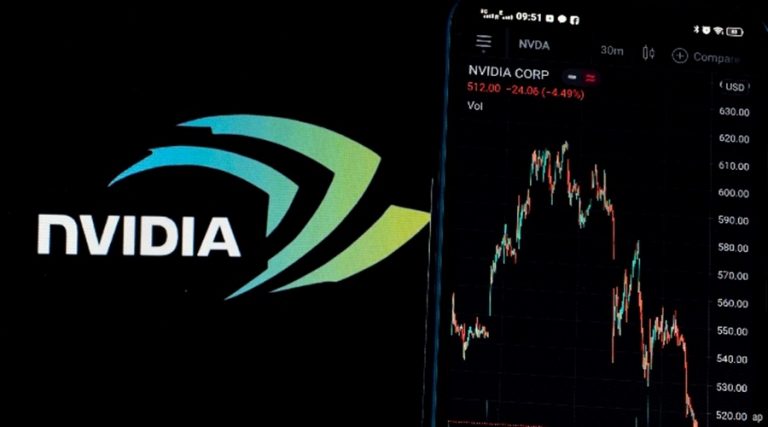
Nvidia shares have turned negative, wiping out all the gains recorded following the company’s latest earnings announcement and highlighting the growing uncertainty surrounding the artificial intelligence investment boom.
The reversal is significant because Nvidia has become one of the most closely watched companies in global financial markets, with its performance often influencing sentiment across the technology sector and broader stock market.
The decline suggests that investors are becoming increasingly cautious about how much optimism is already reflected in Nvidia’s valuation.
Register for the next Tekedia Mini-MBA.
Register for Tekedia AI in Business Masterclass.
Join Tekedia Capital Syndicate and co-invest in great global startups.
Although the company continues to benefit from strong demand for artificial intelligence chips, its latest share price movement demonstrates that impressive financial results do not automatically translate into sustained stock market gains.
Investors are increasingly examining whether future growth can justify the expectations embedded in the company’s market value.
Nvidia’s earnings announcements have repeatedly attracted enormous attention because the company occupies a central position in the global AI infrastructure industry.
Its graphics processing units are essential for training and operating advanced artificial intelligence models, making its products critical to major technology companies investing billions of dollars in data centres and computing capacity.

The market’s reaction indicates that investors want more than strong revenue growth and optimistic forecasts.
They are looking for evidence that AI spending will continue expanding at a sustainable pace and that customers will eventually generate sufficient returns from their enormous investments in computing infrastructure.
Major technology companies have committed substantial resources to AI development, purchasing Nvidia’s advanced processors to build increasingly powerful data centres.

These investments have supported the company’s exceptional financial performance and helped establish it as one of the world’s most valuable publicly traded businesses.
Concerns about elevated valuations, competition and the sustainability of AI-related capital expenditure continue to influence investor decisions.
Companies such as AMD are competing more aggressively in the semiconductor market, while major cloud providers are also developing their own artificial intelligence chips to reduce dependence on external suppliers.
Another concern involves the possibility that technology companies could eventually moderate their spending after several years of aggressive infrastructure expansion.
If demand for AI computing capacity slows, Nvidia could face greater pressure to maintain its extraordinary growth rate. Even without an immediate decline in orders, expectations of slower future expansion could encourage investors to reassess the stock.
The broader economic environment also matters. Interest rate uncertainty, changing expectations about Federal Reserve policy and volatility across technology shares can influence how investors value high-growth companies.
When borrowing costs remain elevated or financial conditions become less supportive, expensive technology stocks can experience significant selling pressure.
The latest reversal does not necessarily indicate deteriorating business fundamentals. Instead, it highlights the difference between corporate performance and investor expectations.
A company can deliver impressive earnings while its shares decline if investors believe future growth has already been priced into the stock. The development also raises questions about the wider AI investment rally.
Nvidia has become a symbol of the artificial intelligence boom, and weakness in its shares could affect semiconductor manufacturers, data-centre operators and technology companies benefiting from rising AI expenditure.
Investors will continue monitoring Nvidia’s revenue growth, profit margins, chip demand and forward guidance. The company remains strategically important to the AI industry, but maintaining market confidence will require consistently strong results.
Erasing its post-earnings gains shows that Wall Street’s enthusiasm is increasingly being tested by valuation concerns and the difficult task of sustaining extraordinary growth.