

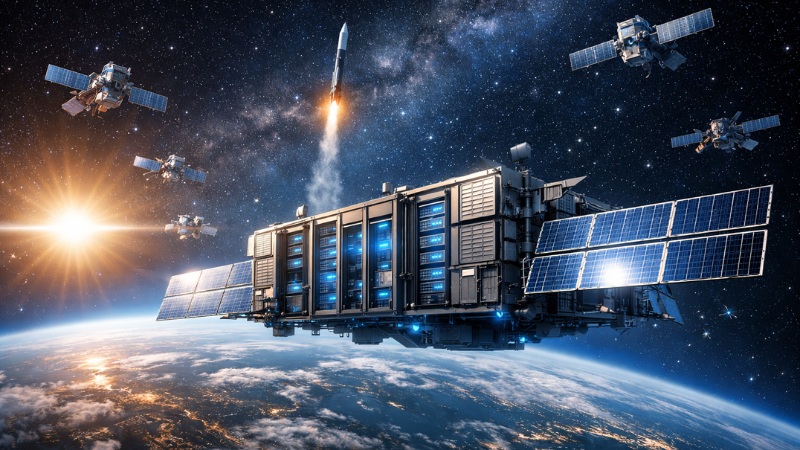
Nvidia on Monday unveiled a new generation of computing platforms designed for orbital data centers, marking a significant step toward deploying artificial intelligence infrastructure in space as demand for computing power continues to surge.
The announcement came during the company’s GTC 2026 conference, where CEO Jensen Huang described space-based computing as the next frontier for AI systems that increasingly require massive processing capacity close to where data is generated.
“Space computing, the final frontier, has arrived,” Huang said during the event. “As we deploy satellite constellations and explore deeper into space, intelligence must live wherever data is generated.”
Register for Tekedia Mini-MBA edition 20 (June 8 – Sept 5, 2026).
Register for Tekedia AI in Business Masterclass.
Join Tekedia Capital Syndicate and co-invest in great global startups.
Register for Tekedia AI Lab.
The move marks a major shift as the AI industry explores unconventional solutions to meet the soaring demand for computing resources driven by generative AI, robotics, and autonomous systems.
A New Computing Platform Built For Space
At the center of the announcement is Nvidia’s Vera Rubin Space-1 Module, a computing platform designed specifically for use in satellites and orbital infrastructure. The module integrates Nvidia’s IGX Thor and Jetson Orin processors and is engineered to operate in size-, weight-, and power-constrained environments, conditions that are critical for space missions where hardware must be compact, energy-efficient, and resilient.
According to the company, the platform will support space missions being developed by several industry partners, including Axiom Space, Starcloud, and Planet Labs. These systems are expected to enable satellites to process data directly in orbit, reducing the need to transmit massive volumes of raw data back to Earth before analysis.

Such an approach could transform how Earth observation, communications, and deep-space exploration missions operate. Traditionally, satellites have collected data and transmitted it back to ground-based data centers for processing.
Nvidia’s approach aims to bring AI computing closer to the data source, allowing satellites to analyze information in real time. This capability could allow satellites to filter and process imagery, track weather systems, monitor infrastructure, or detect anomalies without waiting for instructions from Earth.
For example, Earth-observation satellites could use onboard AI to identify natural disasters, track deforestation, or analyze agricultural activity instantly, dramatically reducing response times. The development also aligns with a broader trend in computing known as edge AI, where processing occurs near the point where data is generated rather than in distant centralized servers.

The Engineering Challenges
Although the technology is promising, significant engineering hurdles remain before orbital data centers become widespread. One of the most difficult challenges is cooling high-performance computing systems in the vacuum of space.
“In space, there’s no convection, there’s just radiation,” Huang said during his keynote address.
“And so we have to figure out how to cool these systems out in space, but we’ve got lots of great engineers working on it.”
Cooling is a major issue because traditional data centers rely on air or liquid circulation to remove heat generated by processors. In space, heat must instead be dissipated through radiation, requiring new thermal designs and materials.
The Search For Power Beyond Earth
The push toward space-based computing is partly driven by the rapidly escalating energy demands of artificial intelligence. The construction of massive AI data centers on Earth has already been linked to rising electricity consumption and strain on power grids in several regions.
By contrast, satellites and orbital facilities could potentially harness virtually unlimited solar energy without the land and infrastructure constraints faced by terrestrial data centers. Technology companies are increasingly studying whether space could provide a long-term solution to the energy demands of large-scale computing.
In November, Google announced Project Suncatcher, an initiative exploring the feasibility of deploying computing infrastructure powered by solar energy in orbit.
The concept is also gaining traction among companies involved in space launch and satellite infrastructure. Last month, Elon Musk’s AI startup xAI was acquired by SpaceX in a deal valued at $1.25 trillion, a move widely interpreted as part of a strategy to build AI-powered computing systems in orbit.
SpaceX is one of Nvidia’s largest customers for AI chips, supplying hardware used to train and operate advanced AI models. Earlier this year, SpaceX also asked the Federal Communications Commission for approval to launch as many as one million satellites intended to support orbital AI infrastructure.
With generative AI models becoming larger and more computationally demanding, traditional data centers on Earth may struggle to keep pace with the scale of future workloads. Against this backdrop, space has become an alternative. But Space-based computing remains an ambitious concept with significant technical and regulatory challenges.