

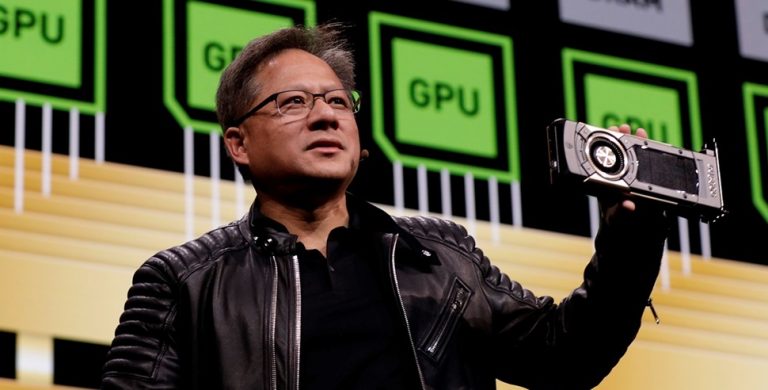
Nvidia’s chief executive Jensen Huang has issued one of his most pointed warnings over China’s unrelenting pace in tech innovation. He warned that China is advancing at breakneck speed in semiconductor development, and U.S. restrictions risk accelerating that progress rather than containing it.
Speaking on the BG2 podcast, Huang described China as “nanoseconds behind” the United States in chipmaking. He painted a picture of a rival that is “formidable, innovative, hungry, fast-moving, underregulated,” driven by an engineering workforce molded by the punishing “9-9-6” culture of working from 9 a.m. to 9 p.m., six days a week.
For Nvidia, one of the challenges is Washington’s ban on shipping its flagship A100 and H100 accelerators to China, which has forced the company to scramble for alternatives. It rolled out the H20 GPU, a cut-down processor designed specifically to comply with U.S. export rules. After months of uncertainty, the Commerce Department began granting licenses in August, allowing shipments to resume. Nvidia is also preparing a successor to the H20 that would push performance higher while still staying under Washington’s regulatory ceiling.
Register for Tekedia Mini-MBA edition 20 (June 8 – Sept 5, 2026).
Register for Tekedia AI in Business Masterclass.
Join Tekedia Capital Syndicate and co-invest in great global startups.
Register for Tekedia AI Lab.
But as Nvidia adapts, China is pressing forward with its own counteroffensive. Huawei has launched volume shipments of its Atlas 900 A3 SuperPoD, built on the domestically produced Ascend 910B chip. The company has laid out a roadmap through 2027, targeting chips that could match or even surpass today’s leaders. Importantly, Huawei’s ecosystem is CUDA-free, a deliberate move away from the proprietary software platform that cemented Nvidia’s dominance in China, where the company once held a 95% market share.
Chinese hyperscalers are rallying behind that shift. Baidu, Alibaba, Tencent, and ByteDance have either built in-house processors or deepened their reliance on local startups. Tencent even confirmed that its infrastructure has been fully adapted to Chinese-designed chips, signaling how far Beijing’s self-reliance drive has advanced.
Huang insists both sides would benefit from renewed openness. “They [China] publicly say… they want China to be an open market, they want… companies to come to China and compete in the marketplace… and I believe and I hope that we return to that,” he said.

For Nvidia, the H20 may lack the power of its flagship hardware, but it offers a way to keep Chinese customers within Nvidia’s orbit rather than losing them entirely to homegrown rivals.
A wider industry contrast
Nvidia’s balancing act stands in contrast to the paths chosen by rivals like AMD and Intel. AMD, which has also been hit by U.S. restrictions, has moved more cautiously in tailoring chips for China. Its MI300 accelerator family, seen as a competitor to Nvidia’s H100, has no sanctioned China-specific version yet. Reports suggest AMD is weighing whether to design compliant hardware for the Chinese market, but it risks cannibalizing margins while exposing itself to regulatory whiplash.
Intel, by contrast, has leaned heavily into government partnerships, positioning itself as the cornerstone of Washington’s domestic semiconductor push. Through multibillion-dollar subsidies under the CHIPS Act, Intel is expanding U.S. foundry capacity, while simultaneously threading the needle in China. The company still supplies certain lower-performance products into the Chinese market, but CEO Lip-Bu Tan has largely aligned Intel’s strategy with U.S. policymakers’ vision of securing advanced manufacturing at home, especially after President Donald Trump accused him of having ties with China.

The divergent playbooks underscore the pressure facing the industry. Nvidia, with a 95% market share in Chinese AI accelerators before the bans, has the most to lose if Beijing achieves chip independence. AMD, with less exposure, has more freedom to wait out the policy climate. Intel, straddling between being both a design house and manufacturer, is doubling down on subsidies while limiting its China bets.
Nvidia’s $2.5 trillion market capitalization has been built on riding the AI wave, and China — one of the world’s largest buyers of advanced chips — remains too important to abandon. The H20, though technically hobbled compared to its top-tier models, represents a compromise: a way to maintain relevance in China without crossing Washington’s red lines.
Although Beijing recently warned Chinese companies to stay off H20, the strategy reflects Huang’s broader point — that trying to wall off China could accelerate Beijing’s push toward full independence. Huawei’s Ascend roadmap, hyperscaler investments, and CUDA-free software ecosystems are already evidence of that momentum. Against this backdrop, Nvidia is betting that staying inside China’s ecosystem — even with constrained offerings — is better than being shut out altogether.