

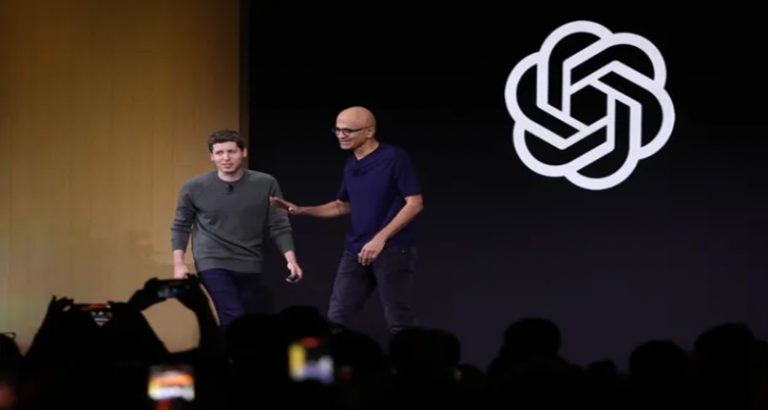
OpenAI has reportedly agreed to cap the total revenue it shares with Microsoft at $38 billion, a significant development that marks how the balance of power inside one of Silicon Valley’s most consequential partnerships is beginning to evolve as the artificial intelligence industry enters a new phase.
According to a report by The Information, the arrangement emerged from a renegotiated agreement between the two companies last month that gives OpenAI greater flexibility to pursue infrastructure and commercial partnerships with other major technology firms, including Amazon and Google.
The move signals that OpenAI is increasingly positioning itself less as a tightly aligned Microsoft partner and more as an independent AI platform company seeking broader control over its future economics, infrastructure, and strategic relationships. The reported cap could also become central to OpenAI’s preparations for a potential public offering, which some executives reportedly believe could happen as early as the end of this year.
Register for the next Tekedia Mini-MBA.
Register for Tekedia AI in Business Masterclass.
Join Tekedia Capital Syndicate and co-invest in great global startups.
Some analysts believe that limiting Microsoft’s long-term revenue participation could materially improve OpenAI’s valuation outlook by increasing the amount of future cash flow retained within the company itself.
The shift, among other things, reflects the extraordinary speed at which the AI industry is maturing. What began in 2019 as a rescue-style investment by Microsoft into a relatively small research lab has evolved into one of the most powerful alliances in modern technology. Microsoft’s more than $13 billion investment helped finance the massive computing infrastructure needed to train OpenAI’s large language models while also transforming Microsoft into one of the biggest beneficiaries of the AI boom through its Azure cloud business and Copilot software suite.
But the relationship has become increasingly complex as OpenAI’s influence and market value have exploded. Earlier this year, OpenAI reportedly reached a valuation of roughly $852 billion, placing it among the world’s most valuable private technology firms and dramatically shifting negotiating leverage between the two companies.

OpenAI Seeks More Independence As AI Infrastructure Race Intensifies
The revised arrangement comes at a critical moment in the global AI infrastructure race, where access to computing power, data centers, and semiconductor supply chains has become as strategically important as software itself. OpenAI’s ability to work more freely with Amazon and Google reflects growing recognition that no single cloud provider may be able to satisfy the staggering computational demands created by next-generation AI systems.
The industry is already facing severe capacity constraints. Executives across the sector, including Dario Amodei of Anthropic, have warned that AI demand is growing faster than companies can build infrastructure.
Amodei recently disclosed that Anthropic’s usage and revenue surged 80-fold in the first quarter on an annualized basis, straining available compute capacity and forcing the company into multibillion-dollar infrastructure agreements with partners including Amazon and SpaceX.

OpenAI faces similar pressures.
As AI models become larger and more capable, companies increasingly require enormous amounts of graphics processing units, power generation, networking equipment, and specialized data centers. That has transformed the sector into a global industrial race involving cloud providers, semiconductor firms, utilities, and governments.
The revised Microsoft agreement appears designed partly to ensure OpenAI is not operationally constrained by overdependence on one infrastructure partner. At the same time, Microsoft is also recalibrating its own AI strategy. While the company remains OpenAI’s largest partner, Microsoft has increasingly diversified its AI portfolio, developing more in-house models and expanding relationships with other AI companies to reduce reliance on OpenAI alone.
The result is a partnership that remains deeply intertwined but is becoming structurally more independent on both sides.
Pressure Mounts from Rivals and Regulators
The development also comes amid intensifying competitive pressure across the AI sector. OpenAI’s early dominance following the launch of ChatGPT is increasingly being challenged by rivals, including Anthropic, Google, Elon Musk’s xAI, and Chinese AI firms advancing rapidly despite U.S. export restrictions. The competition is happening as investors become more focused on sustainable monetization rather than experimental expansion.
OpenAI has reportedly scaled back or shut down several side projects in recent months, including efforts tied to Sora, while concentrating resources around core commercial products such as ChatGPT and Codex. That tightening of focus suggests the company is moving from a hypergrowth research phase toward a more disciplined operational structure consistent with eventual public market scrutiny.
The company also continues to face legal and governance pressures. Elon Musk, one of OpenAI’s original co-founders, filed a lawsuit in 2024 alleging that CEO Sam Altman and President Greg Brockman abandoned the organization’s original nonprofit mission.
Musk is seeking $150 billion in damages and is asking the court to remove both executives from leadership positions. The lawsuit has intensified scrutiny over OpenAI’s unusual hybrid structure, where a nonprofit entity oversees a massively valuable for-profit business increasingly competing at the center of the global technology industry.
In practical terms, the renegotiation between Microsoft and OpenAI is believed to be a pointer that the AI boom is beginning to reshape the traditional balance between startups and Big Tech incumbents. In previous technology cycles, younger firms often remained dependent on larger platforms for distribution, infrastructure, and capital. In AI, however, companies like OpenAI have become powerful enough to renegotiate relationships with the world’s largest technology firms while simultaneously preparing for independent public-market futures.