DD
MM
YYYY

PAGES

DD
MM
YYYY

spot_img

PAGES

Home Blog Page 1010

Paga Unveils Doroki, A Retail Business Management Platform to Streamline SME Operations

0

Paga, a Nigerian mobile payment company, has launched Doroki, an all-in-one business suite designed to simplify operations for small and medium-sized businesses (SMEs).

The platform provides inventory management, CRM, digital payment processing, promotions, and much more—all in one affordable platform. Also, Doroki helps businesses digitize their operations and streamline their payment solutions.

Speaking on the launch, Tayo Oviosu, founder and CEO of Paga Group, emphasized Doroki’s role in empowering SMEs.

He said,

“Running a business in today’s fast-paced economy is challenging, and managing stock, tracking sales, reconciling payments, and keeping customers happy can feel overwhelming. Doroki changes that. It’s not just a tool, it’s a partner that simplifies operations, provides actionable insights, and helps businesses scale with confidence.”

Also commenting, Arike Okunowo, general manager of Doroki said,

Doroki was built by listening to the pain points of real business owners. Whether it’s a restaurant owner struggling with recipe and table management; or a retailer experiencing issues with stock-out and product shelf life management (expiry dates), Doroki provides clarity, control, and confidence. We’re excited to see how Nigerian businesses leverage this platform to unlock their full potential.”

Doroki is a cost-effective, all-in-one solution designed specifically for SMEs. It combines traditional POS functionalities with advanced features like inventory management, CRM, and seamless payment integration. It also offers value-added services like business loans and multiple location support all at an affordable price.

Doroki includes features like:

  • Inventory Management
  • Product Catalog
  • Customer Relationship Management (CRM)
  • Promotions & Discounts
  • Customer Invoices
  • Business Loans(Coming Soon)
  • Multiple Location Management
  • Digital Payment Solutions (including Bank Transfer, USSD, Scan to Pay, etc.)

Doroki empowers SMEs, which form the backbone of Nigeria’s economy, by digitizing operations and reducing reliance on cash-based transactions. The launch of the platform is crucial, as it addresses the needs of Nigeria’s retail sector, where SMEs often face challenges with manual processes and limited access to digital tools.

The platform ensures quick, secure transactions with a range of digital payment options including charge card, bank transfer, Paga, scan-to-pay, bank USSD, and more. The all-in-one business suite is tailored to meet the unique needs of various sectors, including general retail, restaurants, grocery, spa & salon, and more.

Paga CEO Tayo Oviosu on a LinkedIn post described Doroki as more than a product. He noted that it is a mindset shift. “From hustle to systems. From survival to scale. Doroki is a movement for modern business owners across Africa who want to do more with less and grow on their own terms”, he added.

The launch of Doroki aligns with Paga’s broader mission to drive financial inclusion and digitize Nigeria’s cash-based economy. By offering a platform-as-a-service (PaaS) model, Doroki complements Paga’s existing infrastructure, such as the Paga Engine, which supports payment collections for businesses like Meta and Omnibiz.

The suite positions Paga to compete with other fintechs like Moniepoint, which also target SME solutions, in a market where digital adoption is accelerating (Nigeria’s fintech sector processed N17.2 trillion in mobile money transactions in Q1 2024).

Paga Group’s mission is to be the infrastructure that powers Africa’s growing middle class and gives seamless access to global trade.

The Unlock of 1.3% of Sui’s Circulating Supply Presents Both Opportunities and Risks

0

The Sui (SUI) blockchain is set to unlock approximately 44 million SUI tokens on July 1, 2025, representing 1.3% of its circulating supply, valued at around $120.99 million based on current prices. This unlock is part of Sui’s structured token release schedule, designed to balance liquidity and market stability with a capped total supply of 10 billion tokens.
Token unlocks can introduce volatility, as newly available tokens may lead to increased selling pressure if holders choose to trade rather than stake or hold.

However, Sui’s strong fundamentals, including a $2.08 billion Total Value Locked (TVL), robust DeFi activity, and technological advancements like Mysticeti v2’s 390ms transaction finality, suggest resilience. Some X posts indicate mixed sentiment, with concerns about supply inflation potentially impacting price, while others see it as a buying opportunity. Historically, Sui’s price has shown varied responses to unlocks. For instance, a $100 million unlock in October 2024 saw a 5% price increase, supported by rising volume and positive sentiment from Grayscale’s SUI Trust launch.

Conversely, a September 2024 unlock led to a 20% price drop. With the current price around $2.80-$2.83, the market’s reaction will depend on trader behavior and broader sentiment.
Investors should monitor Sui’s staking participation, which exceeds circulating supply due to the Sui Foundation’s staking of locked tokens, and its deflationary mechanisms, like gas fee burning and a dynamic storage fund, which could offset supply increases over time. Always consider market risks and conduct thorough research before investing.

The unlocking of 1.3% of Sui’s circulating supply (44 million SUI tokens, valued at ~$120.99 million) on July 1, 2025, carries significant implications for the Sui ecosystem, its investors, and the broader market. The influx of 44 million tokens could lead to selling by early investors, validators, or other holders who receive these tokens, potentially depressing the price in the short term. A September 2024 unlock led to a 20% price drop, while an October 2024 unlock saw a 5% increase, suggesting context matters (e.g., market sentiment, trading volume).

Increased token availability could enhance liquidity, attracting new investors or traders and tightening bid-ask spreads. This could benefit Sui’s DeFi ecosystem, which already boasts $2.08 billion in TVL. Unlocks often trigger speculative activity. Traders may short SUI anticipating a dip or buy post-unlock if they believe the market has overreacted, as seen in some X posts calling it a “buying opportunity.”

Unlocked tokens are often allocated to developers, validators, or the Sui Foundation, potentially fueling ecosystem growth. Sui’s focus on scalability (e.g., Mysticeti v2’s 390ms finality) and partnerships could benefit from this capital injection. Sui’s high staking participation (exceeding circulating supply due to the Foundation’s staking of locked tokens) suggests many unlocked tokens may be staked rather than sold, mitigating sell-off risks. However, if validators or early investors unstake, it could shift market dynamics.

With only 29.76% of the 10 billion total supply currently circulating (as of recent data), recurring unlocks contribute to gradual supply inflation. This could concern long-term holders if demand doesn’t keep pace. Sui’s tokenomics include deflationary mechanisms like gas fee burning and a dynamic storage fund, which could offset supply increases over time, supporting price stability.

Sui’s strong fundamentals—high TVL, growing DeFi adoption, and technological advancements—may bolster confidence, as seen in positive reactions to past unlocks tied to developments like Grayscale’s SUI Trust. Some investors may view unlocks as dilutive, especially if poorly timed with bearish market conditions, leading to short-term FUD (fear, uncertainty, doubt).

Optimists highlight Sui’s robust metrics—$2.08 billion TVL, 390ms transaction finality, and growing DeFi activity—as signs of resilience. They argue that unlocks fund development and attract institutional interest, as seen with Grayscale’s involvement. High staking participation suggests many unlocked tokens will be staked, reducing circulating supply and limiting sell-off impact.

Some X users view post-unlock price dips as chances to buy at lower levels, especially given Sui’s historical recovery after unlocks (e.g., October 2024’s 5% gain). Gas fee burning and storage fund dynamics are seen as long-term price supports, countering inflation concerns. Pessimists warn that 44 million tokens could flood the market, especially if early investors or validators cash out. The September 2024 unlock’s 20% price drop fuels this concern.

With only 29.76% of the total supply circulating, recurring unlocks could dilute value over time, particularly if demand weakens in a broader market downturn. Negative sentiment on X, with some users expressing FUD about “too many unlocks,” could amplify volatility, especially if broader crypto markets are bearish. Traders may exploit the unlock for short-term gains, increasing downward pressure on SUI’s price (~$2.80-$2.83 currently).

The unlock’s impact depends on broader crypto market conditions. A bullish market could absorb the new supply, while a bearish one might exacerbate price declines. The Sui Foundation’s clarity on token allocation (e.g., to developers, validators, or reserves) could influence sentiment. Past unlocks with clear communication saw less negative impact. Long-term holders may focus on Sui’s fundamentals, while short-term traders might capitalize on volatility.

Risk-averse investors should monitor staking trends and market reactions post-unlock. The unlock of 1.3% of Sui’s circulating supply presents both opportunities and risks. Bulls emphasize Sui’s strong ecosystem and staking dynamics, while bears focus on potential selling pressure and inflation. Investors should weigh these factors, monitor market sentiment, and conduct thorough research.

Binance Changpeng Zhao Advocates For Will Function And Minor Accounts, as JD Tests Stablecoin

0

Binance founder Changpeng Zhao (CZ) has proposed that all crypto platforms implement a “will function” to enable the transfer of assets to designated beneficiaries when users pass away, addressing the issue of lost crypto due to lack of estate planning. He also suggested allowing minors to have accounts specifically for receiving funds, likely to facilitate inheritance or gifting in crypto.

These ideas aim to improve accessibility and long-term asset management in the crypto space, though they raise complex privacy and security questions. For example, a “will function” would require secure mechanisms to verify a user’s passing and execute transfers without compromising privacy or enabling fraud. Similarly, allowing minors to receive funds might conflict with existing financial regulations, like KYC (Know Your Customer) requirements, which vary globally and often restrict minors from holding accounts due to legal and guardianship concerns.

CZ’s remarks, shared via a post on X, reflect ongoing discussions about crypto inheritance and inclusivity. No crypto platform currently offers a native “will function” though some, like Ethereum-based wallets, allow smart contracts for automated transfers (which users must set up themselves). Regulatory hurdles and technical challenges, like securely storing sensitive data for inheritance, remain barriers. On minors’ accounts, most platforms, including Binance, prohibit users under 18 due to compliance with anti-money laundering (AML) laws.

It prevents loss of crypto assets when users die without sharing private keys or recovery phrases. Currently, billions in crypto are estimated to be inaccessible due to deceased owners (e.g., cases like QuadrigaCX). Encourages adoption by addressing long-term asset management, appealing to older or institutional investors planning estates.

Could spur development of secure, decentralized inheritance solutions, like smart contracts or multi-signature wallets tied to legal triggers (e.g., death certificates). Storing sensitive data (e.g., beneficiary details, proof of death) on centralized platforms risks breaches or misuse. Hackers could target “will functions” to redirect assets, requiring robust encryption and verification.

Different jurisdictions have varying inheritance laws, complicating global implementation. Tax authorities might demand access to monitor transfers. Decentralized platforms would need standardized protocols, while centralized ones risk becoming single points of failure.

Financial Inclusion enables younger generations to inherit or receive crypto gifts, fostering early exposure to digital assets. Family Planning simplifies parental or guardian gifting for future financial security (e.g., college funds in stablecoins). Market Growth expands the user base, potentially increasing platform revenue and crypto adoption.

Most countries’ KYC/AML laws restrict minors from financial accounts without guardian oversight, creating legal conflicts. Minors could be targeted by scams or coerced into sharing access, necessitating strict safeguards. Platforms would need mechanisms to ensure guardians manage accounts until minors reach legal age, adding complexity.

Critics might argue it encourages speculative behavior in children or exposes them to volatile markets. Enthusiasts on X and elsewhere often support CZ’s ideas, viewing them as steps toward mainstream adoption and user empowerment. They argue crypto should bypass traditional financial gatekeepers, enabling novel solutions like on-chain wills.

Financial authorities (e.g., SEC, FATF) prioritize consumer protection and compliance. They’re likely to oppose minors’ accounts without strict oversight and demand “will functions” align with tax and inheritance laws, slowing implementation. This divide fuels debates about decentralization vs. centralized control.

Centralized Platforms (e.g., Binance, Coinbase): Could implement “will functions” faster but face trust issues (users fear data misuse or platform insolvency). Minors’ accounts are feasible but would require heavy KYC/guardian integration. Decentralized Platforms (e.g., Ethereum, Uniswap): Offer technical solutions (smart contracts for wills, non-custodial wallets for minors) but lack user-friendly interfaces and legal recognition. Users must be tech-savvy, creating an accessibility gap.

Developed Economies have stringent regulations and established inheritance systems, making CZ’s proposals harder to implement without legal reforms. Users here demand high security and privacy. Developing Economies often lack robust financial systems, so crypto inheritance and minors’ accounts could leapfrog traditional barriers. However, limited internet access and regulatory uncertainty hinder adoption.

Older users likely support “will functions” for estate planning but may resist crypto’s complexity or distrust platforms with personal data. Younger Users favor minors’ accounts for inclusion but face parental and legal restrictions. They’re also more open to crypto but less focused on long-term planning.

Tech-Savvy can already use workarounds (e.g., smart contracts, multi-sig wallets) but want seamless integration. They’re vocal on X, pushing for CZ’s ideas. Non-Tech-Savvy rely on centralized platforms and need simple, secure solutions. Without education, they’re at risk of errors or scams, widening the adoption gap.

CZ’s suggestions, shared via X, tap into ongoing crypto debates about legacy, inclusivity, and regulation. Posts on X show mixed reactions: some praise the vision, others question feasibility or suspect it’s a PR move.

No major platform has a native “will function” yet, though firms like Casa and Safe Haven offer third-party inheritance tools. Minors’ accounts remain rare due to legal barriers, with platforms like Cash App allowing limited teen accounts under parental supervision.

Implications of JD.com’s HKD-Pegged Stablecoin Testing

JD.com, one of China’s largest e-commerce platforms, through its subsidiary JD Coinlink, is testing compliant stablecoins pegged to the Hong Kong dollar (HKD) within the Hong Kong Monetary Authority’s (HKMA) regulatory sandbox. The company aims to launch HKD-pegged stablecoins by Q4 2025 for cross-border payments, retail, and trading, with potential plans to issue offshore yuan-pegged stablecoins pending Beijing’s approval.

CEO Liu Peng claims the stablecoins could reduce transaction times from days to seconds and cut costs by up to 90%. Hong Kong’s new stablecoin law, effective August 1, 2025, supports this initiative by establishing a licensing regime for fiat-referenced stablecoin issuers. JD.com’s stablecoin could reduce transaction times from days to seconds, streamlining cross-border payments for e-commerce. This could enhance efficiency for JD.com’s 600 million+ users and global merchants, potentially increasing trade volumes.

A claimed 90% reduction in transaction costs could lower fees for consumers and merchants, making JD.com’s platform more competitive against rivals like Alibaba and Pinduoduo. Testing within the HKMA’s sandbox aligns with Hong Kong’s ambition to lead in regulated digital assets. The new stablecoin law (effective August 1, 2025) fosters innovation while ensuring stability, potentially attracting more fintech investment.

Success could encourage other Chinese firms to explore stablecoins, particularly if JD Coinlink expands to offshore yuan-pegged stablecoins. This might challenge existing payment systems like Alipay and WeChat Pay, though regulatory approval from Beijing remains a hurdle. Pegging to the HKD, which is tied to the USD, ensures price stability, making the stablecoin attractive for retail and trading. However, it could face scrutiny if China’s government prioritizes yuan-based systems.

The initiative highlights Hong Kong’s semi-autonomous financial system, which allows stablecoin experimentation under HKMA oversight, unlike mainland China’s stricter crypto regulations. This could deepen the financial policy divide between Hong Kong and Beijing. A successful HKD-pegged stablecoin could position Hong Kong as a bridge between China’s economy and global markets, potentially countering USD-dominated stablecoins like USDT or USDC.

Beijing’s cautious stance on cryptocurrencies may limit JD.com’s ability to issue yuan-pegged stablecoins. Any expansion would require navigating China’s capital controls and anti-crypto policies. The HKMA’s sandbox and new stablecoin law create a controlled environment for innovation. Hong Kong’s USD-pegged currency and open financial system make it a testing ground for stablecoins.

China bans crypto trading and mining, prioritizing the digital yuan (e-CNY). Stablecoins, especially those not tied to the yuan, face heavy scrutiny, limiting JD.com’s mainland ambitions. Hong Kong aims to maintain its status as a global financial hub by embracing fintech, including blockchain and stablecoins. Mainland China focuses on state-controlled digital currency (e-CNY) to enhance monetary policy control and reduce reliance on foreign financial systems.

The company can leverage Hong Kong’s permissive environment to test and deploy stablecoins but may face restrictions scaling to mainland China, where e-CNY dominates. This creates a operational divide, with Hong Kong serving as a testing hub and mainland China as a restricted market. If Beijing approves yuan-pegged stablecoins, JD.com could integrate its system with China’s broader digital economy. Without approval, the stablecoin may remain confined to Hong Kong and select markets.

The divide could position Hong Kong as a stablecoin hub, competing with Singapore or Dubai, while mainland China’s policies may limit its global fintech influence. JD.com’s stablecoin initiative could transform e-commerce payments and bolster Hong Kong’s fintech ecosystem but underscores a broader divide between Hong Kong’s liberalized financial policies and mainland China’s tightly controlled system.

Eyenovia’s $50 Million HYPE Treasury Strategy Is A Bold Bet On DeFi’s Future

0

Eyenovia, Inc. (NASDAQ: EYEN), an ophthalmic technology company, announced on June 17, 2025, a $50 million private placement in public equity (PIPE Financing) to establish a cryptocurrency treasury reserve strategy focused on acquiring HYPE tokens, the native token of the Hyperliquid blockchain. The funds will be used to purchase over 1 million HYPE tokens, positioning Eyenovia as one of the top global validators for Hyperliquid and the first U.S. publicly listed company to hold HYPE in its treasury.

The company will issue non-voting convertible preferred stock convertible into approximately 15.4 million shares of common stock at $3.25 per share and warrants to purchase about 30.8 million shares at the same price, potentially raising up to $150 million if all warrants are exercised. Eyenovia also appointed Hyunsu Jung as Chief Investment Officer and Board member to lead this strategy and Max Fiege as Strategic Advisor to support the HYPE treasury initiative. The company plans to implement a HYPE staking program through a partnership with Anchorage Digital while continuing its core business, including the development of the Gen-2 Optejet User Filled Device, expected to be registered with the FDA by September 2025.

Eyenovia will rebrand as Hyperion DeFi with the ticker symbol HYPD, with the transaction expected to close around June 20, 2025. Additionally, Avenue Capital Group, Eyenovia’s largest common stockholder, amended the company’s senior secured debt, extending the maturity from November 2025 to July 2028 and reducing the interest rate from 12% to 8%.

The implications of Eyenovia, Inc.’s (NASDAQ: EYEN) $50 million PIPE financing to establish a HYPE token treasury reserve and its strategic pivot toward decentralized finance (DeFi) and blockchain are multifaceted, creating both opportunities and risks. This move also highlights a growing divide between traditional finance and the emerging crypto/DeFi sector. Eyenovia’s decision to become the first U.S. publicly listed company to hold HYPE tokens in its treasury positions it as a trailblazer in corporate cryptocurrency adoption. By acquiring over 1 million HYPE tokens and becoming a top validator on the Hyperliquid blockchain, Eyenovia could benefit from potential appreciation in HYPE’s value and staking rewards, diversifying its financial strategy.

The volatility of cryptocurrencies, including HYPE, poses significant financial risks. A sharp decline in HYPE’s value could impair Eyenovia’s balance sheet, especially since the $50 million investment represents a substantial allocation of capital for a small-cap company (market cap ~$50 million pre-announcement). Regulatory scrutiny from the SEC or other agencies could also arise, given the novel nature of holding crypto as a treasury asset.

By integrating DeFi through HYPE staking and validator status, Eyenovia aims to create a new revenue stream via staking rewards and potential blockchain governance influence. The rebranding to Hyperion DeFi (ticker: HYPD) signals a long-term commitment to this hybrid model, potentially attracting crypto-savvy investors. This pivot may dilute focus on Eyenovia’s core ophthalmic technology business, including the Gen-2 Optejet device, which is critical for FDA registration by September 2025. Investors expecting a pure-play biotech may view the DeFi strategy as a distraction, potentially leading to stock price volatility or shareholder dissent.

The PIPE financing, convertible preferred stock issuance, and warrant structure could raise up to $150 million if fully exercised, providing significant capital for both the HYPE reserve and ongoing R&D. The debt amendment with Avenue Capital (extended maturity to July 2028, reduced interest rate from 12% to 8%) improves Eyenovia’s financial flexibility. Issuing 15.4 million new shares (plus ~30.8 million via warrants) at $3.25 per share could lead to substantial dilution, potentially depressing the stock price if investor confidence wanes. The conversion price is close to recent trading levels ($3.30 as of June 17, 2025, per X posts), increasing the likelihood of conversion and further dilution.

Appointing Hyunsu Jung as Chief Investment Officer and Max Fiege as Strategic Advisor brings crypto and DeFi expertise to Eyenovia’s leadership, potentially enhancing execution of the HYPE strategy. Partnerships with Anchorage Digital for staking add credibility. The sudden shift in leadership focus toward crypto may raise concerns about alignment with Eyenovia’s biotech mission. Stakeholders may question whether the board and management have the bandwidth to execute both strategies effectively.

The announcement has generated buzz on platforms like X, with some users praising Eyenovia’s bold move into DeFi as a “game-changer” for corporate treasuries. This could attract a new investor base, including crypto enthusiasts and growth-focused funds. Traditional biotech investors may react negatively, perceiving the crypto pivot as speculative or misaligned with Eyenovia’s expertise. X posts show mixed sentiment, with some calling it a “desperate move” for a struggling biotech. The stock’s performance will hinge on how Eyenovia balances its dual identity.

Eyenovia’s strategy underscores a growing divide between traditional finance (TradFi) and the emerging crypto/DeFi ecosystem, with implications for markets, regulation, and investor behavior. TradFi emphasizes stability, regulatory compliance, and tangible assets. Biotech investors typically value predictable cash flows, clinical trial milestones, and FDA approvals. Eyenovia’s core business fits this mold, with its Optejet device targeting a clear market need.

Crypto/DeFi prioritizes decentralization, innovation, and speculative growth. HYPE tokens and Hyperliquid represent a bet on blockchain’s disruptive potential, appealing to investors comfortable with high risk and volatility. Eyenovia’s hybrid model attempts to bridge this divide but risks alienating both camps. TradFi investors may distrust the crypto pivot, while DeFi purists may question a biotech’s role in blockchain.

TradFi operates within well-defined SEC, FDA, and IRS frameworks. Eyenovia’s biotech operations are subject to rigorous FDA oversight, while its public listing requires transparent financial reporting. Crypto/DeFi faces an evolving and fragmented regulatory landscape. The SEC’s stance on crypto as securities remains unclear, and holding HYPE tokens could invite scrutiny. Staking rewards may also raise tax or accounting questions.

Eyenovia’s move could prompt regulators to clarify how public companies can integrate crypto into treasuries, potentially setting a precedent. However, adverse rulings could harm Eyenovia’s strategy or the broader DeFi sector. TradFi institutional investors (e.g., mutual funds, pension funds) dominate biotech, favoring long-term stability. Avenue Capital’s debt restructuring suggests confidence from some TradFi players, but others may hesitate.

Crypto/DeFi attracts retail investors, hedge funds, and crypto-native funds (e.g., via Anchorage Digital). X posts indicate retail excitement around HYPE, but institutional crypto adoption remains limited. Eyenovia’s stock may see increased volatility as these investor groups clash. The PIPE’s success depends on attracting crypto-friendly capital, but dilution risks could deter both sides.

TradFi biotech stocks are valued on fundamentals (e.g., pipeline progress, revenue potential). Eyenovia’s Optejet could address a $5 billion market, per analyst estimates, but its crypto pivot overshadows this narrative. Crypto/DeFi valuations are often sentiment-driven, tied to token utility and network growth. Hyperliquid’s traction (e.g., validator rewards, DeFi use cases) could boost HYPE’s value, benefiting Eyenovia’s treasury.

Eyenovia’s valuation may decouple from biotech peers, becoming a hybrid play. Success hinges on HYPE’s performance and Optejet milestones, creating a complex risk-reward profile. Eyenovia’s $50 million HYPE treasury strategy is a bold bet on DeFi’s future, positioning it as a pioneer among public companies. It offers diversification and potential upside but risks dilution, regulatory hurdles, and investor skepticism. The move amplifies the TradFi-Crypto divide, highlighting tensions between stability and innovation, regulation and freedom, and institutional vs. retail mindsets.

XRP falls 7% due to lawsuit, CryptoMiningFirm helps you make $81,350 a day and avoid the turbulence of the cryptocurrency market

0

XRP’s price has been hit hard by the ongoing legal dispute. After reaching a daily high of $2.31, the token has fallen more than 7% and is currently trading at around $2.15. Since May 29, XRP has failed five times in its attempts to break through the $2.27 to $2.30 resistance level, with the most recent failure occurring on June 16.

Cryptocurrency investors are strategically positioned, and many traders have turned to the cloud mining platform CryptoMiningFirm to obtain safer and more stable passive income to face the market turmoil that may occur at any time. According to one trader, he has made a daily profit of up to $81,350.

First let us briefly understand Crypto Mining Firm?

Crypto Mining Firm is a UK-based cloud mining leader that has been committed to helping Bitcoin (BTC), Ripple (XRP), Dogecoin (DOGE) and Solana (SOL) enthusiasts achieve this goal since its establishment in 2021. With $80 million in Series A funding and 9.39 million users in 195 countries, the platform maximizes computing efficiency and reduces carbon emissions through advanced hardware and intelligent algorithms, providing a simpler and more efficient mining solution for all cryptocurrency enthusiasts. Imagine a world where owning the most coveted cryptocurrency, Bitcoin, doesn’t require a noisy factory or expensive equipment to make $1,000-81350  a day

Investment Security

Your financial security is the top priority of Crypto Mining Firm. We protect your investment security through:

Offline Cold Storage: Most funds are kept in secure offline wallets, free from cyber threats.

Strong Encryption: McAfee® SECURE and Cloudflare® SECURE protocols protect your data.

Transparent Income: Daily payouts are regularly audited to ensure reliability and trust.

With our tight security, you can mine with confidence, knowing that your wealth is protected in a rapidly evolving market.

Website Advantages

Crypto Mining Firm offers a cutting-edge platform designed for simplicity and profitability:

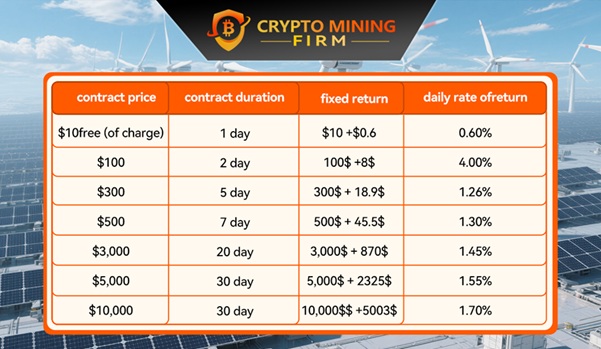
Newbie Bonus: Sign up and get $10-100, which can be used to experience daily signing contracts ($0.60/day) and try cloud computing services risk-free. (508 places remaining)

No hardware hassles: Mine BTC, ETH, DOGE, LTC, and more without owning equipment — our global data centers can handle it all.

Green Mining: Our operations use 100% renewable energy (solar and wind power), achieve carbon neutrality, and integrate profits with sustainability.

Flexible Withdrawal: Enjoy sub-minute USDC withdrawals and support more than 10 cryptocurrencies.

Recommendation Rewards: Referrals can get a 4.5% bonus, with a maximum reward amount of $10,000.

Seamless Interface: Start mining in 30 seconds, perfect for both newbies and experts.

Zero Hidden Fees: Transparent pricing to maximize your profits.

Round-the-Clock Support: 100% uptime and 24/7 expert assistance ensure a flawless experience.

How to participate in Crypto Mining Firm mining:

Step 1: Register an account

Visit cryptominingfarm.COM

Sign up in 30 seconds to claim a bonus of $10 to $100.

Choose a BTC, LTC or Dogecoin mining contract that suits your goals.

Watch daily profits flow in – withdraw or reinvest instantly.

Don’t delay – sign up now to lock in your gains before regulatory changes come!

Step 2: Choose a plan

We offer a variety of high-yield mining programs to meet your financial goals. Whether you are looking for short-term gains or long-term returns, CRYPTOMININGFIRM can meet your needs.

Step 3: Start earning money

Easily control your income growth without any management. Daily income will be automatically deposited into your account, and you can also withdraw your income to your cryptocurrency wallet address.

Investment Plan Details

Starter Plan: $100

o Average daily income: about $2.50

o Suitable for beginners

Pro Plan: $500

o Average daily income: about $15.00

o Most popular among part-timers

Elite Plan: $1,000

o Average daily income: about $35.00

o Most value long-term profits

Once your balance reaches $100, you can withdraw to your wallet or reinvest for significant growth.

Crypto Mining Firm also launched an affiliate program, which is a platform where you can make money by recommending the website to other people. You can start making money even without investing. After inviting a certain number of active referrals, you will receive a one-time fixed bonus of up to $60,000. With unlimited referrals, your earning potential is also unlimited!

Actual Reviews from Real Investors

Amir R., Turkey:

“I began with only $100 and now make more than $150 per day. DOGE withdrawals are quick and easy with CryptoMiningFirm.”


Linda M., UK:

“This is the first time I’ve earned actual passive income on the web. I don’t even have to understand mining — CryptoMiningFirm handles it all.”


Joon Sung., Korea:

“With the AI-supported plans, I amplified my payouts from $500 to $5,000 per month. The XRP withdrawal feature is a game changer at CryptoMiningFirm.”

CRYPTOMININGFIRM‘s cloud mining is one of the safest and most profitable ways to tap into the potential of cryptocurrency. Instead of waiting for market trends, smart investors can proactively create passive income. Join millions of investors earning $1,000 to $81,350 per day through cloud mining and take control of your financial future

For more information, please visit the official website: https://cryptominingfirm.com/