DD
MM
YYYY

PAGES

DD
MM
YYYY

spot_img

PAGES

Home Blog Page 1068

Trump’s ICC Sanctions Spark European Tech Reckoning as Microsoft Cuts Off Prosecutor’s Email – NYT

0

The decision by Microsoft to abruptly suspend the official email account of International Criminal Court (ICC) prosecutor Karim Khan has done more than disrupt communication within the court—it has triggered a continental alarm in Europe, forcing governments and institutions to confront a long-ignored vulnerability: the overwhelming reliance on American technology.

According to The New York Times, the move followed a February executive order from United States President Donald Trump, who imposed sanctions on Khan over his investigation into alleged war crimes by Israel in Gaza. Microsoft, a key digital service provider for the ICC for years, complied swiftly—cutting off Khan’s court email and effectively freezing him out of internal communications. The decision came just months after the court issued an arrest warrant for Israeli Prime Minister Benjamin Netanyahu.

Though Microsoft said it acted after consultation with the court, the broader message sent across Europe was unmistakable. The episode highlighted how deeply European institutions remain entangled in US-controlled digital systems—and how easily those tools can be leveraged or withdrawn based on political calculations in Washington.

“The ICC showed this can happen,” said Bart Groothuis, a Dutch member of the European Parliament and former cybersecurity chief at the Dutch Ministry of Defense. “It’s not just fantasy.”

The fallout from Microsoft’s action touched a nerve that has been raw since Donald Trump’s first presidency. From sudden tariffs on European steel and aluminum to threats against NATO and now, executive orders targeting international institutions, the pattern has left Europe feeling more exposed than ever.

Trump’s actions have reshaped the transatlantic relationship, injecting unpredictability and pushing European governments to question the wisdom of digital dependence on companies bound by US law. The ICC episode simply brought the issue into sharp focus.

Karim Khan, now on leave from the ICC pending an unrelated sexual misconduct investigation—which he denies—had been using Microsoft’s email services as part of broader digital support provided by the company. Microsoft also supplies the court with Office software, data storage tools, and cyber-defense systems to fend off attacks, including those reportedly from Russia, which is also under ICC scrutiny.

Following the sanctions, the company met with ICC officials and agreed to suspend Khan’s access but continue its broader services to the court. Khan shifted his communications to a different platform, while some court officials began using encrypted Swiss-based Proton Mail, The Times cited sources as saying.

Microsoft has since revised its internal policies to better protect clients caught in geopolitical conflicts. When the Trump administration imposed sanctions on four other ICC judges in June, the company did not cut off their email access.

Fueling a Push for European Tech Sovereignty

For many European leaders, the event was more than a warning—it was the evidence they needed to justify calls for technological self-reliance.

“This was the smoking gun that many Europeans had been looking for,” said Casper Klynge, a former Danish and EU diplomat who once worked at Microsoft. “The fear is that American companies will be obligated to comply if the US government targets a country, organization, or individual.”

That fear is now driving real action. Across the continent, efforts are accelerating to develop independent digital infrastructure, secure cloud services, and reduce the reach of Silicon Valley in Europe’s public sector.

Denmark’s digital ministry is testing alternatives to Microsoft Office. Germany’s Schleswig-Holstein region has begun cutting Microsoft from its systems. The Netherlands has declared digital autonomy a matter of national interest. At the EU level, plans are underway to invest billions of euros in AI data centers and sovereign cloud networks that avoid American servers entirely.

Microsoft, Amazon, Google, and other US firms control more than 70% of the European cloud market, according to Synergy Research Group. Their services power everything from law enforcement databases to hospital records and judicial systems.

Despite this dominance, American tech firms have come under increasing scrutiny in Europe. The European Commission has launched multiple antitrust and data privacy cases against Meta, Apple, and Google. But enforcement has done little to address the deeper problem: when political decisions are made in Washington, European access to US-based digital infrastructure can be curtailed with little warning.

Microsoft President Brad Smith acknowledged this imbalance, saying the ICC incident “added fuel to a fire that was already burning.” CEO Satya Nadella traveled to the Netherlands in June to unveil new “sovereign solutions” for European clients—legal and data protections meant to shield institutions during geopolitical crises.

But trust has already been shaken.

“If we don’t build adequate capacity within Europe, then we won’t be able to make political choices anymore,” warned Alexandra Geese, a member of the European Parliament involved in digital policy.

An Opening for Local Alternatives

The drive for sovereignty is already creating opportunities for European companies. Proton Mail reported increased uptake. Dutch-based Intermax Group and Swiss cloud provider Exoscale said demand for local cloud services is growing.

“The situation is not tenable, and we see a big push from European governments to become more independent and more resilient,” said Mr Andy Yen, CEO of Proton.

Ludo Baauw, CEO of Intermax, echoed that shift in sentiment. “A few years ago, everyone was saying, ‘They’re our trusted partners,’” he said, referring to US tech firms. “There’s been a radical change.”

The Next Front in a Fraying Alliance

At its core, the Microsoft-ICC email shutdown has done more than disrupt one prosecutor’s workflow. It has highlighted the fragility of Europe’s digital ecosystem and how vulnerable it remains to American political winds.

Vice President J.D. Vance and Trump have made no secret of their disdain for European regulatory pressures on US tech. Digital governance is now a front-line issue in EU-US trade talks, with American officials urging Brussels to loosen restrictions on companies like Amazon and Meta.

Meanwhile, Europe is rushing to decouple—building new systems, tightening procurement laws, and encouraging public institutions to favor local providers.

Mr Groothuis, who once supported US tech firms but has done a “180-degree flip-flop”, said, “We have to take steps as Europe to do more for our sovereignty.”

Solana Price Path to $300: Is a Rally Possible for SOL as Little Pepe (LILPEPE) Wins Over High-Value Investors?

0

Solana is flirting with a breakout moment, hovering just below key resistance levels as traders weigh whether $300 is still within reach. At the same time, a new contender—Little Pepe (LILPEPE)—is shaking up the meme coin space by attracting substantial capital and building something far beyond mere hype.

Solana Price Path to $300: Is a Rally for SOL Possible?

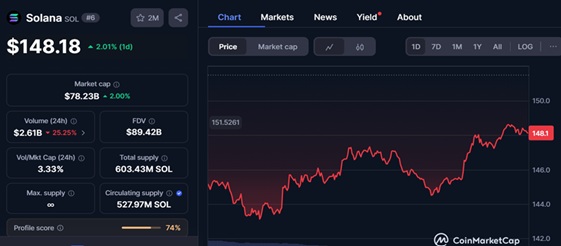
SOL Daily Chart: CMC

Solana has been in a slump lately, with only about 2% growth in the past day, settling at $148. That’s not too scary on its own—but it came alongside a sharp 25% dip in trading volume, which raised some eyebrows. Price action has also been forming a familiar pattern: lower highs, lower lows. That’s classic descending channel behavior, and while it looks bearish on the surface, it’s also a setup that can flip bullish fast—if Solana breaks the right levels.

In the short term, SOL has key resistance levels ahead at $155, $210, and $265, places where buyers previously got rejected. Solana needs to gain this support if it wants to reach $300. Conversely, supports at $115, $95, and $78 are crucial in case the bears dig in deeper.

But here’s the thing: Solana’s long-term story is still intact. It powers thousands of decentralized apps, handles crazy transaction speeds thanks to proof-of-history, and continues to be a magnet for NFT and gaming projects. Ecosystem expansion, new project launches, and growing institutional interest could all add serious fuel to a future rally.

Yes, the Layer-1 space is getting crowded, and macro conditions aren’t helping. But Solana still has one of the strongest narratives in the altcoin space. If it breaks out of this channel convincingly, $300 isn’t just possible; it’s in play. For now, all eyes are on the breakout. If SOL reclaims momentum, the path to $300 could turn from speculation into reality. Keep watching the volume; it’ll tell you when the bulls are back.

Little Pepe (LILPEPE) Wins Over High-Value Investors

In a market where meme coins often rise and fall on pure hype, Little Pepe (LILPEPE) is doing something different, capturing serious attention from high-value investors who usually steer clear of frog-themed tokens.

Why? Because LILPEPE isn’t just a meme—it’s an infrastructure play disguised as a meme coin. While many projects rely on speculative pumps, LILPEPE is launching a dedicated Layer-2 blockchain tailored specifically for meme coins. With built-in sniper bot protection, zero gas fees, and a native meme launchpad, it’s quietly solving the problems that plague most meme projects, and whales are noticing.

With Stage 3 of the LILPEPE presale already surpassing $1.4 million in raised funds, time is running out to secure tokens at just $0.0012. The next stage comes with a higher price, and once it’s live, the upside becomes more limited. Visit Littlepepe now to secure your spot before the next wave hits.

The tokenomics and early-stage price entry are also winning over the big wallets. At just $0.0012 per token, even modest investments could lead to outsized returns if LILPEPE follows PEPE or SHIB’s footsteps. And let’s not forget the $777,000 giveaway aimed at virality; it has brought tens of thousands of new users into the ecosystem almost overnight, reinforcing a flywheel effect that few meme tokens ever achieve.

But it’s not just hype and giveaways. LILPEPE’s launchpad, Pepe’s Pump Pad, is a unique feature that enables community-built meme tokens to go live with liquidity-locking and anti-rug mechanisms built in. That kind of infrastructure is precisely the type of “real value” that savvy investors seek in a meme-fueled narrative.

LILPEPE is flipping the script. While SOL begs for attention, LILPEPE is earning it. And in a meme market that’s growing more sophisticated, that might be the edge that carries it beyond retail pumps and into institutional portfolios.

Conclusion

While Solana eyes a return to form with its bullish setup and expanding ecosystem, LILPEPE is quietly carving a new lane with utility-first meme innovation. Both projects are drawing high-value attention for very different reasons—but in this market, they might rise together.

Don’t miss the Leap; Join the LILPEPE presale before the price jumps.


For more information about Little Pepe (LILPEPE) visit the links below:

Website: https://littlepepe.com

Whitepaper: https://littlepepe.com/whitepaper.pdf

Telegram: https://t.me/littlepepetoken

Twitter/X: https://x.com/littlepepetoken

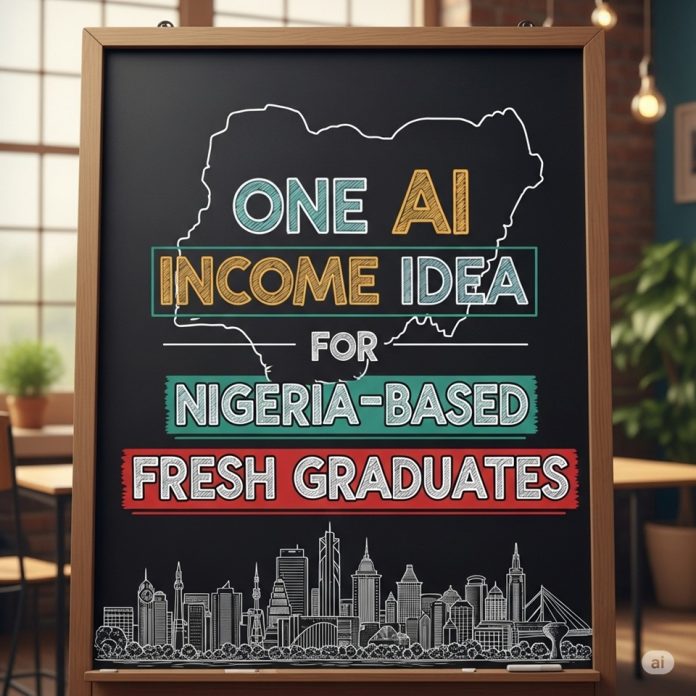
One AI Income Idea for Nigeria-Based Fresh Graduates

0

There is a massive latent opportunity in Nigeria, and that is helping medium and small enterprises (SMEs) to develop an AI roadmap and adopt the appropriate AI solution. In the oceans of AI solutions, someone must have the capabilities to provide guidance.

If you possess basic business skills and you have a technical friend, both of you can look deep into the world of AI offerings, and come together via a partnership, to help these businesses grow, and save money. Go to the Lagos firm and tell the company Chairman that you have something that will help him understand his business better. Many SMEs waste money reconciling their transactions and bank statements. Today’s AI systems can save them days of trouble!

Whenever new technologies come, there are always opportunities to provide services and make money. Many years ago, I would listen to know when Radio Nigeria would announce that professors and lecturers have been paid by the federal government a lump sum benefit. The next day, I would be in UNIJOS meeting professors and lecturers, to help them get their first desktop computers. I sold dozens of computers and bought my first car! I was able to explain how that first computer would make them better teachers instead of waiting for when their offices would get one for them!

Simply, you need to make it clear how value could come. In this AI era, communicating that value is easier as you can help that company to save money. For example, shrink the unit from 12 people to 3, and deploy cheap open-source AI anchored solutions to do the job! Remember, the focus must not be technology. Yes, you must focus on the value tech will provide to enable the company to meet its strategic objective. Most times, that objective for these players is more “profits” which happens when they save money or operate very lean.

Visit Onisha, Kano, Lagos, Osogbo, Calabar, etc and show those small business owners how the associated tech can deliver value to them. Hand over a page document that explains what you can offer. Reconciliation of accounts in minutes and not days? Bringing visibility on their supply chains? Providing real-time cash flow insights by linking the bank accounts and demand forecasts? Planning production with raw materials?

And you do not even need to be a tech creator since you are not pursuing a venture-based path where scale becomes the currency at play. In other words, do not waste your time creating an AI product. There are some amazing open-source AI solutions your tech partner can repurpose so that you keep costs low. You may ask: would they listen to me? Yes, they will if you come with something that differentiates you. Those days as an NYSC member, I added photocopies of my WAEC and FUTO degree results to create a marginal differentiation to be given audience. Maximize that small “win” in your record and capture the moment.

My summary: if you are a fresh graduate in Nigeria, there is an opportunity to repurpose most emerging AI solutions, create value for SMEs, and fatten your pocket!

Microsoft Blocks Google Chrome on Windows: Family Safety Bug or Browser War Strategy?

0

A bug in Microsoft’s Family Safety feature has rendered Google Chrome unusable for many Windows users since early June, sparking accusations that the tech giant is once again undermining its biggest rival to boost its own struggling browser, Edge.

The issue first surfaced on June 3, with users reporting that Chrome either refused to launch or immediately crashed. The problem traced to Microsoft’s Family Safety tool — a parental control feature bundled with Windows and Microsoft 365 — appears to affect only Chrome. Competing browsers like Firefox and Opera remain unaffected, fueling speculation that the glitch may be more than a technical hiccup.

“Our team has investigated these reports and determined the cause of this behavior,” confirmed Ellen T., a Chrome support manager. “For some users, Chrome is unable to run when Microsoft Family Safety is enabled.”

Workarounds That Undermine Safety

With no formal fix from Microsoft for over two weeks, users have resorted to temporary and sometimes unsafe workarounds. These include renaming the Chrome executable file from chrome.exe to chrome1.exe, or disabling the “filter inappropriate websites” setting within Family Safety — a move that essentially turns off all content filtering and defeats the feature’s core purpose.

In a bug-tracking thread dated June 10, a Chromium engineer wrote, “We’ve not heard anything from Microsoft about a fix being rolled out. They have provided guidance to users who contact them about how to get Chrome working again, but I wouldn’t think that would have a large effect.”

Despite user frustration and public requests, Microsoft has remained silent. The company has not issued a statement, leaving many to wonder whether the bug is simply a case of negligence — or a more deliberate strategy.

A Pattern of Interference?

Microsoft’s long history of trying to steer users toward its own browser gives skeptics plenty of ammunition. While Family Safety’s Chrome-blocking bug might be accidental, it comes after years of the company aggressively nudging, prompting, and even tricking users into choosing Edge over Google Chrome.

These tactics have included:

  • Injecting popups and AI-generated “warnings” into Bing results that discourage downloading Chrome
  • Hijacking the Chrome download page with fake surveys or messages promoting Edge
  • Defaulting to Edge in new Windows installations, requiring several steps to change
  • Suggesting that Edge is “faster and safer” than Chrome when users try to switch defaults

Earlier this year, Microsoft even manipulated Bing’s search results to mimic Google’s interface, confusing users trying to download Chrome.

Edge’s Long Battle with Chrome

Microsoft has spent over a decade trying to claw back the browser market share it once dominated. Internet Explorer, once the default for billions, steadily lost relevance through the 2010s. In 2015, Microsoft replaced it with Edge, promising a sleeker, faster, more secure browser.

But users didn’t bite.

Despite being bundled with Windows 10 and 11, Edge has failed to compete with Chrome’s dominance. According to StatCounter, Chrome holds over 64% of the global desktop browser market, while Microsoft Edge trails far behind with around 12% — a figure inflated mostly by default installations rather than voluntary adoption.

Even after switching Edge’s underlying engine to Chromium (the same open-source project that powers Chrome), Microsoft has failed to reverse its browser’s image as a fallback, not a favorite.

Chrome: A Threat Microsoft Can’t Ignore

Google Chrome, launched in 2008, quickly rose to dominance with a clean interface, fast performance, and a vast extension ecosystem. It became the browser of choice not just for individuals but also for businesses, schools, and developers.

As such, any disruption to Chrome’s usability on Windows — especially one tied to Microsoft’s own software — raises alarms.

Even if unintentional, the Chrome-blocking bug in Family Safety conveniently disadvantages Microsoft’s top rival and nudges frustrated users toward Edge. And given Microsoft’s track record, critics argue the company has little benefit of the doubt left.

The lack of urgency in fixing the problem only adds to user skepticism. Without a clear timeline or public explanation, Microsoft is facing a growing backlash from users, parents, educators, and developers who rely on Chrome daily.

Whether the issue is resolved quickly or drags on, the damage is already being done — not just to Microsoft’s reputation, but to the trust consumers place in an operating system that once claimed neutrality in the browser wars.

Intel to Slash Marketing Workforce, Outsource Jobs to Accenture in Aggressive AI-Fueled Restructuring

0

Intel is pushing ahead with one of its most aggressive corporate overhauls in years, announcing plans to outsource a significant portion of its marketing workforce to global consulting firm Accenture.

The move, which is expected to result in significant job cuts, is part of CEO Lip-Bu Tan’s sweeping strategy to cut costs, streamline operations, and reposition the struggling chip giant as a faster, more efficient player in a market increasingly dominated by artificial intelligence.

In a notice sent to employees this week—reviewed by The Oregonian/OregonLive—Intel said it will begin notifying affected marketing staff by July 11, and warned that the transition will bring “significant changes to team structures, including potential headcount reductions.” The company did not say how many jobs would be eliminated, nor how many people currently work in its global marketing division, which includes staff in Oregon and other major Intel locations.

“As we announced earlier this year, we are taking steps to become a leaner, faster and more efficient company,” Intel said in a statement confirming its expanded partnership with Accenture. “As part of this, we are focused on modernizing our digital capabilities to serve our customers better and strengthen our brand.”

The shift is part of a broader restructuring campaign spearheaded by Tan, a veteran semiconductor executive who was appointed CEO in March. Though he is the first Intel CEO in company history who did not rise through its internal ranks, Tan has wasted no time upending legacy operations. In April, he warned employees to expect “significant job cuts,” and details are now emerging across the company’s business units.

Last weekend, Intel informed workers in its manufacturing division that up to 20% of them could be laid off starting in July. The restructuring will reportedly cut thousands of jobs as Tan moves to flatten management layers and speed up decision-making.

Deepening Crisis at Intel

The cuts come as Intel struggles with some of the worst financial and strategic setbacks in its 56-year history. Once the undisputed leader in semiconductor technology, the company has lost ground to rivals like AMD and Nvidia, whose chips now dominate in high-performance computing and AI workloads. Meanwhile, Apple’s decision to ditch Intel processors in favor of its own custom silicon dealt a serious blow to Intel’s prestige and bottom line.

Years of delays in developing advanced chips—especially in shifting from 10nm to 7nm process nodes—have hurt Intel’s standing in both the PC and data center markets. At the same time, its absence from the booming AI chip segment has left it sidelined during one of the most transformative periods in computing.

Intel’s annual revenue has dropped by more than a third since its 2021 peak, falling from $79 billion to about $52 billion in 2023. The company reported a net loss of $2.8 billion in the first quarter of 2024, marking its third consecutive quarterly loss. These setbacks have weakened investor confidence and left the company in a precarious financial position as it seeks to regain market leadership.

AI at the Center of the Overhaul

Tan’s plan to restructure Intel includes a deep reliance on artificial intelligence, both as a business opportunity and as a tool to overhaul internal processes. The outsourcing of marketing functions to Accenture is being framed as part of an AI-driven strategy to eliminate inefficiencies, personalize customer engagement, and reduce operational complexity.

“AI can help us analyze large amounts of information faster, automate routine tasks, personalize customer experiences, and make smarter business decisions,” Intel told employees in its internal memo. “Our goal is to empower teams with more time to focus on strategic, creative and high-impact work by automating repetitive or time-consuming tasks.”

The company described the current structure of its marketing team as too slow, complex, and out of sync with customer expectations. In particular, it acknowledged that its programs were cumbersome and lagged behind more nimble competitors.

“We have received feedback that our decision-making is too slow, our programs are too complex, and our competitors are moving faster,” Intel wrote to staff. “The reality is that we need to change our ‘go to market’ model to be more responsive to what customers want.”

Intel appears confident that Accenture—leveraging advanced AI tools—can execute the marketing vision more effectively. The consulting firm will reportedly manage everything from campaign strategy to customer engagement, supported by machine-learning tools that optimize messaging and automate analytics.

The partnership also suggests a likely shift in job roles: some remaining Intel employees may be asked to help train Accenture staff and AI systems during the transition.

“We may ask impacted team members to share expertise to ensure a smooth transition of work,” the company wrote, hinting at knowledge transfer expectations.

Rising Concern Over AI Replacing Jobs

Intel’s strategy is unfolding amid growing concerns that artificial intelligence is already beginning to displace traditional white-collar roles. Amazon CEO Andy Jassy echoed similar expectations earlier this week, telling staff that AI would likely reduce the company’s total workforce over time. Jassy said many corporate roles would be rendered obsolete as automation takes over internal workflows.

Analysts say Intel’s gamble reflects a broader shift in corporate priorities across the tech sector: move faster, automate what can be automated, and reduce labor costs. But in Intel’s case, it’s also a desperate push to reverse declining revenues and close the technology gap between itself and its fiercest competitors.

While Intel is still investing billions in its foundry business and next-generation chip development, the current wave of restructuring highlights just how urgent its turnaround effort has become.