DD
MM
YYYY

PAGES

DD
MM
YYYY

spot_img

PAGES

Home Blog Page 1103

If You Put $15000 in XRP at the Beginning of 2021, You Made $139950 by Year-End: How Much You Could Make in 2025 and Top Rival to Consider

0

The ‘cross-border finance redefinition’ as well as Ripple’s XRP were among the trending buzz in the crypto world during 2021. If you purchased XRP at the start of 2021, in January, and invested $15,000 USD, you would have seen it reach an estimated $139,950 by the end of the year. That’s $124,950 USD profit, or about an 833% increase in 12 months. With the four-year cycle returning in 2025, investors are wondering if XRP could repeat its success and deliver similar returns again. Also, is there a fresh contender you should be eyeing alongside it? Let’s dive in.

The XRP Rollercoaster

In January 2021, XRP traded around $0.22. By the start of Q2, it had surged to nearly $1.96 due to speculative fervor and hopes of a successful legal resolution. Even after the mid-year pullback, the year-end price still hovered around $0.88—enough to turn a $15k position into a six-figure sum.

Key drivers back then included:

  • Legal optimism: Investors bet heavily on a favorable SEC outcome.
  • On-chain partnerships: Ripple inked deals across Asia and Europe for cross-border payments.
  • Market momentum: Altcoins were on fire, and XRP was among the brightest stars.

Fast-Forward to 2025: Can XRP Stage Another Comeback?

XRP currently sits at a different crossroads. The legal clarity it sought in 2021 has materialized, but global adoption of its On-Demand Liquidity rails remains gradual. Can we expect another massive run in 2025? Let’s break down the possibility.

Bullish Catalysts for XRP in 2025

  1. Regulatory Maturity
     The SEC’s positive outlook and recent court wins have positioned XRP as a compliant digital asset. The recently approved XRP ETFs could open the floodgates for institutional inflows.
  2. CBDC & Stablecoin Integration
     Central banks are pivoting towards token-based settlements and cross-border payments. XRP’s throughput and low fees make it a compelling option for tokenized currency corridors.
  3. Government Acceptance
     The US government is considering buying XRP as a reserve asset using Treasury bills. This move has the potential to drive up demand, adoption, and the price of the coin.

Once XRP captures even a fraction of these catalysts, a 5x-10x move from today’s $2.29 level isn’t out of the question.

Top Rival Watch: Rexas Finance (RXS)

Rexas Finance (RXS) is the newest crypto darling stealing headlines in 2025 and positioned as XRP’s rival thanks to its emphasis on asset tokenization. Real World Asset (RWA) tokenization is one of the most talked-about trends in finance right now. A prominent Hedge Fund manager called it the “next generation for markets.” And Rexas Finance is positioning itself as the platform that turns this narrative into usable infrastructure. Here are some reasons why Rexas Finance is worth considering:

1. Real-World Asset Tokenization

Traditional investment in physical assets, such as real estate, gold, or fine art, requires a significant amount of capital. Rexas Finance lets users fractionalize these assets on-chain, democratizing access and unlocking liquidity.

2. Holistic Ecosystem

RXS powers the comprehensive chain of Rexas Finance, which includes:

  • Rexas Token Builder: enables No-code asset minting for properties, commodities, or businesses.
  • Rexas Launchpad: Decentralized fundraising feature for asset projects.
  • Rexas Marketplace: Trade fractional tokens 24/7, globally, with integrated compliance (KYC/AML).

3. Impressive Presale Performance

  • Stage 1 price: $0.03
  • Current presale price: $0.20 (566% gain)
  • Tokens sold: 462 million of 500 million.
  • Funds raised: $48.4 million.

Rexas Finance will be publicly launched on exchanges in June at $0.25. Buyers of RXS at $0.20 lock in 25% upside instantly, and the long-term holders have a massive shot at another round of 500% gain.

Final Thoughts

XRP’s 800% gain in 2021 was thrilling, but unique market conditions and regulatory drama fueled that ride. In 2025, the game has changed.  XRP still offers upside, mainly as it solidifies its institutional appeal, but Rexas Finance represents the frontier of real-world asset tokenization, a space primed for explosive growth. By blending the established momentum of XRP with a calculated stake in RXS’s cutting-edge ecosystem, you position yourself to capitalize on both waves—traditional financial rails meeting the decentralized age of digital assets. In crypto, those who diversify thoughtfully and act decisively often come out ahead.


For more information about Rexas Finance (RXS) visit the links below:

Website: https://rexas.com

Win $1 Million Giveaway: https://bit.ly/Rexas1M

Whitepaper: https://rexas.com/rexas-whitepaper.pdf

Twitter/X: https://x.com/rexasfinance

Telegram: https://t.me/rexasfinance
What $420 in Dogecoin Could Be Worth if DOGE Hits $1 Versus What $420 in Its Biggest Rival Under $0.01 Could Yield at the Same Price Target

0

Dogecoin is one of the most popular meme coins in the crypto market. It is currently trading at $0.225. In addition, the market value of the coin stands at $34.36 billion. Meanwhile, the trading volume has increased 52.23% to $2.65 billion. If you spend $420 on DOGE today, you would receive around 1,866 tokens. If DOGE reaches one dollar, those tokens would be worth $1,866. That means a return of 344% from your original investment.

Many holders still believe DOGE can reach this target. Its community is well organized and its image is recognized around the world. It is backed by meaningful contributions from well-known people and businesses in the crypto world. Because of this, the company can continuously evolve and keep a strong presence.

The Rise of Salamanca (DON)

Salamanca (DON) is not just another speculative memecoin in the market. It is inspired by the Salamanca cartel from the popular Breaking Bad universe. It is built on Binance Smart Chain and priced at around $0.001170. If you invest $420 in DON today, you would get around 42,800 tokens. If DON reaches one dollar, that investment would grow to 42,800 dollars. This means a return of over 10,000%.

That kind of return easily beats DOGE at its current level. DON launched with a bang and hit its all time high of $0.008522 within days. It is already listed on PancakeSwap, MEXC and Gate.io, with a daily volume of over $5.49 million. Its growth has been fast and steady and more investors are joining in each day. The DON community is also one of the most active online. Fans share memes, anime edits, and Salamanca-themed content across social media. This energy creates a viral effect that keeps the project in the spotlight.

Trade $DON now on Gate.io: https://www.gate.io/zh/trade/DON_USDT

Why DON Has the Edge

The branding behind DON makes it stand out. It is gritty, creative, and backed by strong storytelling. That alone separates it from most meme coins. The coin is not just fun, it is a movement. Early buyers have already seen strong profits. Some even turned a few hundred dollars into thousands within days. This kind of momentum is rare in the market today. DON’s potential also extends to future exchange listings and new ecosystem tools. As the project grows, so does investor confidence.

Conclusion

DOGE remains a favorite for many and still offers decent returns if it climbs. But for investors looking for massive upside, DON may be the better pick. With just $420, the reward potential is far greater. Salamanca (DON) brings viral culture, a strong community, and real trading volume. That combination makes it one of the most exciting coins under one dollar today.


For more information about Salamanca (DON), visit:

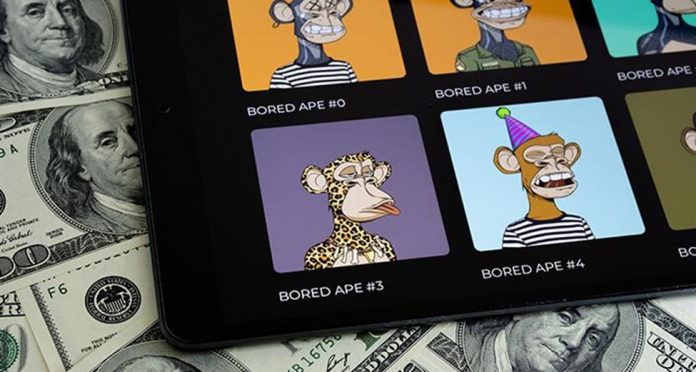
A Foray Into Ape Foundation’s Q1 2025 Banana Bill Transparency Report

0

The Ape Foundation’s Q1 2025 Banana Bill Transparency Report, released in May 2025, details the allocation of 31.2 million $APE from the 100 million $APE treasury to fund various initiatives. Specifically, 14.6 million $APE was used to support 36 projects, including Zharta, LogX, Token Racer, Able Labs, Ithaca Protocol, Merkl, Banxa, WhiteBit, GateIO, Coinstore, Newstalgic Studios, TontachiAR, and SuperVerse.

These funds were directed toward commercial deals, user incentives, integrations, marketing, and foundational efforts to bolster the ApeChain ecosystem. The report reflects a disciplined approach in a challenging market, focusing on creator tools and user experience. The Ape Foundation’s Q1 2025 Banana Bill Transparency Report highlights strategic investments of 31.2 million $APE to bolster the ApeChain ecosystem, but it also underscores a growing divide within the ApeCoin DAO community, with implications for governance, resource allocation, and ecosystem sustainability.

The allocation of 14.6 million $APE to 36 projects signals a strong push to expand ApeChain’s utility and adoption. Funding diverse initiatives like DeFi (Zharta, LogX), gaming (Token Racer, TontachiAR), and infrastructure (Merkl, Banxa) aims to create a robust, multi-faceted ecosystem. Successful execution could enhance ApeCoin’s value proposition and attract new users, potentially increasing $APE’s market relevance.

In a bearish crypto market, the Foundation’s focus on disciplined spending and high-impact projects (e.g., exchange integrations like GateIO and Coinstore) could strengthen ApeCoin’s liquidity and accessibility. However, the effectiveness depends on measurable outcomes, which the report lacks in granular detail, potentially raising concerns about ROI.

The report’s release is a step toward transparency, addressing past criticisms of opaque treasury management. However, the lack of detailed metrics on project performance or specific fund utilization (e.g., exact marketing budgets) may fuel skepticism among token holders about accountability.

Allocating 31.2% of the 100 million $APE treasury in one quarter raises questions about long-term financial sustainability. If market conditions remain challenging, rapid depletion could limit future funding, especially for smaller community-driven projects. The report has amplified tensions within the ApeCoin DAO community, evident from discussions on platforms like X and ApeCoin forums.

Some community members argue the Foundation’s heavy influence over fund allocation undermines the DAO’s decentralized ethos. Projects like SuperVerse and WhiteBit, perceived as corporate-friendly, have sparked debates about prioritizing enterprise deals over grassroots initiatives. Critics on X have called for more community-led proposals to balance influence.

The funding skew toward established players (e.g., Banxa, GateIO) has frustrated smaller developers and creators, who feel sidelined. With analysts highlighting concerns the Banana Bill favors “insiders” or well-connected projects, deepening the divide between influential stakeholders and independent contributors.

There’s a split between those who support the Foundation’s market-driven approach (e.g., exchange listings to boost $APE’s visibility) and those advocating for long-term infrastructure or community-building projects. Some analysts have criticized the lack of funding for educational initiatives or open-source tools, which could foster broader adoption.

While the report is a step forward, vocal community members on ApeCoin forums and X have demanded more granular data, such as project-specific budgets and performance KPIs. This divide between the Foundation’s high-level reporting and the community’s call for detailed accountability could erode trust if unaddressed.

The $APE price, hovering around $0.65-$0.8 in Q1 2025 based on market data, reflects ongoing market challenges. The Foundation’s aggressive spending may be a calculated risk to stimulate growth, but without clear success metrics, it risks alienating token holders. The divide could worsen if funded projects fail to deliver or if smaller community voices continue to feel marginalized in governance processes.

Implications of Big Banks Exploring Joint Stablecoin Ventures

0

Major U.S. banks, including JPMorgan Chase, Bank of America, Citigroup, and Wells Fargo, are in early discussions to launch a joint stablecoin venture to counter growing competition from the cryptocurrency industry. The talks involve bank-owned payment companies like Early Warning Services (operator of Zelle) and The Clearing House (a real-time payments network). The initiative aims to protect banks’ payment and deposit bases, especially against potential moves by big tech or retailers into digital currencies. A proposed model would allow both large and regional banks to use the stablecoin.

Discussions are conceptual and depend on forthcoming U.S. legislation, notably the GENIUS Act, which recently advanced in the Senate and aims to create a regulatory framework for stablecoin issuance. Stablecoins, pegged to assets like the U.S. dollar, are seen as a way to streamline transactions, particularly cross-border payments, which can take days in traditional systems. However, concerns about security, regulatory compliance, and market demand remain. Some regional and community banks are also exploring separate stablecoin consortia.

The joint venture signals a strategic move by traditional banks to counter the growing influence of decentralized cryptocurrencies and stablecoins like USDT and USDC, which are issued by non-bank entities like Tether and Circle. By launching their own stablecoin, banks aim to retain control over payment systems and customer deposits, which are threatened by crypto platforms offering faster, cheaper transactions.

This could accelerate mainstream adoption of stablecoins, as bank-backed stablecoins would likely carry greater trust and regulatory compliance, appealing to institutional and retail clients wary of existing crypto volatility. Stablecoins could streamline cross-border payments, which currently take days and incur high fees through systems like SWIFT. A bank-backed stablecoin could reduce costs and settlement times, enhancing efficiency for global trade, remittances, and B2B transactions. Domestic payments could also benefit, with real-time settlement capabilities challenging existing bank-controlled networks like Zelle or ACH.

The venture’s success hinges on clear U.S. regulations, particularly the GENIUS Act, which aims to establish a framework for stablecoin issuance. Favorable legislation could legitimize and accelerate bank-backed stablecoins, but delays or restrictive rules could stall progress. Regulatory compliance would give bank-issued stablecoins an edge over crypto-native stablecoins, which face scrutiny over reserve transparency and money laundering risks.

A bank-backed stablecoin could capture significant market share in the $200 billion+ stablecoin market (as of 2025), potentially reducing the dominance of Tether and Circle. It could also pressure big tech like PayPal, which issues its own stablecoin and retailers exploring digital currencies, forcing them to compete on trust and integration. However, banks risk cannibalizing their own fee-based payment systems, and widespread adoption could reduce deposit bases if customers shift funds to stablecoin wallets.

Stablecoins, even bank-backed ones, face risks like cyberattacks, smart contract vulnerabilities, or reserve mismanagement. Banks’ involvement could mitigate some concerns due to their experience with financial security, but any failure could damage trust in the banking sector. Stablecoin adoption could introduce systemic risks if not properly regulated, especially if they become integral to global payments.

A bank-backed stablecoin would be centralized, tightly regulated, and integrated into existing financial systems. It would prioritize compliance, security, and interoperability with bank infrastructure, appealing to traditional customers and institutions. Decentralized stablecoins like USDC or algorithmic stablecoins like DAI operate on public blockchains, emphasizing permissionless access, global reach, and innovation. They appeal to crypto-native users but face regulatory uncertainty and trust issues due to past scandals (e.g., Tether’s reserve controversies).

Banks reputation and regulatory oversight could make their stablecoin more trusted by mainstream users, governments, and corporations. However, banks’ slow innovation and profit-driven models may limit flexibility and accessibility compared to crypto alternatives. Crypto stablecoins benefit from rapid innovation and global accessibility but struggle with regulatory scrutiny, volatility risks in underlying blockchains, and skepticism from traditional finance. Adoption is strong among crypto users but limited in mainstream commerce.

A joint venture could consolidate power among major banks, potentially marginalizing smaller institutions or crypto startups. Regional banks forming separate consortia (as noted) suggest a divide even within the banking sector, with smaller players seeking to avoid domination by giants like JPMorgan or Citigroup. The crypto industry could face existential competition from banks, especially if bank stablecoins integrate with existing payment rails like Zelle or The Clearing House. However, crypto’s decentralized nature allows it to serve unbanked populations and bypass traditional gatekeepers, maintaining a niche.

Banks lobbying power and established relationships with regulators give them an edge in shaping stablecoin legislation (e.g., the GENIUS Act). A bank-friendly regulatory environment could stifle crypto-native stablecoins. Crypto firms face stricter scrutiny and may struggle to comply with evolving rules, but their global, decentralized nature makes them harder to regulate fully, allowing continued innovation outside U.S. jurisdiction.

Banks stablecoin would likely prioritize stability over experimentation, potentially lagging in features like DeFi integration or cross-chain compatibility. Collaboration among banks could also slow decision-making. The crypto space moves faster, with constant experimentation in DeFi, NFTs, and tokenized assets. However, this speed often comes with instability, as seen in past stablecoin failures (e.g., TerraUSD).

Banks’ Advantage could bridge traditional finance and crypto, offering a regulated alternative that integrates with existing systems. This could pull crypto users into the banking fold but risks alienating those who value decentralization. The crypto ecosystem thrives on its ability to operate outside traditional systems, serving unbanked populations and enabling novel use cases (e.g., smart contracts). However, it must overcome regulatory hurdles and prove reserve stability to compete with banks.

Users may benefit from faster, cheaper payments but face a choice between bank-controlled stablecoins (safer, less innovative) and crypto-native ones (riskier, more versatile). The divide could fragment the market, with banks dominating institutional use and crypto retaining retail and niche applications. If U.S. banks succeed, other countries’ financial institutions may follow, potentially creating a global network of regulated stablecoins. This could challenge crypto’s borderless ethos but also spur innovation as crypto firms adapt to compete.

Meme Coin Mania Returns? Salamanca (DON) Token Channels Pepe Coin’s (PEPE) 2023 Energy with $400 Set to Become $12000 This Month

0

Pepe Coin allowed people with small wallets to see their balances jump into the thousands in only a few weeks. Right now, traders notice low-market-value assets that have a vibrant community and a recognizable brand. Salamanca’s (DON) excellent results and rising trade on main exchanges have earned it the same respect as other firms. Due to how it has been performing, $DON is emerging as a top pick among meme coins this cycle.

Salamanca Emerges as  Leader on Binance Smart Chain

DON is a meme coin inspired by the Salamanca group from the shows Breaking Bad and Better Call Saul. Since it runs on Binance Smart Chain, the token allows for quick and affordable transfers. Its purpose is to unite the community by using high volume, community culture and digital stories.

The token merges television fandom with Web3 infrastructure to create a crypto-native identity. With this blend of themes and utility, Salamanca positions itself as the real Don in the current meme coin market.

Exchange Listings Boost Performance and Reach

Gate.io, MEXC and PancakeSwap have listed DON, making it available to people around the globe. According to liquidity and trading volume, Gate.io is included in the top three international exchanges.

The daily trading of $DON has exceeded more than $20 million  as DON gains more exposure within the Binance Smart Chain.  The value of the token is still appreciated, so it still attracts more users in the meme market.

Culture-Driven Community Backs Project’s Momentum

Salamanca’s growth is linked to its unique cultural identity and active community presence. Visual themes from the Salamanca cartel blend with anime art and meme culture across social platforms.

Salamanca’s content is presented consistently on Telegram, X and Web3 channels and it regularly gets a lot of responses. The combination of branding and rich culture has resulted in more players arriving at the project without any marketing efforts. The strength of its themes has differentiated $DON from many meme tokens launched this year.

Future Plans and Long-Term Potential

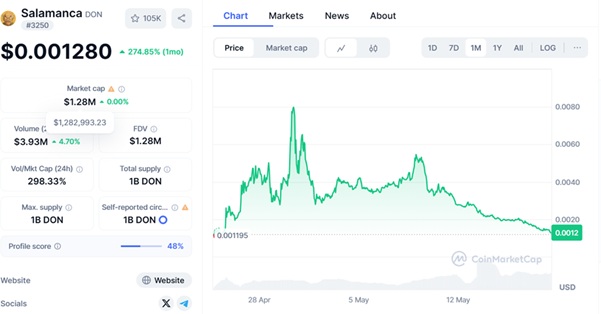
Salamanca (DON) trades at $0.001280, with a 274.85% increase over the past month. The market cap for this coin is still $1.28 million and the daily volume went up by 4.70% to $3.93 million. It is clear from the chart that the price surged above $0.008 and then slowly decreased to $0.0012. Both total supply and circulating supply are 1 billion DON and the ratio between them is 298.33%.

Source :CoinMarketCap

Plans are underway for more centralized exchange listings, with Binance viewed as a potential next step. Roadmap timelines include continued scaling and integration across key ecosystems. Based on current patterns, the team projects a 2000% gain from present price levels.

Compared with other BSC meme coins, Salamanca ranks as one of the fastest-expanding projects of 2025. With its layered narrative and market placement, it remains on track for broader recognition within the meme sector.

Conclusion

BSC and pop culture’s popularity enable Salamanca (DON) to create a unique movement in the market. Its listing on major exchanges, deep community ties, and viral themes have positioned it ahead of meme coin competitors. As the rally continues, Salamanca is one of the places that could perform exceptionally well this year.


For More Details:

Twitter/X: https://x.com/salamanca_token

Telegram: https://t.me/salamancatoken

Website: https://salamanca.club/