DD
MM
YYYY

PAGES

DD
MM
YYYY

spot_img

PAGES

Home Blog Page 1128

Sergey Brin Admits “A Lot of Mistakes” on Google Glass, Backs New AI-Powered Smart Glasses Push

0

Google co-founder Sergey Brin has admitted to “a lot of mistakes” in the company’s failed Google Glass project, as the tech giant unveiled its latest attempt to enter the smart eyewear space with AI-powered Android XR glasses.

Brin made the remarks during a surprise appearance at Google I/O 2025 on Tuesday, joining Google DeepMind CEO Demis Hassabis and journalist Alex Kantrowitz on stage. The candid conversation shed light not just on the past failures of Google Glass, but also the company’s revived confidence in the smart glasses market—this time with the backing of major partners and advanced artificial intelligence.

“I made a lot of mistakes with Google Glass,” Brin said. “I didn’t know anything about consumer electronic supply chains,” he continued, admitting the difficulty of building smart glasses that could be manufactured and sold at a reasonable price. “I’m glad the company is pursuing them again,” he added, “this time with great partners who are helping us build this.”

Earlier in the day, Google unveiled its new Android XR smart glasses, powered by DeepMind’s real-time multimodal AI project, Astra. In a live demonstration, the glasses translated foreign languages, gave real-time directions, and responded to spoken queries in natural language—a sharp contrast to the limited functions and controversial design of Google Glass more than a decade ago.

To realize this vision, Google is partnering with a range of tech and eyewear companies. The list includes Samsung and Xreal, both of which have experience in display and XR technologies. Notably, Google is also investing up to $150 million in a strategic partnership with Warby Parker, the popular direct-to-consumer eyewear brand, and has taken an equity stake in the company. Gentle Monster, a premium smart eyewear maker, is also on board.

Brin acknowledged the value of these alliances, suggesting they could resolve the technical and logistical issues that plagued the original Glass rollout.

“Those experienced eyewear and electronics makers may be able to help with some of the supply chain problems associated with producing smart glasses,” he said.

He also credited advancements in generative AI for making the promise of smart glasses more practical.

“The advent of generative AI makes the capabilities of smart glasses much more tangible than when Google Glass was around,” he said.

Once criticized for releasing a product ahead of its time, Brin now argues that time may have finally caught up to the vision. And he isn’t watching from the sidelines. Brin revealed that he has effectively come out of retirement to work with Google’s AI teams, saying he’s in the company’s Mountain View office “nearly every day.” He’s helping develop Gemini, Google’s AI assistant, as well as its video-generating model, Veo 3.

“Anybody who’s a computer scientist should not be retired right now,” Brin said. “They should be working on AI.”

Brin has reportedly urged Google staff to be more ambitious and focused, with past memos encouraging 60-hour work weeks and daily in-office presence to help the company stay competitive in the high-stakes AI race.

Tuesday’s presentation marked a return not just of Sergey Brin to the spotlight, but of Google’s enduring ambition to lead in both consumer hardware and artificial intelligence. With smarter tools, deeper partnerships, and more cautious execution, Google appears determined to avoid the missteps that sank Glass and instead chart a new path forward in wearable computing.

U.S. Department of Justice Launches An Investigation Into Coinbase Data Breach

0

The U.S. Department of Justice (DOJ) has launched an investigation into a recent data breach at Coinbase, the largest U.S. cryptocurrency exchange, which exposed sensitive customer information. The breach, disclosed by Coinbase on May 15, 2025, involved cybercriminals bribing overseas support agents, primarily in India, to access and steal data from internal systems.

The compromised data, affecting approximately 1% of Coinbase’s 9.7 million monthly active users (around 100,000 individuals), included names, addresses, phone numbers, email addresses, the last four digits of Social Security numbers, masked bank account numbers, government-issued IDs (e.g., driver’s licenses, passports), account balances, transaction histories, and limited corporate data like training materials and communications. No passwords, private keys, or funds were accessed, and Coinbase Prime accounts remained unaffected.

The attackers demanded a $20 million ransom in Bitcoin to not publicly disclose the stolen data, which Coinbase refused to pay. Instead, the company established a $20 million reward fund for information leading to the arrest and conviction of the perpetrators. Coinbase has terminated the involved support staff, is cooperating with the DOJ and international law enforcement, and has implemented heightened fraud monitoring, including additional ID checks for large withdrawals and mandatory scam-awareness prompts. The company estimates remediation costs, including customer reimbursements, to range between $180 million and $400 million.

The DOJ’s probe, involving its criminal division in Washington, is focused on the circumstances of the breach, particularly the insider bribery, and not on Coinbase itself, according to a source cited by Reuters. The investigation highlights ongoing cybersecurity challenges in the cryptocurrency sector, with attackers using stolen data for social engineering scams, leading to losses like the $7 million reported in a single day and a $2 million loss for one user. Legal actions, including potential class action lawsuits, are emerging as affected users seek compensation for privacy violations and losses.

Coinbase is also opening a new U.S.-based support hub and enhancing insider-threat detection and security measures to prevent future breaches. The company has warned users about potential phishing attempts and impersonation scams, advising them to enable two-factor authentication (2FA) with hardware keys and withdrawal allow-listing to secure transfers. Separately, the U.S. Securities and Exchange Commission (SEC) is investigating Coinbase’s past “verified user” metrics, though this is unrelated to the data breach and stems from a prior administration’s inquiry into a metric Coinbase stopped reporting in 2022.

The Coinbase data breach and the subsequent U.S. Department of Justice (DOJ) investigation carry significant implications across multiple dimensions, including Coinbase’s operations, the cryptocurrency industry, affected users, and broader regulatory and cybersecurity landscapes. Remediation costs, including customer reimbursements, are estimated at $180–$400 million, potentially straining Coinbase’s financials, though its $8.2 billion cash reserve (as of Q3 2024) provides a buffer.

The $20 million reward fund for tracking perpetrators adds to expenses but signals proactive engagement with law enforcement. Potential class action lawsuits could further increase costs, depending on settlements or judgments. The breach undermines trust in Coinbase as a secure platform, critical in the crypto industry where security is paramount. This could lead to user churn, particularly among high-net-worth clients.

Termination of involved support staff and the establishment of a U.S.-based support hub indicate a shift to reduce reliance on overseas contractors, potentially increasing operational costs but improving security oversight. Investments in insider-threat detection, enhanced fraud monitoring (e.g., ID checks for large withdrawals), and mandatory scam-awareness prompts reflect long-term commitments to bolster cybersecurity.

While the DOJ investigation targets the breach’s perpetrators, not Coinbase, it may uncover compliance gaps, prompting stricter oversight or fines. The unrelated SEC probe into past “verified user” metrics could compound regulatory pressure, potentially affecting investor confidence. The exposure of sensitive data (names, addresses, SSNs, account details) increases risks of identity theft, phishing, and social engineering scams. Reported losses, like $7 million in a single day, highlight the immediate financial impact.

Users face potential long-term consequences, such as fraudulent accounts opened in their names or targeted scams leveraging stolen data. Class action lawsuits are emerging, offering affected users a chance to seek compensation for privacy violations and losses. Success depends on proving Coinbase’s negligence, which may hinge on its handling of overseas support staff.

Users are advised to enable two-factor authentication (2FA) with hardware keys and use withdrawal allow-listing. This may push less tech-savvy users to adopt stronger security practices or abandon crypto platforms altogether. The breach reinforces concerns about cybersecurity in crypto, likely prompting regulators to push for stricter standards on data protection, insider threat prevention, and third-party contractor oversight.

It may accelerate discussions around mandatory cybersecurity frameworks for crypto exchanges, similar to traditional financial institutions. Other exchanges may face pressure to audit their own systems, particularly those relying on outsourced support, to avoid similar breaches. The incident could drive adoption of decentralized or self-custodial solutions, as users seek alternatives to centralized exchanges like Coinbase.

The bribery of overseas support agents underscores insider threats as a critical vulnerability, likely prompting other industries to scrutinize third-party contractor security. Companies may invest more in employee vetting, monitoring, and localized operations to mitigate similar risks. The DOJ’s collaboration with international law enforcement (e.g., in India) highlights the need for cross-border efforts to combat cybercrime, potentially leading to stronger global frameworks for prosecuting such cases.

The breach may fuel calls for enhanced consumer protections in the crypto sector, such as mandatory breach disclosures, free credit monitoring for affected users, or stricter penalties for data mishandling. Coinbase’s ability to manage the crisis, cooperate with authorities, and implement robust fixes will determine whether it regains user and investor trust. Its dominant position in the U.S. market provides some resilience.

The Coinbase data breach and DOJ investigation highlight systemic challenges in the crypto industry, from insider threats to regulatory gaps. For Coinbase, the incident tests its ability to balance costly remediation with user trust and operational improvements.  For users, it underscores the risks of centralized platforms and the need for proactive security measures.

Industry-wide, it may catalyze stronger regulations and security standards, while globally, it emphasizes the importance of coordinated cybercrime responses. The long-term impact depends on Coinbase’s execution of its remediation plan and the broader industry’s ability to adapt to heightened scrutiny.

Implications of a Potential Circle Acquisition by Coinbase or Ripple

0

Circle is in talks for a $10B+ acquisition with Coinbase or Ripple. However, recent reports indicate Circle, the issuer of the USDC stablecoin, has been engaged in informal discussions with both companies about a potential sale, while simultaneously pursuing a $5B initial public offering (IPO).

Sources suggest Circle rejected a $4B-$5B offer from Ripple, deeming it too low, and some unconfirmed claims on X mention Ripple raising its bid to $9B-$11B, potentially including cash and XRP. Other unverified rumors on X suggested a $20B offer, but experts like Dom Kwok argue this is unrealistic, estimating a more plausible bid range of $6B-$6.5B based on Circle’s $5B IPO valuation target.

Coinbase is seen as a more likely acquirer due to its deep integration with Circle’s USDC ecosystem, including a revenue-sharing arrangement and an equity stake from their dissolved Centre Consortium partnership. Coinbase’s $8B cash reserves and public market access strengthen its position, though Ripple’s substantial XRP holdings (valued at over $90B) provide financial leverage. Circle has publicly denied being for sale, emphasizing its IPO focus, but sources note the situation remains fluid. No formal offers are confirmed, and all discussions appear exploratory

A potential acquisition of Circle, the issuer of the USDC stablecoin, by either Coinbase or Ripple would have significant implications for the cryptocurrency industry, particularly in the stablecoin and broader digital asset markets. Coinbase, already a major player in the crypto exchange space, acquiring Circle would solidify its dominance in the stablecoin market. USDC, with a market cap of over $60 billion (based on recent data), is the second-largest stablecoin after Tether’s USDT.

Coinbase’s existing integration with USDC (through co-ownership of the Centre Consortium until its dissolution in 2023) and its revenue-sharing agreement with Circle would make this a natural fit. It could enhance Coinbase’s ecosystem, streamlining USDC’s use across its trading platform, custody services, and institutional offerings. Ripple acquiring Circle would position it as a major player in the stablecoin market, diversifying its focus beyond XRP and cross-border payments.

Ripple’s significant XRP holdings (valued at over $90 billion) could be leveraged to fund the deal, but integrating USDC into Ripple’s ecosystem might be less seamless due to its focus on XRP-based solutions like On-Demand Liquidity (ODL). As a publicly traded U.S. company, Coinbase operates under strict regulatory oversight, which aligns with Circle’s compliance-focused approach (e.g., USDC’s full reserve backing and transparency reports). An acquisition could strengthen their joint ability to navigate U.S. regulations, especially with increasing scrutiny on stablecoins under frameworks like the U.S. Stablecoin Act.

Ripple’s ongoing legal battles with the SEC over XRP’s status as a security could complicate an acquisition. Regulatory uncertainty around Ripple might raise concerns about Circle’s ability to maintain USDC’s reputation as a compliant, transparent stablecoin. However, Ripple’s global reach could expand USDC’s adoption in markets outside the U.S.

An acquisition by either party would signal further consolidation in the crypto industry, potentially reducing competition in the stablecoin sector. This could attract antitrust scrutiny, particularly if Coinbase, already a dominant exchange, acquires Circle. A Ripple acquisition might diversify the stablecoin market by introducing a new major player, but it could also spark competition concerns if Ripple uses USDC to bolster its XRP ecosystem, potentially sidelining other stablecoins.

Coinbase with its robust infrastructure (exchange, wallet, custody), could integrate USDC more deeply into DeFi, NFTs, and institutional finance, potentially accelerating innovation in these areas. However, Coinbase’s centralized model might limit the pace of decentralized innovation. Ripple’s focus on cross-border payments could lead to USDC being integrated into global remittance and financial institution networks, potentially competing with SWIFT and other traditional systems.

However, Ripple’s XRP-centric approach might prioritize its own token over USDC in some applications. Circle’s reported $5B IPO valuation and rumored $10B+ acquisition talks suggest a high-stakes deal. Coinbase’s $8B cash reserves and public market access make it financially capable, but a $10B+ deal could strain its balance sheet or require stock issuance. Ripple’s XRP holdings provide significant liquidity, but using XRP in the deal could introduce volatility and regulatory risks.

For Circle, an acquisition could provide immediate liquidity and scale, but it risks losing autonomy compared to an IPO, which would allow it to remain independent and raise capital on its own terms. The divide between Coinbase and Ripple as potential acquirers lies in their strategic goals, operational models, and market positioning. Acquiring Circle aligns with Coinbase’s goal of building a comprehensive crypto ecosystem.

USDC is already deeply integrated into Coinbase’s platform, and full ownership could streamline operations, reduce costs, and enhance profitability through USDC’s transaction fees and reserve interest. Coinbase’s focus on institutional clients and retail investors makes it a natural fit for scaling USDC’s adoption. Ripple’s interest in Circle seems driven by a desire to diversify beyond XRP and gain a foothold in the stablecoin market. USDC could complement Ripple’s cross-border payment solutions, but the integration would require significant reengineering to align with Ripple’s XRP Ledger and ODL system.

Ripple’s global focus contrasts with Coinbase’s U.S.-centric approach. Coinbase as a regulated, publicly traded entity, is better positioned to manage the regulatory complexities of owning a major stablecoin. Its compliance track record aligns with Circle’s transparent, fully reserved USDC model.
Ripple: Ripple’s unresolved SEC lawsuit creates uncertainty, which could deter Circle from aligning with it. A Ripple acquisition might face regulatory hurdles, especially if XRP is deemed a security, impacting the deal’s structure or feasibility.

With $8B in cash and access to public markets, Coinbase can fund a $10B+ deal, though it may require a mix of cash and stock. Its stable financial position makes it a safer bet for Circle’s stakeholders. Ripple’s vast XRP holdings provide theoretical liquidity, but their value is subject to market volatility and legal risks. A cash-and-XRP deal (as rumored) could complicate negotiations and valuation. The market views Coinbase as a stable, established player, and its acquisition of Circle would likely be seen as a logical consolidation. However, it could raise concerns about Coinbase’s dominance in the U.S. crypto market.

Ripple’s acquisition would be seen as a bold move to challenge Tether and Coinbase but could face skepticism due to its legal issues and XRP focus. The crypto community might question whether Ripple would prioritize USDC or use it to prop up XRP. Coinbase shares Circle’s U.S.-centric, compliance-driven culture, making integration smoother. Their prior partnership in the Centre Consortium suggests operational synergy. Ripple operates with a more global, decentralized ethos, which could clash with Circle’s centralized stablecoin model. Ripple’s focus on financial institutions contrasts with Circle’s broader DeFi and retail applications.

The implications of a Circle acquisition hinge on the acquirer’s ability to integrate USDC into their ecosystem while navigating regulatory and market dynamics. Coinbase appears better positioned due to its financial stability, regulatory alignment, and existing USDC integration, but Ripple’s global ambitions and XRP liquidity make it a wildcard.

The divide reflects a choice between Coinbase’s centralized, U.S.-focused dominance and Ripple’s riskier, globally oriented vision. However, Circle’s public commitment to an IPO suggests it may prefer independence, rendering these discussions speculative unless a compelling offer emerges.

4 Best Meme Coins to Buy as Crypto Prices Go Parabolic: Number 4 Has a Stronger Community Than PEPE and BONK Together

0

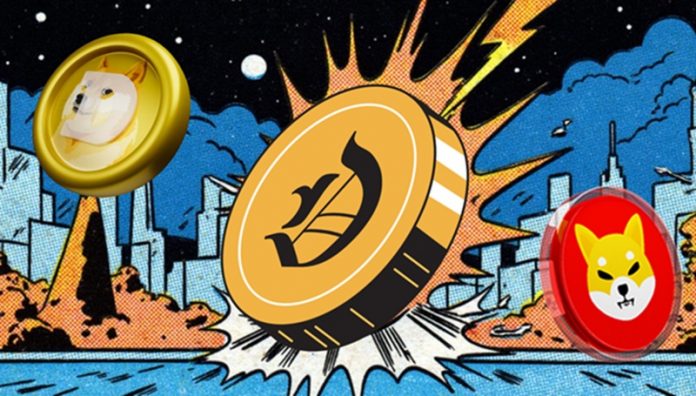
As Bitcoin flirts with six-figure prices and altcoins surge in its wake, meme coins are back in the spotlight — and this time, the stakes are even higher. While many investors once laughed at the idea of meme-based cryptocurrencies, history has shown that tokens like Dogecoin (DOGE) and Shiba Inu (SHIB) can deliver staggering gains. Now, in 2025’s bull run, traders are searching for the next meme coin moonshot — and these four tokens are leading the charge.

Let’s dive into the four best meme coins to consider as prices go parabolic — and why Number 4 might have a stronger community than PEPE and BONK combined.

  1. Dogecoin (DOGE)

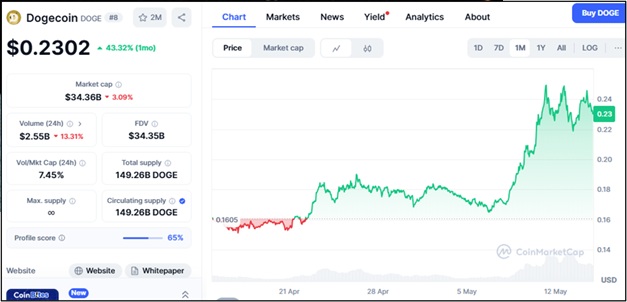
Dogecoin remains the original meme coin that started it all. What began as a joke has grown into a globally recognized cryptocurrency backed by using a strong online community and endorsements from high-profile figures like Elon Musk. DOGE continues to hold its place in many of the top 10 cryptocurrencies by market cap and is broadly accepted by merchants, tipping platforms, and exchanges. As crypto prices surge, DOGE regularly leads the meme coin rally — making it a reliable play for each seasoned and new traders seeking to ride the wave.

  1. PepeCoin (PEPE)

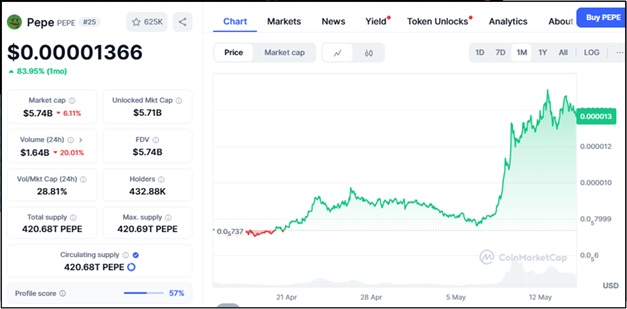
PepeCoin was one of the standout performers in 2023, riding the wave of internet meme culture. Inspired by the famous “Pepe the Frog” meme, PEPE exploded in popularity due to its fast-growing community and clever marketing. Although it saw periods of volatility, it has maintained a core following. With crypto sentiment rising, PEPE is once again heating up — making it a solid speculative bet for those chasing high-risk, high-reward plays.

  1. Floki Inu (FLOKI)

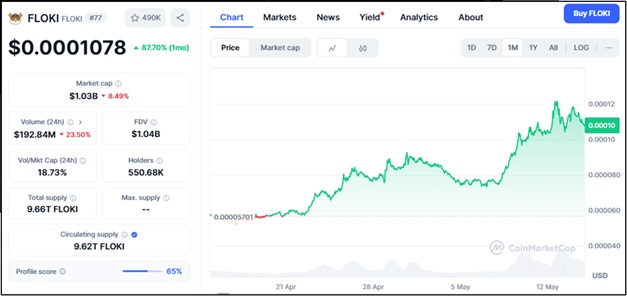
Floki Inu, inspired by Elon Musk’s dog, has positioned itself not just as a meme coin, but as a full ecosystem. FLOKI is building a decentralized finance (DeFi) platform, educational tools like “Floki University,” and NFT/metaverse integrations. This commitment to real-world use cases and a forward-looking roadmap gives FLOKI a different edge compared to pure hype-based tokens. Its dedicated team and steady development give FLOKI long-term viability in a meme coin segment often defined by flash-in-the-pan tokens.

  1. Salamanca (DON)

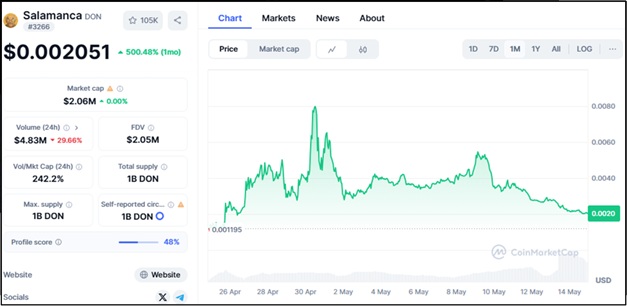
Inspired by the infamous Salamanca family from Breaking Bad and Better Call Saul, Salamanca (DON) has emerged as the dark horse of 2025’s meme coin season. Built on Binance Smart Chain, DON has built a cult-like following drawn to its edgy branding, viral social media campaigns, and clever meme content.

Despite being a newer entrant, DON’s 24-hour trading volume has exceeded $5 million, and it’s seeing rapid wallet growth and consistent social trend spikes. Early investors and influencers alike are rallying around DON, calling it the “next SHIB” — but with an even stronger sense of identity and community engagement.

Unlike PEPE and BONK, which rely heavily on meme recognition alone, DON has established a narrative, aesthetic, and roadmap that gives it more staying power. Its community is active, creative, and fiercely loyal — exactly the kind of environment that drives explosive growth in meme coin cycles.

As crypto prices go parabolic in 2025, meme coins are once again proving that culture, community, and speculation can be a powerful combination. While Dogecoin and PEPE still hold strong, new challengers like Salamanca (DON) are rising fast — and possibly set to outshine the originals. If you’re looking to make bold plays this bull cycle, these four meme coins should be on your radar — especially DON, which could be the biggest surprise of the year.

About Salamanca (DON)

Salamanca (DON) is a rising meme coin stimulated through the notorious Salamanca cartel from Breaking Bad and Better Call Saul, mixing popular culture with crypto hype. Built at the Binance Smart Chain, DON isn’t only a novelty — it is positioning itself as a critical project in the meme coin space.


Website: https://salamanca.club/

Telegram: https://t.me/salamancatoken

Twitter: https://x.com/salamanca_token

Could Rexas Finance (RXS) Deliver 21730% Returns Faster than Dogecoin (DOGE)?

0

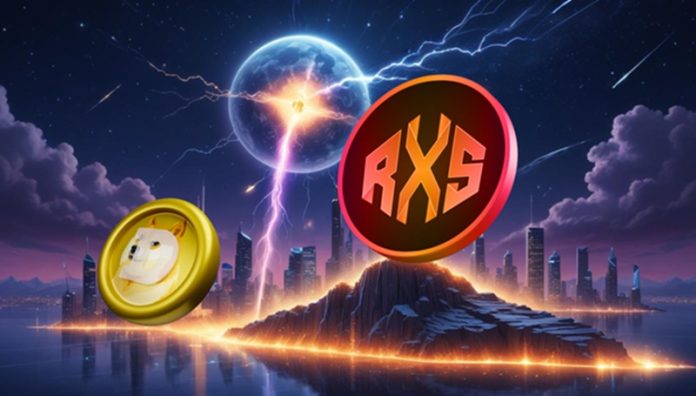
Rexas Finance (RXS) stands as a leading cryptocurrency which has generated intense market interest because experts predict it will reach 21,730% returns possibly faster than Dogecoin achieved its legendary growth. RXS generates intense anticipation because its official listing at $0.25 will happen on June 19, 2025 while the presale has reached 92.27% completion and has raised more than $48 million from selling over 461 million tokens. Rexas Finance establishes itself as a leading blockchain innovation through its 52,000 holders while targeting real-world assets including gold and real estate from multi-trillion-dollar markets.

RXS Unlocks Global Access to Real Assets — Trade Real Estate, Art & Gold Like Crypto

Rexas Finance was constructed to transform the current methods of traditional asset accessibility and management as well as trading systems. Through blockchain technology Rexas Finance enables users to digitize real assets into tradeable tokens accessible for instant purchase and sale. The solution enables regular investors to enter lucrative markets including art, real estate and commodities by enabling fractional ownership and continuous trading. The RXS native token serves as the foundation for this ecosystem because it allows users to execute transactions and make governance choices and engage in liquidity mining through staking or participate directly. Rexas Finance exists to enhance asset trading transparency while securing its efficiency thus enabling worldwide investment access for all.

Utilities That Set RXS Apart

RXS stands apart from other digital tokens because its multiple functions enhance every aspect of the Rexas Finance platform. Holders utilize RXS tokens to pay transaction fees for cross-chain transfers as well as purchase tokenized assets while making use of these tokens for participation. The token provides users access to staking rewards together with liquidity mining features that offer more ways to generate earnings. RXS holders gain governance power through which they can influence platform developments and asset listings and major platform decisions while driving decisions through community participation. RXS offers asset management solutions through its combination of AI security capabilities with no-code token builders and DeFi tools that create an efficient secure system for users to manage their assets. RXS functions as a bridge between traditional financial methods and decentralized digital environments while simultaneously making investments accessible to everyone and establishing new wealth generation possibilities.

RXS and the 21,730% Potential: Why the Hype Is Real

The market interest in RXS stems from its distinctive method of RWA tokenization and its swift acceptance among investors which could generate a 21,730% return. The current stage of RXS presale shows strong investor support because it has raised $48 million from more than 461 million token sales. RXS’s credibility gains further strength because it already exists on CoinMarketCap and CoinGecko and passed the CertiK audit. The remaining 7.73% of presale tokens will complete before the June 19, 2025 listing date at $0.25 price point when explosive growth becomes possible.

The market signals are strong because RXS has accumulated over 52,000+ holders and concentrates on high-end markets such as gold and real estate that show increasing global interest. RXS stands prepared to deliver extraordinary growth that may surpass Dogecoin’s historical success because it combines solid backing with modern technological advancements.

Conclusion: The Road to 21,730%—Is RXS the Next Big Thing?

Rexas Finance (RXS) enters the market with promising potential as it brings its innovative RWA tokenization model alongside high levels of investor support and a presale that has already reached 92% completion. The anticipated 21,730% return has genuine foundations because RXS enables massive market access while delivering functional benefits to its user base. All attention is focused on RXS before its $0.25 listing on June 19, 2025 since it raised over $48 million through the sale of 461 million tokens. RXS demonstrates all the potential to become the next major crypto sensation which could transform the 21,730% profit projections into actual value for early investors.

Website: https://rexas.com

Whitepaper: https://rexas.com/rexas-whitepaper.pdf

Twitter/X: https://x.com/rexasfinance

Telegram: https://t.me/rexasfinance