DD
MM
YYYY

PAGES

DD
MM
YYYY

spot_img

PAGES

Home Blog Page 114

Wall Street Rallies as Rate-Cut Hopes Surge, Tech Megacaps Lead Broad Market Rebound

0

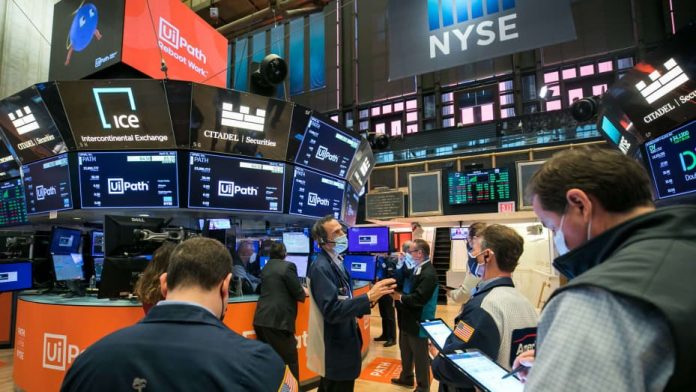
Wall Street kicked off the week on a strong note on Monday, reversing part of a bruising November stretch as investors piled back into tech names and other mega-cap favorites.

Alphabet, Tesla, and Broadcom powered the rebound, helped by growing expectations that the Federal Reserve could finally deliver its first rate cut in December.

The renewed risk appetite followed a wave of dovish signals from influential Fed officials, including Governor Christopher Waller and New York Fed President John Williams. Their comments helped ease pressure after a month-long selloff that had left U.S. equities struggling for direction.

The tone inside the central bank is far from unified, with other policymakers still warning against premature policy easing ahead of December’s FOMC meeting. But traders appear far more convinced the Fed is heading toward a pivot: market pricing now reflects a 76.9% probability of a 25-basis-point cut next month, up sharply from 42% just a week earlier, according to CME’s FedWatch Tool.

That shift alone was enough to ignite buying across the board.

Alphabet jumped 4.6%, Tesla surged 6.7%, and Broadcom notched a standout 10% gain. Communication Services led all S&P 500 sectors with a 3% rise, while chipmakers roared back as the semiconductor index climbed 4.3%.

“It’s a combination of rate-cut enthusiasm, which has completely turned around since Williams made his comments on Friday morning, and the usual fear of missing out,” said Steve Sosnick, chief market analyst at Interactive Brokers.

By late morning — around 11:40 a.m. ET — the indexes were all firmly higher:
• Dow Jones Industrial Average: +249.13 points, or 0.54%, at 46,494.54
• S&P 500: +87.81 points, or 1.33%, at 6,690.80
• Nasdaq Composite: +503.65 points, or 2.26%, at 22,776.74

A Tech Bounce Amid Bubble Concerns

The turnaround offered relief after weeks of turbulence. Markets had been grappling with fears that the artificial-intelligence boom — the engine behind this year’s enormous tech-sector gains — might be tipping toward bubble territory. The volatility was amplified by the prolonged U.S. government shutdown, which cut off key economic data releases that investors typically rely on to gauge demand, hiring, and inflation trends.

Both the S&P 500 and the Nasdaq remain on track for monthly losses in November, with the slide shaping up to be the steepest since the March selloff triggered by tariff-hike worries. Analysts warn that the market’s choppiness may not be over, even if Monday’s rally suggests investors are still willing to buy dips.

Deutsche Bank maintains its bullish long-term view, projecting the S&P 500 will reach 8,000 by the end of 2026, supported by resilient earnings and sustained AI-related productivity gains that bolster corporate margins.

Holiday Season to Test Consumer Strength

Investors will turn their focus later this week to September retail sales and producer price data — key indicators ahead of the crucial holiday shopping season. With Thanksgiving approaching, followed by Black Friday and Cyber Monday, retailers are hoping to capitalize on what could be a record-breaking period.

The National Retail Federation expects holiday sales to surpass $1 trillion for the first time, even as signs of household strain continue to emerge.

A string of layoff announcements, rising unemployment numbers, and new rounds of U.S. tariffs have clouded consumer sentiment. But spending has held up better than expected.

“The consumer sentiment numbers are still lousy. But it’s telling us the consumer is nervous but still somewhat resilient,” Sosnick said.

Sector Movers: Health Stocks, Pharma, and Insurers

In healthcare, Bristol-Myers rose 4.9% after Bayer reported strong late-stage trial data for a cardiovascular drug — news that lifted sentiment across the large-cap pharma space.

Health insurers and hospital operators registered broader gains following a report that President Trump’s health plan could extend certain subsidy provisions for two years. Centene climbed 7.5%, while Oscar Health surged 20% as investors bet on a more favourable short-term regulatory environment.

Advancers comfortably outpaced decliners, with a 1.96-to-1 ratio on the NYSE and 2.18-to-1 on the Nasdaq — evidence that the rally extended beyond the tech giants. The S&P 500 tallied 17 new 52-week highs against two new lows, while the Nasdaq recorded 87 new highs and 88 new lows, a sign the market remains bifurcated even amid Monday’s optimism.

The Bigger Picture

Monday’s upswing was powered by rate-cut optimism, but the market is still navigating a thorny backdrop. Inflation remains above the Fed’s comfort zone, the labor market is cooling unevenly, and trade tensions and lingering shutdown effects continue to distort forecasts.

For now, traders are betting that December marks the beginning of monetary easing — a shift that would relieve pressure on the tech sector’s stretched valuations and give consumers and corporates breathing room heading into 2026.

But with internal divisions at the Fed, a fragile consumer mood, and geopolitical crosswinds still swirling, the path ahead remains uncertain. While investors have embraced Monday’s rally, many remain cautious about calling it a turning point.


Anthropic Claims Coding Crown with “Superhuman” Opus 4.5 Launch – Its Latest Model

0

The relentless velocity of the artificial intelligence arms race accelerated once again on Monday as Anthropic announced the immediate release of Claude Opus 4.5, a flagship model that the startup claims has eclipsed both human experts and rival systems from Google and OpenAI in complex software engineering tasks.

The launch marks the San Francisco-based lab’s third major model release in just two months, underscoring a frenetic pace of development that has propelled the company’s valuation to a staggering $350 billion.

The debut of Opus 4.5 serves as a direct counterstrike to recent moves by Anthropic’s primary competitors. According to the company, the new model is now state-of-the-art for “agentic coding”—the ability of an AI to autonomously plan and execute programming tasks. On SWE-bench Verified, the industry standard test set for measuring software coding abilities, Opus 4.5 reportedly outperformed Google’s Gemini 3 Pro, which was announced just last week, as well as OpenAI’s GPT-5.1.

Perhaps the most striking metric of the model’s capability comes from Anthropic’s internal hiring data. The company revealed that when it tested Claude Opus 4.5 on the rigorous take-home exam given to prospective performance engineers, the AI scored higher than any human candidate in the company’s history. This level of proficiency marks the model as a highly specialized tool for professional software developers, financial analysts, consultants, and accountants—knowledge workers who require high-level reasoning rather than simple chatbot interactions.

Scott White, Anthropic’s product leader for Claude.ai, described the release as a milestone for users eager to expand their professional purview.

“The amount that we’re releasing to the market and the feedback loops that we’re generating from it just make me so unbelievably excited,” White said.

He noted that the ideal user for the new system is someone looking to push their creativity and build new things, as the model is “meaningfully better” at everyday enterprise workflows, such as conducting deep research and manipulating complex data in spreadsheets and slide decks.

The release creates a crowded timeline for the company, known for its “Claude” family of models. The startup unveiled its mid-sized Claude Sonnet 4.5 in late September, followed swiftly by the compact Claude Haiku 4.5 in October. The previous iteration of its flagship, Claude Opus 4.1, was released only in August. This rapid obsolescence cycle is fueled by massive capital injections; just last week, Microsoft and Nvidia announced multi-billion-dollar investments in the firm, cementing Anthropic’s status as a central pillar of the generative AI economy alongside OpenAI and Google.

Beyond the raw intelligence of the model, Monday’s announcement included a suite of integration updates designed to weave Claude deeper into corporate workflows. The company is expanding “Claude for Chrome,” a browser extension that allows the AI to take action across tabs, to all Max users. Additionally, “Claude for Excel,” which enables the AI to understand, edit, and analyze spreadsheets, is now generally available to all Max, Team, and Enterprise users. The startup is also bringing its specialized “Claude Code” environment to its desktop application, further lowering the barrier for non-engineers to generate software.

Claude Opus 4.5 is available immediately and will serve as the default intelligence engine for Anthropic’s Pro, Max, and Enterprise subscription tiers, signaling the company’s intent to capture the high-end enterprise market while the window of technological superiority remains open.

Hyperliquid Team’s HYPE token Allocation Unlocks This Week

0

The Hyperliquid team’s HYPE token allocation is set to begin unlocking this week, specifically on November 29, 2025, marking the first major vesting event since the token’s genesis in November 2024.

This is a cliff unlock followed by linear vesting, and it’s generating significant market buzz and caution due to potential short-term sell pressure. Core Contributors team and early developers, which represents 23.8% of total supply 238 million HYPE out of 1 billion total.

12-month cliff: fully locked until November 29, 2025. Linear vesting over 24 months, releasing ~9.92 million HYPE per month roughly 2.66%–2.97% of current circulating supply, estimated at ~373 million HYPE. First unlock value: Approximately $308–$327 million at current prices ~$33 per HYPE.

Total Over 24 Months: ~238 million HYPE, or up to $500M+ in monthly potential supply if prices hold steady—far exceeding the protocol’s current buyback capacity of ~$30–120M/month from fees.

This structure is designed for long-term alignment but creates a predictable supply overhang, with full vesting extending into 2027–2028. $HYPE has dropped ~20% over the past week to around $30–$33, with elevated volatility and $565M in 24-hour volume.

Traders are de-risking ahead of the event, but on-chain data shows whales accumulating in the $30–$33 range and $4.1M in leveraged long positions. Some analysts see it as a “generational buying opportunity” amid FUD, urging the team to stay silent and let fear drive dips for long-term holders.

Others highlight the protocol’s strength: $4.3B TVL, $260B+ 30-day volume, gas-free trading, and 175+ teams building on HyperEVM. Recent team unstaking of 2.6M HYPE ~$86M has fueled speculation, though no sales have occurred yet.

$HYPE is part of a $566M token unlock wave, including Plasma’s $XPL (Nov 25, $17.5M) and Jupiter’s $JUP (Nov 28, $12.8M). Hyperliquid’s tokenomics are deflationary by design, with 97% of protocol revenue ~$105M/month from $357B derivatives volume funneled into HYPE buybacks via the Assistance Fund.

This has created a self-reinforcing cycle of reduced supply and price support. No VC allocations mean less early sell-off risk.Upcoming catalysts could offset pressure. Institutional staking via Anchorage Digital.

HIP-3 DEX launches and a proposed 450M HYPE burn. HyperEVM mainnet and Airdrop Season 2 in 2026. Potential $1B SPAC deal. Expect volatility and possible dips as recipients team/early backers may sell portions for liquidity—net supply imbalance could push prices lower if volume doesn’t absorb it.

If Hyperliquid sustains growth it’s already the top perp DEX, this could be a stress test it passes, turning unlocks into accumulation zones. Analysts eye $80–$100 by mid-2026 if buybacks scale.

While it’s just the start of a 24-month linear vesting 238 million total, it carries multifaceted implications across markets, sentiment, protocol health, and strategy. Drawing from recent analyses and community discourse.

This is not financial advice—crypto markets are volatile, and outcomes depend on broader conditions like BTC’s trajectory. The influx could increase circulating supply by 2.7% from ~373 million, potentially leading to dumps if recipients sell for liquidity.

Whales have already withdrawn ~$122 million in HYPE pre-unlock, signaling de-risking, and recent team unstaking of 2.6 million HYPE ($86 million) has amplified FUD. Expect 10–30% price dips, with shorts targeting $28 support levels amid a risk-off market.

This is part of a $566 million event including Plasma ($XPL) and Jupiter ($JUP) unlocks, which could compound sector-wide selling in DeFi/perps tokens. Hyperliquid’s $565 million 24-hour volume and $4.3 billion TVL suggest liquidity to absorb some pressure, but leveraged positions risk cascades.

On-chain data shows accumulation at $30–$33, but panic selling could create “generational buy-in” opportunities for spot holders. Lack of team communication on vesting plans is eroding trust in a bearish macro, with calls for transparency to counter “PTSD from past dumps.

Bears are gaining ammo, suppressing spot conviction and boosting perps shorts. Optimists view it as a “coiled spring”—volatility drives fees ~$105 million/month, fueling 97% revenue into buybacks via the Assistance Fund AF, holding 29.8 million HYPE worth $1.5 billion+.

This acts like a “black hole” for supply, reducing availability long-term. Bears highlight overhang risks, with some speculating delays in ecosystem moves to buy cheaper post-unlock. Encourages DCA strategies for believers, with community framing it as a “stress test” for Hyperliquid’s resilience—past unlocks didn’t derail the rally to $50 ATH.

As a top perps DEX, Hyperliquid thrives on volatility—$6.5 million daily fees with zero emissions outperform rivals like dYdX TVL bleed despite bribes and GMX 60% drop post-V2. Builder Codes have routed $100 billion+ volume via 170+ integrations, paying out $40 million and adding 253K users.

Unlocks coincide with catalysts like institutional staking, HIP-3 DEX launches, HyperEVM mainnet, and a proposed 450 million HYPE burn. Portfolio margin via lending/borrowing on HyperCore could “eat all of finance,” per community buzz. No VC allocations reduce early sell risk, emphasizing community focus.

If unlocks erode confidence, TVL could shift to competitors like Aster, but high retention and expansions position it as DeFi’s “AWS of liquidity.” The vesting promotes alignment—full release by 2027–2028 ensures skin-in-the-game, while AF’s buybacks no burns yet create scarcity 1.26 years to absorb all sellable supply at current pace.

This could propel HYPE to $80–$200 by mid-2026 if volume scales, turning unlocks into accumulation zones. Rewards long-term holders via staking/governance; upcoming Airdrop Season 2 and USDH as quote asset broaden utility. Team’s “decades-long vision” and expansions (e.g., $300 million+ DAT accumulation) signal sustainability.

Success here validates buyback models over emissions, influencing copycats via Polymarket’s Builders Program. Failure could highlight vesting pitfalls, but Hyperliquid’s $1 trillion+ cumulative volume and 90K+ users suggest it’s a “revaluation milestone” for on-chain perps.

In essence, short-term pain dips, FUD is probable but buyable for those betting on fundamentals—Hyperliquid’s revenue machine and zero-compromise design make it a standout.

US Equities Open Green at Pre-Markets

Meanwhile, US stock futures are trading in positive territory during premarket hours this Monday, signaling a higher open for major indices amid a shortened Thanksgiving trading week markets close early on Friday and are shut on Thursday.

This rebound follows a volatile November, where the S&P 500 has declined about 3.5% month-to-date and the Nasdaq Composite is down 6.1%, largely due to a pullback in overvalued AI and tech stocks.

Today’s green tone reflects renewed optimism around potential Federal Reserve rate cuts in December, supported by cooling inflation signals and a softening labor market—though economic data remains mixed.

Broad market recovery; extending Friday’s gains after last week’s 2% drop. Tech-heavy; Alphabet (GOOGL) leading premarket gains with +2% on AI optimism. More modest lift; energy and industrials providing support amid stable oil prices ~$60s/barrel.

Traders are pricing in a higher probability of a December Fed cut, with gold prices holding above $4,000/oz reflecting expectations of easier monetary policy without immediate recession fears.

After AI-driven sell-offs, names like Alphabet are bouncing, while broader sentiment tests risk appetite. Light volume due to holidays, but watch for reports from Corporacion America Airports (CAAP) and BioLineRx (BLRX) pre-open; later in the week, key data like jobless claims and manufacturing PMI could sway momentum.

Global cues are supportive, with Asian markets (e.g., Alibaba + in Tokyo trading) edging higher. Crypto and fintech news, like Upbit’s potential Nasdaq IPO, adds to positive vibes in digital assets.

Volumes are thin, so expect some choppiness at the 9:30 AM ET open. If you’re trading, stick to limit orders given the lower liquidity. Fed rate cut probabilities represent the market’s collective expectations for whether the Federal Reserve (Fed) will lower its target federal funds rate—the key benchmark interest rate that influences borrowing costs across the economy—at upcoming Federal Open Market Committee (FOMC) meetings.

These probabilities aren’t official Fed predictions but are derived from the prices of 30-Day Fed Funds futures contracts traded on the Chicago Mercantile Exchange (CME). Traders’ bets on future rates are translated into implied odds using tools like the CME FedWatch Tool.

For example, if futures prices suggest a high likelihood of rates dropping, it boosts the probability of a cut. These odds can shift rapidly based on economic data releases, Fed speeches, and global events. The current federal funds target rate stands at 3.75%–4.00%.

Markets are pricing in a strong chance of easing, driven by cooling inflation and a softening labor market, though recent strong jobs data has tempered aggressive cut expectations. The next FOMC meeting is December 10, 2025, where a 25 basis point (0.25%) cut to 3.50%–3.75% is seen as the base case.

Probabilities for cuts are highlighted where they exceed 50% cumulatively (e.g., any move below the current range). These sum to ~100% per meeting; hikes are negligible (<1%) across the board.

Cumulative cut probability ~82.9% to 3.50%–3.75% or lower. Cumulative cut ~90% further easing expected. Cumulative for ?3.25%: ~47%; markets see ~2–3 more cuts by mid-2026. Cumulative for ?3.00%: ~52%; total easing of ~100 bps priced in over 12 months.

Recent reports have reduced cut odds from near 100% in October to ~75% now, as the Fed balances inflation control with growth risks. Chair Powell’s comments emphasize data-dependence; no cut in September delayed the cycle.

Bond yields and stock futures react instantly—e.g., today’s premarket green reflects cut optimism boosting risk assets. By end-2026, markets imply rates around 2.75%–3.25% a ~100 bps total cut, assuming no recession.

But this could change with upcoming data like Thursday’s Thanksgiving-shortened PCE inflation report. These are market bets, not guarantees—the Fed could surprise.

Indian Rupee Depreciates Against USD On Concerns of Growth and Liquidity

0

The Indian rupee enters a critical week of trading, facing renewed depreciation pressure, with currency desks across Mumbai bracing for a potential slide toward the psychological barrier of 90 per U.S. dollar.

The bearish sentiment follows a punishing week in which the currency slumped to a record low of 89.49 on Friday, capping a 0.8% weekly decline that has left traders scrambling to adjust their positions.

Market participants describe the current environment as a “perfect storm” of headwinds. A sudden bout of portfolio outflows, exacerbated by uncertainty surrounding a pending U.S.-India trade deal and the imposition of U.S. tariffs, has sparked a hit to trade flows. Crucially, the Reserve Bank of India (RBI) appears to have pulled back its defense of key technical levels, a strategic withdrawal that one trader at a large private bank noted “caught the market on the wrong side.”

The currency’s trajectory has been undeniably downward throughout 2025. The rupee has shed 4.5% of its value this year, consistently lagging behind its regional Asian peers despite India’s domestic economic fundamentals remaining resilient and the stock market hovering near all-time peaks. Abhishek Goenka, CEO of forex advisory firm IFA Global, predicts the volatility will continue, forecasting the rupee to settle into a new range between 88.80 and 90.00. He describes the currency’s behavior as a “gradual, staircase-like” descent.

Bond Markets and Central Bank Maneuvers

While the currency markets battle volatility, the bond market is fixated on the RBI’s liquidity management ahead of the central bank’s monetary policy decision on December 5. The benchmark 10-year bond yield settled at 6.5665% on Friday, with traders expecting it to remain rangebound between 6.52% and 6.60% this week.

Investors are closely parsing the central bank’s recent open market operations for clues on policy direction. The RBI net bought bonds worth 148.10 billion rupees ($1.65 billion) in the week ended November 14, following a purchase of 124.70 billion rupees the prior week—its first such buying spree in nearly six months. However, the “frontloaded” nature of these purchases has led to market speculation that this is merely replacement demand rather than a deliberate signal to suppress yields.

The focus now shifts to the December 5 policy meeting, where the debate over interest rates is intensifying. Deutsche Bank Chief India Economist Kaushik Das argues that the time for easing has arrived.

“We expect the RBI to deliver a 25-basis point repo rate cut in the December policy,” Das stated.

Citing the Taylor Rule—a formula used to guide central bank rates based on inflation and growth—Das noted that the terminal repo rate should theoretically fall to 5.25% based on FY27 forecasts.

The Week Ahead

The immediate direction of both the rupee and bond yields will likely be dictated by a heavy calendar of economic data. On Friday, November 28, India will release its fiscal deficit figures and industrial output data, but the headline event will be the GDP growth figures for the July-September quarter. Deutsche Bank forecasts a robust 7.7% expansion, largely keeping pace with the 7.8% growth seen in the previous quarter, while a Reuters poll pegs the number slightly lower at 7.1%.

Globally, the U.S. dollar index remains a formidable opponent, having gained last week despite markets reloading wagers on a Federal Reserve rate cut next month. Dovish remarks from New York Fed President John Williams have solidified expectations, but the greenback remains buoyed by comparative economic strength.

Traders will be watching a slew of U.S. data points that could sway the dollar and, by extension, the rupee. The schedule kicks off Tuesday, November 25, with manufacturing PPI, retail sales, and consumer confidence data. This is followed on Wednesday by durable goods orders, new home sales, and initial jobless claims, all of which will be scrutinized for signs of the economic softening required to justify the Fed’s dovish pivot.

Solana Proposal to Double Deflation Rate Goes Live

0

The Solana Improvement Document (SIMD-0411) went live, proposing a significant adjustment to the network’s tokenomics.

Authored by Solana developers under GitHub handles 0xIchigo and lostintime101, this initiative aims to double the annual disinflation rate from -15% to -30% without altering current staking rewards or introducing new mechanisms like fee burns.

The proposal has sparked widespread discussion in the Solana community, with figures like Helius CEO Mert Mumtaz calling it a potential “permanent change” to the Layer-1 blockchain’s outlook.

Solana’s inflation model was designed to start at 8% in 2020, gradually declining to a long-term target of 1.5% by 2032. Under the existing schedule. Current inflation rate: ~4.5-4.8%. Disinflation occurs in 15% increments every ~1 year 180 epochs. Time to reach 1.5%: Approximately 6.2 years from now.

The SIMD-0411 proposal accelerates this curve: Disinflation jumps to 30% increments annually. Projected time to 1.5%: ~3.1 years by early 2029. Total emissions reduction: 22.3 million SOL $2.9 billion at current prices over the next six years.

This creates a “double disinflation” effect, often dubbed the “double disinflation plan” in community discourse, making SOL scarcer faster and aligning Solana’s monetary policy more closely with Ethereum’s low-issuance model post-Merge.

Solana’s high throughput thousands of TPS and low fees have driven explosive growth, but the network’s inflation has been criticized for “overpaying” for security amid rising fee revenue. With ~70% of SOL staked, emissions fund validator rewards, but proponents argue the current curve dilutes value unnecessarily.

The timing aligns with bullish catalysts: Record inflows into newly launched Solana ETFs (e.g., 21Shares’ TSOL on CBOE, plus Bitwise, Grayscale, Fidelity, and VanEck products) and a broader market rebound. SOL trades around $130, up ~2.5% in the last 24 hours but down 7% weekly.

Validators will vote via on-chain governance. Early signals are positive, with no major opposition reported yet. Faster disinflation could squeeze smaller validators’ margins up to 47 potentially unprofitable in 3 years, though the proposal claims no immediate cuts. Critics from prior debates worry about “analysis paralysis” stalling innovation.

Potential Impact on SOL Price and Ecosystem

If passed, this could reinforce SOL’s narrative as a “mature asset” with stronger DeFi incentives and lower “risk-free” rates for borrowing. Short-term price scenarios:Bull case: ETF inflows + scarcity narrative push SOL toward $144 by end-November per some forecasts.

Broader market risk-off or technical death cross drags it to $100-125 support. This isn’t financial advice—crypto markets are volatile. Track the GitHub pull request for updates: SIMD-0411. The proposal underscores Solana’s maturing governance, prioritizing sustainability amid 2025’s ETF-fueled momentum.

SIMD-0228, formally titled “Proposal for Introducing a Programmatic, Market-Based Emission Mechanism Based on Staking Participation Rate,” was a pivotal governance proposal in the Solana ecosystem.

Introduced in late February 2025 and put to a validator vote in early March, it sought to overhaul Solana’s fixed inflation schedule by introducing a dynamic, market-driven model for token emissions. Authored primarily by Vishal Kankani of Multicoin Capital, the proposal aimed to align SOL issuance more closely with network security needs and economic incentives, potentially slashing inflation by up to 80% under certain conditions.

However, it ultimately failed to pass in a highly contentious vote on March 13, 2025, highlighting deep divisions in Solana’s governance around validator incentives and decentralization.

This analysis breaks down the proposal’s motivations, mechanics, implementation details, risks, community reactions, voting outcomes, and lasting implications. Solana’s original tokenomics, established in 2020, featured an initial 8% annual inflation rate that disinflates by 15% annually until reaching a steady-state 1.5% by around 2030-2032.

This model was designed to bootstrap network security through staking rewards, with ~70% of SOL typically staked across validators. However, as Solana matured—with surging transaction volumes, MEV (Maximal Extractable Value), and priority fees generating substantial revenue—the fixed schedule came under fire for “over-issuing” SOL, diluting token value and creating sell pressure from reward dumps.

Reduce emissions to the “minimum necessary” to secure the network, shifting from passive issuance to revenue-driven incentives like fees and MEV. Use staking dynamics as a signal for network health, incentivizing higher participation without arbitrary cuts.

Address criticisms that high inflation ~4.5-5% at the time outpaced revenue growth, potentially harming SOL’s price and attractiveness to investors. Drew inspiration from models like Livepeer’s 50% staking participation target, which dynamically adjusts rewards to balance security and participation.

Proponents, including Multicoin and figures like Mert Mumtaz, argued it would make Solana’s monetary policy more “Ethereum-like” post-Merge, emphasizing low issuance amid high utility. At its core, SIMD-0228 replaced the fixed disinflation curve with a feedback loop tied to staking participation rate (s), defined as:s = (Total SOL Staked) / (Total SOL Supply)

The model targeted s = 50% as the “equilibrium” point—below this, emissions increase to encourage staking; above it, emissions decrease to avoid over-incentivizing and potential centralization. The adjustment formula was: ?i = k × s_target – s_actual.

Where:i = Annual inflation rate emissions as % of supply. k = Speed coefficient 0.05 per annum, allowing gradual adjustments over ~20 years to reach equilibrium. ?s = Deviation from target (e.g., if s = 40%, ?s = 10%, so ?i = +0.5%). This created a self-regulating system: Low staking triggers higher rewards to bootstrap security; high staking reduces issuance as fees/MEV take over.

Under optimistic scenarios, inflation could drop to ~1% within 2-3 years, saving ~$3.5 billion in emissions over five years. The mechanism would be hardcoded into the Solana runtime via a hard fork, with staking ratio calculated epochally every ~2-3 days using on-chain data.

No immediate changes; adjustments begin post-activation, with simulations showing minimal disruption to current ~6-7% APY for stakers. Validators vote via on-chain signals; delegators could influence via SIMD-0123 reward sharing.

The full draft was discussed on GitHub solana-improvement-documents #229 and the Solana Forum, with simulations shared to model outcomes under varying s values. Automatically scales rewards to actual security needs, potentially lowering long-term inflation to <2% faster than the fixed curve.

Critics argued staking ratio ignores revenue growth or deflation; suggested tying to REV instead. Rapid disinflation could deter new stakers, creating a feedback loop of declining participation. 50% s was seen as too low; suggestions for 67% to maximize “useful” security.

Decentralization Fears: Broader concerns that cuts would centralize power, as noted by Anza and Figment. The failure preserved the status quo but accelerated calls for reform, paving the way for simpler proposals like SIMD-0411 doubling disinflation without dynamics.

SOL dipped ~10% post-vote amid broader market weakness, but long-term, it underscored governance maturation: High turnout showed engagement, but revealed needs for better delegator tools (e.g., Galaxy’s MESA framework).