DD
MM
YYYY

PAGES

DD
MM
YYYY

spot_img

PAGES

Home Blog Page 1144

Meet Blucera WinGPT, WinGPT Enterprise; Call for Partnerships with Companies, Universities

0

Good People, meet Tekedia’s Blucera WinGPT, an AI system which is trained with Tekedia Institute global library and knowledge.  With Tekedia Mini-MBA annual plan, you will have access to this solution later in the month. We want everyone to settle with Tekedia Mini-MBA platform before we move into the domain of using AI to learn on Tekedia’s world class knowledge system at Blucera.

I am also using this moment to ask people to share case studies of companies, with focus on Nigerian and African enterprises. Knowledge about your community.  If you are a company, you can load your knowledge, and your staff can learn about your firm by asking questions through Blucera WinGPT Enterprise version.

If you are a university, the Blucera WinGPT Enterprise can make sense of all lectures, courses, videos, etc within your school, making it easier for students to deepen the academic mastery.  A professor of agriculture loads his class on maize farming, another professor of geography loads her course on the geography of Ovim Abia State, a professor of business administration loads his on farming business in Abia State, etc, our technology will provide clear answers on “How Can A Graduate Build A Maize Business in Ovim?” as the engine aggregates and parses all the knowledge base with practical and actional insights.

Many startups use my One Oasis Strategy around the world. I have expanded the framework, well beyond what I have in Harvard Business Review, to enable the practical application of the One Oasis and Double Play Strategy.  Blucera is launching later in the month.

A Private ChatGPT-Like AI On Proprietary Internal Data

In June, Tekedia Mini-MBA’s learners with an annual plan will have access to Blucera WinGPT, a personal AI educator and coach. Besides other capabilities, Blucera WinGPT will enable learners to study on Tekedia Institute libraries and proprietary internal knowledge systems which are not public. The knowledge systems include videos, written materials, etc. Our system also has a node to global knowledge systems (yes, the public internet).

To companies, universities, and all types and forms of organizations, we can extend what we are doing with our private knowledge systems, to enable you to do the same,  on your own systems. Yes, we will give you a personalized ChatGPT-like AI solution that relies on your internal knowledge systems, not just the global ones, since some of the most impactful understanding of companies can only be done via proprietary data. 

You feed the AI with your internal knowledge and advance your mission. Email support@blucera.com for a Demo; use your business email, not free Yahoo or Gmail.

To Universities and Companies in Nigeria and Africa

We’re excited to unveil Tekedia’s Blucera WinGPT, an AI system which is trained with Tekedia Institute global library and knowledge.  We created this AI to help our learners advance the mastery of business education and entrepreneurial capitalism. Our technology has an enterprise version, Blucera WinGPT Enterprise, which is designed to support universities and companies. Our focus is on Nigeria and broad African companies. With Blucera WinGPT, we bring unification of disparate knowledge within your firm, making it possible for you to see the full picture, and based on that capability, advance your corporate mission. Let us partner with your firm; connect here.
For universities, we take knowledge to a new level. You have, say three professors, and they have created different courses focusing on their specialties – yam farming best practices in Southeast Nigeria (from a Prof of Agriculture), geography of Umuahia (from a Prof of geography), agro business in Umuahia (Prof of a Business Administration) – our technology can help answer questions like “how can I build a good yam farming business in Umuahia?”,  by heuristically parsing the knowledge base, and in the process deliver actional practical insights for farmers, students and policymakers.

What we have done is beyond software. Yes, besides coding, we’re microelectronics engineers. Fasmicro, Intel’s only programmable microprocessor knowledge partner in Africa (here on Intel website), is our company, and we are experts on building the infrastructure component of the AI agentic era.

I am using this medium to reach professors with PhD students in their labs, to explore how we can partner to aggregate proprietary knowledge, deepen productive applications and fulfil the vision of UNN (to restore the dignity of man & woman) through my beloved FUTO’s mission of “technology for service”.
U.S. Securities and Exchange Commission (SEC) Rescinds 14 Rule Proposals Under Gary Gensler

0

U.S. Securities and Exchange Commission (SEC) announced on June 12, 2025, the withdrawal of 14 rule proposals introduced during the tenure of former SEC Chair Gary Gensler under the Biden administration. These proposals, introduced between October 2020 and November 2023, were rescinded under the leadership of new SEC Chair Paul Atkins, signaling a shift in the agency’s regulatory approach. The decision reflects a move away from what some critics described as an overly regulatory agenda, particularly in areas affecting investment managers and the cryptocurrency industry.

This would have expanded the Custody Rule to include all assets, such as cash, real assets, and cryptocurrencies, requiring segregation to protect them in case of bankruptcy. Critics argued it was impractical for certain assets and could limit banking services for crypto firms. Proposed in May 2022, this rule aimed to combat “greenwashing” by requiring funds claiming ESG (environmental, social, governance) focus to disclose specific details about their strategies and categorize them as integrated, focused, or impact funds.

Predictive Data Analytics and Conflicts of Interest: This rule targeted the use of AI, machine learning, and data algorithms by investment advisers to address potential conflicts of interest.

Cybersecurity Risk Management: Proposed in February 2022, it would have mandated broker-dealers to maintain policies identifying cybersecurity risks and report major incidents to the SEC within 48 hours.

Regulation Best Execution (Reg BE): Proposed in January 2023, it aimed to shift enforcement of best execution standards from FINRA to the SEC.

Adviser Outsourcing: This would have imposed diligence, monitoring, and recordkeeping requirements on investment advisers outsourcing certain functions.

Order Competition Rule: Intended to enhance competition in securities trading. Exchange Act Rule 3b-16: This proposal would have included decentralized finance (DeFi) platforms under national securities exchange rules, a move criticized by blockchain policy experts.

The SEC provided no detailed reasoning for the withdrawals, stating only that it no longer intends to issue final rules for these proposals. Industry experts, such as Jay Gould from Baker Botts, noted that many of these areas are already covered by existing SEC regulations, suggesting the specific rules may have been redundant. For instance, conflicts of interest are regulated even without the predictive data analytics proposal, and misleading ESG claims remain prohibited.

The move has been praised by figures like Rep. French Hill (R-Ark.), Chair of the House Committee on Financial Services, who called it a step toward restoring balance, protecting investors, and encouraging innovation. In the crypto sector, the withdrawal of rules like the Custody Rule and Exchange Act Rule 3b-16 is seen as a shift toward a more pro-crypto regulatory stance under Atkins’ leadership, emphasizing clarity and consultation over enforcement.

The SEC’s decision to rescind 14 unfinished rule proposals from the Gensler era, announced on June 12, 2025, carries significant implications for financial markets, investors, and specific industries like cryptocurrency. The withdrawal of rules like the Safeguarding of Client Assets, Adviser Outsourcing, and Predictive Data Analytics reduces compliance burdens. Firms won’t face new requirements for asset custody, outsourcing oversight, or AI-driven conflict management, potentially lowering operational costs.

Scrapping the Cybersecurity Risk Management and Regulation Best Execution proposals means broker-dealers avoid stricter reporting and enforcement standards, maintaining reliance on existing FINRA regulations. The rescission of the Safeguarding of Client Assets and Exchange Act Rule 3b-16 proposals is a major win for the crypto sector. The former would have imposed stringent custody requirements on crypto assets, potentially limiting banking services for crypto firms. The latter would have classified DeFi platforms as securities exchanges, subjecting them to heavy regulation.

This signals a more crypto-friendly SEC under Chair Paul Atkins, likely fostering innovation and market growth in blockchain and digital assets. It aligns with broader political shifts, as seen in comments from Rep. French Hill, emphasizing innovation. The withdrawal of the ESG Disclosures rule means funds won’t need to categorize or provide detailed disclosures for ESG strategies. This could lead to continued “greenwashing” risks, as investors may lack clear information to assess ESG claims, but it also reduces compliance costs for funds marketing ESG products.

The move reflects a pivot toward deregulation under the new SEC leadership, prioritizing market efficiency and innovation over stringent oversight. This could encourage risk-taking and investment but may raise concerns about investor protections, especially in areas like cybersecurity and conflicts of interest. Without rules like ESG Disclosures or Cybersecurity Risk Management, investors may face higher risks from misleading fund claims or unreported cyber incidents. However, existing SEC and FINRA regulations still provide some safeguards.

Reduced regulatory burdens could stimulate market activity, particularly in crypto and alternative investments, but may also lead to volatility if oversight gaps emerge. The decision aligns with a broader deregulatory agenda under the incoming administration, as Atkins’ leadership emphasizes consultation over enforcement. This could set the stage for further rollbacks or a reevaluation of SEC priorities, impacting future rule-making.

Critics may argue that withdrawing these proposals weakens investor protections and market stability. For example, the absence of the Cybersecurity Risk Management rule could leave markets vulnerable to unreported cyber threats, while scrapping the Order Competition Rule may limit trading efficiency gains. The SEC’s action creates a more permissive environment for financial and crypto industries, potentially spurring innovation but raising concerns about oversight gaps.

Amazon and Walmart Explore Launching Their Own Stablecoins Amid U.S. Government Support and Surging Institutional Adoption

0

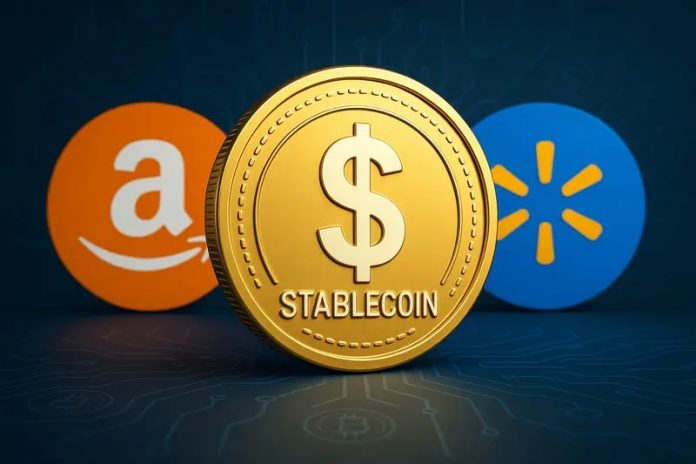
Retail giants Amazon and Walmart are reportedly exploring the launch of their own U.S. dollar-pegged stablecoins, according to The Wall Street Journal.

The move signals a significant shift in how major retail players are thinking about the future of payments—away from traditional banking infrastructure and toward blockchain-based financial instruments that promise faster, cheaper, and more borderless transactions.

Unlike volatile cryptocurrencies such as Bitcoin, stablecoins are designed to maintain a fixed value, typically pegged to a fiat currency like the U.S. dollar or commodities such as gold. Amazon and Walmart’s consideration of stablecoins underscores a growing trend of institutional adoption and comes at a time when stablecoins are increasingly being positioned not just as a private sector innovation—but as a tool of national financial strategy.

Institutional Adoption Grows on the Back of U.S. Government Backing

Stablecoins are no longer confined to crypto-native startups. Major financial institutions like JPMorgan Chase, Citigroup, Bank of America, and Wells Fargo are already working on launching a joint stablecoin, while travel tech firms like Expedia and U.S. airlines are looking into stablecoin integration to optimize payments and reduce cross-border transaction frictions.

This momentum is being buoyed by growing U.S. government support. U.S. Treasury Secretary Scott Bessent, speaking before a Senate Appropriations subcommittee on Wednesday, projected that dollar-linked stablecoins could surpass $2 trillion in market capitalization, positioning them as a strategic financial instrument for global economic growth.

“The rise of stablecoins is part of a larger strategy to enhance and preserve the U.S. dollar’s position as the world’s reserve currency,” said Bessent, a veteran of global currency markets and former hedge fund executive. “Stablecoin legislation backed by U.S. Treasuries or T-bills will create a market that will expand U.S. dollar usage via these stablecoins all around the world.”

Bessent also revealed that legislation is being drafted in Congress that would mandate stablecoins to be fully backed by high-quality liquid assets, such as U.S. Treasury bills. The goal is to ensure price stability, build trust among users, and create a transparent framework that could attract even more corporate issuers like Amazon and Walmart.

“This administration is committed to keeping the reserve currency status and enhancing that,” Bessent added, reinforcing the idea that stablecoins are now being considered an extension of U.S. financial policy.

What This Means for Amazon and Walmart

For Amazon and Walmart, the push toward launching stablecoins is as much about logistical optimization as it is about financial independence. With massive global operations, these firms stand to save billions on transaction fees, enhance settlement speed, and reduce reliance on intermediaries like banks and card networks.

Amazon has previously posted crypto-related job openings and invested in blockchain tools through its AWS cloud division. Walmart, meanwhile, filed patents several years ago for a digital currency and has tested blockchain to track supply chains.

However, both companies are likely waiting for clearer regulatory signals, especially around the GENIUS Act—a proposed bill that aims to govern the issuance and backing of stablecoins. While the bill is receiving Republican support, it has faced criticism from Democrats who warn about the risks of private corporations issuing widely used digital money.

According to DeFiLlama, the total market cap of stablecoins currently stands at $251 billion, dominated by Tether’s USDT and Circle’s USDC, which collectively command more than 86% of the market. Smaller entrants like PayPal’s PYUSD and even USD1, a stablecoin tied to entities affiliated with President Donald Trump, have failed to gain significant traction.

However, the entry of Amazon and Walmart could change that. With their vast customer bases, global reach, and infrastructure to support adoption, these firms could quickly become dominant players in a space previously led by fintech startups and crypto-native platforms.

Their adoption of stablecoins would not only put pressure on existing players but could also accelerate the normalization of digital dollar usage in everyday commerce, laying the groundwork for a broader transformation of how payments are handled globally.

In essence, stablecoins are no longer a fringe innovation. They’re rapidly evolving into a pillar of modern finance, and the involvement of Amazon, Walmart, Wall Street banks, and the U.S. government suggests they may soon become as ubiquitous as credit cards—and far more transformative.

Moove Eyes Unicorn Status With $300M Fundraise Amid U.S Expansion

0

Moove, the African-born global mobility Fintech that provides revenue-based vehicle financing and financial services to mobility entrepreneurs, is reportedly in the process of raising $300 million in a new funding round that could propel its valuation beyond the $1 billion mark.

This would mark a major milestone for the startup as it positions itself as a key player in the evolving mobility and autonomous vehicle ecosystem. The funds will enable Moove to deepen its role in the autonomous vehicle sector, potentially leasing robotaxi fleets, and positioning it as a leader in future mobility solutions.

Founded in 2020 by Ladi Delano and Jide Odunsi, Moove provides vehicle financing solutions to ride-hailing drivers using a drive-to-own model. The company purchases vehicles using bank loans and leases them to drivers in Africa, India, and the UK, who pay for the vehicles from their earnings and can eventually own them.

Moove has built the third side of mobility marketplaces by providing dedicated supply via Drive-to-Own, Taxi, and Autonomous fleets and continues to lead the transformation of mobility globally. Since its inception, the company has raised $750 million in debt and equity to date from investors such as Uber—which holds over a 10% stake and Mubadala Investment Company.

In 2024, Moove secured $100 million at a $750 million valuation. Now, with a $300 million raise on the horizon, the startup could be on the verge of joining the unicorn club. Achieving a valuation above $1 billion would place Moove among elite startups, enhancing its reputation and attracting more investors, partners, and talent.

In December 2024, the company partnered with Waymo, the global leader in autonomous driving technology. This partnership marked a defining moment in its journey to revolutionize mobility and place Moove at the forefront of the commercial AV revolution on a global scale.

Through this partnership, Moove will play a pivotal role in supporting Waymo’s expansion into Miami in 2026, while taking over existing fleet operations in Phoenix, one of Waymo’s most established markets, in 2025. Also, the company will deploy Waymo’s fleet of autonomous vehicles into the Waymo One service. From overseeing fleet operations and charging infrastructure to optimising vehicle supply availability, Moove’s operational expertise will ensure a seamless, safe, and sustainable rider experience.

Moove’s expansion into the U.S. market and its deepening partnership with Waymo, Alphabet’s self-driving vehicle unit, highlight its growing ambitions.

Fast forward to January 2025, Moove announced the acquisition of Kovi, an urban mobility provider headquartered in São Paulo. This strategic acquisition aligns with Moove’s commitment to advancing mobility and expanding its footprint in the rapidly growing Latin American market.

Beyond this, Moove is preparing for a broader role in the autonomous vehicle space. According to co-founder Ladi Delano, the company is exploring the purchase of autonomous vehicles directly from manufacturers to lease out as mini fleets. These could be operated by individuals—including former ride-hailing drivers—or businesses.

A key component of Moove’s growth strategy has been strategic acquisitions. The company’s annualized revenue has soared to $360 million—up from $115 million a year earlier—indicating monthly revenues of about $30 million.

Moove’s vision is to build the world’s largest fleet and best-in-class technologies to power mobility platforms. The company is transforming the future of Mobility as a Service by providing comprehensive fleet solutions across the mobility spectrum.

Notably, this latest fundraising initiative reflects Moove’s intent to scale aggressively and solidify its role in the next generation of urban mobility. As the company grows its presence in autonomous fleet management and continues to innovate in vehicle financing for drivers, its path toward becoming a unicorn looks increasingly likely.

Oil Prices Surge 7% as Israel-Iran Conflict Escalates – But It’s Not All Good News For Nigeria

0

Global oil prices surged on Friday, marking the sharpest single-day gain in over two years, as hostilities between Israel and Iran intensified. The spike was ignited by fears of a wider conflict in the Middle East that could severely disrupt oil exports from the region.

Brent crude jumped by 7 percent to close at $74.23 per barrel, after touching an intraday high of $78.50 — the strongest level seen since January 27. Similarly, U.S. West Texas Intermediate (WTI) surged to $72.98 per barrel, up $4.94 or 7.6 percent, after earlier reaching $77.62. Both benchmarks recorded their largest intraday gains since Russia’s 2022 invasion of Ukraine, which had caused a similar shock across global energy markets.

The price rally follows Israel’s targeted airstrikes on Iran’s nuclear facilities, ballistic missile factories, and senior military command infrastructure. Iran responded by launching missile attacks on Tel Aviv and parts of southern Israel. Both sides have vowed to continue their operations, signaling a prolonged conflict that investors worry could spill over into energy infrastructure or transport routes.

At the center of this concern is the Strait of Hormuz, a narrow maritime chokepoint that handles nearly 20 percent of global oil traffic — roughly 18 to 19 million barrels per day. Any threat to free passage through this waterway could significantly disrupt global oil supply chains.

Although Israeli strikes have so far avoided Iranian oil infrastructure, including Kharg Island, which is responsible for about 90 percent of Iran’s crude oil exports, analysts warn that any retaliatory attacks could follow an “energy-for-energy” pattern. This raises the specter of Iranian strikes on Gulf oil facilities or Israel’s allies in the region.

Not All Good News for Nigeria

For Nigeria, which relies heavily on oil exports, the sharp increase in oil prices offers an immediate fiscal upside. The country’s 2025 national budget is benchmarked at $75 per barrel. A sustained rally above this threshold could translate into higher revenues, potentially easing Nigeria’s budget deficit and enhancing foreign exchange reserves.

However, the development is far from good news for the general public. Nigeria, despite being an oil-producing country, depends heavily on imported petroleum products to meet domestic fuel demand. Although the recent activation of the Dangote Refinery has reduced the volume of petrol imports, the price of refined fuel in the country still responds to movements in international crude prices. The refinery sources crude from outside Nigerian shores.

Since commencing partial operations, the Dangote Refinery has helped ease petrol prices by selling at a lower rate compared to imported alternatives. In recent months, Dangote Industries slashed its ex-depot petrol price to around N840 per liter, making retail prices in Lagos fall to between N860 and N910. This was largely possible due to declining crude oil prices earlier in the year, which allowed the refinery to maintain relatively cheaper production costs.

But with crude now threatening to breach $100 per barrel amid escalating geopolitical tensions, the situation may soon reverse. Should oil prices remain elevated, the cost of refined products from Dangote Refinery will inevitably rise, erasing the gains made so far. This means Nigerians could begin to pay well over N1,000 per liter of petrol — a move that could trigger widespread discontent in a country already battling soaring inflation and meager wages.

Such a scenario also risks dragging the government back into subsidy territory. The administration of President Bola Tinubu removed petrol subsidies in mid-2023, citing unsustainable fiscal costs. However, if pump prices spiral out of control and public backlash intensifies, pressure may mount on the government to either intervene or reinstate some form of price support — an action that could further strain public finances.