DD
MM
YYYY

PAGES

DD
MM
YYYY

spot_img

PAGES

Home Blog Page 12

Amazon Blocks Meta’s Muse, Exposing New Fault Line in AI Shopping Race

0

Amazon is blocking Meta’s Muse from accessing its marketplace, exposing an emerging fault line in the race to build AI agents that can shop, transact, and carry out tasks on behalf of users.

People using Meta’s personal AI assistant to access Amazon are encountering a warning that “continued access by an unauthorized AI agent” violates the retailer’s conditions of use.

Amazon said it had asked Meta to remove its marketplace from Muse, arguing that third-party AI agents cannot assume access to commercial websites simply because users want them to perform tasks there.

“Third-party applications that offer to make purchases on behalf of customers from other businesses should operate openly and respect service provider decisions about whether or not to participate,” an Amazon spokesperson said.

“Agentic third-party applications such as Muse have the same obligations,” the spokesperson added.

The dispute highlights a problem that could become more valuable as AI agents move beyond answering questions and begin acting independently across the internet. A chatbot can provide a link to a product. An agent can potentially search for the product, compare prices, log into an account, and complete the purchase.

That difference gives retailers a new reason to control how AI systems interact with their platforms. Amazon says Muse was not authorized to access its store, does not identify itself as an AI agent, appears to capture and store customer credentials, and scrapes account data. The company also argues that automated agents can bypass elements of its personalized shopping experience, potentially presenting products without taking into account a customer’s purchase history and recommendations.

Amazon said it expects AI agents to be transparent about their activity, give retailers the ability to opt out, and establish a “mutual exchange of value” with the businesses whose platforms they access.

The confrontation was flagged by Muse users on X after Amazon’s bot-detection systems began blocking access. Startup founder Jonathan Wegener posted a screenshot of the warning, highlighting the direct conflict between AI agents and websites designed around human users.

Amazon’s existing conditions of use do not explicitly refer to AI shopping assistants, but they prohibit the use of “data mining, robots, or similar data gathering and extraction tools.” The company has relied on that language as it seeks to limit automated access to its marketplace.

The dispute with Meta is also not an isolated case. Amazon has sued Perplexity over shopping activity conducted through its Comet browser and has moved to restrict agents from Google and OpenAI.

Meta launched Muse on September 8 as a general-purpose AI assistant capable of handling multistep tasks involving email, calendars, dining, payments and shopping. The application reached the top of Apple’s US free-app chart within a week, underscoring rapid consumer interest in systems that can do more than generate text or answer questions.

The Amazon dispute, however, exposes the limits of that model.

AI companies can build agents capable of navigating websites, but they do not necessarily control whether those websites will accept automated activity. As agents become more autonomous, access rights, authentication, data handling, and commercial agreements could become as important as the underlying AI capabilities.

The issue is especially sensitive in e-commerce because the agent sits between the consumer and the retailer. An agent that chooses products, decides where to buy them and completes transactions could influence which merchants receive sales, how products are ranked and what customer information is shared.

For retailers, that creates both an opportunity and a threat. AI agents could generate additional purchases by making shopping easier, but they could also weaken the direct relationship between retailers and customers. An intermediary agent could determine what consumers see, which products they compare, and where their money ultimately goes.

Amazon has already indicated that it wants a commercial framework for that relationship rather than unrestricted access.

There is also a potential contradiction in the emerging AI shopping market. Agents need access to large retail platforms to become useful, while those platforms have little incentive to surrender control of customer data, recommendations, and transactions without receiving something in return.

That tension could force the development of a new layer of agreements between AI companies and online businesses. Instead of agents treating the open web as an unrestricted operating environment, retailers may demand authenticated access, explicit identification of AI systems, limits on data collection and commercial arrangements governing transactions.

The economics could become significant as well. If AI agents become a major channel for online shopping, retailers will have to decide whether to treat them as another source of traffic, paid distribution partners, or competitors for the customer relationship.

Amazon’s relationship with OpenAI adds another complication. The companies recently announced an advertising partnership, suggesting that Amazon has a commercial incentive to work with at least some AI systems even as it resists unauthorized automated shopping activity.

For Meta, the challenge is more fundamental. Muse’s value depends partly on its ability to act across services that Meta does not control. If major platforms can independently block the agent, its ability to function as a general-purpose assistant becomes dependent on a patchwork of permissions and commercial agreements.

The Amazon dispute therefore goes beyond a single bot blocker. Many see it as an early test of who controls the next interface to the internet: the platforms that own the websites and customer relationships, or AI agents that want to act on behalf of users across those platforms.

Muse may be ready to shop, but Amazon’s response shows that retailers are not necessarily ready to let AI agents do the shopping on their terms.

Meta’s Muse AI Agent Surges to No. 1 on U.S. App Store, Challenging ChatGPT

0

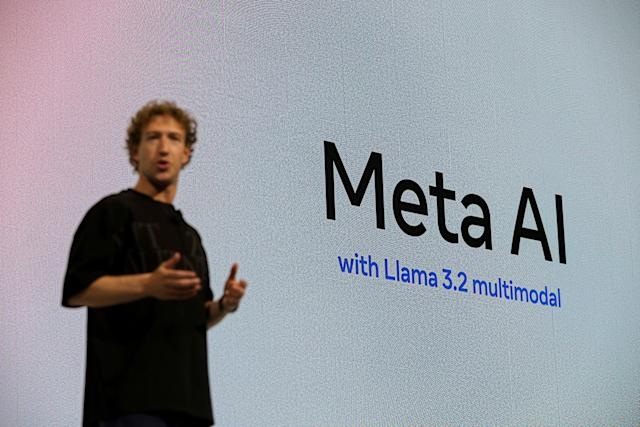
Meta’s Muse AI personal agent has taken the top spot among free iPhone apps in the U.S., overtaking OpenAI’s ChatGPT less than two weeks after its launch and giving Mark Zuckerberg’s push into consumer AI agents an early sign of traction.

Muse ranked ahead of ChatGPT, Polymarket, Kashi, Anthropic’s Claude, xAI’s Grok and Meta’s own Meta AI app on Apple’s U.S. App Store on Monday.

The app moved into the No. 1 position on Friday, just days after Meta released it on September 8. According to analytics firm Sensor Tower, Muse recorded about 730,000 downloads over roughly five days following its launch.

Its cumulative downloads during that initial period also exceeded those of ChatGPT, Claude and Grok, although Sensor Tower cautioned that differences in the timing of releases across Apple’s App Store and Google Play affect comparisons.

The early adoption gives Meta an important foothold in a market that is beginning to move beyond conventional chatbots toward AI systems capable of taking actions for users.

Meta is positioning Muse as a personal AI agent that can perform tasks across the internet, including filling out electronic forms and organizing email inboxes. The application is powered by Meta’s Muse Spark family of AI models and represents one of Zuckerberg’s most significant attempts to put agentic AI directly into consumers’ hands.

The distinction between an AI chatbot and an agent is central to the strategy. Traditional chatbots primarily respond to prompts, while agents are designed to carry out tasks on behalf of users, potentially interacting with websites, applications, and digital services without requiring users to execute every step themselves.

“I think up to this point most of the agentic use cases have not really been for normal people,” Bernstein analyst Stacy Rasgon told CNBC. “Now you’ve got Meta’s Muse and other agents out there that are starting to maybe get more potential for more broad-based adoption.”

That shift could create a much larger consumer market for AI. Instead of using an AI system occasionally to generate text or answer questions, users could increasingly delegate routine digital work to an agent.

For Meta, the opportunity extends beyond user engagement.

Meta Sees A New AI Revenue Stream

Muse is free to download, but Meta is also offering monthly subscriptions priced at $20 and $100 depending on usage. That gives the company a potential source of AI revenue that is separate from its advertising business, which remains the foundation of Meta’s finances.

The subscription model is significant because the economics of consumer AI agents could differ from those of conventional social media products.

Running an agent capable of browsing the web, processing documents, managing email, and completing transactions can require substantially more computing resources than serving advertising-supported social feeds. A paid subscription could therefore become an important mechanism for covering those costs while giving Meta another way to monetize its growing AI infrastructure investment.

The initial market response was also visible in Meta’s shares, which jumped more than 11% on Monday. Wells Fargo raised its price target for the company to $796, according to multiple reports.

But the early success of Muse does not yet establish that Meta has created a durable consumer AI franchise.

AI applications have repeatedly experienced sharp increases in downloads after launch before losing momentum. OpenAI’s Sora and Meta’s Vibes AI video application are examples of products that generated substantial initial interest without establishing the same level of sustained consumer engagement as their launch-period performance suggested.

Muse also faces a more complicated challenge than simply attracting users: convincing them to trust an AI agent with access to sensitive personal information and the ability to take actions on their behalf.

That issue is already emerging.

Amazon recently blocked the Muse bot from accessing its website, according to GeekWire, citing privacy and security concerns.

“We think it’s fairly straightforward that third-party applications that offer to make purchases on behalf of customers from other businesses should operate openly and respect service provider decisions about whether or not to participate,” an Amazon spokesperson told GeekWire.

The dispute illustrates one of the major problems facing the agentic AI industry. An AI agent that can independently navigate websites and make purchases is more useful than a chatbot, but that capability also gives websites greater reason to control how external agents interact with their systems.

Meta is receiving a different response from Shopify.

Shopify CEO Tobias Lütke said Monday that the e-commerce company is working with Meta to enable agentic checkout in its online stores. The partnership could give Muse a direct path from recommending or finding products to completing purchases on participating merchants. That could become an important test of whether AI agents can evolve into a new interface for commerce.

But the broader issue is trust.

Meta has already faced intense scrutiny over the effects of its social platforms on younger users and recently agreed to pay about $17 billion to settle with a coalition of state attorneys general that had sued the company over alleged harms to children and teenagers associated with products including Facebook and Instagram.

Muse introduces a different category of risk because the product is designed to operate using users’ personal information and potentially act on their behalf.

Rasgon said the key question is whether Meta can maintain security while addressing privacy concerns surrounding a product that could have access to large amounts of personal data.

“They care about security, I don’t know how much they care about privacy,” he said.

That could increasingly come into play as agents move from answering questions to performing real-world digital tasks.

For Meta, the early App Store ranking provides evidence that consumers are willing to experiment with that model. But sustaining that interest will depend on whether Muse can become something users rely on regularly rather than another AI application that experiences a burst of curiosity before fading.

The competition is also intensifying. ChatGPT already has a large installed user base, while Claude and Grok are competing for consumers interested in sophisticated AI assistants. Google is also developing agentic products designed to integrate AI into everyday tasks.

Muse therefore enters a market where distribution is as important as model capability. Meta’s enormous consumer ecosystem gives it access to billions of potential users, while its control of social platforms, messaging services and advertising infrastructure could eventually give its agents more opportunities to interact with the digital lives of consumers.

The first two weeks show that Meta can generate attention. The harder test will be whether Muse can turn that attention into recurring usage, paid subscriptions and trusted transactions. If it does, the significance of the App Store ranking will extend beyond a successful product launch. It would indicate that AI agents are beginning to move from an experimental technology used mainly by enthusiasts into a consumer software category capable of competing directly with the leading AI assistants.

What is Wild Rift Boost and How Does Wild Rift Boosting Work?

0

What is Wild Rift Boosting in practical terms? It is ranked progression assistance provided by a stronger player, usually through account-share, duo queue, placement games, or coaching. Wild Rift boost through Eloboss connects account owners with high-rank specialists who can handle rank targets, net wins, and placements, or play alongside the customer while they retain control of the account.

Objectives vary depending on each particular order. One may seek to achieve a certain level by the end of the season, regain losses after a hard streak, or understand how an experienced player conducts drafts, rotations, and objectives.

What Is Wild Rift Boosting?

A Wild Rift boost is a service designed to move an account toward a defined ranked goal. Unlike a vague promise to improve results, an order normally has a measurable endpoint, such as a target rank, a fixed number of wins, or completion of placement matches.

Ranked progression is not determined by the visible rank alone. The game also relies on hidden information from matchmaking in order to create matches for two players with equal ranks who might be advancing in their ratings at different rates depending on recent performance, the quality of matchmaking, and the current ranked status of the account.

The one executing the order is generally an experienced top-tier player. A strong booster relies on stable decision-making rather than trying to force every game. In Wild Rift, it is generally building around what the team lacks, taking control of early game objectives, and not entering avoidable fights where a better deal is available on the map.

Often coaching is mentioned together with boosting; however, the process of coaching differs from boosting. Coaching is about studying the client’s gameplay and improving it, while boosting is more direct assistance with ranked progression.

How the Wild Rift Boosting Process Works

The usual order starts with selection of an objective by the customer, such as reaching a certain rank, achieving net wins, placing the account, or duos. The platform might also ask to specify server, preferred mode, number of wins required, preferred role, and other factors.

The typical sequence of the order execution process is:

  1. Customer selects rank progress, net victories, placements, duo queue, or coaching.
  2. Price is formed based on the rank difference and selected add-ons.
  3. An appropriate booster is assigned to the order.
  4. The customer monitors the progress through the dashboard, match history, or other means.
  5. Order is completed once the selected target is met.

Higher-rank orders may cost more because they can require more games and a higher level of expertise. The price for a duo queue can be different due to the need for coordination of the customer and booster. The server population, queue limitations, and speed of order completion can also influence the quotation.

Before placing an order, players are able to compare available options, prices, customer support, and other order features to find the most fitting service.

Modern boosting platforms, including Eloboss, provide additional features, such as vpn protection, offline mode, duo queue, and order monitoring to make the process transparent.

The account-share option includes accessing the account by the specialist; therefore, the policies of Riot Games should be taken into consideration.

Popular Wild Rift Boosting Options

The best format depends on how involved the customer wants to be. Some methods prioritize speed, while others keep the account owner inside every match.

Account-Share Boosting

Account-share boosting implies that the specialist accesses the account and plays ranked games until the desired outcome is achieved. It takes minimal time from the account owner and is frequently ordered to obtain direct ranking or net wins in a bundle.

During an account-share order, the booster handles the active sessions until the selected objective is completed.

Duo Queue Boosting

Duo queue involves the customer playing along with an experienced teammate on his/her account. The player influences the games by applying pressure to lanes, rotating, calling objectives, and making more consistent decisions in late game.

This format suits someone who wants to stay involved. It also creates a chance to study practical details that are difficult to pick up from generic guides, such as when to abandon a losing fight or trade Herald pressure for a dragon setup.

“For customers who want to keep control of their login and follow the games directly, duo queue is usually the preferred method,” says Eloboss, a Wild Rift boosting and coaching service.

Wild Rift limits ranked parties according to tier differences, so duo availability can change with the customer’s rank and the account used by the booster.

Placement Match Boosting

Placing the account into a new starting rank is done by the services providing placing assistance. They are popular among players during seasons reset periods as each victory or defeat affects the future climb.

A placement order can be offered on the basis of matches instead of final ranks. No one can manipulate the matchmaking process entirely, and therefore the contract should clearly state what is provided – games or victories.

Net Wins and Per-Game Orders

Net-win packs represent the gap between wins and losses. In case of orders involving five net wins, usually the loss should be neutralized first before moving closer to the goal.

Game packages are easier. In this case, the client buys a specific number of games or wins without having to lock in at a certain level. This option is suitable when there is little left to reach.

Coaching and Self-Play

With coaching, the client remains in charge, but still a top-ranked player analyzes live gameplay or replayed game footage. Coaching might focus on one particular topic like pathing in the jungle, the timing of recalls, selecting champions, or positioning during the end game.

The self-play service might look like a guided duo queue. The client plays, gets calls and makes decisions instead of giving away the whole climbing process.

Why Players Choose Wild Rift Boosting

Time is the clearest reason. Wild Rift matches are shorter than PC League games, but a ranked climb can still require dozens of sessions. A player with limited weekly availability may want the result without committing an entire season to the ladder.

Seasonal milestones create another deadline. Ranked rewards and personal targets become harder to reach after a poor start or an extended losing run, particularly when only a few days remain.

Some customers feel comfortable at a higher level but struggle to get through a specific tier. Others want access to stronger lobbies, need help completing placements, or want to close the distance between their rank and that of their regular teammates.

Learning may be another component of the decision process as well. Duos allow the client to observe how his top rank team mate performs contested objectives, modifies his build in the game, or plays around a difficult lane. Coaching focuses even more on these aspects.

Key Benefits of Wild Rift Boosting

The first advantage is a quicker way of getting a set ranked milestone. Rather than keeping the destination open-ended, the customer will determine the scope of work beforehand.

Adjustable participation is available. If the client is unable to participate in the sessions, the account-share method suits them, while duo queue and coaching will ensure that the customer takes part. This distinction is more important than slight time delivery differences.

The structured provider may also provide:

  • Progress management using an order dashboard
  • Assistance while there is an active order
  • Rank, win and placement package options
  • Selection of boosters depending on server or tier goal
  • Clarified completion and refund conditions

After reaching a new tier, some players also choose coaching to adjust to the stronger level of competition. Once the player enters a new tier, he or she faces new opponents, and therefore a smaller target is usually easier to retain. A short coaching session after reaching it will help with choosing a champion and making decisions in the new tier.

Final Thoughts

There are several formats of Wild Rift boosting, including account-share progression, duo queue, and coaching. The best format depends on how much the player wants to participate in the boosting and what he needs.

Before placing the order, players might compare the goal, format, price, and available support in order to find a service fitting their preferences. The clearly defined objective will help to make the choice.

7 Best AI Video Marketing Tools Startups Can Use Before Scaling Paid Ads

0

Before a startup puts real money behind paid ads, it needs to know which video creative actually works. That testing phase is where a lot of early budget gets wasted, mostly because teams either produce too little content to compare or they spend too much on production before they know if the concept is worth scaling. The tools on this list are built for that in-between stage. They let founders and small marketing teams produce, review, and compare video content without needing a full production crew behind every idea.

Why Testing Video Matters Before You Scale Ad Spend

Paid platforms tend to reward creative that performs, not creative that simply exists. A startup that jumps straight into scaled ad spend with unproven video often pays more to get the same result a tested asset would have delivered for less. Running a few concepts through review before committing budget gives founders a clearer picture of what’s working and what isn’t. That’s the real value these tools bring. They shorten the distance between an idea and a testable video, so decisions about paid spend are based on something real instead of a guess.

1. Intellemo AI

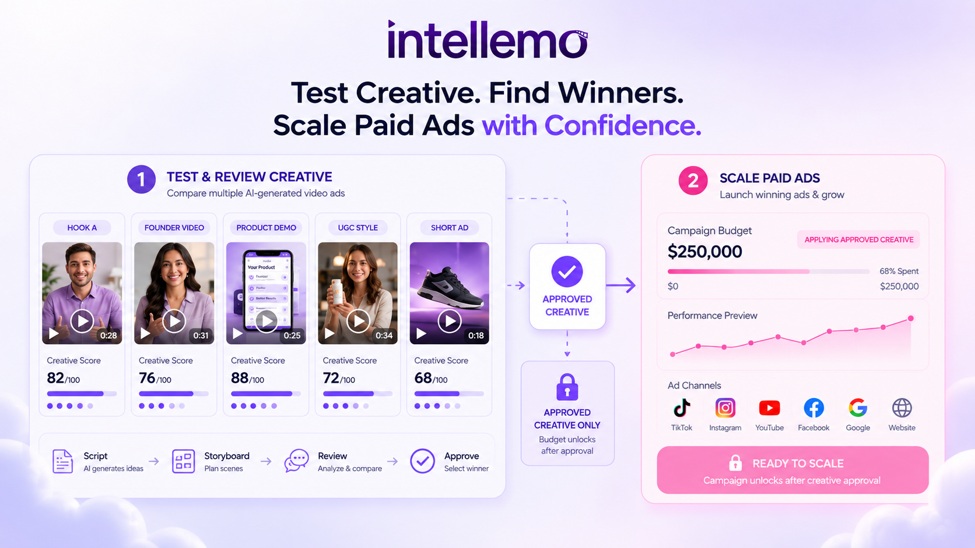
Intellemo AI is built around a guided production and review workflow, which makes it useful for startups testing video creative before putting serious money behind paid ads. Teams can start with a campaign idea, product message, story prompt, or website URL and develop it into a complete video rather than building each production stage separately. When a website URL is used, Intellemo can pull available brand context and assets, such as the logo, to help shape the script and video around the actual business.

  • Key production stages are reviewed before moving forward, giving teams more control over creative quality before the final render.
  • The Audioboard lets users check narration for pronunciation, pacing, tone, emotion, timing, and naturalness before approving it for the next stage.
  • Individual storyboard scenes can be revised without regenerating the whole video. Teams can adjust elements such as characters, backgrounds, camera angles, product placement, lighting, or composition while leaving approved scenes unchanged.
  • Lip sync supports spokesperson-led and talking-head formats, which can be useful when testing different ad styles.
  • The workflow brings script, scenes, visuals, voice, music, lip-sync, and sound into one production process, reducing the need to move between separate tools while preparing ad variations.

Ideal for: Intellemo is ideal for anyone looking to create high-quality AI videos without the need for a traditional production team. From individuals and creators to marketing teams, D2C brands, businesses, and agencies, anyone who needs AI videos can use Intellemo to create brand-consistent, multi-scene videos for a wide range of use cases.

2. Synthesia

Synthesia generates avatar-led video straight from a script, and it’s one of the more established names in that category. Startups often turn to it for founder-style explainer videos or short product walkthroughs where a steady, professional presenter matters more than visual flair. It won’t give a team the flexibility of a fully generative tool, but for a certain kind of ad, that’s not really the point.

  • Wide range of avatars and voice options, with support for many languages, useful if a startup is testing messaging across different markets.
  • Works from templates rather than open prompts, which keeps output consistent even across a small team producing several videos a week.
  • Custom backgrounds, logos, and brand colors can be added, so the video stays recognizably tied to the company.
  • Reasonable option for checking whether a presenter-led format resonates before a bigger production budget gets involved.
  • Scripts can be updated and re-rendered quickly, so small copy changes don’t mean starting the whole video over.

Best for: startups that want quick, consistent presenter videos for early testing.

3. HeyGen

HeyGen focuses on personalized avatar video, and that makes it more useful for outreach-style testing than for broad-audience ads. A founder can record one video, then generate variants that swap in different names, company details, or languages. For early sales teams, that kind of one-to-many production is genuinely hard to replicate manually at any real speed.

  • Personalization at scale from a single source video, without reshooting for every prospect or market.
  • Natural lip sync across variants, which matters when outreach needs to feel tailored rather than templated.
  • Fast avatar creation, so a founder can get a digital presenter running in a short amount of time.
  • Works well for testing sales or founder-led messaging before deciding whether to push it into paid channels.
  • Can also handle broader localization, which helps if a startup is testing the same offer across more than one market at once.

Best for: early sales and outreach teams testing personalized video before scaling it.

4. Creatify

Creatify turns a product page into a short-form video ad, which shortens the gap between having a product and having something to test. For startups running early paid social experiments, that speed is the main draw, since a founder can go from product URL to a testable ad in minutes rather than days.

  • Generates ad variations directly from a product URL, with little manual input needed to get started.
  • Built specifically for platforms like TikTok, Instagram Reels, and YouTube Shorts, so the output already fits the format.
  • Useful for testing several hooks or angles quickly, without committing to a full creative brief for each one.
  • Narrower in scope than a full production tool, so it works best for short ad testing rather than longer brand content.
  • Works well alongside a paid ad account, since new variations can be pushed out as soon as an old one starts to underperform.

Best for: e-commerce and D2C startups testing several short ad angles before committing spend.

5. Runway

Runway leans toward higher production value, giving users more control over camera movement and visual style than most avatar-based tools. Startups with a stronger creative identity sometimes use it to test whether a more cinematic ad direction performs better than a template-based one, especially once they have enough data to justify the extra effort.

  • More granular creative control than most generation tools on this list, including camera direction and scene composition.
  • Suited to hero ads or launch campaigns where visual distinctiveness matters more than speed.
  • Has a steeper learning curve, so it works best when someone on the team is comfortable directing the output instead of just prompting it.
  • Better suited to later-stage testing, once a startup already has some signal on what visual direction is worth pursuing.
  • Output quality is high enough to hold up in placements where cheaper generation tools start to look obviously synthetic.

Best for: startups testing a distinctive, brand-forward visual style before a bigger campaign push.

6. Kling AI

Kling AI is known for fast generation and a strong free tier, which makes it a reasonable starting point for startups that want to test video content without committing to a paid plan right away. It won’t offer the same production structure as some other tools here, but for early validation, that’s often not what’s needed yet.

  • Free tier is generous enough for genuine early experimentation, not just a limited trial.
  • Handles realistic human motion well, which helps for social-style test content that needs to look natural.
  • Generation speed is fast enough to run several quick tests in a single sitting.
  • Good for validating whether video works as a format for a specific audience before spending on a heavier tool.
  • Low commitment makes it easier to justify testing several unrelated ideas in the same week without worrying about wasted spend.

Best for: bootstrapped startups validating video as a channel before investing further.

7. InVideo

InVideo is a template-driven editor built for social output, and it’s less about generating new video from scratch and more about repurposing what a startup already has. It leans on trend-aware templates and editing styles suited to short-form platforms, which makes it a fast way to get existing footage into a testable shape.

  • Fast turnaround for social-native content without needing deep editing skills on the team.
  • Useful for repurposing existing footage or assets into multiple formats for different platforms.
  • Suggests music and editing styles based on current trends, which can save time on smaller decisions.
  • Not a generative tool in the same sense as the others, but still practical for organic testing alongside paid creative.
  • Reasonable option for startups that already have raw footage sitting around and just need it cut into something usable.

Best for: startups that need quick, platform-ready video without a steep learning curve.

FAQs

Is AI-generated video good enough for paid ad campaigns?

Yes, as long as there’s a review step before the final version goes live. Startups should compare a few concepts internally before putting spend behind any single video.

Do these tools replace a video production team entirely?

For most early-stage needs, yes. Startups with bigger brand ambitions may still need human direction for certain campaigns, particularly with tools like Runway.

How should a startup budget for AI video tools before scaling ads?

Look for platforms that charge based on final output rather than every intermediate step. Intellemo AI, for example, only bills when the final video is generated and doesn’t charge separately for image elements or other production-stage outputs, which keeps testing costs more predictable.

How to Choose the Right Tool for Your Stage

Finding the right AI video tool isn’t really about picking one winner. It’s about matching the tool to the stage of testing a startup is in. Some teams need speed and a free tier to validate whether video works at all. Others need a structured review process that catches weak creativity before it reaches a paid test. As these tools keep developing through 2026, startups that treat testing as a deliberate step, rather than something to rush past, will likely get more out of every dollar they eventually put behind paid ads.

AMD Surpasses $1 Trillion Valuation as Investors Pour Back Into AI Chip Trade

0

Advanced Micro Devices crossed $1 trillion in market value for the first time on Monday, extending a powerful 2026 rally as investors increasingly bet that the semiconductor company can capture a larger share of the spending on artificial intelligence infrastructure.

AMD shares rose 9.6% to $613.31, a record high, taking the Santa Clara, California-based chipmaker into an exclusive group of U.S. semiconductor companies valued at more than $1 trillion.

AMD is now the fourth U.S. chipmaker to reach the milestone, following Nvidia, Broadcom and Micron Technology. Nvidia crossed $1 trillion in 2023 and has since expanded into the world’s most valuable company, with a market capitalization above $5 trillion.

The move marks a significant shift in how investors view AMD’s role in the AI boom. For much of the current cycle, Nvidia has dominated the market for the graphics processing units used to train and run advanced AI models. AMD has increasingly positioned itself as the closest U.S. challenger in high-performance AI accelerators, while expanding its offering beyond individual chips.

“Money is moving back into the AI trade,” said Thomas Hayes, chairman at Great Hill Capital in New York.

The renewed enthusiasm comes after several months in which investors questioned whether hyperscalers could continue spending at the pace required to justify the enormous valuations attached to AI-related companies.

Higher oil prices linked to the U.S.-Iran conflict and expectations that interest rates could remain elevated for longer also weighed on technology stocks. Those pressures raised questions about the ability of highly valued technology companies to continue attracting capital in a slower-growth environment.

Hayes said investors are now treating AI as one of the areas capable of continuing to attract spending even if the Federal Reserve-induced slowdown weighs on the broader economy.

“AMD is representative of that,” he said.

The renewed demand was not limited to AMD. Intel shares jumped about 11.8%, Qualcomm gained 4.5%, and the Philadelphia Semiconductor Index rose 2.7% to its highest level in more than a month.

The scale of AMD’s move, however, stands out. Its shares have risen about 185% in 2026, compared with a 15.8% gain for the Nasdaq Composite.

That performance has pushed AMD firmly into the group of companies investors are using to express a view on the next phase of AI infrastructure spending.

AMD Is Moving Beyond The Chip

One of the most important changes in AMD’s AI strategy is its move beyond selling individual processors.

The company has accelerated the launch of AI products and is now offering complete computing systems that combine processors, networking equipment, and other hardware. The approach brings AMD closer to the integrated infrastructure model that has helped Nvidia expand its position across the AI computing stack.

The shift is considered integral because AI data centers are no longer simply collections of individual accelerators. Training and inference require processors, accelerators, high-speed networking, memory, and software to operate as a coordinated system. That creates a larger potential market for AMD if it can persuade customers to adopt more of its components rather than using its chips as alternatives to Nvidia’s products in isolation.

AMD is also benefiting from another part of the AI infrastructure buildout. Its central processing units are increasingly being used alongside GPUs in servers running AI inference, helping the company take market share from Intel in the server CPU market. That gives AMD two separate opportunities within the AI data center: supplying accelerators that perform AI workloads and supplying the general-purpose processors that support them.

The company’s recent financial outlook illustrates both the opportunity and the pressure surrounding the stock. AMD forecast quarterly revenue above Wall Street expectations last month, but the result still fell short of the elevated expectations that had built up around the company.

Analysts consider that vital as AMD’s valuation rises.

At around 41 times forward earnings, AMD is trading below its 10-year average multiple of about 44 times. But the comparison with Nvidia shows how different investor expectations have become across the semiconductor industry. Nvidia recently traded at about 16.3 times forward earnings, according to the data cited by Reuters.

AMD therefore has considerable expectations already embedded in its share price. Its 2026 rally has been driven not simply by an improvement in earnings, but by expectations that its addressable market in AI computing will expand substantially.

The $1 trillion milestone consequently represents more than a round-number valuation. It signals that investors increasingly see AMD as a major participant in the infrastructure layer of the AI economy rather than simply another semiconductor company competing with Intel.

However, that doesn’t excuse questions around the company’s ability to convert that opportunity into sustained earnings growth at a pace capable of supporting its rapidly increased valuation.

Nvidia’s dominance also remains a major hurdle. Its advantage extends beyond accelerator hardware into software, networking, and the broader ecosystem surrounding its chips. AMD’s strategy of selling complete systems is an attempt to close part of that gap.

For now, the market is rewarding the effort.

Overall, AMD’s ascent above $1 trillion shows how quickly capital can return to AI infrastructure when investors regain confidence that spending on computing capacity can continue through a weaker macroeconomic environment.

But the valuation also raises the bar. After a 185% gain this year, AMD no longer needs to demonstrate that AI is a growth opportunity. Investors are now pricing in its ability to become one of the companies that captures a meaningful share of that spending.