DD
MM
YYYY

PAGES

DD
MM
YYYY

spot_img

PAGES

Home Blog Page 1200

Stripe Unveils AI Foundation Model, Stablecoin Accounts, and Global Tools in Massive Product Overhaul

0

For years, Stripe has quietly underpinned much of the internet’s financial plumbing. On Wednesday, the company turned up the volume.

At its annual Stripe Sessions event, the $50 billion fintech heavyweight rolled out one of its most expansive product overhauls to date, offering a glimpse into what the future of digital finance might look like, from self-learning AI systems to stablecoin-powered transactions and even a surprisingly fast onboarding of tech titan Nvidia.

Stripe’s most striking reveal was an AI foundation model, years in the making, trained on an ocean of payment data—tens of billions of transactions. Emily Glassberg Sands, the company’s head of information, called it a breakthrough.

“Previously, we couldn’t take advantage of our vast data,” she said. “Now, we can.”

This new engine isn’t just about data crunching. It identifies subtle signals that indicate fraudulent behavior—patterns so nuanced that most traditional systems would never catch them. Card testing attacks, a method where fraudsters verify stolen card credentials, have long plagued online businesses. Stripe said its new model boosted the detection of these attacks by 64 percent “practically overnight” for large clients. Its previous systems had already cut such attacks by 80 percent over two years, but the company sees this leap as evidence of what’s possible with more generalized machine learning.

Will Gaybrick, Stripe’s president of product and business, said the model was built through self-supervised learning, allowing it to discover its own features.

“We have found over and over and over again in machine learning, generalized models outperform,” Gaybrick said. “A big part of that is agility. It just performs better and adapts better to changes in fraud patterns.”

Alongside its AI effort, Stripe announced a push into stablecoin-backed multicurrency card products, partnering with startups like Ramp, Squads, and Airtm. The new offering aims to allow businesses across borders to operate in the same currency for the first time—a significant step in reducing the friction that typically comes with international commerce. The move comes only three months after Stripe completed its acquisition of stablecoin platform Bridge, indicating the company’s long-term bet on crypto-backed rails, albeit in a tightly regulated, fiat-pegged form.

Stripe also unveiled its Orchestration feature, which gives businesses the tools to manage and optimize performance across multiple payment providers from a single dashboard, regardless of whether they process payments with Stripe. The offering is designed to give enterprise-scale users more control and resilience, particularly in global operations where reliance on a single provider can be risky.

One of the event’s more unexpected headlines came from Stripe’s relationship with Nvidia. According to Vivek Sharma, Stripe’s head of revenue automation, Nvidia migrated its entire subscriber base to Stripe Billing in just six weeks—a process that typically takes several months. The switch marked the fastest-ever migration to Stripe Billing. Nvidia was already a Stripe Payments customer, but this billing transition demonstrated the growing trust enterprise customers are placing in the fintech’s broader ecosystem.

Stripe also revealed that it now supports 25 new payment methods, including UPI in India and PIX in Brazil, bringing its total global offering to more than 125 payment methods. Klarna, the Swedish buy-now-pay-later giant, will soon be available through Stripe’s consumer payments product, Link, starting this summer.

In a move aimed at physical retailers, Stripe Terminal can now be used with third-party hardware, beginning with Verifone. That shift gives businesses more flexibility at the checkout counter, signaling Stripe’s intent to play a broader role in the point-of-sale market.

Stripe also launched Managed Payments, a merchant-of-record solution that allows companies to expand internationally without dealing directly with tax codes, fraud prevention systems, dispute handling, and fulfillment requirements. The idea is to give businesses a plug-and-play infrastructure to operate globally without having to build in-house compliance and operations teams from scratch.

The company is leaning deeper into automation across the board. Smart Disputes is a new tool that uses AI to automate the process of handling payment disputes, while Stripe Tax has expanded its availability from 57 countries to 102. The service now covers the full tax lifecycle, from monitoring and registering to collecting and filing, making it one of Stripe’s most comprehensive global compliance tools.

Finally, Stripe introduced Global Payouts, which enables businesses to send money to customers, contractors, and other third parties using nothing more than an email address. The simplicity is the point: Stripe wants to make cross-border payments as seamless as sending an invoice.

Perhaps what says the most about Stripe’s evolving role in the tech ecosystem is who’s already using its tools. The company named several AI-focused startups—including OpenAI, Anthropic, Cursor, Perplexity, Windsurf, and Eleven Labs—that rely on Stripe Billing. These are some of the most closely watched players in the new wave of artificial intelligence, and their reliance on Stripe’s infrastructure suggests that the company is increasingly seen as a foundational layer not just for e-commerce, but for innovation itself.

With this slate of announcements, Stripe is making it clear that it no longer sees itself as merely a payments processor. It’s building toward becoming an all-in-one financial operating system for the internet economy—one that sits at the intersection of automation, compliance, global payments, and emerging technologies like AI and stablecoins.
ExxonMobil to Inject $1.5bn into Nigeria’s Deepwater Oil Assets, Reaffirms Long-Term Commitment

0

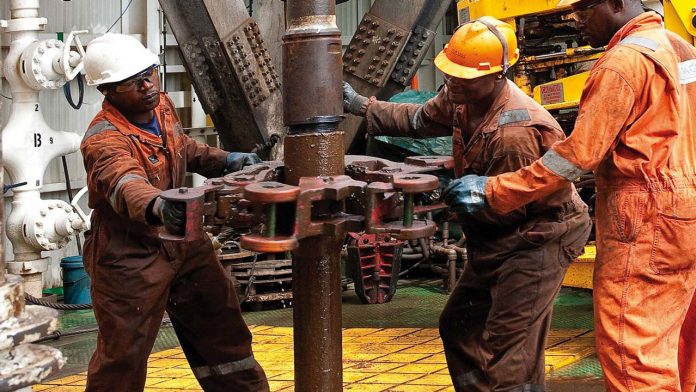
ExxonMobil has reaffirmed its long-term commitment to Nigeria’s oil and gas sector with a planned $1.5 billion investment in deepwater exploration and development projects, a move that signals renewed confidence in the country’s upstream potential and reflects shifting dynamics in the industry’s regulatory and investment landscape.

The investment, scheduled for rollout between Q2 2025 and 2027, will primarily target the revitalization of production at the Usan deepwater oil field. A Final Investment Decision (FID) is expected by late Q3 2025, pending final approval of the Field Development Plan (FDP), along with internal corporate and joint venture partner approvals.

Beyond Usan, the oil major disclosed it would accelerate development activities in other key deepwater assets, including the Owowo and Erha fields. These efforts are part of ExxonMobil’s broader strategy to consolidate its position in Nigeria’s offshore basin and back the country’s drive to ramp up oil production.

The announcement was made during a courtesy visit by ExxonMobil’s Managing Director in Nigeria, Mr. Shane Harris, to the Commission Chief Executive (CCE) of the Nigerian Upstream Petroleum Regulatory Commission (NUPRC), Engr. Gbenga Komolafe, according to a statement published on the NUPRC’s website on Tuesday.

Mr. Harris stated that the planned capital expenditure reflects ExxonMobil’s belief in the long-term viability of Nigeria’s upstream sector and its strategic value in the evolving global energy landscape.

Tied to NNPCL Shake-up

Industry experts have pointed to recent leadership changes at the Nigerian National Petroleum Company Limited (NNPCL) as a critical factor that helped unlock ExxonMobil’s renewed commitment. The ouster of Mele Kyari as Group Chief Executive Officer and the broader restructuring of the national oil company under President Bola Tinubu’s administration are being credited for clearing a major obstacle to new investments.

“Told you Exxon was waiting for Mele and his crew to leave before they start to commission FID for their offshore arm — ESSO,” said energy analyst Kelvin Emmanuel, reacting to the development. “This one is for Usan, next one will be for Owowo, and that’s the one that will have Total and CNOOC as PSC partners.”

Kyari’s tenure at NNPCL had been dogged by controversy and regulatory opacity, with several international oil companies reportedly delaying critical investment decisions. His removal and the subsequent reorganization under a new management team have been interpreted by analysts as a strong signal of reform, especially in how joint venture disputes and deepwater agreements are handled.

ExxonMobil Backs NUPRC’s ‘Project 1 Million Barrels’

Mr. Harris also expressed ExxonMobil’s alignment with NUPRC’s “Project 1 Million Barrels” initiative — a medium-term goal to raise the country’s crude oil production to 2.4 million barrels per day. He emphasized the importance of strategic collaboration between oil producers and regulators to unlock investment and scale production.

Welcoming the announcement, the NUPRC Chief Executive described ExxonMobil’s renewed commitment as both timely and critical for growth in Nigeria’s upstream space. He noted that fostering investor confidence remains central to the success of the Petroleum Industry Act (PIA) and the Commission’s regulatory mandate.

Discussions during the visit also touched on ongoing reforms, including compliance with the Domestic Crude Supply Obligation (DCSO) and implementation of Section 109 of the PIA, which introduces a “willing buyer, willing seller” market structure for domestic crude sales.

In his capacity as Chairman of the Oil Producers Trade Section (OPTS), Mr. Harris pledged to leverage the platform to strengthen collaboration between operators and the NUPRC, focusing on regulatory clarity and policies that unlock further upstream investments.

Implications for Jobs, Production, and Foreign Exchange

ExxonMobil’s renewed capital injection into Nigeria’s deepwater segment is expected to stimulate job creation, improve local content participation, and drive technology transfer. The projected increase in national oil output is expected to help stabilize Nigeria’s foreign exchange market, improve fiscal revenues, and bolster energy security.

While upstream activity in Nigeria has faced setbacks in recent years due to regulatory uncertainty, sabotage, and underinvestment, the renewed focus by one of the world’s leading oil companies sends a positive signal to other investors.

The development stands in contrast to growing concerns over the future of Nigeria’s onshore oil and gas sector, where divestment pressures persist. TotalEnergies recently confirmed plans to sell its minority stake in a major onshore joint venture, following similar moves by Shell and other IOCs exiting high-risk, lower-margin terrains.

China Signals Strain as It Slashes Rates, Frees Up $138bn, and Opens Door to Trade Talks with U.S.

0

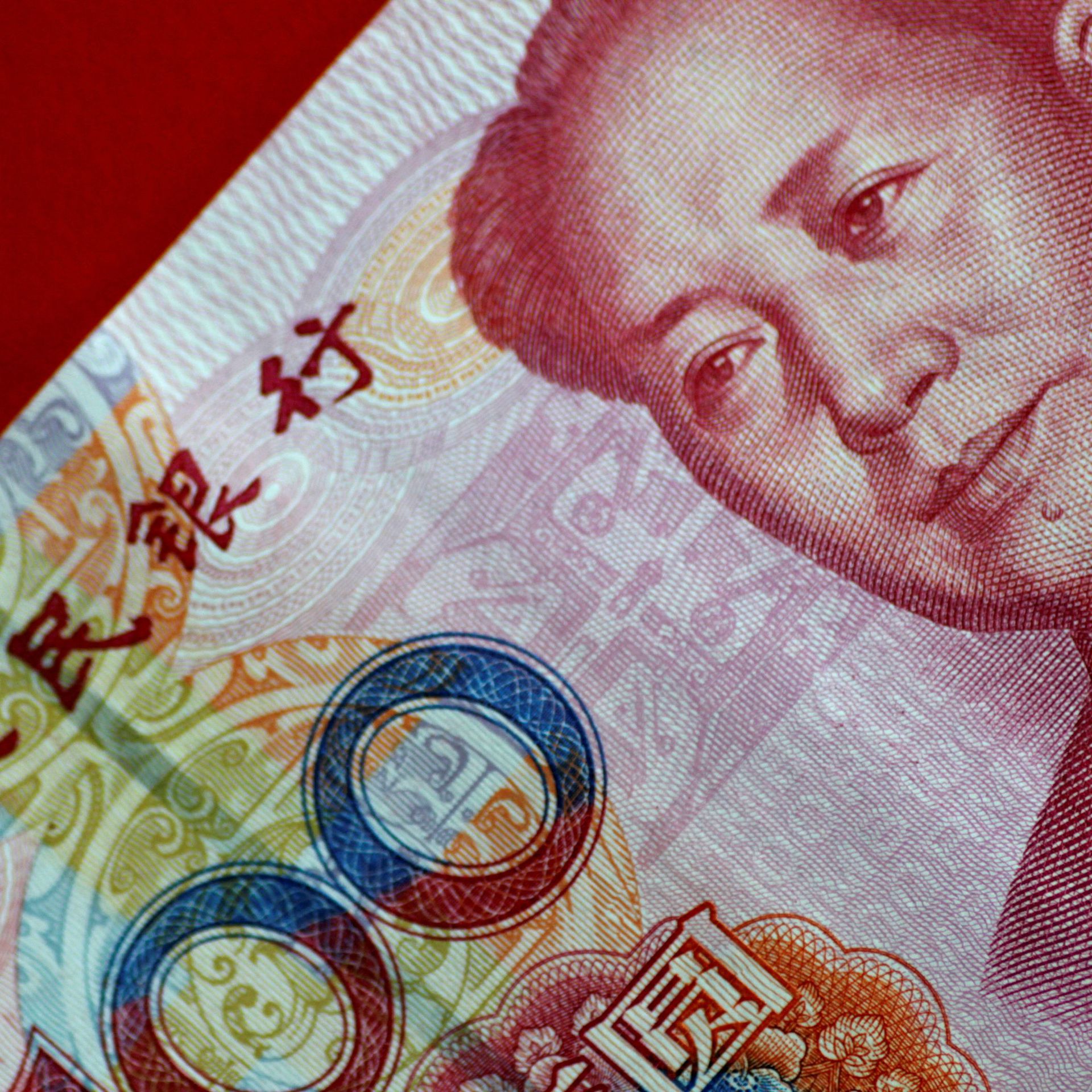
After months of insisting it had the tools to weather any economic headwinds, China’s leadership has abruptly swung into action, slashing interest rates, freeing up massive liquidity, and announcing its first confirmed trade talks with the United States since relations plunged into deeper hostility under a new round of tariffs from Washington.

The sweeping policy moves unveiled Wednesday—interest rate cuts, a reserve requirement ratio (RRR) reduction, and targeted lending support—have been interpreted by analysts as more than a stimulus effort. They are being seen as a tacit admission that the world’s second-largest economy is buckling under intensifying pressure and that Beijing may no longer afford the luxury of defiance.

At a press briefing in Beijing, People’s Bank of China Governor Pan Gongsheng laid out the central bank’s most expansive stimulus package in over a year.

The PBOC will reduce the seven-day reverse repo rate by 10 basis points, to 1.4%, while the main policy lending rate, the loan prime rate (LPR), is expected to follow suit with a similar cut. More notably, the reserve requirement ratio for banks will be trimmed by 50 basis points, effective May 15. This is expected to inject 1 trillion yuan ($138.5 billion) in liquidity into the banking system—a figure that underscores the scale of Beijing’s new urgency.

Additional measures include a 500-billion-yuan lending program to support consumption and elderly care, as well as a 25-basis-point cut in mortgage rates under the nation’s housing provident fund scheme. First-time homebuyers will see five-year loan rates fall to 2.6% from 2.85%. In a further push to revive credit and consumption, auto finance companies will eventually see their reserve requirement slashed to zero from the current 5%.

While these measures target a variety of sectors, from real estate to automobile financing, they arrive in a context of faltering confidence, both domestically and abroad.

Policy Shift Interpreted as a Crack in the Armor

Until recently, Beijing had resisted more aggressive policy interventions, relying instead on limited or sector-specific measures to steer the economy through slow growth and mounting trade uncertainty. The pivot on Wednesday represents a significant shift in posture.

Some analysts believe the scale and urgency of the announcements suggest a recognition that the policy approach of doing just enough is no longer working.

“Borrowing activity has been largely unresponsive to prior rate cuts, indicating deeper structural malaise,” said Tianchen Xu, senior economist at the Economist Intelligence Unit.

The Tariff Shock and the Silent Pressure

The urgency stems in part from a deepening trade standoff with Washington. President Donald Trump, now in his second term, escalated the confrontation last month by raising tariffs on a wide range of Chinese imports to 145%. Beijing retaliated with its own steep levies of 125% on U.S. goods. The tit-for-tat measures have had a chilling effect on bilateral trade, leading to production slowdowns and shrinking factory orders.

While Beijing publicly maintains a posture of resilience, sources close to policy circles suggest internal data may be painting a grimmer picture. At a high-level policy meeting in April, top officials were reportedly told to prepare for “worst-case scenarios.” Analysts believe this was a coded acknowledgment of the potential for economic contraction if the situation continues to spiral.

That context may explain Wednesday’s announcement that Chinese Vice Premier He Lifeng will meet U.S. Treasury Secretary Scott Bessent in Switzerland later this week—the first such engagement since the tariff war escalated. While no breakthrough is expected, the very fact that Beijing is agreeing to talks is being seen as a significant retreat from its earlier hardline stance.

Deflation, Weak Demand, and the Yuan

Adding to Beijing’s woes is the persistent deflationary environment. Core inflation remains flat, and domestic credit demand has failed to pick up despite earlier monetary easing. The yuan has been another source of concern. Earlier this month, the offshore yuan weakened to a record low of 7.4287 per U.S. dollar, fueling fears of capital flight.

The Wednesday measures offered some relief. The yuan strengthened modestly to 7.2227 per dollar, helped by the removal of immediate pressure on capital outflows now that interest rates and RRRs are being lowered in a more stable currency environment.

“There is no longer pressure on the RMB to depreciate against the dollar,” said Zhiwei Zhang of Pinpoint Asset Management. “That gives the PBOC room to act more decisively without triggering panic.”

Despite the strong monetary response, some analysts believe a meaningful recovery will require a coordinated fiscal boost—something still missing from Beijing’s playbook. This will require new fiscal tools, such as direct subsidies or public investment packages, which may only emerge when the leadership sees unmistakable signs of deterioration.

Until then, economists expect further incremental moves. Song from ING forecasts another 20-basis-point interest rate cut and a further 50-basis-point RRR reduction later this year. But he warned that any subsequent stimulus will likely hinge on when the U.S. Federal Reserve begins cutting rates.

China’s bond market responded with caution. The yield on 10-year government bonds was little changed at 1.636%, reflecting investor hesitation to price in a full recovery just yet.

But traders are watching the upcoming talks in Switzerland closely. Should they produce even the outline of a truce, Beijing may find some breathing space. If they fail—or worse, break down in acrimony — the current stimulus may turn out to be only the first step in a much longer battle to shield the Chinese economy from deep damage.

Lesson on Innovation as Wegovy Takes Weight Watchers to Bankruptcy

0

Those weight-loss drugs like Wegovy do not have joy because they’re disrupting the weight-loss via dieting and exercising industry. Yes, before the arrival of those drugs, people had two core options to lose weight: eat well and exercise. But today, those are no more key requirements as just by taking some drugs, the pounds will go!

Weight Watchers is one of the casualties of this redesign: “Wellness giant Weight Watchers has filed for bankruptcy protection. Founded as a weight-loss program more than 60 years ago, Weight Watchers has undergone several strategic pivots in recent years and faced pressure from the rise of GLP-1 weight-loss drugs, which it belatedly began offering through its own telehealth platform.” – LinkedIn News

Good People, this is what we call disruption in the market. What these drugs are doing to the decades-old weight-loss sector which Weight Watchers has participated is what AI will do to many SaaS (software as a service) companies. Largely, you are going to see a new basis of competition that will decouple many software companies and take them out of the market. I have argued that many SaaS companies will expire in Africa if they do not evolve for the AI era.

Did you notice something? The company which took down Weight Watchers does not look like it. That is an asymmetric competitor which may not even show signals on the company’s path, but when the light flashes, it can blur growth vision and destroy a business.

Tech Will Power Nigeria’s Empires of the Future

Power Blocs and Influence Ahead of Osun 2026

0
Source: National Newspapers, 2024-2025; Infoprations Analysis, 2025

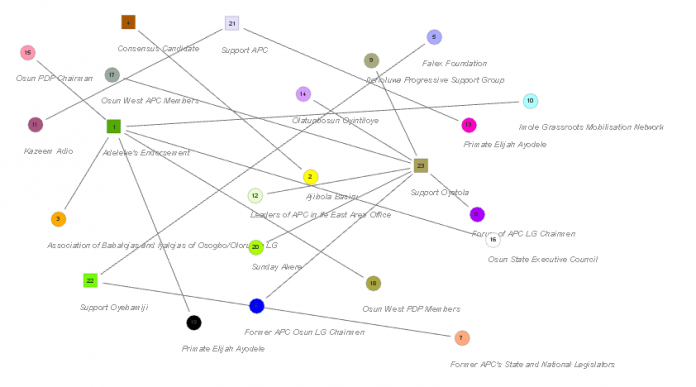
As Osun State inches towards the 2026 governorship election, the political chessboard is already taking shape. While party names and candidate declarations often dominate headlines, a deeper look at the forces behind the scenes reveals where the real power lies. Our analysis of influence based on political endorsements, support groups, and internal party movements shows that this will be more than just a two-party contest. It will be a battle of competing factions, power brokers, and shifting loyalties.

Adeleke’s Grip: Incumbency as Central Power

At the heart of it all stands Governor Ademola Adeleke, whose endorsement ranks as the most influential force in the current political conversation. This is no surprise. As the sitting governor, Adeleke’s ability to shape outcomes within the Peoples Democratic Party (PDP) and influence public perception is unmatched. His endorsement is not just symbolic. It signals to grassroots structures and elite players alike where the wind might blow. In Osun’s political culture, the sitting governor holds the reins on everything from party unity to resource flow, and this power is being felt early.

Exhibit 1: Affiliation network of Osun 2026 governorship election

Source: National Newspapers, 2024-2025; Infoprations Analysis, 2025

Oyetola and the Struggle for APC’s Soul

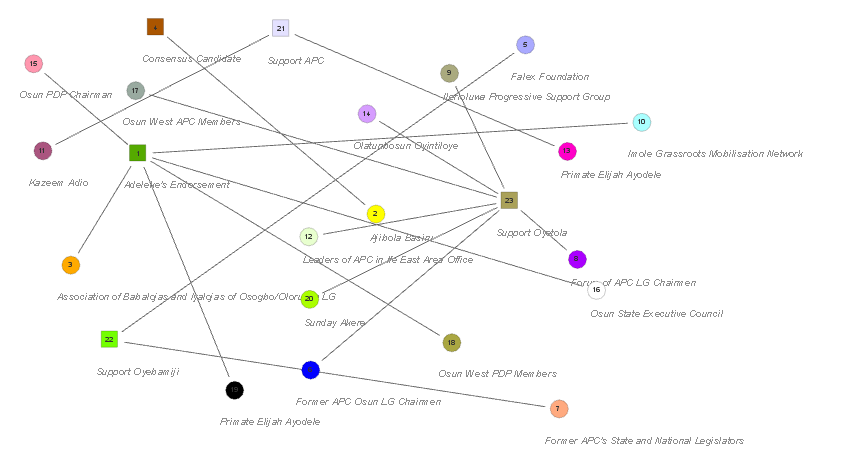
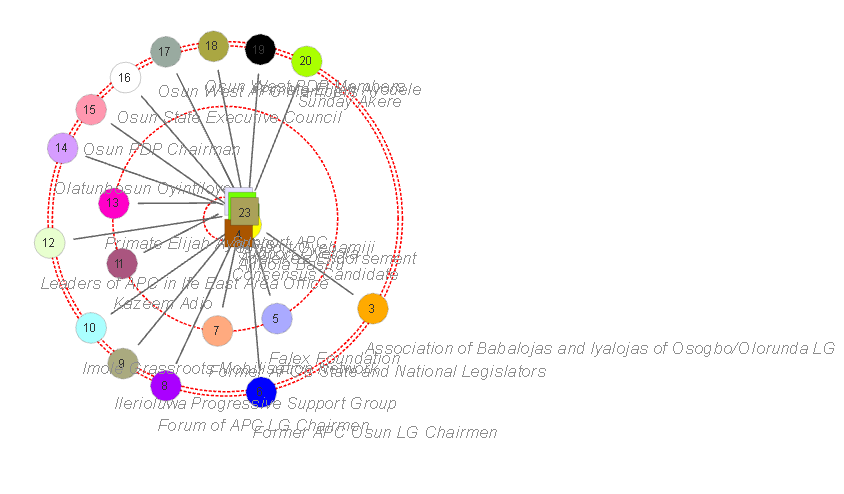
On the other side of the aisle, former governor Gboyega Oyetola remains a dominant figure. The data shows that support for Oyetola is the single most powerful force within the All Progressives Congress (APC) ecosystem [represented by node 23 in exhibit 2]. His political machine, built over years in office and sustained through loyal structures like the Ilerioluwa Progressives and various APC local groups, remains firmly intact.

However, this strength does not come without friction. Multiple groups within the APC, such as the Forum of APC Local Government Chairmen, Former Stakeholders, and regional blocs like the Osun West APC Members, also hold significant sway. This suggests that while Oyetola is still central, there is growing pressure for broader consensus or perhaps even a shift in leadership. The rise of “Consensus Candidate” [see node 4 in exhibit 1 and 2] as a top-tier influence indicates that internal negotiations are underway to avoid a bitter primary contest.

Ajibola Basiru’s Quiet Climb

Senator Ajibola Basiru emerges in this analysis as an unexpectedly strong figure. Though often seen as operating behind the scenes, his influence ranks on par with the most powerful groups and individuals. Basiru could play a critical role as a kingmaker or as a potential unifier within APC’s divided ranks. If the party aims to challenge Adeleke’s incumbency effectively, figures like Basiru will likely be the bridge-builders.

Exhibit 2: Power centrality in affiliation network of Osun 2026 governorship election

Source: National Newspapers, 2024-2025; Infoprations Analysis, 2025

Support Groups: The New Political Middlemen

Another interesting trend is the rising relevance of support groups. Organizations like the Imole Grassroots Movement and Falex Foundation are wielding considerable influence. They are working at the intersection of politics and social engagement.  Religious leaders are also emerging as important players. Primate Elijah Ayodele, for instance, features prominently in the power rankings. This reflects a wider reality in Osun politics, where religious and spiritual endorsements can shift the mood of the electorate, particularly among undecided or low-information voters.

PDP: Quiet but Coordinated

While Adeleke’s personal influence looms large, the institutional side of the PDP, represented by actors like the Osun PDP Chairman and Osun West PDP Members, also holds firm ground. These structures are not as flashy as their APC counterparts, but they appear more coordinated and less divided. If PDP manages to avoid internal splits, it could enter the race with a unified front that proves hard to beat.

Zoning, Consensus, and the Search for Unity

The concept of zoning and regional representation remains a sensitive issue, and its impact is seen in the prominence of agendas like “Osun West APC” and other geographically defined blocs. While some players are pushing for zoning equity, others are working hard to form consensus candidacies to avoid splintering the vote. The fact that “Consensus Candidate” ranks highly in influence indicates that both APC and PDP are acutely aware of the need to present unified fronts in a highly fragmented electoral space.

What This Means for 2026

The political map of Osun in 2026 will not be drawn solely by party primaries or the Independent National Electoral Commission. It is being shaped now by the interactions between power blocs, endorsements, grassroots mobilizers, and behind-the-scenes negotiators.

If Adeleke maintains control of the PDP machinery while avoiding internal rifts, he will be difficult to unseat. But if APC manages to align its various factions, particularly the Oyetola loyalists and consensus advocates, it could present a serious challenge. Figures like Ajibola Basiru may become the tipping point between a fractured party and a winning coalition.

The road to Osun 2026 is already paved with influence. Understanding who holds that influence, and how they use it, may tell us more than any campaign slogan or press release ever could.