DD
MM
YYYY

PAGES

DD
MM
YYYY

spot_img

PAGES

Home Blog Page 1203

Power Blocs and Influence Ahead of Osun 2026

0
Source: National Newspapers, 2024-2025; Infoprations Analysis, 2025

As Osun State inches towards the 2026 governorship election, the political chessboard is already taking shape. While party names and candidate declarations often dominate headlines, a deeper look at the forces behind the scenes reveals where the real power lies. Our analysis of influence based on political endorsements, support groups, and internal party movements shows that this will be more than just a two-party contest. It will be a battle of competing factions, power brokers, and shifting loyalties.

Adeleke’s Grip: Incumbency as Central Power

At the heart of it all stands Governor Ademola Adeleke, whose endorsement ranks as the most influential force in the current political conversation. This is no surprise. As the sitting governor, Adeleke’s ability to shape outcomes within the Peoples Democratic Party (PDP) and influence public perception is unmatched. His endorsement is not just symbolic. It signals to grassroots structures and elite players alike where the wind might blow. In Osun’s political culture, the sitting governor holds the reins on everything from party unity to resource flow, and this power is being felt early.

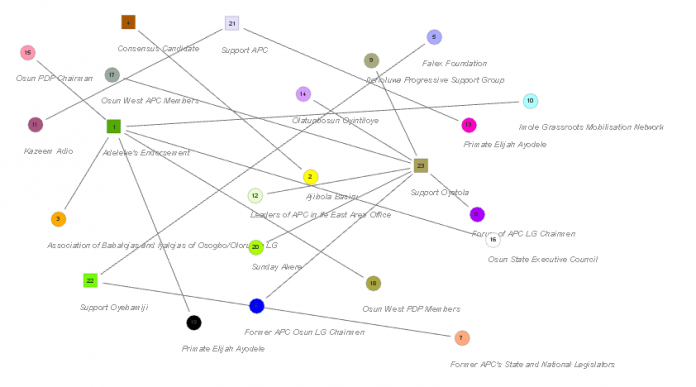
Exhibit 1: Affiliation network of Osun 2026 governorship election
Source: National Newspapers, 2024-2025; Infoprations Analysis, 2025

Oyetola and the Struggle for APC’s Soul

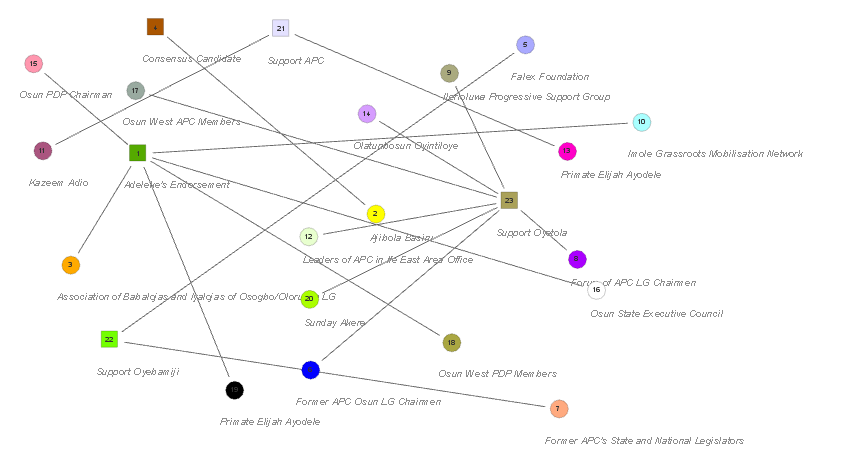
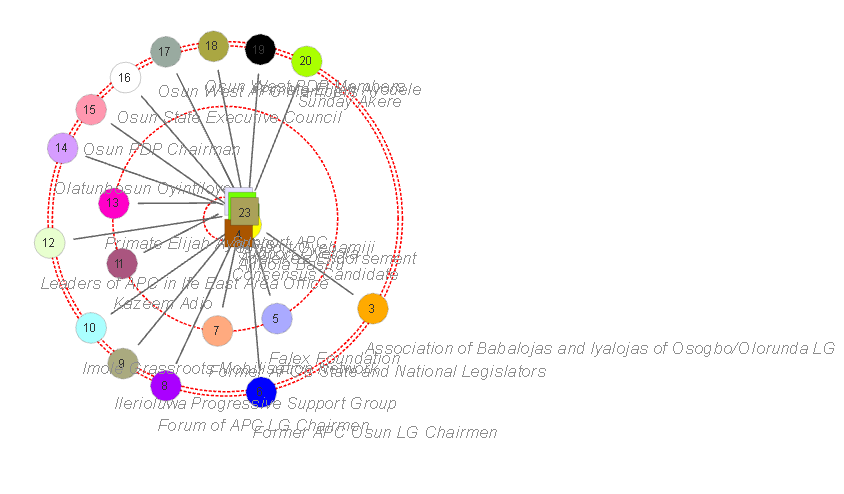
On the other side of the aisle, former governor Gboyega Oyetola remains a dominant figure. The data shows that support for Oyetola is the single most powerful force within the All Progressives Congress (APC) ecosystem [represented by node 23 in exhibit 2]. His political machine, built over years in office and sustained through loyal structures like the Ilerioluwa Progressives and various APC local groups, remains firmly intact.

However, this strength does not come without friction. Multiple groups within the APC, such as the Forum of APC Local Government Chairmen, Former Stakeholders, and regional blocs like the Osun West APC Members, also hold significant sway. This suggests that while Oyetola is still central, there is growing pressure for broader consensus or perhaps even a shift in leadership. The rise of “Consensus Candidate” [see node 4 in exhibit 1 and 2] as a top-tier influence indicates that internal negotiations are underway to avoid a bitter primary contest.

Ajibola Basiru’s Quiet Climb

Senator Ajibola Basiru emerges in this analysis as an unexpectedly strong figure. Though often seen as operating behind the scenes, his influence ranks on par with the most powerful groups and individuals. Basiru could play a critical role as a kingmaker or as a potential unifier within APC’s divided ranks. If the party aims to challenge Adeleke’s incumbency effectively, figures like Basiru will likely be the bridge-builders.

Exhibit 2: Power centrality in affiliation network of Osun 2026 governorship election
Source: National Newspapers, 2024-2025; Infoprations Analysis, 2025

Support Groups: The New Political Middlemen

Another interesting trend is the rising relevance of support groups. Organizations like the Imole Grassroots Movement and Falex Foundation are wielding considerable influence. They are working at the intersection of politics and social engagement.  Religious leaders are also emerging as important players. Primate Elijah Ayodele, for instance, features prominently in the power rankings. This reflects a wider reality in Osun politics, where religious and spiritual endorsements can shift the mood of the electorate, particularly among undecided or low-information voters.

PDP: Quiet but Coordinated

While Adeleke’s personal influence looms large, the institutional side of the PDP, represented by actors like the Osun PDP Chairman and Osun West PDP Members, also holds firm ground. These structures are not as flashy as their APC counterparts, but they appear more coordinated and less divided. If PDP manages to avoid internal splits, it could enter the race with a unified front that proves hard to beat.

Zoning, Consensus, and the Search for Unity

The concept of zoning and regional representation remains a sensitive issue, and its impact is seen in the prominence of agendas like “Osun West APC” and other geographically defined blocs. While some players are pushing for zoning equity, others are working hard to form consensus candidacies to avoid splintering the vote. The fact that “Consensus Candidate” ranks highly in influence indicates that both APC and PDP are acutely aware of the need to present unified fronts in a highly fragmented electoral space.

What This Means for 2026

The political map of Osun in 2026 will not be drawn solely by party primaries or the Independent National Electoral Commission. It is being shaped now by the interactions between power blocs, endorsements, grassroots mobilizers, and behind-the-scenes negotiators.

If Adeleke maintains control of the PDP machinery while avoiding internal rifts, he will be difficult to unseat. But if APC manages to align its various factions, particularly the Oyetola loyalists and consensus advocates, it could present a serious challenge. Figures like Ajibola Basiru may become the tipping point between a fractured party and a winning coalition.

The road to Osun 2026 is already paved with influence. Understanding who holds that influence, and how they use it, may tell us more than any campaign slogan or press release ever could.


How to Avoid Ghosting and Games on Online Dating Sites

0

Online dating has made meeting new people more convenient than ever. You can match, message, and build connections right from your phone. But with that convenience comes a downside—ghosting and mind games. These behaviors can leave you confused, disappointed, and even hurt.

While you can’t control how others act, you can take steps to protect yourself and create better experiences. This blog will guide you through practical ways to avoid ghosting and games on online dating sites.

Understanding Ghosting and Mind Games

What Is Ghosting?

Ghosting is when someone you’re talking to suddenly cuts off all communication without explanation. One moment you’re texting regularly, and the next, they disappear completely—no response, no closure.

It can happen after a few messages or even after a few dates. Ghosting leaves the other person wondering what went wrong and often questioning their self-worth.

What Do Dating “Games” Look Like?

Mind games in online dating can take many forms. Some people take hours or days to reply just to appear less eager. Others may manipulate you into competing for their attention or keep you on standby while exploring other options.

These games are emotionally draining. They make it hard to know where you stand and often lead to mixed signals and confusion.

Red Flags to Watch Out For

Inconsistent Communication

One day they’re super talkative, the next day they vanish. If someone can’t maintain consistent communication early on, it’s often a sign they’re not serious or emotionally available.

Avoiding Direct Answers

People who play games often dodge serious questions. If you ask about intentions, plans, or even simple personal facts and they change the subject, be cautious.

Love Bombing Followed by Silence

Love bombing is when someone showers you with compliments and attention, only to suddenly pull away. This emotional rollercoaster is often used to manipulate your feelings.

Talking Only When It’s Convenient

If the other person only messages you late at night, on weekends, or when they’re bored, you may be an option rather than a priority.

How to Set the Tone Early

Be Clear About What You Want

Start with honesty. Whether you’re looking for a serious relationship or something casual, say it. When you’re clear, you attract people who want the same things—and weed out those who don’t.

Ask Direct Questions

Don’t be afraid to ask someone what they’re looking for or how they like to communicate. Whether you’re seeking a serious relationship or hoping to find a sugar daddy, being clear up front helps set expectations. If someone avoids answering, it’s a red flag. People with honest intentions usually appreciate directness.

Match Energy and Effort

Pay attention to how much effort the other person puts into the conversation. If you’re always the one initiating or keeping the chat alive, consider taking a step back. Healthy relationships are built on mutual interest.

Practical Tips to Avoid Ghosting

Don’t Get Attached Too Fast

It’s easy to get excited about someone new, especially if the chemistry is strong. But try to pace yourself. Focus on getting to know the person before forming emotional attachments. This protects your feelings if things don’t work out.

Avoid Oversharing Early On

Keep conversations balanced. Sharing too much too soon can make you feel vulnerable and increase the hurt if someone disappears. Build trust gradually, not all at once.

Move Beyond the App When It Feels Right

If things are going well, suggest a phone call or video chat. This can help filter out people who aren’t genuinely interested. People who want to play games usually avoid real-time conversations.

Protecting Your Peace of Mind

Don’t Take Ghosting Personally

Ghosting says more about the ghoster than it does about you. It often comes from their lack of emotional maturity or inability to communicate. Try not to internalize it—it’s not your fault.

Unmatch and Move On

If someone ghosts you or starts playing games, unmatch them. Don’t wait around hoping they’ll come back with an explanation. Holding on only delays your chance of meeting someone better.

Focus on Yourself

Spend time on hobbies, self-care, and connecting with people who value you. The better you feel about yourself, the easier it becomes to let go of people who don’t treat you right.

Choose the Right Dating Platform

Some Sites Encourage Better Behavior

Not all dating apps are the same. Some platforms focus on serious relationships and have features that encourage accountability. Look for apps that require profile verification or offer community guidelines that discourage ghosting and disrespect.

Read Reviews Before Joining

User reviews can reveal a lot about what to expect. If you’re tired of casual hookups and games, avoid apps known for superficial interactions.

Conclusion

Ghosting and games are frustrating parts of online dating—but they don’t have to define your experience. By being clear about your intentions, recognizing red flags, and protecting your emotional boundaries, you can avoid most of the emotional drama that online dating sometimes brings.

Most importantly, remember that the right people won’t play games or disappear without reason. They’ll respect your time, match your effort, and make you feel seen. Stay patient, stay grounded, and keep showing up for yourself—and the right match will follow.

Hot Cam and the Rise of Digital Companionship in a Busy World

0

In an age defined by constant hustle, never-ending to-do lists, and increasing social isolation, the need for meaningful connection has never been more urgent. Technology continues to evolve at a rapid pace, changing the way we communicate, date, and form relationships. One surprising area where this shift is becoming evident is in the rise of Hot Cam platforms. Originally designed for adult entertainment, these platforms are now playing a much deeper role by offering digital companionship to users around the world.

What started as a way to stream sensual content is now growing into a space where emotional connection, live interaction, and companionship are just as important as visual appeal. Hot Cam is part of a larger movement that reflects how people are adapting to modern life and seeking connection in new and innovative ways.

From Viewers to Participants

Hot Cam platforms differ from traditional forms of adult entertainment by allowing users to interact directly with live models. Instead of passively consuming content, viewers can have real-time conversations, request specific performances, and even share stories or thoughts. The experience feels personal and engaging, which is why so many people are now choosing live cam shows over static videos.

These platforms let users customize their experiences and select models based on preferences like language, personality, or interests. This makes each interaction feel tailored, creating a sense of being part of something more meaningful than just a show. For even more personalized suggestions, you can visit Reddit for cam recommendations and discover user-approved favorites that match your style and vibe.

The Importance of Digital Companionship

As more people work from home, move to new cities, or find themselves isolated from their social circles, the value of digital companionship continues to rise. Hot Cam platforms provide an outlet for communication that is accessible, immediate, and pressure-free.

Users enjoy:

  • The ability to talk without judgment
  • Casual flirtation that feels safe and consensual
  • A sense of familiarity and emotional comfort

Rather than replacing real-world relationships, these digital interactions often serve as supplements to a user’s emotional and social life. They provide connection at times when it might not be possible to find it elsewhere.

A Place to Be Yourself

One of the greatest advantages of platforms like Hot Cam is the safe and open environment they create. Users can express themselves honestly, share their feelings, and enjoy a level of emotional intimacy that can sometimes be missing in traditional relationships or casual social media interactions.

Many cam performers go beyond just physical appeal. They provide conversation, companionship, and even emotional support to their regular viewers. Some have built loyal communities that return not just for the entertainment but for the feeling of being seen, heard, and valued.

Entertainment with Personality

Hot Cam platforms are evolving to include much more than adult content. Many performers now bring other forms of entertainment into their shows, including music, cooking, cosplay, or storytelling. These experiences blur the lines between adult entertainment and mainstream content.

Users are increasingly drawn to personality as much as appearance. This shift has allowed cam models to become full-fledged entertainers with a unique style, tone, and fanbase. For many viewers, watching a Hot Cam show is less about desire and more about engagement, interaction, and light-hearted fun.

Technology That Creates Closeness

High-speed internet, quality webcams, and user-friendly apps have helped Hot Cam platforms feel more intimate and accessible than ever before. Whether a user is on a phone, tablet, or desktop, the connection feels direct and personal.

Some platforms are even moving into virtual reality and 3D technology, offering a more immersive and realistic experience. With features like private chat rooms, one-on-one sessions, and high-quality video streaming, users feel closer to performers in ways that text or static content cannot replicate.

A Boost for Mental Wellness

It might seem surprising, but Hot Cam platforms also serve as a form of emotional relief for many people. Users facing loneliness, anxiety, or social stress often find comfort in regular interactions with cam performers.

These digital connections offer:

  • A sense of routine
  • Human contact in times of isolation
  • Validation and appreciation

While not a substitute for professional mental health support, the presence of a friendly face and a warm conversation can make a noticeable difference in how someone feels at the end of a long day.

Rethinking Modern Relationships

The idea of relationships has changed. People now form friendships, romantic connections, and emotional bonds through screens as much as in person. Hot Cam is part of that shift, offering a form of connection that fits into the busy, fast-paced lives many people lead today.

It’s no longer just about intimacy in the physical sense. It’s about emotional availability, respectful conversation, and the option to engage on your own terms. These platforms give users control over how they interact and help them feel empowered in their digital relationships.

Conclusion

Hot Cam platforms are more than just a trend. They are part of a new digital culture where connection, entertainment, and emotional intimacy meet. In a world that moves quickly and can often feel disconnected, these platforms offer a valuable outlet for companionship that is genuine, engaging, and easy to access.

Whether someone is looking for casual conversation, personalized attention, or simply a break from everyday stress, Hot Cam provides a space where people can feel connected and appreciated. It reflects how technology is not only changing how we entertain ourselves but also how we relate to one another in meaningful ways.

Global Debt Hits Record $324tn in Q1 as Emerging Economies Face $7tn Maturity Wall

0

Global debt surged by $7.5 trillion in the first quarter of 2025 to a record $324 trillion, according to data released Tuesday by the Institute of International Finance (IIF).

The staggering increase, driven largely by China, France, and Germany, underscores the scale of global reliance on borrowed capital—even as countries struggle to manage rising interest costs, slowing growth, and mounting economic uncertainty.

The increase was more than four times the average quarterly rise of $1.7 trillion since 2022, the IIF noted, pointing to a combination of foreign exchange factors and new borrowing. The depreciation of the U.S. dollar against major currencies also contributed to the higher dollar value of non-dollar denominated debt, but analysts say the sheer volume of new issuance reflects deeper structural pressures.

In emerging markets, total debt jumped over $3.5 trillion to a new high of $106 trillion in Q1 alone. China accounted for over $2 trillion of that increase, pushing its government debt-to-GDP ratio to 93%, with projections suggesting it could cross 100% by the end of the year. Brazil, India, and Poland also recorded significant increases. However, despite these sharp rises, the overall debt-to-GDP ratio for emerging markets excluding China actually fell below 180%, down from previous highs, thanks in part to stronger nominal GDP growth in some regions.

The global debt-to-output ratio remains just above 325%, edging slightly downward. But the headline figure masks more troubling signs. Emerging markets are now staring down a $7 trillion wall of maturing bonds and loans for the remainder of 2025. For developed economies, that number is closer to $19 trillion, both historic highs that threaten to test the resilience of global capital markets.

Who is The World Owing?

The rise in global debt has once again raised an old but persistent question: who is the world actually indebted to? While the record $324 trillion in global debt sounds like a singular burden, the answer lies in a complex and layered financial ecosystem, where countries, banks, investors, and institutions are simultaneously creditors and debtors in a tightly wound web of obligations.

In many developed economies, debt is increasingly held domestically. For example, much of Japan’s government debt is owed to its own citizens, banks, and institutions. The same is true to a lesser degree in Italy, where local banks and pension funds are heavily invested in government bonds. This internalized structure can provide short-term stability, since creditors are unlikely to flee en masse, but it also means that debt distress could trigger wider domestic financial crises.

In contrast, emerging markets are far more exposed to foreign lenders. Governments and companies in these regions often rely on borrowing from international investors, development banks, and hedge funds. This opens them up to the whims of global capital flows. A shift in sentiment, triggered by rising U.S. interest rates or geopolitical instability, can prompt capital flight, currency crashes, and debt-servicing difficulties.

The dominance of private creditors has added another layer of risk. Over the last decade, the share of developing country debt held by private entities—such as hedge funds, institutional investors, and foreign banks—has expanded rapidly. These lenders are far less patient than traditional multilateral institutions. When things go wrong, they are quicker to demand repayment or initiate legal action, as seen in the drawn-out debt restructuring battles in Argentina and Zambia.

Meanwhile, multilateral lenders like the IMF and World Bank continue to play a critical role, particularly in times of crisis, but their influence has waned. Their loans now make up a shrinking share of the total debt landscape, especially as developing nations turn to faster, albeit more expensive, sources of private credit. This shift has weakened global coordination in times of debt distress and diluted efforts to implement long-term fiscal reforms.

Another important but often overlooked creditor class includes foreign governments. The U.S. Treasury market, for instance, is heavily financed by overseas buyers—most notably China and Japan, which remain among the largest foreign holders of U.S. debt. However, even this dynamic is evolving. China’s appetite for Treasuries has waned in recent years as it seeks to insulate its economy from Western financial pressure and diversify its reserves.

Ultimately, global debt is less about nations owing money to external entities and more about a fragile network of cross-border interdependence. The global economy, in essence, owes itself, though unevenly. Some countries, mostly advanced economies, lend far more than they borrow. Others, particularly developing nations with current account deficits and weaker institutions, are net debtors—vulnerable to shifts in global financial conditions they cannot control.

However, this intricate web comes with real consequences. If emerging markets begin to default in large numbers, the impact won’t stay local. Defaults can undermine confidence across asset classes, trigger contagion in global bond markets, and provoke recessionary pressures in economies already dealing with tight monetary conditions. Similarly, a surge in U.S. debt issuance, driven partly by Trump’s renewed push for tax cuts, could force yields higher globally, increasing borrowing costs everywhere from Lagos to London.

Tariffs, pitched by the Trump administration as a fix for America’s fiscal gap, have only added to the challenge. While a weaker dollar has temporarily cushioned some emerging markets, the IIF warns that prolonged policy unpredictability could prompt foreign retaliation and reduce global trade volumes, further straining public finances.

US SEC Has Postponed Decision on Canary Capital’s Litecoin Spot ETF

0

U.S. Securities and Exchange Commission (SEC) has postponed its decision on Canary Capital’s proposed spot Litecoin (LTC) exchange-traded fund (ETF), as announced on May 5, 2025. The regulator is seeking public comments until May 26, 2025, with a rebuttal period open until June 9, 2025, to assess whether the ETF meets standards for preventing fraud and market manipulation.

The new deadline for the SEC’s decision is set for June 17, 2025. This delay aligns with similar postponements for other crypto ETF proposals, including those for XRP, Hedera, and Dogecoin, reflecting the SEC’s cautious approach to altcoin-based financial products.

Despite the delay, analysts like Bloomberg’s James Seyffart estimate a 90% chance of approval by the end of 2025, citing Litecoin’s strong positioning among altcoins. The announcement led to a market reaction, with Litecoin’s price dropping nearly 8% to around $81.29. Canary Capital, founded by Steven McClurg, filed the ETF application in October 2024, aiming to offer investors regulated exposure to Litecoin, which has a market cap of approximately $6.6 billion.

The SEC’s cautious approach to approving spot cryptocurrency ETFs, like Canary Capital’s Litecoin ETF, stems from its mandate to protect investors and ensure market integrity. The SEC prioritizes ensuring that financial products are resistant to fraud and manipulation. Cryptocurrencies like Litecoin, while established, operate in relatively unregulated markets compared to traditional assets.

The SEC is evaluating whether Litecoin’s underlying market has sufficient safeguards, such as robust surveillance mechanisms, to prevent manipulative practices like wash trading or pump-and-dump schemes. Cryptocurrencies are volatile, and altcoins like Litecoin can experience significant price swings, as seen with the 8% drop following the delay announcement. The SEC aims to ensure retail investors are not exposed to undue risk through regulated products like ETFs, which could amplify losses if the underlying asset is unstable or poorly understood.

Regulatory Uncertainty: The crypto industry lacks clear, comprehensive regulations in the U.S. The SEC is navigating a complex landscape where cryptocurrencies are sometimes classified as securities, commodities, or something else entirely. Litecoin, often viewed as a commodity like Bitcoin, still faces scrutiny to clarify its legal status and how an ETF would comply with securities laws.

The SEC’s approval of Bitcoin and Ethereum spot ETFs in 2024 set a precedent, but altcoins like Litecoin are less liquid and have smaller market caps ($6.6 billion for Litecoin vs. $1.2 trillion for Bitcoin). The SEC is cautious about extending approvals to altcoins without thorough analysis, as a misstep could undermine confidence in the broader ETF market.

Public and Industry Input: By delaying decisions and opening comment periods (e.g., until May 26, 2025, for the Litecoin ETF), the SEC gathers insights from market participants, exchanges, and the public. This helps assess whether proposed ETFs, like Canary’s, align with investor interests and market stability, especially given concerns about custody, liquidity, and exchange reliability.

The SEC has a history of delaying or rejecting crypto ETF proposals. Bitcoin spot ETFs took years to gain approval due to similar concerns about market manipulation and investor safety. The agency is applying the same rigorous standards to altcoin ETFs, ensuring they meet the high bar set for traditional financial products.

This cautious approach reflects the SEC’s balancing act: fostering innovation in financial products while mitigating risks in a rapidly evolving crypto market. Delays, like the one until June 17, 2025, for the Litecoin ETF, allow the SEC to conduct thorough due diligence, potentially paving the way for approvals if concerns are adequately addressed.