DD
MM
YYYY

PAGES

DD
MM
YYYY

spot_img

PAGES

Home Blog Page 123

Ethiopia Edges Closer To Restructuring Deal On $1bn Bond With Bondholder Group

0

Ethiopia has edged closer to resolving one of Africa’s most closely watched sovereign debt crises after striking a preliminary agreement with a group of investors holding a significant portion of its $1 billion international bond that matured in 2024.

The deal, disclosed by the Finance Ministry on Friday, marks a critical milestone in the country’s prolonged effort to restructure its debt following its first-ever default late in 2023.

In a statement posted on the ministry’s official Facebook page, Ethiopian authorities said the parties had reached an “agreement in principle” covering the core financial terms of the bond restructuring. While the announcement signals meaningful progress, the government stressed that discussions are still ongoing over the non-financial terms of the new debt instrument that will replace the defaulted Eurobond.

These outstanding elements typically include legal provisions, governance clauses, and other structural features that can materially affect investor protections and the long-term viability of the reworked debt.

Coordination under the G20 Common Framework

The agreement has been communicated to both the International Monetary Fund and Ethiopia’s Official Creditor Committee (OCC), which represents bilateral lenders under the G20’s Common Framework for debt treatments. That step is crucial, as the framework requires comparable treatment across all creditor classes — bilateral lenders, multilateral institutions, and private bondholders — to prevent any group from receiving preferential terms.

“The terms of the Agreement in Principle have been communicated to the OCC for their non-objection as well as to the IMF to ensure compliance with Ethiopia’s long-term debt sustainability,” the ministry said.

An IMF spokesperson welcomed the development, describing it as an important advance in Ethiopia’s reform programme.

“This marks an important step toward restoring debt sustainability,” the spokesperson said in an emailed response. “We will assess the consistency of the agreement with the objectives and parameters of the IMF-supported program in the coming days.”

IMF approval is widely seen as a linchpin for Ethiopia’s broader recovery strategy, not only to unlock further disbursements under its Fund-supported programme but also to rebuild confidence among external investors and development partners.

According to the finance ministry, the Ad Hoc Committee involved in the talks consists of institutional investors controlling more than 45% of the outstanding 2024 Eurobond. Formal negotiations between the two sides took place between December 23 and January 1, following months of informal engagement that yielded limited progress.

Ethiopia said it aims to complete the restructuring process and implement the new bond instrument as early as possible in 2026. That timeline underscores both the complexity of the negotiations and the need to align private-sector concessions with agreements already reached with official creditors.

In July, the government finalized a restructuring deal with bilateral lenders, which it said would provide more than $3.5 billion in cashflow relief. That agreement was widely viewed as a necessary precursor to serious negotiations with bondholders, who have often been reluctant to commit without clarity on the scale of relief granted by governments and multilateral institutions.

Ethiopia defaulted on its sole international bond in late 2023 amid severe macroeconomic strains, including chronic foreign exchange shortages, high inflation, the economic fallout from internal conflict, and tighter global financial conditions. The default pushed the country into the G20 Common Framework, making it one of the highest-profile African economies to test a mechanism that has been criticized for slow timelines and procedural complexity.

Since then, progress has been uneven. While talks with bilateral creditors advanced more quickly, negotiations with private bondholders dragged on for months, highlighting persistent coordination challenges between different creditor groups.

What the preliminary deal signals

Although specific financial terms were not disclosed, restructurings under the Common Framework typically involve a combination of maturity extensions, reduced interest payments, and, in some cases, nominal haircuts on principal. The unresolved non-financial terms could cover issues such as governing law, dispute resolution mechanisms, and performance-linked features tied to Ethiopia’s economic recovery.

The agreement in principle offers investors the clearest indication yet that Ethiopia is moving toward a resolution, reducing uncertainty after a prolonged period of stalemate. For the government, it represents progress toward stabilizing public finances, restoring external credibility, and eventually regaining access to international capital markets.

Ethiopia’s restructuring is being closely watched by other low-income and frontier-market countries grappling with unsustainable debt burdens. A successful outcome would strengthen the case that the G20 Common Framework can deliver results, even if slowly, for countries with diverse creditor bases.

However, finalizing the deal will require securing sufficient bondholder participation, IMF sign-off, and continued implementation of domestic economic reforms. With growth pressures, social demands, and external financing needs still acute, Ethiopia’s debt challenge is far from over.

For now, however, the agreement in principle represents the most substantive step yet toward closing a chapter that has weighed heavily on the country’s economy since its 2023 default — and a tentative move toward financial normalization after years of strain.

CSU Pushes Merz’s Vision of a Single European Stock Exchange, Framing It as a Fight for Capital, Listings, and Influence

0

Germany’s conservative Christian Social Union (CSU) has moved to formally back Chancellor Friedrich Merz’s proposal for a single European stock exchange, elevating the idea from a broad political ambition into a concrete strategic priority for Europe’s largest economy.

The party is positioning the plan as both an economic necessity for the European Union and a national interest for Germany, arguing that fragmented capital markets are steadily eroding Europe’s ability to finance growth, innovation, and globally competitive companies.

In a draft internal paper obtained by Reuters, the CSU said it would support efforts to strengthen European capital markets through the creation of a unified bourse, with the explicit goal of keeping successful German companies listed within Europe. The paper leaves little doubt about the party’s ambitions, stating that Germany should take a leadership role in the process and host the headquarters of any future European exchange.

“We support the strengthening of European capital markets and a European bourse in order to keep successful German companies in the country,” the document said. It added that the CSU intends to “ensure that the headquarters of a European bourse are located in the European Union’s biggest economy, Germany.”

The paper was circulated ahead of three-day party meetings beginning on Tuesday in Seeon, a Bavarian town that often serves as a setting for high-level CSU strategy discussions. The timing suggests the party wants the proposal firmly embedded in its broader economic agenda, as Merz seeks to define his chancellorship around competitiveness, investment, and Europe’s place in the global economy.

Merz first unveiled the idea in October, arguing that Europe’s capital markets are structurally too weak and too divided to support companies at scale. His argument taps into a long-running debate in Brussels, Frankfurt, and Paris about why Europe struggles to produce and retain global champions, particularly in technology and other capital-intensive sectors.

While Europe has a large pool of savings, policymakers have repeatedly warned that those funds are poorly channeled into productive investment because capital markets remain national, shallow, and complex.

Backing for deeper integration has grown steadily among senior officials. European Central Bank President Christine Lagarde has said that more unified capital markets are essential if Europe is to mobilize private investment, especially as public finances are under pressure and governments are expected to fund green and digital transitions. German Finance Minister Lars Klingbeil and Bundesbank President Joachim Nagel have also spoken in favor of closer market integration, seeing it as a way to reduce Europe’s reliance on bank lending and to create a more resilient financial system.

Supporters of a single exchange point to the stark contrast with the United States. U.S. companies benefit from a dominant, highly liquid market centered on the New York Stock Exchange and Nasdaq, operating under a single regulatory framework. This concentration of capital attracts global investors and makes it easier for firms to raise large sums quickly.

In Europe, by comparison, listings are spread across multiple national exchanges, each governed by different rules, supervisory regimes, and market practices. That fragmentation, advocates say, dilutes liquidity, increases costs, and leaves European firms at a disadvantage when competing for global capital.

European exchange operators themselves have warned that this structure is hurting the continent’s ability to attract initial public offerings. Lower liquidity often translates into lower valuations, making European listings less appealing, particularly for fast-growing companies that need scale and visibility. The result has been a steady flow of European firms either postponing IPOs or choosing to list in the United States, a trend that has alarmed policymakers in Berlin, Paris, and Brussels.

For Germany, the issue carries added weight. As Europe’s largest economy, it has a strong interest in maintaining Frankfurt’s status as a major financial center and in keeping high-growth companies anchored in the region. The CSU’s insistence that Germany should host the headquarters of a European bourse signals concern that, without a decisive move, influence could drift toward other financial hubs or outside Europe altogether.

At the same time, the proposal faces significant political and practical challenges. National exchanges and regulators may be wary of losing authority, while smaller financial centers could fear marginalization. Creating a single bourse would require harmonizing listing standards, supervision, and market infrastructure across the EU, a process that would test political will and institutional coordination.

Even so, the CSU’s endorsement underlines a growing sense among Europe’s political leadership that incremental reforms may no longer be enough. With global capital increasingly gravitating toward large, unified markets, advocates of Merz’s plan argue that Europe must think and act on a similar scale. For them, a single European stock exchange is not just a financial reform, but a statement about Europe’s ambition to compete, invest, and grow on its own terms.

U.S. Captures Venezuela President Nicolas Maduro: The Legality Question And Impact on Global Oil Markets

0

In the early hours of Saturday, the geopolitical map of the Western Hemisphere shifted abruptly after U.S. forces carried out a dramatic operation in Venezuela that American officials say resulted in the capture of President Nicolás Maduro and his wife, Cilia Flores.

The operation, described by President Donald Trump as a joint military and law-enforcement action, immediately ignited diplomatic backlash, legal controversy in Washington, and acute anxiety across global energy markets.

According to Trump, who announced the operation on Truth Social, U.S. forces executed a “large-scale strike” aimed at enforcing arrest warrants issued by the Southern District of New York, where Maduro and Flores have been indicted on charges including narco-terrorism, cocaine trafficking conspiracies, and weapons offenses.

Attorney General Pam Bondi said the indictments allege that Maduro led what U.S. officials describe as the “Cartel de los Soles,” a network accused of funneling narcotics into the United States.

“Nicolas Maduro has been charged with Narco-Terrorism Conspiracy, Cocaine Importation Conspiracy, Possession of Machineguns and Destructive Devices, and Conspiracy to Possess Machineguns and Destructive Devices against the United States.  They will soon face the full wrath of American justice on American soil in American courts,” she said.

Trump said the operation was delayed for days due to weather conditions and was ultimately executed overnight, resulting in injuries but no U.S. fatalities. The president added that Maduro and his wife were extracted by helicopter, transferred to the USS Iwo Jima, and are expected to be brought to New York to face trial.

A Legal and Constitutional Flashpoint in Washington

The operation immediately exposed deep divisions in Washington. Republican leaders largely praised the move as long-overdue accountability for a leader the U.S. has long accused of criminal activity. Senate Majority Leader John Thune called the action “an important first step” toward justice, while House Speaker Mike Johnson said Trump was “putting American lives first.”

However, some GOP members have some questions. Rep. Marjorie Taylor Green, R-Ga., the former Trump ally who had a falling-out with the president and is resigning from Congress on Jan. 5, was part of a small group within the GOP who questioned the attack.

?(W)hy is it ok for America to militarily invade, bomb, and arrest a foreign leader, but Russia is evil for invading Ukraine, and China is bad for aggression against Taiwan? Is it only ok if we do it? (I’m not endorsing Russia or China),” Greene posted to X on Saturday.

And Rep. Thomas Massie, R-Ky., a frequent foil to Trump, questioned the constitutionality of Trump’s removal of Maduro.

“If this action were constitutionally sound, the Attorney General wouldn’t be tweeting that they’ve arrested the President of a sovereign country and his wife for possessing guns in violation of a 1934 U.S. firearm law,” Massie posted to X.

Democrats, however, questioned both the legality and strategic endgame of the operation. House Minority Leader Hakeem Jeffries said Congress had not been notified and demanded immediate briefings. Senator Andy Kim warned that bypassing congressional authorization risked pulling the United States into another open-ended conflict.

“Pursuant to the Constitution, the framers gave Congress the sole power to declare war as the branch of government closest to the American people,” Jeffries said. “The House and Senate must be briefed immediately and compelling evidence to explain and justify this unauthorized use of military force should be presented forthwith.”

Trump dismissed constitutional concerns in interviews, arguing that notifying Congress in advance would have jeopardized operational security. Secretary of State Marco Rubio echoed that position, calling the mission “largely a law enforcement function” that could not tolerate leaks.

The debate hinges on whether the operation constitutes an act of war or a cross-border enforcement action against an indicted individual. Critics point to the War Powers Resolution, while administration allies argue the president acted within Article II authority to protect U.S. personnel and enforce federal arrest warrants.

International Alarm and the Risk of Escalation

Reaction abroad was swift. Colombia’s President Gustavo Petro called for an emergency meeting of the Organization of American States and the United Nations, warning that Caracas was under attack. Venezuela, supported by Russia and China, requested an emergency session of the U.N. Security Council.

U.N. Secretary-General António Guterres, through his spokesperson, said he was “deeply alarmed,” warning that the operation could set a dangerous precedent under international law. Venezuela’s U.N. ambassador accused the U.S. of violating the U.N. Charter’s prohibition on the use of force against a sovereign state.

These diplomatic reactions highlight the risk that the episode could widen into a broader confrontation, particularly if Maduro’s removal creates a power vacuum or triggers internal unrest.

Oil Markets Brace for a Reset

Beyond politics and law, the most immediate global impact may be felt in energy markets.

Venezuela holds the world’s largest proven oil reserves (303 billion barrels), and even in its diminished state, its crude exports remain significant — particularly for buyers navigating sanctions through intermediaries. Traders were already on edge following Trump’s recent blockade of sanctioned oil tankers and stepped-up U.S. naval presence in the Caribbean.

If Maduro’s removal leads to U.S. access to Venezuelan oil, as many have predicted, analysts expect a sharp repricing of risk in oil markets. Crude oil has fallen sharply since the start of last year. U.S. access to Venezuelan oil, combined with a possible ceasefire between Russia and Ukraine, is expected to significantly crash crude prices.

Trump said that US oil companies would be returning to Venezuela, and that the US will look to tap Venezuelan oil reserves.

But in the immediate days ahead, volatility is likely. Traders are watching shipping lanes, insurance premiums, and signals from OPEC members closely. Even reports that PDVSA facilities remain operational have done little to calm nerves, as ports such as La Guaira reportedly suffered damage, and the political chain of command remains uncertain.

However, the central unanswered question is governance. With Maduro reportedly removed, there is no clarity on who controls the state, the military, or PDVSA. The opposition, led by figures such as María Corina Machado, has so far refrained from public comment. By law, Venezuelan vice president Delcy Rodríguez should assume power in Maduro’s absence. But Trump said the US would “run the country” until a “safe, proper” election can occur.

Bitcoin Tops $90,000, But On-Chain Signals And Geopolitical Risks Temper Bullish Euphoria

0
CREATOR: gd-jpeg v1.0 (using IJG JPEG v80), quality = 82

The price of Bitcoin (BTC) briefly surged above the $90,000 mark after spending weeks consolidating between the $80,000 and $90,000 range.

While the breakout initially sparked optimism, fresh on-chain data and renewed geopolitical tensions suggest investors may need to remain cautious.

According to Burak Kesmeci, an analyst at CryptoQuant, Bitcoin’s short-term holder (STH) realized price—currently around $99,600 as of late December 2025 remains a critical resistance level. This metric represents the average cost basis of recent buyers, many of whom are still underwater at current prices.

Kesmeci noted that until Bitcoin achieves a decisive close above this level, there is little reason for excitement. In his words, there can be no true bull market until short-term investors “with a broken heart” return to profitability.

On-chain data shows a convergence of resistance between $99,000 and $102,000, reinforcing the importance of this zone for sustained upside momentum.

As of January 4, 2026, Bitcoin was trading around $90,000, following approximately $161 million in short liquidations. However, the rally proved fragile. With traditional markets closed, BTC attempted to hold early-year gains ahead of futures reopening on Sunday.

Momentum above $90,000 was cut short after reports of explosions in Venezuela triggered a sharp sell-off. Reports revealed that the US had launched airstrikes in the Venezuelan capital. Within an hour, Bitcoin dropped from near $91,000 to below $90,000, underscoring how quickly geopolitical headlines can unsettle crypto markets.

The episode reflects a familiar pattern. During periods of heightened geopolitical tension, Bitcoin has often behaved like a risk-sensitive asset rather than a standalone hedge.

The price briefly slid toward the $87,500 region, erasing gains from the previous day and halting the recovery attempt. A modest rebound followed, with BTC stabilizing near $90,000 at the time of reporting.

Throughout 2025, Bitcoin repeatedly reacted to global macro and geopolitical developments, ranging from U.S. government shutdown concerns to U.S.–China trade tensions and conflicts in the Middle East. Just days into 2026, the trend appears to be continuing, with Bitcoin once again responding sharply to global risk events.

Market commentators remain divided but cautiously optimistic. The analytics account @Wealthmanager attributed the dip to short-term selling pressure linked to U.S. actions involving Venezuela, while maintaining a bullish near-term outlook.

The account suggested that if tensions do not escalate, the move could prove temporary, with a recovery toward the $96,000–$100,000 range in the coming days or weeks.

Crypto trader and analyst Michaël van de Poppe echoed this view, describing the pullback as a “classic” reaction to Venezuela-related headlines. He emphasized that the broader January trend remains upward, as long as Bitcoin holds above its 21-day simple moving average, currently around $87,850.

Outlook

In the short term, Bitcoin’s price action is likely to remain headline-driven, with geopolitical developments and broader risk sentiment playing an outsized role. Elevated volatility could persist if global tensions intensify.

From a structural perspective, however, the $99,000–$102,000 zone remains the key hurdle. A sustained break above the short-term holder realized price would likely restore confidence among recent buyers and strengthen the case for a renewed bull phase.

Until then, Bitcoin may continue to oscillate between optimism and caution, reacting swiftly to both on-chain signals and global events.

Top 3 Crypto Price Predictions: Ethereum Eyes $5K, Solana $200, Ozak AI $1

0

Crypto market momentum continues strengthening as analysts outline bold predictions for the next major bull cycle, placing Ethereum, Solana, and Ozak AI at the center of high-confidence forecasts. Sentiment is shifting toward assets that combine strong fundamentals with clear long-term narratives, and all three projects are entering 2025 with powerful catalysts.

Ethereum is regaining dominance across the smart-contract space, Solana is accelerating with explosive user activity, and Ozak AI is emerging as the fastest-growing intelligence-driven ecosystem in Web3. Together, they form one of the most compelling trios heading into the next market expansion.

Ethereum (ETH)

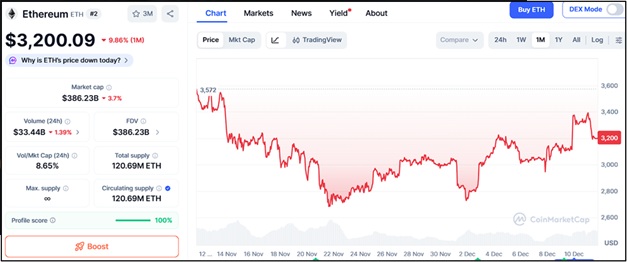
Ethereum continues to build one of the strongest structural styles in the market as its space expands through Layer-2 scaling, real-world asset tokenization, and institutional-grade settlement. Trading near $3,200, ETH remains firmly supported by key levels around $3,150, with deeper structural help at $3,080 and $2,960, zones that traditionally attract smart-money accumulation at some stage in consolidation stages.

On the upside, ETH approaches the first breakout zone at $3,280, followed by $3,345 and $3,420, levels that tend to unlock rapid multi-week surges when cleared with strong volume. Analysts now place Ethereum on a realistic path toward $5,000 in a full-scale bull cycle, driven by rising L2 throughput, increasing staking participation, and expanding institutional use cases. Ethereum remains the backbone of Web3—but its multiplier potential is naturally capped compared to emerging early-stage intelligence assets.

Solana (SOL)

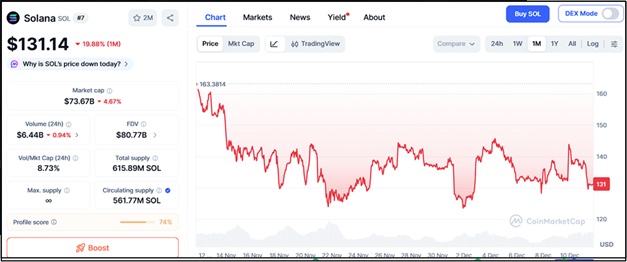
Solana maintains one of the most bullish trajectories among large caps, fueled by explosive developer activity, surging user growth, and increasing adoption across consumer applications. SOL trading near $131 shows strong structural support at $129, reinforced by deeper demand around $124 and $119, areas repeatedly associated with aggressive dip-buying.

On the resistance front, Solana must clear $136, $141, and $148 to unlock its next expansion phase. Once above these levels, historical patterns show SOL accelerating quickly into multi-week breakout territory. Analysts increasingly view $200 as a realistic target for Solana in the early phases of the bull market, with its long-term potential extending far beyond that if ecosystem momentum continues rising. Solana remains a top performer—but again, as a large-cap, its growth follows a more linear path.

Ozak AI Forecast Toward $1

Ozak AI enters this prediction trio as the most aggressive long-term performer due to its intelligence-driven architecture and early-stage valuation. As an AI-native engine equipped with millisecond-speed predictive processing, Ozak AI leverages HIVE’s 30 ms signals, Perceptron Network’s 700K+ node data backbone, and SINT-powered autonomous agents to analyze multi-chain conditions in real time.

This continuous data ingestion means the system grows more accurate and more capable every hour it runs—creating a compounding intelligence effect that no traditional blockchain asset can replicate. With the Ozak AI Presale now surpassing $5M, early investors are positioning before further stage increases as analysts outline a realistic path toward $1 based on adoption curves, utility expansion, and growing multi-chain integration.

Because Ozak AI enters the market at a low initial valuation with rapidly expanding intelligence infrastructure, its multiplier potential far exceeds that of ETH and SOL. A move toward $1 represents one of the most aggressive early-stage projections in the market today. 

The Trio That Defines the Next Cycle

Ethereum is preparing for a strong run toward the $5K range. Solana is building momentum toward the $200 region. Ozak AI is rapidly evolving toward a trajectory that could send it toward the $1 mark—a move that outpaces both major assets in terms of pure ROI. Ethereum and Solana look powerful, but Ozak AI remains the standout for exponential growth in 2025–2026.


About Ozak AI

Ozak AI is a blockchain-based, totally crypto project that provides an era platform that specializes in predictive AI and advanced data analytics for economic markets. Through machine learning algorithms and decentralized network technologies, Ozak AI allows real-time, accurate, and actionable insights to help crypto fans and corporations make the suitable decisions.


For more, visit:

Website: https://ozak.ai/

Telegram: https://t.me/OzakAGI

Twitter: https://x.com/ozakagi