DD
MM
YYYY

PAGES

DD
MM
YYYY

spot_img

PAGES

Home Blog Page 1240

How To Bet On Kentucky Derby 2025 In Illinois

0

The 2025 Kentucky Derby is upon us, and the most famous race of them all is scheduled to take place on Saturday, May 3rd in Louisville.

Residents of Illinois can get in on the betting action with TwinSpires, but there are other options in the sportsbook market that are featuring big bonus bets this year. Offshore sportsbooks to bet on the Kentucky Derby like BetOnline have more than $5,000 in free bets available to new users, who can place wagers straight from the comfort of their own homes no matter where the location.

Read below and learn how to bet on the 2025 Kentucky Derby in Illinois, and claim up to $5,000 in promotional bets.

How To Bet On Kentucky Derby 2025 in Illinois

  1. Click here to get $250 in free bets at BetOnline
  2. Sign up and deposit $50 or more
  3. Get your free bets
  4. Place wagers on the 2025 Kentucky Derby

Best Kentucky Derby 2025 Betting Offers In Illinois

  1. BetOnline$250 in free bets for Kentucky Derby 2025
  2. BetUS125% bonus, up to $2,625 on your first 3 deposits
  3. BetWhale$1,250 Kentucky Derby betting offer
  4. MyBookie$1,000 horse racing betting offer
  5. BetNow$500 Kentucky Derby bonus

1. BetOnline — $250 in free bets for Kentucky Derby 2025

One of the best and longest running betting options for the 2025 Kentucky Derby is BetOnline. This year, new users can earn up to $250 in free bets upon enrollment, and without any hidden rollover requirements. All it takes is a minimum of a $50 initial deposit. They are also featuring Kentucky Derby betting contests with over $20,000 in prize money set to be given away.

Why Sign Up For BetOnline?

  • Available in all 50 U.S. states
  • Better Kentucky Derby odds
  • Sign-up bonus has 1x rollover requirement
  • Fast payouts and secure payment methods

Join BetOnline Now!

2. BetUS — 125% bonus, up to $2,625 on your first 3 deposits
BetUS has been a mainstay in the industry, and are featuring arguably the best promotions for this year’s Kentucky Derby. They not only have a 125% deposit match bonus, but the offer is eligible for your first three deposits, worth up to $2,625 in free bets. A crypto bonus is available as well, which gives users of the currency a 200% boost upon deposit. It doesn’t stop there, though, as there is also a 300% bonus for referring a friend.

Why Sign Up For BetUS?

  • Huge welcome bonus offer on first 3 deposits
  • Competitive Kentucky Derby odds
  • 200% crypto deposit bonus
  • 300% refer-a-friend bonus

Join BetUS Now!

3. BetWhale — $1,250 Kentucky Derby betting offer
BetWhale has one of the easiest to use mobile platforms of the available options, and have an extensive betting menu for the 2025 Kentucky Derby. But it is their deposit bonus for this year’s big event that make them a solid choice, as they are offering a promotion of free bets that is worth up to $1,250. They also feature fast and secure payouts, which is an important aspect when deciding on which option to select.

Why Sign Up For BetWhale?

  • Up to $1,250 in welcome bonuses
  • Full range of Derby betting options
  • Fast, secure payouts
  • Mobile-friendly platform

Join BetWhale Now!

4. MyBookie — $1,000 sports betting offer
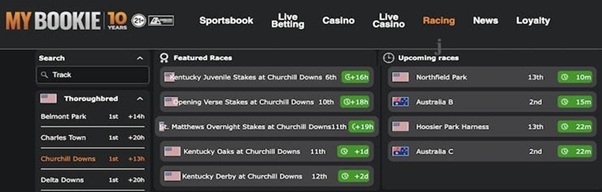
MyBookie is one of the most trusted sites when it comes to sports wagering of any kind, and hose racing fans in Illinois should take advantage this weekend. New members can earn a 100% welcome bonus on their first deposit, which is worth up to $1,000 in free bets. They have one of the deepest betting menus, which include bets like exatcas, trifectas, and more for this year’s Run for the Roses.

Why Sign Up For MyBookie?

  • Trusted betting site for U.S. players
  • $1,000 welcome bonus offer
  • Wide variety of horse racing bets
  • Better odds for top contenders

Join MyBookie Now!

5. BetNow — $500 bonus for Kentucky Derby

BetNow has a wide variety of sign-up bonuses. The betting boost for new users is valued at 150% for initial deposits, and there is a 200% bonus for those funding their accounts with cryptocurrency. There is another 200% boost that BetNow is offering, which is available for those who refer a friend to the site.

Why Sign Up For BetNow?

  • 150% deposit bonus up to $500
  • Registration is quick and easy
  • Competitive Derby odds
  • Reliable customer support

Join BetNow Now!

Is It Legal To Bet On Kentucky Derby 2025 In Illinois?

The best Kentucky Derby betting sites according to businessinsider.com is legal in the state of Illinois at a Federal level, and has been since 2020. There are more than a handful of physical locations throughout the state, as well as online betting being available as well. But there are plenty of limitations when it comes to legalized gambling, and bettors may find the offshore sportsbook options to be more advantageous to them.

Potential users of offshore options typically only need to be 18 years old as opposed to 21. There is also the factor of the aforementioned promotions and bonus bets that are available via the non-local options, which are offering more than $5,000 in free wagers this year for the 2025 Kentucky Derby.

Who Can Bet On the Kentucky Derby In Illinois?

  • Must be at least 18 years old
  • Sign up for your sports betting without ssn account with a valid email address
  • Fund your account with an accepted deposit method

Kentucky Derby 2025 Odds

The 2025 Kentucky Derby odds are set following the post position draw. Journalism is currently listed as the overall favorite, featuring +285 odds to nab the first leg of a potential Triple Crown. The favorite hasn’t won the race since 2015, but it is hard to ignore the gap between Journalism and the next horse on the board. Sovereignty is second on the list at +600, with Sandman rounding out the top three while sitting at +1000. Neoequos and Render Judgment are brining up the rear when it comes to the betting odds, as they share the designation of being the biggest long shots at 80-to-1.

Horse Odds
Journalism +285
Sovereignty +600
Sandman +1000
Luxor Cafe +1100
Rodriguez +1400
Burnham Square +1400
Baeza +1400
Final Gambit +1600
Citizen Bull +1800
American Promise +1800
East Avenue +1800
Grande +2000
Tiztastic +2500
Coal Battle +2500
Publisher +3300
Admire Daytona +4000
Flying Mohawk +5000
Chunk of Gold +5000
Owen Almighty +5000
Neoequos +8000
Render Judgement +8000

Kentucky Derby 2025 Picks and Predictions

Sandman is listed at +1000 odds and is third on the betting board this year, and might hold the most value despite others having larger numbers attached. The colt was foaled in 2022, and has started 8 races in its career. All of them have features finishes in the top-5, including three first place finishes, one of them being the Arkansas Derby back in late March. In its five races run since September 2024, Sandman has finished in the top-3 in each.

The value is hard to pass up, as a $100 winning wager on Sandman would net bettors $1,000. 

Kentucky Derby 2025 Prediction: Sandman (+1000)

What Is The Best Betting Site In Illinois For Kentucky Derby 2025?

All in all, potential Kentucky Derby bettors in Illinois are best off using a site like BetUS. The total of over $5,000 in promotions and Kentucky Derby free bets available from the offshore sportsbooks makes going non-local a solid option. These outlets make it easy and fun for Illinois residents to boost their bankroll and maximize profits when betting on free horse racing tips.

Claim $250 in free Kentucky Derby bets!

Fidelity Bank Posts N107.77bn Q1 Profit, Rewarding Investor Confidence Amid Recapitalization Drive

0

Fidelity Bank Plc has opened 2025 with a powerful earnings statement, reporting a pre-tax profit of N107.77 billion for the first quarter, a 167.79% year-on-year leap – signaling that its recent strategic moves, including a successful capital raise, are already delivering returns to investors.

The performance, announced in the bank’s unaudited financial statement for the quarter ended March 31, 2025, confirms a continuation of the bank’s growth trajectory, with earnings underpinned by a sharp increase in interest income, disciplined cost management, and improved asset quality.

The result also bolsters investor sentiment following last year’s oversubscribed public offers and rights issue, which Fidelity Bank launched as part of its plan to meet the Central Bank of Nigeria’s (CBN) N500 billion minimum capital requirement for tier-one banks. The recapitalization directive, issued in March 2024, gave banks a 24-month window to bolster their capital base to improve financial system stability.

Fidelity Bank’s combined capital raise via public offer and rights issue, which closed in late 2024 — drew massive interest from investors, who were betting on the bank’s profitability and management’s strategy. This Q1 result now serves as proof that those bets are beginning to pay off. Fidelity Bank raised a total of N231.97 billion through its public offer. The offer received applications for 23.79 billion shares valued at N231.97 billion. The bank initially aimed to raise N97.5 billion through the public offer, with a total capital raise of N127.1 billion including a rights issue.

Core Earnings Drive Profit Surge

Gross earnings rose to N315.42 billion in Q1 2025, a 64.21% increase from the N192.1 billion recorded in the same period last year. The bulk of this came from interest income, which surged 65.44% year-on-year to N281.47 billion. Notably, 75% of interest income came from loans and advances to customers, affirming the bank’s aggressive but disciplined lending stance. Investment in securities added another 18.31% to interest income.

At the same time, interest expenses rose to N90.65 billion, a 28.58% increase, largely due to rising deposit rates. However, this accounted for just 32% of total interest income, a marked improvement from 41.14% in Q1 2024, meaning Fidelity is now retaining a greater share of its income.

Net interest income jumped 91.52% to N190.82 billion, while net interest income after credit loss provisions grew 111.45% to N184.53 billion. The bank’s cost of risk fell significantly, with credit loss expenses dropping by nearly half to N6.28 billion, down from N12.37 billion a year earlier — indicating fewer bad loans and improved loan book quality.

Non-Interest Income and Fee Growth

Fidelity Bank also made significant headway in its non-lending business. Fees and commission income rose 30.10% year-on-year to N23.82 billion. While income from account maintenance fees slightly declined, the bank saw a 57% jump in earnings from traveler’s cheques and foreign bills and a 23.38% increase in commissions from letters of credit. Fee and commission expenses, however, rose by 37.56% to N2.67 billion.

Ultimately, net profit for the period rose to N91.10 billion, up from N31.44 billion in Q1 2024 — a growth of 189.75%. This translated to earnings per share of N1.81, representing an 84.69% improvement from N0.98 recorded a year earlier.

Balance Sheet Expansion and Liquidity Strength

Fidelity Bank’s balance sheet continues to expand at pace. Total assets climbed to N10.45 trillion, representing an 18.48% growth from the same quarter in 2024. The bank also recorded a sharp increase in cash and cash equivalents, which jumped by 128.90% to N1.62 trillion — a key indicator of the bank’s healthy liquidity position.

Loans and advances to customers rose 4.96% to N4.61 trillion, underlining controlled lending growth despite aggressive interest income expansion. Customer deposits also grew by 11.15% to N6.60 trillion, reflecting sustained depositor confidence and strong mobilization of retail and institutional funds.

Shareholders’ funds rose slightly by 3.39% to N933.14 billion, boosted by retained earnings and capital injection from the recently concluded public offers.

A Payout for Investor Faith

With its Q1 profit now standing at over N107 billion, roughly 75% of its full-year 2024 pre-tax earnings of N140 billion, Fidelity has effectively rewarded investor confidence just months after their commitment. The performance suggests the bank is on track to deliver another record-breaking year.

The Q1 earnings also improve the bank’s capacity to retain profits for future capital buffers while maintaining dividend potential — a key attraction for retail shareholders.

On the Nigerian Exchange (NGX), Fidelity Bank began the year trading at N17.50 per share. As of the close of Q1 2025, the stock had gained 14%, making it the 48th best-performing stock on the exchange in year-to-date rankings. This upward movement mirrors growing investor optimism, especially as the broader banking sector enters a period of transformation under the CBN’s capital restructuring directive.

Analysts say Fidelity Bank’s result strengthens its positioning to become one of the strongest indigenous players in the tier-one banking space. Its ability to mobilize deposits, grow interest income, maintain cost discipline, and manage risk effectively, while also attracting market capital, puts it in a favorable spot as Nigerian banks adjust to tougher regulatory and economic conditions.

The ‘Digital Assets Investment Act’ Bill Passed in North Carolina House

0

The North Carolina House of Representatives passed House Bill 92 (H92), known as the Digital Assets Investment Act, with a 71–44 vote. Introduced by Republican House Speaker Destin Hall, the bill allows the state treasurer to allocate up to 5% of select public funds, including the General Fund and Highway Fund, into Bitcoin-related exchange-traded products (ETPs) listed on regulated U.S. exchanges like NASDAQ and NYSE. Direct Bitcoin purchases are prohibited, and eligible digital assets must have a market capitalization of at least $750 billion, currently limiting investments to Bitcoin.

The bill aims to diversify state investments, potentially hedging against inflation and addressing a $16 billion pension fund shortfall. Safeguards include secure cold wallet storage, multi-signature authentication, monthly audits, and a two-thirds legislative vote for sales during financial emergencies. The bill now awaits Senate approval.

Allocating state funds to Bitcoin ETPs introduces a non-traditional asset to North Carolina’s portfolio, potentially hedging against inflation and currency devaluation. Bitcoin’s historical performance could help address the state’s $16 billion pension fund shortfall if returns are favorable. State-level adoption of Bitcoin as an investment vehicle signals growing institutional acceptance, potentially encouraging other states or municipalities to explore similar policies. This could bolster Bitcoin’s credibility and market stability.

Bitcoin’s volatility poses risks. A market downturn could lead to significant losses, impacting public funds critical for pensions, infrastructure, or emergencies. The 5% cap and strict safeguards (e.g., cold storage, audits) aim to mitigate this, but risk remains. The bill’s restrictions—limiting investments to regulated ETPs with high market cap assets—set a cautious framework for state involvement in crypto. This could influence federal or state-level regulations, balancing innovation with investor protection.

The bill’s passage (71–44) reflects polarized views. Senate approval is uncertain, and public opinion may split over using taxpayer funds for a speculative asset. Opposition could intensify if market losses occur. State investment in Bitcoin ETPs could drive demand, potentially increasing Bitcoin’s price or stabilizing its market. However, the 5% allocation limit suggests a modest immediate effect.

The policy positions North Carolina as a forward-thinking state in financial technology, potentially attracting blockchain-related businesses or investment, though it may also draw scrutiny from risk-averse stakeholders. If the bill passes the Senate, these implications will depend on implementation, market conditions, and public response. Failure in the Senate could stall similar initiatives elsewhere.

The passage of North Carolina’s House Bill 92 (H92), allowing investment of up to 5% of certain state funds in Bitcoin-related exchange-traded products (ETPs), has highlighted a clear divide in perspectives, as evidenced by the 71–44 House vote and broader discourse. Led by Republican House Speaker Destin Hall, proponents view the bill as a bold step toward financial innovation. They argue it diversifies state investments, potentially offsetting inflation and addressing the $16 billion pension fund shortfall.

They emphasize safeguards like cold storage, multi-signature authentication, and monthly audits, framing the bill as a calculated risk with Bitcoin’s high market cap ($750 billion threshold) ensuring stability. Supporters align with pro-crypto factions, seeing state adoption as a way to position North Carolina as a leader in emerging financial technologies, potentially attracting blockchain businesses.

The bill aligns with broader Republican themes of reducing reliance on centralized financial systems and embracing market-driven solutions. Opponents argue that Bitcoin’s volatility makes it an inappropriate investment for public funds, which are critical for pensions, infrastructure, and emergencies. A market crash could lead to significant losses, burdening taxpayers.

They question the prioritization of a speculative asset over traditional investments like bonds or equities, viewing it as a risky gamble with unproven long-term value. Some Democrats frame the bill as favoring niche crypto interests over broader public needs, potentially alienating constituents who see Bitcoin as a “tech bro” phenomenon. Concerns exist about regulatory uncertainty, with fears that federal crackdowns or market manipulation could undermine the investment.

Crypto enthusiasts and investors see the bill as a validation of Bitcoin’s role as a store of value and inflation hedge. They point to its historical returns (e.g., ~20% annualized over a decade) as a way to bolster state finances. They argue that the 5% cap and focus on regulated ETPs (not direct Bitcoin ownership) minimizes risk while capturing upside potential, especially in a low-yield bond environment.

Blockchain industry leaders view this as a catalyst for economic growth, potentially attracting crypto startups or investment to North Carolina. Economists and financial advisors skeptical of crypto highlight Bitcoin’s volatility (e.g., 50%+ drawdowns in 2022) and lack of intrinsic value compared to assets like real estate or equities. Pension fund managers and public finance experts worry about fiduciary responsibility, arguing that public funds should prioritize stability over speculative gains.

Critics note that Bitcoin’s correlation with tech stocks reduces its diversification benefits, and its energy-intensive mining raises environmental concerns, clashing with sustainable investment trends. Younger, tech-oriented individuals and libertarian-leaning groups support the bill, viewing Bitcoin as a decentralized alternative to fiat currency and a hedge against government overreach or monetary policy failures. They see state adoption as a step toward mainstreaming crypto, empowering individuals and reducing reliance on traditional banking systems.

Older generations and those unfamiliar with crypto often view Bitcoin as speculative or associated with illicit activities (despite declining illicit use). They distrust its intangible nature and lack of physical backing. Public sector workers and retirees, reliant on pension funds, may oppose the bill, fearing losses could jeopardize their financial security. Environmental advocates criticize Bitcoin’s energy consumption, arguing that public funds should align with ESG (environmental, social, governance) principles.

Supporters accept Bitcoin’s volatility for potential high rewards; opponents prioritize stability for public funds. Younger, tech-savvy groups are more open to crypto; older or less tech-literate groups are skeptical. Proponents lean toward decentralization and innovation; opponents favor traditional financial systems and regulatory caution.

Crypto’s complexity creates a divide between those educated on blockchain (supportive) and those reliant on mainstream narratives (skeptical). The polarized House vote (71–44) suggests a contentious Senate battle. If the Senate rejects the bill, it could dampen similar initiatives elsewhere. Passage could embolden other states but deepen political divide.

The debate may polarize voters, with crypto becoming a wedge issue in future elections. Missteps (e.g., market losses) could fuel distrust in state financial management. The divide reflects broader national tensions over crypto regulation. North Carolina’s approach could influence whether other states adopt cautious (ETP-only) or bolder (direct ownership) strategies.

AfDB Approves $3.25bn Support for Nigeria Until 2030 Amid Growing Fears of Misuse Due to Weak Accountability Structures

0

The African Development Bank (AfDB) has unveiled a new five-year Country Strategy Paper (CSP) for Nigeria, pledging to provide around $650 million annually from 2025 to 2030 — a move that could inject a total of $3.25 billion into Africa’s fourth-largest economy over five years.

The initiative forms part of the Bank’s broader effort to scale up development financing across Africa, after years of lamenting the region’s chronic underfunding and underperformance in critical sectors.

Under the first phase of the strategy, Nigeria is set to receive $2.95 billion in AfDB financing between 2025 and 2029, complemented by an additional $3.21 billion in co-financing from development partners. The Bank says the strategy seeks to unlock inclusive growth, create millions of jobs, and support the country’s ambition to double the size of its economy to $1 trillion.

But the plan, though ambitious in scope, is already generating anxiety over the likelihood of the funds being squandered — especially in a country long plagued by corruption, lack of transparency, and poor implementation of past international interventions.

AfDB’s Bigger Push Across Africa

The development financing drive in Nigeria is part of AfDB’s broader shift to address what it has repeatedly described as “Africa’s chronic development financing gap.” The continent, according to the Bank’s leadership, needs between $68–$108 billion annually just to bridge its infrastructure deficit, yet struggles to mobilize even a fraction of that due to global funding imbalances, investor hesitation, and weak domestic capacity.

AfDB President Akinwumi Adesina has in several public addresses decried the low share of global development finance that comes into Africa, pointing out that African countries, despite being the most vulnerable to climate shocks and infrastructure shortfalls, receive less than 5% of global climate financing.

In response, the Bank is increasing its commitments, establishing funding mechanisms, attracting partners, and ramping up its country-specific strategies. Nigeria, being its largest shareholder and the continent’s most populous nation, is now a key focus of this recalibrated approach.

Yet, while AfDB is scaling up its lending, there is an equally significant challenge on the receiving end — how to ensure that funds are not diverted or wasted.

Nigeria’s History of Missed Opportunities

Nigeria’s infrastructure and social development deficits are well-documented. From power outages that cripple industries to dilapidated roads and a water system that excludes millions, the country has struggled for decades to turn financial aid and loans into tangible improvements. And the problem has rarely been the lack of money, but how it’s managed or mismanaged.

The corruption risks surrounding Nigeria’s institutions remain a deep concern. The country consistently ranks low on Transparency International’s Corruption Perceptions Index, and there have been repeated cases of funds meant for roads, hospitals, education, and power being embezzled or misused. Several state and federal agencies have been implicated in the misappropriation of donor funds in the past, leading to disillusionment among international partners.

This new wave of AfDB funding, while promising, has not yet been accompanied by any enforceable safeguards to guarantee accountability. There is currently no clear mechanism outlined in the strategy to monitor how funds will be deployed.

Development analysts have raised red flags over this.

Aside from the concerns, the strategy itself is one of the most ambitious in recent memory. It focuses on two priority areas:

  1. Promoting sustainable, climate-smart infrastructure to improve industrial competitiveness — including roads, power, and water systems;
  2. Driving inclusive green growth by supporting agro-industrialization and job creation for youth and women.

Nigeria’s infrastructure gap is estimated at $2.3 trillion between 2020 and 2043, and the Bank believes targeted investments in renewable energy, clean transport systems, and resilient agricultural infrastructure could significantly lower business costs and unlock new economic zones.

AfDB projects that the strategy could generate 1.56 million jobs, mostly through agribusiness expansion, youth-focused training schemes, and the scaling up of support for women-led enterprises. The Bank’s Affirmative Finance Action for Women in Africa (AFAWA) programme will be deployed in Nigeria to provide tailored financial access to female entrepreneurs — a move long overdue given their disproportionate exclusion from credit markets.

The plan is also aligned with Nigeria’s own development blueprint — including Agenda 2050, the National Development Plan 2021–2025, and the Tinubu administration’s Renewed Hope Agenda.

AfDB said the strategy would also support Nigeria’s ability to take advantage of the African Continental Free Trade Area (AfCFTA) by boosting energy access, upgrading logistics networks, and connecting farmers and businesses to larger markets.

Rural Focus, But No Guarantees

Millions of Nigerians, particularly in rural communities, small towns, and marginalized groups — are expected to benefit from improved services and economic opportunities if the strategy is implemented faithfully. However, this remains a big “if”.

The absence of a rigorous auditing system, transparent tracking, and public engagement mechanisms may erode the potential impact. It is believed that in the current Nigerian context, where even state-level budgets are rarely published and procurement is often opaque, the AfDB’s assumption of effective implementation is overly optimistic.

However, Abdul Kamara, Director General of the AfDB’s Nigeria Office, expressed confidence in the transformative potential of the plan.

“By investing in sustainable infrastructure and inclusive agricultural growth, we are not only building roads, power systems, and transforming agriculture – we are building pathways to prosperity for millions of Nigerians,” Kamara said.

Still, for many Nigerians, the announcement is bittersweet — hopeful on the surface, but laced with the familiar fear that another windfall may end up benefiting only a few at the top.

Meta Launches Standalone Meta AI App Powered by Llama 4, Intensifies Competition in The Generative AI chatbot Market

0
Meta, the parent company of Facebook, has unveiled a dedicated Meta AI app, intensifying competition in the generative AI chatbot market. Built on the advanced Llama 4 model, the app offers services akin to Google’s Gemini and OpenAI’s ChatGPT, marking Meta’s push toward more personalized AI experiences.
Meta AI uses Llama 4 to help users solve problems, navigate their daily questions, and better understand the world around them. With the ability to search across the web, it can help them get recommendations, deep dive on a topic, and stay connected with their friends and family.
In a blog post, Meta wrote,
“We’re launching a new Meta AI app built with Llama 4, a first step toward building a more personal AI. People around the world use Meta AI daily across WhatsApp, Instagram, Facebook and Messenger. And now, people can choose to experience a personal AI designed around voice conversations with Meta AI inside a standalone app. This release is the first version, and we’re excited to get this in people’s hands and gather their feedback.”
Meta AI is designed to understand users on a personal level, delivering tailored responses that enhance their experience. It offers a conversational interface that feels effortless and intuitive, making interactions smooth and natural. With a strong social focus, Meta AI connects users to content from the people and communities they value most. Additionally, its voice features allow users to engage with the assistant while multitasking on their devices, with a clear microphone icon indicating when it’s active.
Meta plans to introduce a premium tier and incorporate advertisements into the Meta AI app. These monetization strategies are expected to roll out after the company focuses on scaling and increasing user engagement.

Key Features of Meta AI App

  • Personalized Interaction: Meta AI adapts to users’ preferences, delivering tailored, context-aware responses to enhance daily tasks, problem-solving, and engagement with topics of interest.
  • Seamless Voice Experience: The app prioritizes natural, conversational voice interactions, allowing multitasking with a visible microphone icon for transparency.
  • Social Integration: Leveraging Meta’s ecosystem, the app connects users to content from friends, family, and communities, making interactions more social and relevant.
  • Web Search and Recommendations: Powered by Llama 4, Meta AI provides web-based insights, recommendations, and in-depth topic exploration, helping users stay informed and connected.

Strategic Impact

The standalone Meta AI app positions Meta as a direct competitor to industry leaders like Gemini and ChatGPT, capitalizing on its vast user base across WhatsApp, Instagram, and Facebook. By releasing a dedicated AI app, Meta is moving beyond embedding AI features into its platforms and now offering a centralized hub for generative AI capabilities. This aligns with the current trend set by OpenAI and Google, who each provide standalone AI apps with multimodal capabilities.
The Meta AI app also serves as a controller for its Ray-Ban smart glasses, bridging AI with wearable technology. This real-world, voice-first AI experience is a unique direction not yet mainstream in ChatGPT or Gemini, giving Meta an early-mover advantage in AI-enhanced AR and smart wearables. 

Looking Ahead

As Meta gathers user feedback on this initial release, the app’s integration with Llama 4 and its focus on seamless, social interactions signal a bold step toward redefining AI-driven communication. The launch underscores Meta’s ambition to lead in the chatbot space while deepening user engagement across its platforms.