DD
MM
YYYY

PAGES

DD
MM
YYYY

spot_img

PAGES

Home Blog Page 128

US Senate Introduces New Bill Aimed at Social Media Algorithms, To Rewrite Sec 230, Give Users Right to Sue

0

A new bill introduced on Wednesday by Sen. John Curtis of Utah is set to reopen one of Washington’s most contentious debates: whether social media giants should finally face legal consequences for algorithm-driven recommendations that push users toward harmful content.

The proposal, called the Algorithm Accountability Act, would deliver the most consequential rewrite of Section 230 in decades and could expose the platforms to lawsuits if their recommendation systems help radicalize users or contribute to real-world violence.

Curtis said the law is long overdue. He argued that Section 230, created nearly 30 years ago, was written for a small and untested internet — not the sprawling world of algorithmic feeds designed to keep billions of users online.

“Section 230 was written nearly 30 years ago for a very different internet,” he said in a statement. “What began as a commonsense protection for a fledgling industry has grown into a blanket immunity shield for some of the most powerful companies on the planet — companies that intentionally design algorithms that exploit user behavior, amplify dangerous content, and keep people online at any cost. Our bill will hold them accountable.”

At the core of the bill is a simple idea that if a platform knowingly uses an algorithm to push harmful content that sparks injury or death, it must “own” the consequences. Under the proposal, platforms could be sued directly by individuals who can prove the algorithm played a role. The measure would impose a duty of care, requiring companies to design, test, and operate their recommendation systems with safety in mind.

Curtis introduced the bill with Sen. Mark Kelly of Arizona, who said families have endured too much harm from addictive algorithmic systems designed to maximize revenue, not safety.

“Too many families have been hurt by social media algorithms designed with one goal: make money by getting people hooked,” Kelly said. “Over and over again, these companies refuse to take responsibility when their platforms contribute to violence, crime, or self-harm. We’re going to change that and finally allow Americans to hold companies accountable.”

The legislation makes clear that ordinary speech is not the target. It bars enforcement based on viewpoint, seeking to avoid any perception that the bill polices political expression. It also grants states the authority to pass similar or stronger laws, giving them flexibility to confront harms emerging from platforms within their borders.

Curtis said the issue has taken on new urgency following the killing of conservative activist Charlie Kirk, who was assassinated in September during an event at Utah Valley University. According to early FBI findings, the gunman spent extensive time in fringe online forums and had been drawn into extremist ideology.

Utah Governor Spencer Cox said the suspect had been “engulfed” by a radical left worldview. Cox welcomed the new bill and said national action is essential.

“Utah has led the nation in passing laws to protect children from the harms of social media, but these challenges don’t stop at state lines,” he said. “We need a national standard for accountability.”

Curtis has been building toward a measure like this for months, pressing tech executives in hearings and insisting they acknowledge how their products shape public behavior. In a Senate hearing last month, he told executives they must “own” the choices they make in their recommendation engines. He has also compared the current moment to the 1990s, when tobacco executives denied nicotine’s dangers until the evidence became overwhelming.

The proposal marks one of the most aggressive attempts yet to narrow the legal shield that has defined social media’s rise. Passed in 1996, Section 230 prevented platforms from being sued over user-generated posts, a protection that digital rights advocates say enabled the early internet to flourish. But Curtis and Kelly argue that the architecture of today’s technology — with personalized feeds, targeted engagement loops, and algorithmic steering — bears no resemblance to the online world Congress sought to protect nearly three decades ago.

Curtis put it bluntly during an interview with the Deseret News, noting: “If they’re responsible for something going out that caused harm, they are responsible. So think twice before you magnify. Why do these things need to be magnified at all?”

The bill arrives at a moment when lawmakers from both parties are increasingly skeptical of social media companies and are searching for ways to curb the influence of their algorithmic systems. The question now borders on whether Congress is ready to take on a reform that has eluded lawmakers for years — and whether the tech industry is prepared for what could be the most significant shift in internet liability since the 1990s.

Ripple (XRP) Loses the Spotlight as Little Pepe (LILPEPE) Emerges as the Best Cheap Crypto to Invest in Before 2026

0

Once a darling of payments-focused investors, XRP is starting to fade from the limelight as a surprising new star emerges: Little Pepe (LILPEPE). Several XRP holders have been noticed selling off their XRP holdings and diverting the funds into LILPEPE at $0.0022, before the expected 1,200% exchange launch surge.

XRP’s Struggle: Steady but Slower

XRP’s reputation has long been built on institution-level credibility, cross-border payments, and partnerships. But lately, its momentum is showing signs of strain. According to analysts, whale activity has declined, and address growth isn’t keeping up, suggesting that fresh capital is looking elsewhere.  Some earlier bullish forecasts for XRP have been revised downward. For instance, one trader recently reduced their 2025 target from $22 to $10, citing that large holders are unloading XRP and macroeconomic headwinds are weighing on its growth. That’s quite a step back for a coin that many once viewed as a blue-chip altcoin play. On the other hand, more modest forecasts still exist: DeepSeek projects that XRP could reach $5 by the end of 2025, although skeptics argue that even this outlook is aggressive, given the current on-chain softness.  Even long-term narratives, like XRP becoming deeply embedded in global payments, are being questioned.

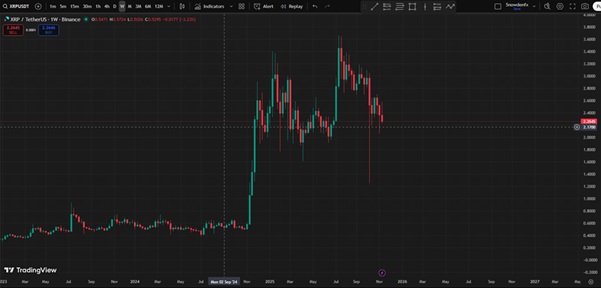
XRP Price Chart | Source: Tradingview

Little Pepe (LILPEPE): Meme Coin Meets Real Utility

Little Pepe (LILPEPE) is quietly creating a stir in the meantime. With each token priced at $0.0022, the presale is currently in Stage 13. After selling over 16.5 billion tokens, the team has already raised almost $27.3 million. That kind of demand from presale investors is no joke, especially for a “cheap” crypto.

So why are people paying attention? Because LILPEPE isn’t just a meme coin. It’s built on its own Layer-2 blockchain, optimized for lightning-fast, low-cost swaps, especially for meme projects. That infrastructure gives LILPEPE genuine utility, not just hype. The project has even been audited by CertiK, which gives some peace of mind to investors who might otherwise be wary of meme coins. Little Pepe is also listed on CoinMarketCap, which helps with legitimacy and visibility.

Big Upside, Big Potential

According to its roadmap and presale structure, LILPEPE could soar to $0.0030 at listing, meaning investors still in Stage 13 (at $0.0022) are looking at a 36% gain. For those who were around from Stage 1 (when the price was $0.001), the paper gains are already 120%.  However, the story doesn’t finish there. Due to its Layer-2 architecture, specific projections suggest that LILPEPE may eventually experience a rise of up to 21,365% if it completes its roadmap and expands its ecosystem. That’s the kind of return many retail investors only dream about when looking at the next big altcoin. One of the most telling shifts? Liquidity is leaving XRP. As more speculators chase high-volatility, high-upside bets, meme-driven Layer-2 plays like LILPEPE are catching that capital.  In other words, traders are favoring projects with massive asymmetrical upside, not just steady, slow growth. Little Pepe isn’t just relying on fundamentals. A $777,000 giveaway is currently underway, and the team has also launched a Mega Giveaway that rewards top presale buyers (from Stages 12–17) with over 15 ETH.  For many crypto investors, that’s a fun, community-driven way to get involved, and it’s helping drive excitement.

The Bottom Line

Yes, XRP still has a role: it’s mature, established, and tied to real-world use cases. However, for investors seeking substantial upside, Little Pepe may offer something more explosive, more viral, and potentially more rewarding. If you believe in meme coins plus real utility, LILPEPE might be the play to watch before 2026.

For more information about Little Pepe (LILPEPE) visit the links below:

Website: https://littlepepe.com

Whitepaper: https://littlepepe.com/whitepaper.pdf

Telegram: https://t.me/littlepepetoken

Twitter/X: https://x.com/littlepepetoken

 $777k Giveaway: https://littlepepe.com/777k-giveaway/

Bitcoin Slump Reflects Broader Market Risk Aversion, Says Binance CEO

0

Bitcoin’s sharp retreat this month has become one of the defining stories in global markets, with the world’s most valuable cryptocurrency slipping deeper into a downturn that reflects a wider wave of investor caution.

Binance Chief Executive Richard Teng said on Friday that the latest slump is being driven largely by investors unwinding leveraged positions and pulling back from risk—a pattern now visible across most major asset classes.

Bitcoin has fallen 21.2% in November alone, putting its three-month decline at 23.2%. The pullback has raised the odds that the token could end the year below $90,000, a symbolic threshold traders once considered a floor after it surged past $126,000 in early October to set an all-time high. The reversal since then has been swift and bruising, creating anxiety among momentum traders who piled in during the autumn rally.

Speaking during a media roundtable in Sydney, Teng said the recent turbulence should not be seen as isolated to crypto markets.

“As with any asset class, there are always different cycles and volatility. What you’re seeing is not only happening to crypto prices,” he said. “At this point in time, there’s a bit of risk (off) and deleveraging happening as well.”

That risk aversion has been evident throughout global markets this week. Investors have been unnerved by fears that an AI-driven valuation bubble—particularly around Big Tech—may be approaching a breaking point. Even Nvidia’s stronger-than-expected results have not done much to calm nerves, a sign of how deeply the unease has spread.

Bitcoin’s downturn comes after a remarkable stretch of gains stretching back roughly a year and a half. Teng emphasized that even with the recent decline, bitcoin is still trading at more than twice its level in 2024, when institutional giants like BlackRock began launching crypto-focused investment products that helped pull new capital into the sector.

“Over the past 1.5 years, the crypto sector has performed very, very well, so it’s not unexpected that people do take profit,” he said.

He argued that the present lull may ultimately be constructive. “Any consolidation is actually healthy for the industry, for the industry to take a breather, find its feet.”

Teng also addressed renewed attention on Binance founder Changpeng Zhao, known globally as CZ. Zhao, a Canadian citizen born in China, was pardoned by U.S. President Donald Trump in October after serving nearly four months in prison and paying a $50 million fine for pleading guilty to violations of U.S. money-laundering laws. His legal saga prompted a leadership transition in 2023, when Teng replaced him as chief executive.

When asked whether Zhao might return to the company, Teng said no decision had been taken.

“CZ has always been a controlling shareholder. As controlling shareholder he has more shareholder rights associated with that,” he said. “On the day-to-day basis, I work very closely with the board directors that comprise seven members, three independent directors, including an independent chairman, so we continue to chart the future strategy of the company.”

The combination of bitcoin’s rapid pullback, equity-market jitters, and lingering questions around Binance’s future leadership has created a tense backdrop for crypto traders. But Teng insisted the sector remains fundamentally stronger than it was in previous downturns. While in sum, he said the market is pausing, not collapsing—the coming weeks, with mounting pressure across global assets, are expected to test that confidence.

Flip Your SHIB Profits Into Ozak AI—Analysts Say ROI Could Multiply

0

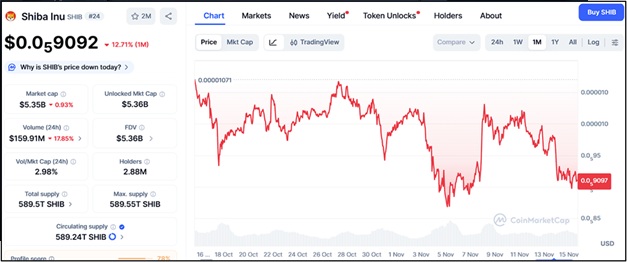
Meme coin market is heating up again, with Shiba Inu (SHIB) showing renewed strength and attracting traders looking to capitalize on short-term volatility. Trading around $0.000009092, SHIB’s bullish sentiment has returned—but analysts suggest investors might find even greater upside by rotating profits into next-generation AI projects.

Ozak AI (OZ), an emerging AI-driven ecosystem, is drawing increasing attention thanks to its strong presale performance, real-world integrations, and potential for 50x–100x growth. As investors begin securing profits from SHIB’s latest rally, many are eyeing Ozak AI as the smarter move for exponential returns in 2025.

Shiba Inu and Ozak AI

Shiba Inu remains one of the most traded and recognizable meme coins in crypto. Trading at $0.000009092, SHIB shows healthy market momentum as whales accumulate positions ahead of a possible broader meme resurgence. Resistance is forming at $0.000009460, $0.000009870, and $0.000010240, where previous rallies have met selling pressure. Strong support remains intact near $0.000008730, $0.000008390, and $0.000008050, creating a strong base for potential continuation.

Analysts believe SHIB could deliver a modest 5x–10x during peak meme season, but beyond that, its upside may begin to plateau. This is prompting many traders to take partial profits from SHIB’s rally and redirect capital toward early-stage utility-driven tokens like Ozak AI, where the growth potential remains far greater.

Ozak AI (OZ)

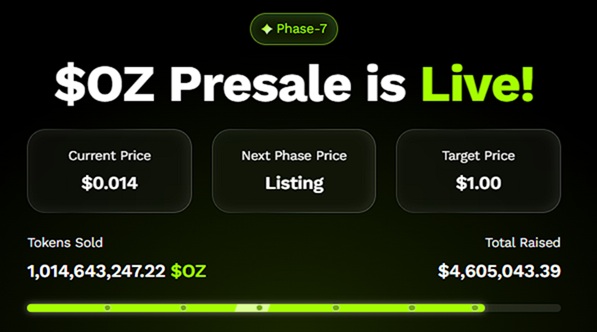
Ozak AI (OZ) is quickly emerging as one of the most promising early-stage crypto projects of the year. Its ecosystem combines prediction agents, real-time market intelligence, and cross-chain AI automation—all designed to make blockchain systems faster, smarter, and more autonomous. The project’s momentum is undeniable: over 1 billion tokens sold and more than $4.5 million raised during the OZ presale.

Strategic partnerships with Perceptron Network, HIVE, and SINT enhance Ozak AI’s credibility, connecting it to real-time 30 ms data signals, trust-based verification systems, and AI-driven agent toolkits. Analysts describe Ozak AI as the perfect bridge between artificial intelligence and decentralized data networks—two of the fastest-growing sectors in tech. With AI narratives dominating the next cycle, Ozak AI’s fundamentals place it in a prime position for massive returns once it lists.

Why SHIB Traders Are Rotating Profits Into Ozak AI

Seasoned meme traders are known for spotting early market rotations, and the current trend is clear: profits from meme coins like SHIB are flowing into AI projects. Three key factors explain this shift:

  • Massive upside potential: SHIB’s rally may continue, but its large market cap makes 50x–100x gains unlikely. Ozak AI, on the other hand, is still in its early valuation phase, where exponential returns remain achievable.
  • AI narrative strength: Artificial intelligence is becoming the dominant macro trend in both crypto and traditional tech, making Ozak AI’s growth story even more appealing.
  • Real utility over speculation: Unlike meme tokens, Ozak AI offers working technology—prediction agents, automation systems, and on-chain intelligence—all designed for real-world use.

As this rotation intensifies, Ozak AI is absorbing liquidity from meme-driven assets, becoming the focal point of early-cycle investment strategies.

Shiba Inu’s rally shows that community-driven momentum still works—but smart money is already moving into the next big narrative. Ozak AI offers that perfect mix of hype, real utility, and early-stage positioning. Analysts believe investors flipping their SHIB profits into Ozak AI could see their ROI multiply dramatically as the AI–crypto intersection matures through 2025.

SHIB’s run may be strong, but Ozak AI’s forecast looks explosive—making it the ideal target for traders aiming to turn meme gains into long-term wealth.

About Ozak AI

Ozak AI is a blockchain-based crypto venture that offers a technology platform that focuses on predictive AI and advanced records analytics for financial markets. Through machine learning algorithms and decentralized network technologies, Ozak AI permits real-time, correct, and actionable insights to help crypto fanatics and companies make the precise choices.


For more, visit:

Website: https://ozak.ai/

Telegram: https://t.me/OzakAGI

Twitter: https://x.com/ozakagi

Google Cloud VP Says Company Must Double Compute Capacity Biannually to Keep Pace With AI Services

1

During an all-hands meeting on November 6, Amin Vahdat, the vice president of Google Cloud responsible for AI infrastructure, laid out a staggering internal mandate: the company must double its compute capacity every six months to keep pace with the voracious demand for artificial intelligence services.

In a presentation viewed by CNBC titled “AI Infrastructure,” Vahdat displayed a slide that underscored the exponential stakes of the current technology arms race.

“Now we must double every 6 months,” the slide read, projecting a trajectory that would require a “1000x” increase in capacity within the next four to five years. Vahdat described the competition in AI infrastructure as “the most critical and also the most expensive part of the AI race,” a sentiment that aligns with the company’s massive financial escalation.

The internal disclosure comes just a week after Alphabet, Google’s parent company, reported better-than-expected third-quarter results and raised its capital expenditures forecast for the second time this year. The company now anticipates spending between $91 billion and $93 billion in 2024 alone, with a “significant increase” projected for 2026. This aggressive outlay is part of a broader trend among the “hyperscaler” giants—including Microsoft, Amazon, and Meta—who collectively expect to pour more than $380 billion into capital expenditures this year.

However, Vahdat emphasized to employees that the strategy is not merely about brute-force spending.

“Google’s job is of course to build this infrastructure but it’s not to outspend the competition, necessarily,” he said. While acknowledging that the company is “going to spend a lot,” he clarified that the ultimate goal is to engineer infrastructure that is “more reliable, more performant and more scalable than what’s available anywhere else.”

To achieve this efficiency, Google is leaning heavily on custom silicon. Vahdat highlighted the public launch of the company’s seventh-generation Tensor Processing Unit (TPU), codenamed “Ironwood,” which Google claims is nearly 30 times more power-efficient than its first Cloud TPU from 2018. He also pointed to a strategic advantage provided by DeepMind, whose research offers a roadmap for what future AI models will require. The objective, according to Vahdat, is to deliver 1,000 times more capability and compute power for “essentially the same cost and increasingly, the same power, the same energy level”—a feat he admitted “won’t be easy.”

The meeting also featured Alphabet CEO Sundar Pichai, who fielded questions alongside CFO Anat Ashkenazi regarding the sustainability of this spending spree. Addressing an employee’s question about the “zeitgeist” of a potential AI bubble and market skepticism regarding the return on investment, Pichai offered a pragmatic defense of the company’s aggressive posture. He reiterated his long-held view that in platform shifts of this magnitude, the risk of underinvesting far outweighs the risk of overinvesting.

“I actually think for how extraordinary the cloud numbers were, those numbers would have been much better if we had more compute,” Pichai said, referencing the cloud unit’s recent 34% annual revenue growth to over $15 billion, with a backlog swelling to $155 billion.

He argued that Google’s balance sheet and diverse business model make it “better positioned to withstand, you know, misses, than other companies.”

Pichai provided concrete examples of how hardware constraints are already throttling product distribution. He cited the video generation tool Veo, noting that while the launch was exciting, the company could not roll it out to as many users within the Gemini app as they wished “because we are at a compute constraint.” This bottleneck validates the urgency of Vahdat’s six-month doubling mandate.

The internal dialogue at Google mirrors the broader anxiety in the market. The bubble conversation intensified this week after Nvidia’s earnings report. Despite Nvidia CEO Jensen Huang rejecting the bubble premise and reporting 62% revenue growth with strong guidance, markets reacted negatively, with Nvidia shares sliding 3.2% and dragging the Nasdaq down 2.2%. Pichai acknowledged these external jitters, telling employees that 2026 will be “intense” and that “there will be no doubt ups and downs.”

Looking toward the financial horizon, CFO Anat Ashkenazi addressed concerns that capital expenditures are accelerating faster than operating income. She framed the spending as a critical opportunity to migrate more customers from physical data centers into the cloud, asserting that “the opportunity in front of us is significant and we can’t miss that momentum.”

With the launch of the new Gemini 3 model and the race against OpenAI tightening, Mountain View is preaching that the only way out is through—specifically, through a massive, unprecedented expansion of silicon and steel.