DD
MM
YYYY

PAGES

DD
MM
YYYY

spot_img

PAGES

Home Blog Page 129

Bitcoin Slump Reflects Broader Market Risk Aversion, Says Binance CEO

0

Bitcoin’s sharp retreat this month has become one of the defining stories in global markets, with the world’s most valuable cryptocurrency slipping deeper into a downturn that reflects a wider wave of investor caution.

Binance Chief Executive Richard Teng said on Friday that the latest slump is being driven largely by investors unwinding leveraged positions and pulling back from risk—a pattern now visible across most major asset classes.

Bitcoin has fallen 21.2% in November alone, putting its three-month decline at 23.2%. The pullback has raised the odds that the token could end the year below $90,000, a symbolic threshold traders once considered a floor after it surged past $126,000 in early October to set an all-time high. The reversal since then has been swift and bruising, creating anxiety among momentum traders who piled in during the autumn rally.

Speaking during a media roundtable in Sydney, Teng said the recent turbulence should not be seen as isolated to crypto markets.

“As with any asset class, there are always different cycles and volatility. What you’re seeing is not only happening to crypto prices,” he said. “At this point in time, there’s a bit of risk (off) and deleveraging happening as well.”

That risk aversion has been evident throughout global markets this week. Investors have been unnerved by fears that an AI-driven valuation bubble—particularly around Big Tech—may be approaching a breaking point. Even Nvidia’s stronger-than-expected results have not done much to calm nerves, a sign of how deeply the unease has spread.

Bitcoin’s downturn comes after a remarkable stretch of gains stretching back roughly a year and a half. Teng emphasized that even with the recent decline, bitcoin is still trading at more than twice its level in 2024, when institutional giants like BlackRock began launching crypto-focused investment products that helped pull new capital into the sector.

“Over the past 1.5 years, the crypto sector has performed very, very well, so it’s not unexpected that people do take profit,” he said.

He argued that the present lull may ultimately be constructive. “Any consolidation is actually healthy for the industry, for the industry to take a breather, find its feet.”

Teng also addressed renewed attention on Binance founder Changpeng Zhao, known globally as CZ. Zhao, a Canadian citizen born in China, was pardoned by U.S. President Donald Trump in October after serving nearly four months in prison and paying a $50 million fine for pleading guilty to violations of U.S. money-laundering laws. His legal saga prompted a leadership transition in 2023, when Teng replaced him as chief executive.

When asked whether Zhao might return to the company, Teng said no decision had been taken.

“CZ has always been a controlling shareholder. As controlling shareholder he has more shareholder rights associated with that,” he said. “On the day-to-day basis, I work very closely with the board directors that comprise seven members, three independent directors, including an independent chairman, so we continue to chart the future strategy of the company.”

The combination of bitcoin’s rapid pullback, equity-market jitters, and lingering questions around Binance’s future leadership has created a tense backdrop for crypto traders. But Teng insisted the sector remains fundamentally stronger than it was in previous downturns. While in sum, he said the market is pausing, not collapsing—the coming weeks, with mounting pressure across global assets, are expected to test that confidence.
Flip Your SHIB Profits Into Ozak AI—Analysts Say ROI Could Multiply

0

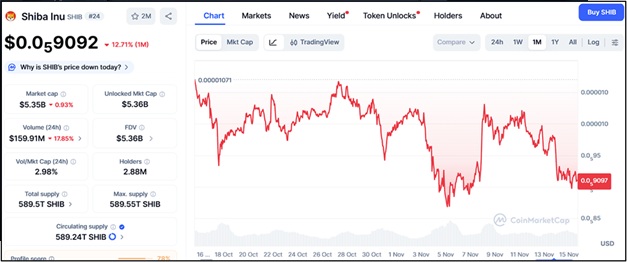
Meme coin market is heating up again, with Shiba Inu (SHIB) showing renewed strength and attracting traders looking to capitalize on short-term volatility. Trading around $0.000009092, SHIB’s bullish sentiment has returned—but analysts suggest investors might find even greater upside by rotating profits into next-generation AI projects.

Ozak AI (OZ), an emerging AI-driven ecosystem, is drawing increasing attention thanks to its strong presale performance, real-world integrations, and potential for 50x–100x growth. As investors begin securing profits from SHIB’s latest rally, many are eyeing Ozak AI as the smarter move for exponential returns in 2025.

Shiba Inu and Ozak AI

Shiba Inu remains one of the most traded and recognizable meme coins in crypto. Trading at $0.000009092, SHIB shows healthy market momentum as whales accumulate positions ahead of a possible broader meme resurgence. Resistance is forming at $0.000009460, $0.000009870, and $0.000010240, where previous rallies have met selling pressure. Strong support remains intact near $0.000008730, $0.000008390, and $0.000008050, creating a strong base for potential continuation.

Analysts believe SHIB could deliver a modest 5x–10x during peak meme season, but beyond that, its upside may begin to plateau. This is prompting many traders to take partial profits from SHIB’s rally and redirect capital toward early-stage utility-driven tokens like Ozak AI, where the growth potential remains far greater.

Ozak AI (OZ)

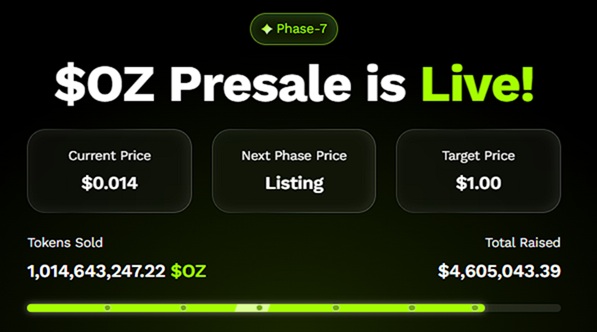
Ozak AI (OZ) is quickly emerging as one of the most promising early-stage crypto projects of the year. Its ecosystem combines prediction agents, real-time market intelligence, and cross-chain AI automation—all designed to make blockchain systems faster, smarter, and more autonomous. The project’s momentum is undeniable: over 1 billion tokens sold and more than $4.5 million raised during the OZ presale.

Strategic partnerships with Perceptron Network, HIVE, and SINT enhance Ozak AI’s credibility, connecting it to real-time 30 ms data signals, trust-based verification systems, and AI-driven agent toolkits. Analysts describe Ozak AI as the perfect bridge between artificial intelligence and decentralized data networks—two of the fastest-growing sectors in tech. With AI narratives dominating the next cycle, Ozak AI’s fundamentals place it in a prime position for massive returns once it lists.

Why SHIB Traders Are Rotating Profits Into Ozak AI

Seasoned meme traders are known for spotting early market rotations, and the current trend is clear: profits from meme coins like SHIB are flowing into AI projects. Three key factors explain this shift:

  • Massive upside potential: SHIB’s rally may continue, but its large market cap makes 50x–100x gains unlikely. Ozak AI, on the other hand, is still in its early valuation phase, where exponential returns remain achievable.
  • AI narrative strength: Artificial intelligence is becoming the dominant macro trend in both crypto and traditional tech, making Ozak AI’s growth story even more appealing.
  • Real utility over speculation: Unlike meme tokens, Ozak AI offers working technology—prediction agents, automation systems, and on-chain intelligence—all designed for real-world use.

As this rotation intensifies, Ozak AI is absorbing liquidity from meme-driven assets, becoming the focal point of early-cycle investment strategies.

Shiba Inu’s rally shows that community-driven momentum still works—but smart money is already moving into the next big narrative. Ozak AI offers that perfect mix of hype, real utility, and early-stage positioning. Analysts believe investors flipping their SHIB profits into Ozak AI could see their ROI multiply dramatically as the AI–crypto intersection matures through 2025.

SHIB’s run may be strong, but Ozak AI’s forecast looks explosive—making it the ideal target for traders aiming to turn meme gains into long-term wealth.

About Ozak AI

Ozak AI is a blockchain-based crypto venture that offers a technology platform that focuses on predictive AI and advanced records analytics for financial markets. Through machine learning algorithms and decentralized network technologies, Ozak AI permits real-time, correct, and actionable insights to help crypto fanatics and companies make the precise choices.


For more, visit:

Website: https://ozak.ai/

Telegram: https://t.me/OzakAGI

Twitter: https://x.com/ozakagi

Google Cloud VP Says Company Must Double Compute Capacity Biannually to Keep Pace With AI Services

1

During an all-hands meeting on November 6, Amin Vahdat, the vice president of Google Cloud responsible for AI infrastructure, laid out a staggering internal mandate: the company must double its compute capacity every six months to keep pace with the voracious demand for artificial intelligence services.

In a presentation viewed by CNBC titled “AI Infrastructure,” Vahdat displayed a slide that underscored the exponential stakes of the current technology arms race.

“Now we must double every 6 months,” the slide read, projecting a trajectory that would require a “1000x” increase in capacity within the next four to five years. Vahdat described the competition in AI infrastructure as “the most critical and also the most expensive part of the AI race,” a sentiment that aligns with the company’s massive financial escalation.

The internal disclosure comes just a week after Alphabet, Google’s parent company, reported better-than-expected third-quarter results and raised its capital expenditures forecast for the second time this year. The company now anticipates spending between $91 billion and $93 billion in 2024 alone, with a “significant increase” projected for 2026. This aggressive outlay is part of a broader trend among the “hyperscaler” giants—including Microsoft, Amazon, and Meta—who collectively expect to pour more than $380 billion into capital expenditures this year.

However, Vahdat emphasized to employees that the strategy is not merely about brute-force spending.

“Google’s job is of course to build this infrastructure but it’s not to outspend the competition, necessarily,” he said. While acknowledging that the company is “going to spend a lot,” he clarified that the ultimate goal is to engineer infrastructure that is “more reliable, more performant and more scalable than what’s available anywhere else.”

To achieve this efficiency, Google is leaning heavily on custom silicon. Vahdat highlighted the public launch of the company’s seventh-generation Tensor Processing Unit (TPU), codenamed “Ironwood,” which Google claims is nearly 30 times more power-efficient than its first Cloud TPU from 2018. He also pointed to a strategic advantage provided by DeepMind, whose research offers a roadmap for what future AI models will require. The objective, according to Vahdat, is to deliver 1,000 times more capability and compute power for “essentially the same cost and increasingly, the same power, the same energy level”—a feat he admitted “won’t be easy.”

The meeting also featured Alphabet CEO Sundar Pichai, who fielded questions alongside CFO Anat Ashkenazi regarding the sustainability of this spending spree. Addressing an employee’s question about the “zeitgeist” of a potential AI bubble and market skepticism regarding the return on investment, Pichai offered a pragmatic defense of the company’s aggressive posture. He reiterated his long-held view that in platform shifts of this magnitude, the risk of underinvesting far outweighs the risk of overinvesting.

“I actually think for how extraordinary the cloud numbers were, those numbers would have been much better if we had more compute,” Pichai said, referencing the cloud unit’s recent 34% annual revenue growth to over $15 billion, with a backlog swelling to $155 billion.

He argued that Google’s balance sheet and diverse business model make it “better positioned to withstand, you know, misses, than other companies.”

Pichai provided concrete examples of how hardware constraints are already throttling product distribution. He cited the video generation tool Veo, noting that while the launch was exciting, the company could not roll it out to as many users within the Gemini app as they wished “because we are at a compute constraint.” This bottleneck validates the urgency of Vahdat’s six-month doubling mandate.

The internal dialogue at Google mirrors the broader anxiety in the market. The bubble conversation intensified this week after Nvidia’s earnings report. Despite Nvidia CEO Jensen Huang rejecting the bubble premise and reporting 62% revenue growth with strong guidance, markets reacted negatively, with Nvidia shares sliding 3.2% and dragging the Nasdaq down 2.2%. Pichai acknowledged these external jitters, telling employees that 2026 will be “intense” and that “there will be no doubt ups and downs.”

Looking toward the financial horizon, CFO Anat Ashkenazi addressed concerns that capital expenditures are accelerating faster than operating income. She framed the spending as a critical opportunity to migrate more customers from physical data centers into the cloud, asserting that “the opportunity in front of us is significant and we can’t miss that momentum.”

With the launch of the new Gemini 3 model and the race against OpenAI tightening, Mountain View is preaching that the only way out is through—specifically, through a massive, unprecedented expansion of silicon and steel.

Robert Kiyosaki Sells $2.25M of His Bitcoin Holdings

0

Robert Kiyosaki, author of the bestselling Rich Dad Poor Dad, has revealed that he recently sold a portion of his Bitcoin holdings valued at $2.25 million. According to his recent post on X, Kiyosaki disclosed that he originally purchased the coins years ago at about $6,000 each, giving him a substantial gain despite the current market downturn.

In his post, the Rich Dad Poor Dad author stated that he sold the Bitcoin for roughly $90,000 per coin and is now channeling the proceeds into two surgery centers and a billboard business. He estimates that these new investments will collectively generate approximately $27,500 in monthly, tax-free cash flow by February, further strengthening what he describes as a “fluffier” financial cushion that already runs into the hundreds of thousands of dollars per month from his existing real estate ventures.

He wrote,

“I sold $2.25 million in Bitcoin for approximately $90,000. I purchased the Bitcoin for $6,000 a coin years ago. With the cash from Bitcoin, I am purchasing two surgery centers and investing in a billboard business. I estimate my $2.25 million Bitcoin investment into the surgery centers and Billboard business will be positive cash flowing, approximately $27,500 a month income by next February tax tax-free. Adding $27,500 a month income to my years of previous Cashflow positive real estate-based business makes my cash flow cushion a bit fluffier, into $100’s of thousands per month.”

Despite liquidating a multimillion-dollar portion of his crypto holdings, Kiyosaki emphasized that he remains bullish on Bitcoin and plans to resume accumulation using cash flow from his businesses. He framed the move as part of a long-term wealth-building strategy rooted in the principles he learned from his “Rich Dad,” comparing it to the strategy taught in his Cashflow board game, turning speculative gains into income-producing assets with tax and debt advantages.

Kiyosaki acknowledged that he was advised not to publicly disclose the sale due to safety concerns, referencing what he called “too many sickos out there.” Still, he chose to share the update as part of his ongoing focus on transparency and financial education. His decision comes as a surprise to many, given his earlier predictions that Bitcoin could climb as high as $250,000. Only weeks earlier, he stated he was buying more Bitcoin and Ethereum during the market correction, forecasting “massive riches” ahead.

Kiyosaki’s selloff coincides with another notable move in the crypto space, where a Bitcoin whale who first accumulated BTC in 2011 is reported to have liquidated his entire holdings. These significant exits appear as Bitcoin faces mounting selling pressure, triggering renewed concerns that the market may be transitioning into a bear phase.

The price of Bitcoin continued to plunge, falling to around $80,628 on Friday, its lowest level in six months. The crypto asset closed below its 50-week moving average, a key level closely monitored by analysts. Crypto strategist Rekt Capital noted that Bitcoin’s failure to reclaim this threshold has “invalidated bullish market structures,” pointing to a shift in the macro trend. BTC has also dropped below the 100-week moving average, reinforcing the downward momentum.

Additional bearish confirmation came from Bitcoin’s SuperTrend indicator, which flashed a sell signal a pattern that has historically marked the beginning of extended bear markets. Meanwhile, realized losses across the Bitcoin network have soared above $800 million, levels not seen since the collapse of FTX in 2022. On-chain data from Glassnode shows both short-term and long-term holders capitulating, with short-term investors increasingly selling at losses and amplifying downward pressure.

Analysts suggest that the Bitcoin market is currently undergoing a full momentum reset, a cooling phase that typically emerges between major market cycles. With directional strength fading and sentiment weakening, the cryptocurrency finds itself in a period of uncertainty as investors reassess its next trajectory.

Nvidia-fueled Rout sweeps Asian chip shares, Sinks SoftBank by over 10%

0

A punishing wave of selling washed over Asia’s technology sector on Friday, erasing billions in market value as investors reacted to a paradox that has rattled global trading floors: Nvidia, the engine of the artificial intelligence boom, posted a blockbuster earnings beat, and the market hated it.

The result was a sea of red across Asian exchanges, led by a stunning double-digit collapse in SoftBank Group, as traders priced in a harsher reality for the AI ecosystem.

The damage was most acute in Japan, where SoftBank plunged more than 10%. The drop carried a bitter irony for the Japanese conglomerate. SoftBank recently liquidated its direct stake in Nvidia—securing billions in profit—yet found itself unable to escape the gravitational pull of the chip giant’s sentiment. Investors punished SoftBank for its lingering exposure to the sector through its controlling stake in Arm Holdings, the British chip designer whose architecture underpins Nvidia’s processors, and its massive capital commitments to AI infrastructure projects like the $500 billion “Stargate” data center initiative.

The bleeding in Tokyo was indiscriminate. Tokyo Electron, a bellwether for chip manufacturing equipment, shed 6.6%, while Lasertec dropped 5.2%. Even Renesas Electronics, a smaller but critical supplier in the Nvidia chain, retreated 3%.

Supply Chain Contagion

The selloff rippled rapidly through the critical supply chains in Korea and Taiwan.

  • SK Hynix plummeted nearly 10%. The South Korean titan is Nvidia’s primary supplier of High Bandwidth Memory (HBM), the “turbocharger” memory chips essential for AI accelerators.
  • Samsung Electronics, currently playing catch-up in the HBM race, was not spared, falling over 5%.
  • TSMC (Taiwan Semiconductor Manufacturing Company), the sole manufacturer of Nvidia’s cutting-edge GPUs, dropped over 4% in Taipei.
  • Foxconn (Hon Hai Precision Industry), the builder of the server racks that house these AI brains, dipped 4.86%.

The Nvidia Paradox

The catalyst for the panic occurred thousands of miles away during Thursday’s U.S. trading session. Nvidia delivered what looked like a perfect scorecard: a beat on third-quarter earnings and revenue, coupled with a fourth-quarter sales forecast that exceeded Wall Street’s wildest estimates. CEO Jensen Huang even declared demand for the new Blackwell chips to be “off the charts.”

Yet, Nvidia shares fell over 3% in New York. The market’s reaction signaled a shift in psychology—investors are no longer satisfied with “great” results; they demand perfection. The selloff suggests that fears of valuation ceilings and “execution risk” are beginning to outweigh raw growth numbers.

Analysts argue this isn’t just about one company. The semiconductor slump is colliding with a broader risk-off environment.

“Nvidia was a victim of a combination of a Bitcoin selloff, the possibility of a delayed Fed rate cut, and generally tighter financial conditions,” said Billy Toh, regional head of retail research at CGS International Securities Singapore.

Speaking to CNBC, Toh pinpointed the psychological pivot point: “Add in the ongoing talk of an AI bubble, which triggers a broader risk-off rotation, and naturally Nvidia becomes one of the first pressure points.”

With Bitcoin retreating and the Federal Reserve’s minutes casting doubt on a December rate cut, liquidity is tightening just as the AI trade demands massive new capital outlays.