DD
MM
YYYY

PAGES

DD
MM
YYYY

spot_img

PAGES

Home Blog Page 1354

Nigeria’s Net FX Inflow Dropped to $4.79bn in Jan 2025 – Central Bank

0

Nigeria’s foreign exchange market in January 2025 tells a story of shifting control—one that subtly exposes the weakening grip of the Central Bank of Nigeria (CBN) over the country’s forex inflows, even as private players quietly expand their footprint.

According to the January 2025 Economic Report released by the CBN on April 17, net foreign exchange inflows into the economy dropped to $4.79 billion, down 4.49% from $5.01 billion recorded in December 2024. At first glance, this may seem like a minor dip. But scratch beneath the surface and a deeper trend becomes evident: the sharp decline in CBN-led inflows contrasts starkly with the surge in autonomous inflows—those from non-government sources like private exporters, international investors, and diaspora remittances.

The central bank’s share of foreign exchange inflows plummeted to $2.33 billion in January, a dramatic fall from $4.09 billion in December—a 43% drop in just one month. On the other hand, autonomous inflows surged to $7.31 billion from $6.08 billion, marking a growing confidence in private channel participation amid the government’s struggle to maintain its influence in the FX ecosystem.

While aggregate inflows fell from $10.17 billion to $9.63 billion during the period, foreign exchange outflows also eased to $4.84 billion from $5.17 billion. But it’s the breakdown of these flows that truly reshapes the narrative. Outflows through the CBN dropped to $3.80 billion from $4.16 billion, yet that reduction did not cushion the impact of falling inflows through the same channel. What resulted was a net outflow of $1.47 billion via the CBN—a reversal from the marginal net outflow of $0.07 billion in December. Autonomous sources, by contrast, posted a net inflow of $6.26 billion, up from $5.07 billion.

Naira Finds Strength, Turnover Rises

The foreign exchange market itself responded in kind. The naira appreciated at the Nigerian Foreign Exchange Market (NFEM), strengthening by 1.16% to an average of N1,535.94 per US dollar in January from N1,553.73 in December. The end-period exchange rate fared even better, gaining 3.90% to close at N1,478.22 from N1,535.82.

Increased confidence among market participants also translated into activity. Average daily turnover on the NFEM jumped 18.30% to $408.49 million, up from $345.30 million in December, underscoring a more liquid market with greater participation—again, largely driven by the non-official segment.

Is CBN Losing Its Grip on FX Inflow?

While the improvement in the exchange rate and growing liquidity appear encouraging, the underlying shift in forex inflow dynamics calls for concern. A declining share of inflows through the CBN signals dwindling government capacity to intervene in the market when necessary. This erosion of influence can become problematic if external shocks hit—especially in the absence of robust reserves or policy buffers.

It also poses a challenge to the country’s balance of payments, which leans heavily on oil receipts and foreign investments typically channeled through official sources. As the CBN recedes, the onus shifts to private capital to plug the gap—an unreliable solution at best in an economy where investor confidence can evaporate quickly.

Yet the rise in autonomous inflows may offer some hope. It reflects renewed activity among non-oil exporters, possibly spurred by exchange rate adjustments and sustained remittance flows. If properly incentivized and regulated, these inflows could become more stable over time and help Nigeria reduce its overreliance on oil-linked forex.

The CBN’s declining role also speaks to broader questions of confidence in government-led monetary policy. The foreign exchange market has long been plagued by dual rates, inconsistent interventions, and a lack of transparency. Investors and exporters often prefer alternative channels to avoid bureaucratic delays or unfavorable rates. The result is an FX market where informal and autonomous channels increasingly call the shots.

Going forward, economic analysts argue that simply watching the naira appreciate month to month is not enough. They note that the government must address core structural problems: rebuild external reserves, improve non-oil exports, and restore trust in CBN’s policy framework.

According to them, Nigeria’s foreign exchange scene may continue to be dominated by autonomous actors, not out of strength, but because the official channels have ceded ground if the above steps are not taken.
Mapping the CBEX Ponzi Scheme’s Footprint in South West Nigeria

0

Between January and April 2025, the digital footprint of an emerging Ponzi scheme, known as CBEX, quietly expanded across Nigeria’s South West region. At first glance, CBEX resembled countless other high-yield investment platforms promising fast returns with minimal risk. But behind the façade was a familiar story: financial desperation, uneven digital literacy, and the illusion of opportunity fueled by social validation and algorithmic reach.

Understanding the CBEX Exposure Curve

While traditional investigations into such schemes typically emerge after damage has been done, digital behaviour patterns offer a different vantage point. By analysing public interest data sourced from Google Trends, two distinct indicators—general search queries for “CBEX” and login-related searches such as “CBEX login” evolved as critical markers. These search patterns tell a deeper story about how exposure, engagement, and vulnerability vary not only between individuals but also across geographies.

Regional Hotspots: A Data-Driven View

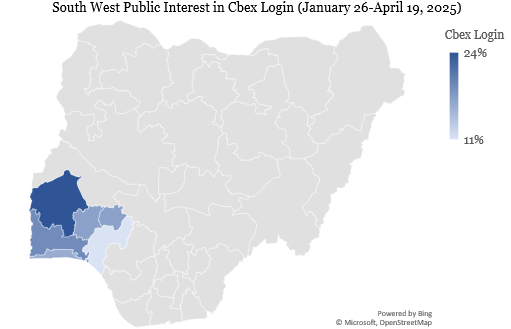
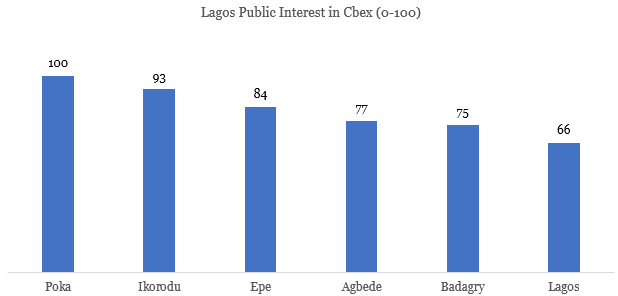
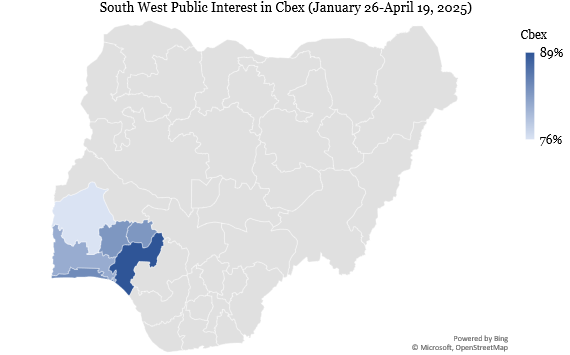
The South West zone of Nigeria, comprising Lagos, Ogun, Oyo, Osun, Ondo, and Ekiti states, offers a unique lens to assess these differences. Lagos, unsurprisingly, ranked highest in both public interest and login-related search activity. Nearly 89% of all CBEX-related searches in the region were concentrated in Lagos, with login-specific searches accounting for 24%. This suggests that, beyond curiosity, a substantial proportion of Lagosians were actively interacting with the platform—either logging in to invest, track returns, or, as typically happens in such schemes, attempting to recover funds after withdrawal problems began.

Source: Google Trends, 2025; Infoprations Analysis, 2025

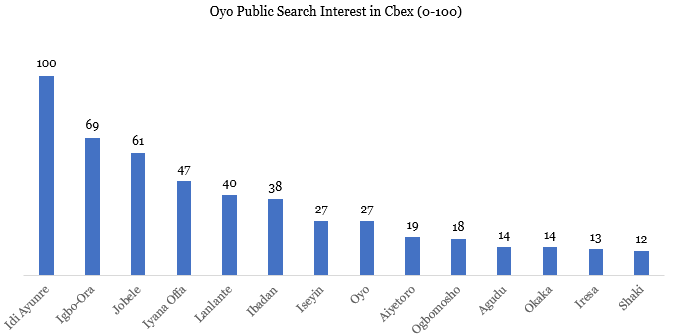
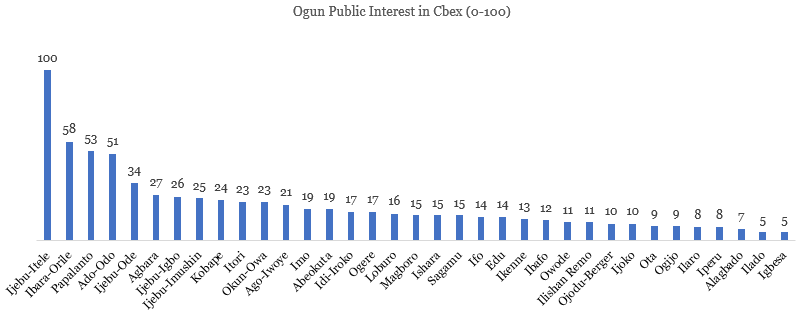
In nearby states such as Ogun and Oyo, the trends remained strong, though slightly less intense. High general interest and moderate-to-high login-related activity imply that these states formed the second layer of the scheme’s diffusion. Social and familial ties, digital connectivity, and migration patterns likely played a role in this regional spread. Such behaviours follow a known model in fraud research: financial schemes often travel fastest along trusted social lines.

Source: Google Trends, 2025; Infoprations Analysis, 2025

Osun, Ondo, and Ekiti, however, present a contrasting narrative. While general awareness of CBEX was present, with search interest ranging around 76%, login-specific queries were markedly lower, fluctuating between 11% and 15%. This may suggest a more skeptical user base or delayed exposure. Alternatively, it could reflect systemic barriers such as limited internet access, lower digital confidence, or stronger informal resistance to non-traditional financial products.

Source: Google Trends, 2025; Infoprations Analysis, 2025

The distinction between public interest and platform engagement is more than academic—it has policy and business implications. General search interest represents attention, curiosity, and early-stage exposure. Login interest, on the other hand, signals interaction and potential financial commitment. When both spike, especially within a compressed time window, the result may be an early warning system for regulators, banks, fintech providers, and consumer protection agencies.

Source: Google Trends, 2025; Infoprations Analysis, 2025

In a digital economy characterised by speed and decentralisation, financial scams no longer require complex infrastructure. All they need is visibility—amplified through search engines, social media algorithms, and word-of-mouth virality. CBEX’s regional spread followed this model precisely. It did not require a physical presence to operate. Instead, it relied on search relevance, referral links, and urgent storytelling—powerful psychological levers that have been tested and perfected in today’s online marketplaces.

Source: Google Trends, 2025; Infoprations Analysis, 2025

Reframing Digital Financial Risk

The implications are significant. Monitoring digital search behaviour in real time can be a powerful fraud detection tool. Much like marketers use search intent to model consumer demand, regulators and financial educators can use it to forecast risk exposure and deploy targeted interventions.  Financial literacy efforts need to become hyper-local and behaviour-specific. It’s not enough to run national campaigns; messages must be tailored to the state-level contexts revealed in data.

A broader governance rethink is needed. As Ponzi schemes evolve in sophistication, so too must our mechanisms for protecting the financially vulnerable. That means bringing together digital platforms, local agencies, behavioural scientists, and civil society in co-designing fraud-resistant ecosystems.

Trump’s Escalating Interest Rate Tension and Potential Rise on Inflation Due to Tariff

0

President Donald Trump has repeatedly pressured Federal Reserve Chair Jerome Powell to lower interest rates, escalating tensions by publicly calling for Powell’s termination. Trump argues that cutting rates would stimulate the economy, citing falling oil prices and claiming tariffs are boosting U.S. wealth. However, Powell has warned that Trump’s sweeping tariff policies are likely to increase inflation and slow economic growth, creating a challenging scenario for the Fed’s dual mandate of price stability and maximum employment.

Trump’s Position

Trump has criticized Powell for being “too slow” and “wrong” on monetary policy, accusing him of playing politics by not cutting interest rates. In posts on Truth Social, Trump claimed that lower rates are needed as tariffs “transition” into the economy, asserting that the U.S. is “getting rich on tariffs” and that inflation is declining (despite data showing otherwise). He has even suggested Powell’s “termination cannot come fast enough,” reigniting concerns about the Fed’s independence, a norm Trump has historically challenged.

Powell’s Warnings

Jerome Powell, in speeches on April 4 and April 16, 2025, emphasized that Trump’s tariffs—described as significantly larger than anticipated—are likely to lead to higher inflation and slower economic growth. Tariffs, such as a 10% baseline on all U.S. imports and up to 145% on Chinese goods, are expected to raise consumer prices, potentially causing a temporary or even persistent rise in inflation. Core inflation was at 2.8% in February 2025, above the Fed’s 2% target.

The tariffs could weaken growth by disrupting supply chains and reducing consumer and business confidence. The Fed lowered its 2025 growth forecast to 1.7% from 2.1%.  Powell noted the risk of stagflation—a combination of rising inflation, higher unemployment, and stagnant growth—last seen in the 1970s. This would put the Fed in a bind, as raising rates to curb inflation could exacerbate unemployment, while cutting rates to boost growth could fuel inflation.

Powell advocated a “wait-and-see” approach, keeping the Fed’s benchmark rate at 4.25–4.5%. He stressed the need to monitor data to ensure inflation expectations remain anchored and avoid a one-time price increase becoming sustained inflation. Trump’s tariffs include 25% duties on steel, aluminum, and goods from Mexico and Canada, a 145% duty on Chinese imports, and a 10% baseline tariff on all imports, with some exemptions for electronics. Retaliatory tariffs from China (34% on U.S. goods) and threats from the EU have escalated global trade tensions.

U.S. stock markets have plunged, with the Dow dropping 1,600 points on April 4 and the S&P 500 falling 4.5%, marking some of the worst trading days since 2020. Global markets also slid, reflecting fears of a trade war and potential recession. Despite tariff concerns, the economy remains solid, with a 4.2% unemployment rate and 228,000 jobs added in March 2025. However, consumer confidence hit its lowest level since January 2021, and small-business uncertainty spiked.

Fed’s Dilemma and Independence

The Fed faces a delicate balancing act. Cutting rates, as Trump demands, could exacerbate inflation, especially if tariffs drive persistent price increases. Conversely, maintaining or raising rates to combat inflation risks further slowing growth and raising unemployment. Powell has emphasized the Fed’s independence, refusing to engage with Trump’s political remarks and focusing on data-driven policy. Economists like Kathy Bostjancic of Nationwide argue the Fed is unlikely to cut rates soon, predicting a pause until Q4 2025 as inflation accelerates. Others, like Chicago Fed President Austan Goolsbee, highlight the lack of a clear playbook for navigating stagflationary shocks.

While Trump’s tariffs aim to boost U.S. manufacturing and correct trade imbalances, the consensus among economists and Powell is that they risk backfiring by raising costs for consumers and businesses, disrupting global trade, and potentially triggering a recession. Trump’s claim that tariffs are reducing inflation contradicts data showing inflation at 2.8% and rising goods prices. His pressure on the Fed undermines its independence, a cornerstone of stable monetary policy. On the other hand, Powell’s cautious approach may be prudent but could be criticized for underestimating the need for preemptive action in a volatile trade environment. The lack of modern precedent for such large-scale tariffs (the Smoot-Hawley tariffs of 1930 being the closest parallel) adds uncertainty to forecasting outcomes.

Trump’s push for lower interest rates and Powell’s warnings about tariff-driven inflation and slower growth highlight a fundamental policy clash. The Fed’s decision to hold rates steady reflects caution amid unprecedented trade disruptions, but the risk of stagflation looms large. The coming months will be critical as tariff effects materialize, potentially forcing the Fed to make tough choices between fighting inflation and supporting growth. For now, Powell’s focus remains on anchoring inflation expectations while navigating an economy facing significant uncertainty.

European Central Bank Cuts Its Interest Rate By 25 BPS

0

European Central Bank (ECB) cut its key interest rate by 25 basis points on April 17, 2025, lowering the deposit facility rate from 2.5% to 2.25%. This marks the seventh consecutive rate cut since June 2024, bringing the rate down from a high of 4% in mid-2023. The decision, unanimously supported by the ECB’s Governing Council, aims to bolster eurozone economic growth amid escalating global trade tensions, particularly due to U.S. tariffs imposed by President Donald Trump. ECB President Christine Lagarde cited “exceptional uncertainty” and a “deteriorated” growth outlook, driven by a 20% tariff on EU goods and additional industry-specific tariffs, as key factors.

Inflation remains close to the ECB’s 2% target at 2.2% in March 2025, supporting the disinflationary trend. Economists, including Deutsche Bank’s Mark Wall, expect further cuts, potentially reaching 1.5% by year-end, with markets pricing in additional reductions by June. However, some ECB policymakers warn that tariffs could fuel longer-term inflation, complicating future decisions.

Lower interest rates reduce the attractiveness of euro-denominated assets, decreasing demand for the currency. Following the announcement, the euro weakened slightly, with posts on X noting a decline against the U.S. dollar to around $1.04, reflecting market expectations of further cuts. U.S. tariffs, including a 20% levy on EU goods, exacerbate the euro’s depreciation. These tariffs, combined with the ECB’s dovish stance, signal weaker economic growth in the eurozone, further pressuring the euro.

Analysts cited suggest the euro could drop to $1.01-$1.03 by mid-2025 if trade tensions persist. The U.S. Federal Reserve’s tighter policy stance, with fewer rate cuts expected, widens the interest rate differential, favoring the dollar. This dynamic supports a stronger dollar-euro exchange rate, potentially pushing the euro lower. While inflation is near the ECB’s 2% target, potential tariff-driven price increases could complicate future ECB decisions. If inflation rises, the ECB might pause cuts, offering some euro support.

Lower interest rates reduce borrowing costs, encouraging consumer spending and business investment. This is critical as the ECB aims to counter a “deteriorated” growth outlook amid U.S. tariffs and global trade tensions. If stimulus overshoots, it could fuel demand-driven inflation, especially if tariffs increase import costs. However, with inflation near 2.2%, the ECB sees room for further easing.

Export-oriented sectors like automotive and manufacturing may face challenges from a weaker euro and tariffs, while domestic-focused sectors like services could benefit from cheaper credit. A depreciating euro (around $1.04 and potentially falling to $1.01-$1.03) makes eurozone exports cheaper, partially offsetting the impact of U.S. tariffs. This could support industries like machinery and chemicals.

A weaker euro raises the cost of imported goods, particularly energy and raw materials priced in dollars, which could squeeze consumer purchasing power and business margins. Lower yields on eurozone assets may drive capital outflows to higher-yielding markets like the U.S., further pressuring the euro. The rate cut supports demand, reducing the risk of deflation in a slowing economy. However, U.S. tariffs could introduce cost-push inflation by raising prices of imported goods.

If tariffs drive inflation above the 2% target, the ECB may need to slow or pause rate cuts, potentially limiting economic stimulus. Markets expect rates to fall to 1.5% by year-end, but persistent inflation could alter this trajectory. Lower ECB rates keep eurozone government bond yields, like German 10-year Bunds, suppressed, supporting debt affordability but challenging savers and pension funds.

A weaker euro and lower rates generally boost equities, particularly export-driven firms. However, tariff-related uncertainty could cap gains in sectors exposed to U.S. markets. The euro’s decline increases forex market volatility, as traders weigh ECB policy against U.S. tariff impacts and Federal Reserve actions. The weaker euro may escalate trade disputes, as the U.S. could view it as a competitive devaluation. This risks retaliatory measures, further disrupting eurozone exports. A stronger U.S. dollar due to the euro’s weakness could strain emerging markets with dollar-denominated debt, indirectly affecting eurozone banks with exposure to these regions.

Cheaper loans could boost spending, but higher import prices and tariff-driven uncertainty may dampen confidence, particularly in trade-exposed countries like Germany. Firms face a mixed outlook—lower rates aid investment, but tariffs and a weaker euro raise costs and complicate planning, especially for SMEs reliant on U.S. markets. Markets anticipate further cuts, with some economists forecasting a 1.5% rate by late 2025. However, the ECB’s data-dependent approach means inflation spikes or worsening growth could alter this path. The ECB’s dovish stance contrasts with the Federal Reserve’s relatively hawkish outlook, reinforcing dollar strength and euro weakness, which could shape ECB rhetoric to avoid excessive currency depreciation.

The ECB’s rate cut aims to stimulate growth but risks euro depreciation, higher import costs, and potential inflationary pressures from tariffs. While exporters may gain, consumers and import-reliant businesses face challenges. Financial markets will see mixed effects, with equities potentially supported but currency volatility rising. The ECB must navigate trade tensions and inflation risks carefully, as global uncertainties could force a recalibration of its dovish stance. Monitoring U.S. policy and eurozone data will be critical for future implications.

How To Raise Fund and Launch a Business – Ndubuisi Ekekwe

0

Factors of production enable the creation of products and services towards fixing frictions in markets. One of those factors, Capital, is very catalytic in the operations of firms. Among other things, it makes it possible for you to acquire other factors you do not have (you may need capital to pay workers, buy land, etc).

Join us today at Tekedia Mini-MBA as we discuss how to raise capital and launch your business venture. As I write, Tekedia Capital is investing in 18 companies covering continents and industries (check them here https://capital.tekedia.com/course/fee/ ). What do we look for in these ventures?

Sat, April 19 | 7pm-8.30pm WAT | How To Raise Fund and Launch a Business – Ndubuisi Ekekwe, Tekedia Capital | Zoom link

Tekedia Mini-MBA >> our product is knowledge