DD
MM
YYYY

PAGES

DD
MM
YYYY

spot_img

PAGES

Home Blog Page 1373

Tekedia Mid-Week Crypto and Blockchain Digest

0

Michael Saylor, a prominent Bitcoin advocate and Strategy chairman, has predicted Bitcoin could reach a $500 trillion market cap, implying a per-coin price of roughly $23.8 million to $25.2 million, given its 21 million total supply or 19.84 million circulating supply. His reasoning hinges on Bitcoin absorbing value from traditional assets like gold, real estate, and other stores of value, which he argues will be demonetized as capital shifts to digital assets. He sees Bitcoin as the next evolution of money, driven by its fixed supply and growing institutional adoption, potentially causing a supply shock.

U.S. Securities and Exchange Commission (SEC) announced that certain stablecoins, specifically those referred to as “covered stablecoins” like USD Coin (USDC) and Tether (USDT), are not classified as securities under federal securities laws. This clarification came from the SEC’s Division of Corporation Finance, stating that these stablecoins—designed to maintain a 1:1 peg with the U.S. dollar, fully backed by low-risk, liquid reserves, and redeemable on demand—do not meet the definition of a security. As a result, transactions involving the minting or redeeming of these stablecoins do not require registration with the SEC.

However, the announcement has nuances. The SEC’s guidance applies strictly to stablecoins meeting specific criteria, such as being backed solely by USD or high-quality liquid assets, with no interest or profit promised to holders. Some sources suggest Tether’s USDT may not fully align with these standards due to its reserve composition, which includes assets like commercial paper, bitcoin, and gold, potentially complicating its status under the SEC’s framework. Commissioner Caroline Crenshaw dissented, arguing the guidance oversimplifies risks, particularly for retail investors relying on intermediaries, and may misrepresent the market’s stability.

World Liberty Financial (WLFI) proposed a test airdrop of its USD1 stablecoin to all WLFI token holders to validate its on-chain airdrop system, reward early supporters, and boost USD1 visibility before a broader launch. The airdrop, planned for Ethereum Mainnet, will distribute a fixed amount of USD1 per eligible wallet, with the exact amount and timing still under review based on the number of wallets and budget. The proposal requires community feedback and a governance vote to proceed, but WLFI reserves the right to modify or cancel it even if approved. The USD1 stablecoin, launched in March 2025, is pegged to the US dollar, backed by US Treasuries, dollar deposits, and cash equivalents, and managed by custodian BitGo.

Gold reaching $3,220 per ounce reflects strong safe-haven demand amid economic and geopolitical uncertainty. Factors like tariff tensions, inflation fears, central bank buying, and stock market volatility are likely driving the surge. While some sources suggest prices could climb further—potentially to $3,300 by year-end—others warn of profit-taking or resistance at these levels. Always consider market dynamics and risks before acting on such trends.

U.S. Department of Justice (DOJ) disbanded its National Cryptocurrency Enforcement Team (NCET) on April 7, 2025, as confirmed by multiple sources. Deputy Attorney General Todd Blanche issued a memo stating the DOJ will no longer pursue cases against crypto exchanges, mixers, or offline wallets for their users’ actions or unintentional regulatory violations. The focus is shifting to prosecuting individuals who directly harm crypto investors or use digital assets for crimes like terrorism, drug trafficking, or fraud. This aligns with the current administration’s push to reduce regulatory pressure on the crypto industry and foster innovation, though critics warn it could weaken oversight of illicit activities. Ongoing investigations inconsistent with this policy are to be closed, but specific case details weren’t disclosed.

A wallet linked to the bankrupt FTX exchange and its affiliate Alameda Research unstaked 186,326 Solana (SOL) tokens, valued at approximately $21.56 million. This move sparked speculation about potential sell-offs, as FTX continues liquidating assets to repay creditors. Despite concerns, Solana’s price rose slightly, gaining 3.57% to trade at around $119 that day, showing resilience amid broader market recovery and optimism around a possible Solana ETF. Historically, FTX and Alameda have unstaked millions of SOL since November 2023, often moving tokens to exchanges like Binance and Coinbase, which can pressure prices.

Mantra’s OM token crashed ~90% on April 13, 2025, dropping from ~$6.30 to below $0.50, wiping out over $5 billion in market cap. MANTRA attributes the collapse to “reckless forced liquidations” by centralized exchanges during low-liquidity hours, denying insider selling. Co-founder John Mullin suggested one exchange’s sudden closure of positions without warning triggered the cascade. However, community skepticism persists, with some alleging insider dumps due to large pre-crash token deposits (e.g., 3.9M OM to OKX). No conclusive evidence confirms either narrative, and investigations are ongoing.

Binance executives reportedly met with U.S. Treasury officials to discuss easing regulatory oversight, particularly around anti-money laundering compliance, while also exploring a deal with the Trump family’s crypto venture, World Liberty Financial. The talks involved potentially listing a new dollar-pegged stablecoin, USD1, which could leverage Binance’s massive user base and trading volume for adoption, potentially generating significant profits for the Trump family. Discussions about a Trump family stake in Binance.US have also surfaced, though details remain unclear. These moves align with Binance’s efforts to re-enter the U.S. market after a $4.3 billion settlement in 2023 for violating anti-money laundering laws.

Data from IntoTheBlock indicates a recent increase in transaction volumes on Virtuals Protocol, a blockchain project focused on AI agent creation and deployment. This uptick, noted around mid-April 2025, suggests renewed interest in the platform after a significant decline earlier in the year, with transaction volumes rising by 20% from April 1 to April 10. However, the ecosystem has faced challenges, with prior reports showing a 99% drop in revenue and DEX trading volumes since December 2024. While this resurgence could signal a potential recovery for Virtuals Protocol and its native token, market sentiment remains cautious due to earlier losses and broader uncertainties.

OpenAI Developing Social Media Platform Inspired by xAI’s X, Aiming to Rival Tech Giants

0

OpenAI, the creator of ChatGPT, is reportedly working on its own social media network, a strategic move inspired by xAI’s integration of its Grok AI with the X social platform, according to a report from The Verge.

The project, currently in its early stages with an internal prototype, centers on integrating ChatGPT’s image-generation capabilities into a social feed. While it remains uncertain whether this platform will launch as a standalone app or be embedded within the ChatGPT app, OpenAI’s ambitions signal a bold push to compete with Elon Musk’s X, Meta’s Facebook, and Instagram, while securing critical user data to fuel its AI models.

Copying xAI’s Blueprint for Data and AI Synergy

The impetus for OpenAI’s social media venture is believed to stem from xAI’s successful leveraging of X’s user-generated data to train its AI model, Grok. When Elon Musk acquired Twitter in 2022, later rebranding it as X, he restricted bot access to the platform’s data—a move that sparked backlash but was strategically designed to prevent competitors from freely harvesting X’s valuable content for AI training. When it was launched, Musk directed this data exclusively to xAI, his AI startup, enabling the development of Grok, a chatbot and AI model series that competes directly with OpenAI’s ChatGPT.

Grok’s integration with X has fueled both AI advancements and new forms of content creation, creating a feedback loop that strengthens the platform’s ecosystem.

OpenAI, led by CEO Sam Altman, appears to be emulating this approach. By building its own social network, OpenAI could gain direct access to real-time, human-generated data—text, images, videos, and commentary—to train its AI models, such as GPT-4 and the new 4o image-generation tool. This would reduce OpenAI’s dependence on scraping publicly available internet data, which is increasingly difficult and expensive to obtain at the scale required for cutting-edge AI development.

The Verge’s report suggests that OpenAI’s prototype is a direct response to xAI’s data-driven strategy, positioning OpenAI to replicate the synergy between social engagement and AI innovation that has propelled xAI and X.

Why a Social Network? Rivalry, Attention, and Data

Bill Gross, founder of tech incubator Idealab, outlined three key motivations behind OpenAI’s social media push, as cited by The Verge: a personal rivalry between Altman and Musk, the need to capture greater user attention to justify a trillion-dollar valuation, and the pursuit of high-quality, labeled data for AI training.

Altman vs. Musk: Gross emphasized that Altman’s competitive dynamic with Musk, a former OpenAI co-founder, is a significant driver. “Altman doesn’t like Musk, so why not start competing head-on with X?” Gross told The Verge. This rivalry adds a personal layer to OpenAI’s strategic pivot, as Altman seeks to challenge Musk’s dominance in the AI and social media arenas.

Capturing Attention: OpenAI, recently valued at approximately $300 billion, is striving to join the trillion-dollar valuation club alongside Microsoft, Google, Amazon, and Meta, all of which boast billions of daily users.

“Altman needs to have more attention to justify OpenAI’s valuation,” Gross explained.

ChatGPT already attracts between half a billion and a billion monthly unique visitors, but a social network could amplify this reach by enabling users to share AI-generated content, such as images, in a dynamic feed.

“They just need more attention. So why not harvest the output of their models that users will share on a new social network, and this should attract even more users and even more attention,” Gross added, echoing the sentiment of Google’s seminal AI paper, “Attention Is All You Need.”

The Data Imperative: The most critical motivation is data. AI companies like OpenAI have an insatiable demand for human-generated content to train their models. While raw data is valuable, labeled data, where users provide context through comments, captions, or interactions—is far more useful for AI development. A social network would provide OpenAI with a continuous stream of such data.

“If users start typing words into this new OpenAI social network, the company can use that for all kinds of AI model training,” Gross said. “Users would also share images and videos and add commentary. This is essentially humans identifying and labeling content on a massive scale.”

This mirrors xAI’s approach, where X’s user activity directly informs Grok’s training, creating a powerful cycle of data collection and AI refinement.

The Prototype and Altman’s Next Steps

According to The Verge, OpenAI’s internal prototype focuses on integrating ChatGPT’s image-generation capabilities with a social feed, potentially allowing users to create and share AI-generated visuals alongside text-based posts. While specifics remain limited, the prototype’s existence indicates that OpenAI is actively exploring this venture.

Altman has reportedly been seeking external feedback, privately consulting industry outsiders to refine the project’s direction. In a recent post on X, Altman hinted at OpenAI’s evolving strategy, stating, “How about we fix our model naming by this summer and everyone gets a few more months to make fun of us (which we very much deserve) until then?”

Though lighthearted, the comment reflects Altman’s awareness of the competitive pressures and the need to innovate rapidly.

OpenAI did not respond to The Verge’s inquiries, leaving many details speculative. Key questions remain: Will the platform prioritize user privacy, given its data-intensive goals? How will it differentiate itself in a crowded social media landscape? And will it ever progress beyond the prototype stage to a public launch?

A New Era of AI-Driven Social Platforms

OpenAI’s social media ambitions reflect a broader shift in the tech industry, where AI and user data are increasingly inseparable. A decade ago, social platforms monetized attention through targeted advertising. Today, the focus has shifted to collecting user activity to train powerful AI models, which are then offered as premium services or subscriptions.

Meta and X already leverage their vast user bases to fuel their AI initiatives, giving them a significant advantage. OpenAI, lacking a native social platform, is at a disadvantage—hence the push to create one, inspired by xAI’s model.

Do Unemployment, Inflation Drive Nigeria’s Ponzi Scheme Surge?

0

From the early crash of MMM Nigeria in 2016 to the collapse of CBEX in 2025, Ponzi schemes have become an unsettling fixture in Nigeria’s economic landscape. With over 50 major schemes recorded since 2016, our analyst notes that their growth appears to mirror the nation’s economic turbulence, but a closer look reveals a more layered reality.

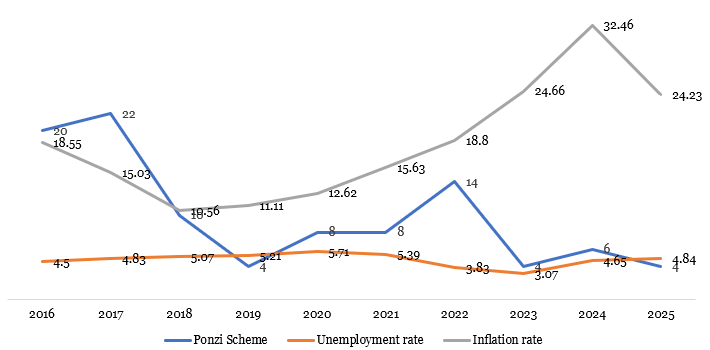
While inflation and unemployment are often cited as triggers for financial desperation, recent data shows that inflation, more than joblessness, has a stronger correlation with Ponzi activity. Between 2020 and 2022, inflation reached multi-year highs. That same period saw the emergence and collapse of schemes like Racksterli, 86FB, InksNation, and Baraza Multipurpose Cooperative, which attracted thousands of participants before eventually defaulting.

Analysis of macroeconomic indicators from 2016 to 2024 points to a pattern: as the cost-of-living soars and the naira weakens, Nigerians increasingly seek out risky alternatives to preserve purchasing power. While unemployment also peaked in 2020, Ponzi scheme proliferation more closely followed inflationary surges. According to our analyst, this suggests that the erosion of real income may be a more immediate driver of fraudulent investment activity.

Exhibit 1: Ponzi schemes and selected macroeconomic indicators

Source: National Bureau of Statistics, 2016-2025; Macrotrends, 2016-2025; Infoprations Analysis, 2025

However, macroeconomic conditions alone do not fully explain the pattern. Only 14% of the variation in Ponzi scheme operations between 2016 and 2024 can be attributed to inflation and unemployment combined. Our analyst points out that this implies that while economic pressure is a factor, it is not the primary determinant of Ponzi participation.

Further predictions extending from 2026 to 2030, based on constant inflation and unemployment rates, suggest minimal change in Ponzi scheme activity. These projections highlight the limits of macroeconomic indicators in forecasting fraudulent investment trends. Real-world complexities such as digital access, information flow, and community behaviour play a far more significant role.

One of the most persistent drivers of Ponzi scheme participation in Nigeria is low financial literacy. Many individuals, especially in low-income and semi-urban areas, struggle to distinguish between legitimate investment opportunities and schemes designed to collapse. Operators of these scams often present themselves as investment experts, leveraging buzzwords such as cryptocurrency, forex trading, and digital arbitrage to lend false credibility.

Weak regulatory enforcement continues to be a challenge. Many schemes operate for months before being investigated or sanctioned. In some cases, warnings from regulatory agencies come after significant public losses have already occurred. Delays in enforcement create an enabling environment for fraudulent actors to expand operations, recruit more victims, and siphon off larger sums.

Another critical issue is the deep-seated distrust of formal financial institutions. Years of banking collapses, inaccessible pension funds, and opaque government-backed financial schemes have eroded public confidence. In such an environment, informal investment groups, often promoted by friends, family, or community leaders, appear more trustworthy than official channels. Ponzi schemes exploit this trust, embedding themselves in everyday social networks.

The role of social media and instant messaging platforms cannot be understated. These digital spaces allow schemes to spread rapidly through viral marketing, fake testimonials, and exaggerated success stories. With limited fact-checking and a high emotional appeal, these platforms have become the primary launchpads for many recent schemes.

Periods of Ponzi decline also deserve attention. In 2019 and 2023, there was a noticeable reduction in fraudulent scheme activity. These declines may be attributed to a combination of regulatory crackdowns, increased public awareness, and growing digital financial literacy. Expanded financial inclusion initiatives and youth-targeted education campaigns during those periods likely played a role in lowering public susceptibility.

Despite the link between economic instability and Ponzi activity, socioeconomic desperation is a broader and more persistent issue. The desire for financial relief, regardless of inflation levels or employment status, fuels risky behaviour. As formal job opportunities shrink and the gap between income and living costs widens, more Nigerians turn to unregulated alternatives, despite the repeated collapses of such schemes.

Going forward, our analyst says Nigeria faces a choice. Without systemic improvements in financial education, rapid-response regulation, and public trust in formal systems, Ponzi schemes will continue to evolve and resurface under new names and models. Inflation and unemployment may set the stage, but it is the absence of strong financial safeguards that allows the performance to continue.

Access Holdings Posts N867bn Pre-Tax Profit For 2024 FY

0

Access Holdings Plc closed its 2024 financial year with a robust profit profile, cementing its position among Nigeria’s most aggressive and expansive banking institutions.

The group posted a pre-tax profit of N867.02 billion, a solid 19% increase from the N729.00 billion recorded in the previous year. Although the profit after tax rose marginally by 3.7% to N642.22 billion from N619.32 billion, the group’s ability to deliver growth amid tightening market conditions and rising cost pressures speaks to its scale, aggressive lending drive, and improved investment returns.

The most striking feature of the 2024 performance is the sheer size of gross earnings, which nearly doubled to N4.878 trillion from N2.594 trillion in 2023. This 88% jump is a reflection of both the group’s aggressive expansion in interest-generating assets and the sharp rise in interest rates over the year. Interest income alone surged by more than 110% to N3.48 trillion, meaning that over 71% of the bank’s revenue came from its core business of lending and investing. The contribution of interest income to total gross earnings increased by about 12% year-on-year, underlining Access Holdings’ sustained focus on its primary revenue engine.

A deeper dive into this interest income reveals that about 51% came from loans to customers and other banks, while 47% was derived from investments in securities, including government and corporate bonds. The remaining 2%, although a small proportion, came from cash balances. Interestingly, this segment of the bank’s income grew by nearly 1,000% in 2024, showing how even idle liquidity was efficiently deployed to earn returns, especially amid rising monetary policy rates.

However, Access Holdings also faced a sharp increase in its interest expenses, which rose by 130.7% to N2.212 trillion. Much of this cost, about 88%, was tied to interest payments on customer deposits and borrowings from other financial institutions. The group’s balance sheet shows that deposits from customers climbed steeply, rising by nearly N12 trillion, or 61%, to stand at just under N32 trillion. While this deepened the group’s liquidity base and gave it the firepower to lend and invest, it also meant that Access had to offer higher interest to attract and retain depositors, reflecting the high-rate environment in 2024.

Altogether, the group spent over 63% of its interest income on deposit-related interest expenses. However, it still managed to grow its net interest income to N1.268 trillion, up 82.4% from the previous year. After accounting for impairment charges, which rose 75.8% to N245.32 billion largely due to higher provisions for bad loans and investment losses, net interest income stood at N1.023 trillion—an 84% increase that underscores the group’s capacity to extract value from its core activities even in the face of rising credit risk.

Access Holdings also reported a substantial increase in its non-interest income, although its contribution to overall revenue shrank when measured as a percentage of gross earnings. Fees and commission income contributed about 10.5% of gross earnings, while fair value gains and foreign exchange earnings added another 8.5%. Nonetheless, the absolute figures were significantly higher than those of 2023. The group raked in N162 billion in credit-related fees, marking a 60% jump from the previous year, and earned another N59.8 billion from account maintenance charges, up 87%. These numbers contributed to total fees and commission income of N415.24 billion, nearly doubling year-on-year.

The bank’s balance sheet continues to be driven by a deposit-heavy model, with customer and institutional deposits accounting for 77% of its total assets in 2024. This structure remains a competitive advantage, as deposits typically come at a lower cost compared to wholesale borrowing. However, it also exposes the group to liquidity and interest rate risks, especially if market dynamics push depositors toward alternative investment outlets with better yields. Nonetheless, the group seems to be actively managing these risks, particularly as it prepares to meet the Central Bank of Nigeria’s new capital requirement.

To shore up its capital base, Access Holdings carried out a rights issue in July 2024, raising N351 billion. Existing shareholders were allowed to purchase one new share for every two shares they held at a price of N19.75 per share. After deducting associated costs, the group added N343 billion to its equity, bringing its share capital and premium to N594.903 billion, a 136% rise from the prior year. This capital injection played a major role in strengthening shareholders’ funds, which jumped by 72% to N3.76 trillion.

From a capital adequacy and liquidity standpoint, the group appears well-positioned. Total assets closed the year at N41.50 trillion, a 55.9% growth, while cash and cash equivalents with banks rose by over 70% to N5.22 trillion. Loans and advances to customers also grew strongly by 42.9% to N11.49 trillion, showing that the group remains focused on expanding its credit book despite rising impairments. Retained earnings grew by 60% to N1.14 trillion, reinforcing Access Holdings’ ability to reinvest profits for future growth while still rewarding shareholders.

Shareholders are expected to receive a final dividend of N2.05 per share, taking the total dividend for the 2024 financial year to N2.50 per share. This dividend, when measured against the year’s closing share price, reflects the group’s commitment to shareholder returns, even as its share performance in 2025 has been somewhat underwhelming.

As of April 15, 2025, Access Holdings’ stock was trading at N21.40 per share, down 10.3% since the start of the year and 9% lower compared to mid-March. The company currently ranks 114th on the Nigerian Exchange in terms of year-to-date performance—a surprising decline considering the strength of its earnings. The market reaction suggests that investors may be cautious about rising impairments and the long-term cost of aggressive expansion, especially under a tighter regulatory and monetary environment.

Still, with a diversified revenue stream, a growing balance sheet, a bolstered capital base, and sustained profitability, Access Holdings appears determined to retain its status as a financial powerhouse in Nigeria’s banking sector. Whether the group can maintain this trajectory in 2025 will depend on how effectively it manages risk, curbs impairments, and optimizes returns on its growing pool of assets.

Moniepoint Enters UK Market With Launch of Remittance Product “MonieWorld”

0

Moniepoint, Africa’s all-in-one financial ecosystem, helping 10 million businesses and individuals access seamless payments, banking, credit, amongst others, had entered the UK market with the launch of a new remittance platform called “MonieWorld”.

The MonieWorld application, available via the App Store and Google Play, allows UK customers to send money to Nigeria seamlessly making financial transactions easier.

Remittances are a material contributor to Nigeria’s economy, significantly contributing to its GDP, foreign exchange reserves, and household welfare. In 2023, Nigeria received approximately $20.5 billion in remittances, accounting for about 6% of its GDP, according to World Bank data. Global remittances to Nigeria rose 9% in 2024 to $20.98 billion, with the UK diaspora contributing 50%, helping to grow businesses, support families, and drive economic development.

These inflows, primarily from the Nigerian diaspora in countries like the United States, United Kingdom, and Canada, make Nigeria one of the top remittance recipients in Sub-Saharan Africa. They supplement foreign direct investment while supporting household consumption and foreign exchange liquidity.

With a significant percentage of remittance coming from the UK, Moniepoint’s expectation is that MonieWorld will enhance financial access for everyone involved, boosting UK-Nigeria bilateral trade and benefiting the global economy.

Speaking on the launch of the remittance platform in the UK, Moniepoint CEO Tosin Eniolorunda said,

“The launch of MonieWorld is an exciting step on our journey to create financial happiness and support Africa’s entrepreneurial potential. It is a natural addition to our existing suite of solutions and will be hugely valuable for customers. It makes it easy, quick, and reliable to send remittances – a critical source of funds for Nigeria’s economy.

“The African diaspora needs a one-stop solution to better meet its financial service’s needs – and improve on the current fragmented market. I am thrilled Moniepoint is tackling this challenge and can’t wait to announce future additions to the MonieWorld solution. Our expectation is that MonieWorld will enhance financial access for everyone involved, boosting UK-Nigeria bilateral trade and benefiting the global economy.”

MonieWorld makes it easy for the fast-growing Nigerian diaspora in the UK to send remittances quickly, reliably, and cost-effectively. Transactions are usually complete in seconds, competitive exchange rates are adjusted throughout the day, and no transaction fees are charged. Customers can pay for services via various methods which include, bank transfers, debit/credit cards, and mobile payment services such as Apple Pay and Google Pay.

Post-launch, MonieWorld will expand to a fully-fledged finance platform purpose-built for the African diaspora, with further solutions added in due course. Notably, Moniepoint’s end-to-end control over the payment process, plus its robust technology infrastructure, guarantees industry-leading reliability for customers – a major competitive advantage for MonieWorld.

Moniepoint is the leading financial platform for Nigeria’s vast network of SME businesses and their consumers with its integrated suite of services digital payments, bank accounts, credit, and management tools. The company processes 1 billion+ transactions monthly, with a total payment volume of over $22 billion. It serves ten million businesses and individuals across Nigeria, driving financial inclusion efforts.

Moniepoint launch of a remittance product comes after the fintech company secured $110 million in a Series C funding round, led by Development Partners International (DPI) in October 2024, and announced a strategic investment from Visa in January 2025.

The company announced that the capital raised will accelerate its growth across Africa, as it builds an all-in-one, seamlessly integrated platform for African businesses of all sizes. This platform will include services such as digital payments, banking, cross-border payments, credit, and business management tools, making it a one-stop shop for business solutions.

As the fintech landscape continues to evolve rapidly, driven by a dynamic ecosystem and a focus on bridging the financial inclusion gap, Moniepoint has been successful in helping Africans on the continent with the tools they need to manage their finance and grow their businesses. Notably, the company is currently making this possible for every African everywhere.