DD
MM
YYYY

PAGES

DD
MM
YYYY

spot_img

PAGES

Home Blog Page 1378

Tekedia Crypto and Blockchain Weekend Roundup

0

MetaMask, in collaboration with CompoSecure, Baanx, and Mastercard, launched the MetaMask Metal Payment Card, a premium, physical crypto debit card enabling tap-to-pay transactions directly from self-custody MetaMask wallets. Announced on April 28, 2025, the card eliminates the need for preloading funds or converting crypto to fiat before spending, with transactions authorized via smart contracts in under five seconds on the Linea network, an Ethereum-based zkEVM blockchain.

Supported tokens include USDC, aUSDC, USDT, WETH, EURe, and GBPe. The card is set for a global rollout in Q2 2025, with early access available in Argentina, Brazil, Colombia, the EEA, Mexico, Switzerland, the UK, and the US (excluding New York and Vermont). A limited-edition Metal Card offers premium rewards and exclusive perks. This partnership aims to bridge Web2 and Web3, making crypto spending seamless and secure.

Ledger Live now enables users to earn stablecoin yields directly from self-custody through a new integration with Kiln, announced on April 28, 2025. This feature allows users to generate passive income on stablecoins like USDC, USDT, USDS, and DAI with yields ranging from 5% to 9.9% APY, depending on the protocol used e.g., Aave, Compound, Morpho, Sky, Spark. The key advantage is that users maintain full control of their private keys, ensuring self-custody without transferring assets to centralized platforms.

This is facilitated through Ledger Live’s interface, where Kiln provides backend access to DeFi lending protocols, simplifying the process while prioritizing security. Only 4% of stablecoin holders currently earn yield, so this integration aims to make DeFi more accessible and secure for Ledger users.

On April 28, 2025, a suspected theft of 3,520 Bitcoin (BTC), valued at approximately $330.7 million, led to a 50% surge in Monero (XMR) prices, with the privacy coin reaching an intraday high of $339-$391, according to various sources. Blockchain investigator ZachXBT flagged the suspicious transfer from a potential victim’s wallet (address: bc1qcrypchnrdx87jnal5e5m849fw460t4gk7vz55g), noting that the stolen BTC was rapidly laundered through over six instant exchanges and converted into XMR to obscure the trail.

The large-scale conversion caused a supply-demand shock in Monero’s market, given its lower liquidity compared to Bitcoin, driving the price spike. Trading volume surged by up to 500%, with open interest in XMR futures hitting a yearly high and over $1 million in short positions liquidated. However, XMR later retraced, trading between $263-$295 by the end of the day, still up 15-25% over 24 hours. ZachXBT dismissed speculation that North Korea’s Lazarus Group was involved, suggesting independent hackers targeted a longtime Bitcoin holder, likely an “OG Bitcoiner.”

FTX has initiated legal action against certain token and coin issuers, including NFT Stars Limited and KUROSEMI INC. (operating as Delysium), for failing to deliver contractually obligated tokens and refusing to cooperate in returning assets owed to the FTX estate. These lawsuits, announced on April 29, 2025, are part of FTX’s efforts to recover assets to repay customers affected by the exchange’s collapse in November 2022.

The complaints follow multiple unsuccessful attempts to resolve the issue without litigation, and FTX has warned that additional lawsuits will be filed against other non-responsive token issuers. The FTX Recovery Trust is actively pursuing these actions to maximize asset recovery for creditors and customers.

MoonPay, a leading crypto payments company, has relocated its U.S. headquarters to New York City, opening a 5,000+ square-foot office in Manhattan’s SoHo neighborhood. Announced on April 29, 2025, this move marks MoonPay’s largest U.S. office to date and serves as a hub for its growing U.S. workforce, which comprises nearly 20% of its global employees.

The relocation from Miami aligns with New York’s status as a finance and tech hub, joining other crypto firms like Coinbase and Gemini. MoonPay’s expansion follows a strong financial performance, with Q1 2025 being its most successful quarter, driven by a booming crypto market. The move also reflects strategic positioning amid increasing U.S. regulatory clarity for cryptocurrencies.

Circle, the issuer of the USDC stablecoin, has received in-principle approval (IPA) from the Financial Services Regulatory Authority (FSRA) of Abu Dhabi Global Market (ADGM) to operate as a money services provider in the UAE, announced on April 29, 2025. This is not a full license but a significant step toward obtaining a Financial Services Permission (FSP), allowing Circle to offer regulated financial services in the region. The approval follows Circle’s incorporation of a legal entity in ADGM in December 2024, aiming to expand its presence in the Middle East and Africa.

USDC, with a circulating supply of $62 billion (up 40% in 2025), is the second-largest stablecoin, backed by US dollar reserves. Circle’s CEO, Jeremy Allaire, stated that the approval aligns with the UAE’s push for innovation in digital finance and strengthens Circle’s commitment to global stablecoin oversight, trust, and compliance. Circle also partnered with Hub71, Abu Dhabi’s tech ecosystem, to foster fintech innovation through ADGM’s digital regulatory sandbox, providing startups with resources and mentorship.

Tether has confirmed that its Tether Gold (XAUT) token is backed by 7.7 tons (246,523.33 troy ounces) of physical gold, as detailed in its first Q1 2025 attestation report. Each XAUT token is pegged 1:1 to one troy ounce of London Bullion Market Association (LBMA)-certified gold, securely stored in Swiss vaults. The acquisition supports XAUT’s market capitalization, which reached $770 million by March 31, 2025, and peaked at $853.7 million recently, driven by rising global demand for safe-haven assets amid economic uncertainty, inflation concerns, and geopolitical tensions.

Tether’s CEO, Paolo Ardoino, emphasized XAUT’s role as a digital, transferable form of physical gold, combining blockchain efficiency with gold’s stability. The attestation, conducted under El Salvador’s regulatory framework, aims to ensure transparency, though critics have raised concerns about Tether’s auditing practices, noting that the BDO Italia report lacks full compliance with international financial reporting standards.

U.S. Securities and Exchange Commission (SEC) has approved ProShares Trust to launch three XRP futures-based exchange-traded funds (ETFs) on April 30, 2025. These ETFs include the Ultra XRP ETF (2x leverage), the Short XRP ETF (-1x leverage), and the Ultra Short XRP ETF (-2x leverage). Unlike spot ETFs, these funds track XRP’s price movements through futures contracts, not direct ownership of the cryptocurrency.

They will be the second, third, and fourth XRP-tracking ETFs in the U.S., following Teucrium’s 2x Long Daily XRP ETF launched earlier in April 2025. ProShares’ separate application for a spot XRP ETF remains pending, alongside similar proposals from Grayscale, 21Shares, and Bitwise.


Solana Led All L1 Blockchains in Revenue Generation For Q1 2025

0

In Q1 2025, Solana reportedly led all Layer 1 blockchains in revenue, generating $370 million in fees, outpacing Ethereum, TRON, BNB Chain, and others, according to posts on X and industry sources. This revenue includes fees, tips, and maximum extractable value (MEV), with Solana’s high transaction demand driven by its scalability and low-cost transactions. Solana’s ability to process up to 65,000 transactions per second, facilitated by its Proof of History (PoH) and Proof of Stake (PoS) consensus mechanisms, has fueled its dominance in on-chain activity, particularly in meme coin trading and decentralized finance (DeFi).

Additionally, Solana surpassed Ethereum in staking market capitalization, reaching $53.15 billion compared to Ethereum’s $53.72 billion. Approximately 64.86% of Solana’s total supply is staked, yielding an annual percentage yield (APY) of 8.31%, significantly higher than Ethereum’s 28.18% staked supply with a 2.98% APY. Solana’s staking appeal is bolstered by its low entry barrier (0.01 SOL minimum) and growing liquid staking protocols, though its lack of a slashing mechanism has raised security concerns among critics.

While Solana’s performance metrics are impressive, some argue its revenue and staking figures may be inflated by speculative activity, such as meme coin trading, and question its long-term sustainability compared to Ethereum’s more mature DeFi ecosystem. Ethereum’s higher total value locked (TVL) and developer base still make it a formidable competitor, despite Solana’s Q1 lead. Always consider cross-referencing these metrics with primary blockchain data, as reported figures can vary and may not fully reflect network health or decentralization.

Solana’s $370 million in revenue signals strong user demand and network activity, particularly in high-throughput applications like meme coin trading and DeFi. Its ability to handle 65,000 transactions per second at low costs positions it as a go-to platform for retail users and developers building scalable dApps, potentially challenging Ethereum’s dominance in DeFi and NFT markets. With a $53.15 billion staking market cap and 64.86% of its supply staked, Solana’s high participation rate strengthens network security and validator decentralization. The 8.31% APY attracts investors, but the absence of a slashing mechanism could raise concerns about validator accountability, potentially exposing the network to risks if malicious behavior goes unpunished.

Solana’s cost-efficiency and performance are drawing developers away from Ethereum, where high gas fees remain a barrier. This could accelerate dApp development on Solana, particularly in gaming, DeFi, and social finance (SocialFi), but Ethereum’s entrenched developer community and robust tooling (e.g., EVM compatibility) may slow this shift. Critics highlight that Solana’s revenue is partly driven by speculative meme coin trading, which may not be sustainable long-term. If speculative activity wanes, Solana’s revenue could decline unless it diversifies into more stable use cases like tokenized real-world assets or enterprise applications.

Solana’s lead puts pressure on Ethereum to optimize its scaling solutions, such as Layer 2 rollups, and reduce fees to retain users. Ethereum’s higher TVL ($51 billion vs. Solana’s $10 billion) and institutional adoption still give it an edge, but Solana’s performance could force Ethereum to accelerate upgrades like sharding or lower staking barriers. Solana’s metrics bolster its appeal to investors, with SOL’s price potentially benefiting from its revenue and staking dominance. However, volatility tied to speculative trading and macroeconomic factors (e.g., interest rates) could temper gains. Investors should weigh Solana’s high APY against risks like network outages, which have historically plagued Solana.

Solana’s high throughput relies on relatively centralized infrastructure (fewer, more powerful validators), raising concerns about censorship resistance compared to Ethereum’s more decentralized validator set. This could impact long-term trust among users prioritizing ideological principles of blockchain. Solana’s rapid growth may strain its infrastructure, risking congestion or outages if transaction volumes surge further. Additionally, reliance on liquid staking protocols introduces counterparty risks, as seen in past DeFi exploits.

To navigate these implications, stakeholders should monitor Solana’s ability to sustain revenue beyond speculative trends, improve decentralization, and maintain network stability. Ethereum’s response—via scaling or fee reductions—will also shape the competitive landscape. Always verify on-chain data and network health metrics independently.

From Change to Big Cash: How to Make $1 Million with $100 in 2025

0

As the times change, people’s concept of energy is also evolving. Today, people rely on renewable energy such as solar and wind power to drive their new energy cloud mining business. Thanks to this, the cost of mining and the cost of integrating surplus energy into the grid are reduced. This not only saves a lot of energy consumption, but also creates high profits and opens the door to new energy investment opportunities for investors.

In the rapidly evolving cryptocurrency industry, profitability and ease of use are critical. Cloud mining offers an attractive option for newbies looking for a reliable, low-input income source. This article will explore the concept of cloud mining, focus on TWL Miner, a leading brand in cloud mining, and introduce some methods to help you start making $100 to $1 million a day or more.

The attraction of new energy cloud mining

Due to its convenience and ease of use, cloud mining has always been favored by Bitcoin enthusiasts. Compared with traditional mining, cloud mining does not require expensive equipment, expertise or ongoing supervision. Because cloud mining simplifies the process, anyone can participate in this cryptocurrency revolution regardless of their level of expertise.

Users can rent mining algorithms from remote data centers and earn a share of the profits, saving money and the hassle of maintaining complex setups and expensive mining equipment.

TWL Miner: Where laziness meets profit

It is worth mentioning that TWL Miner takes the simplicity of cloud mining to the extreme, making it ideal for beginners. The platform’s user-friendly interface ensures that even cryptocurrency novices can easily get started. For TWL Miner, laziness is not a disadvantage, but a necessary path to success. As a pioneer in cloud mining services, TWL Miner has 100 mining farms and more than 300,000 mining equipment around the world. All mining equipment is powered by new energy and renewable energy cycles, and has won the recognition and support of more than 7 million users with its stable income and security.

Unimaginable money-making opportunities

What makes TWL Miner different is its super high daily passive income, with the opportunity to earn $100 to $1 million or more every day, helping users realize their dreams of getting rich online. Imagine earning a lucrative income without continuous effort or complex settings. This is the charm of TWL Miner.

Security and Sustainability

Trust and security are critical in the mining industry, and TWL Miner understands this and puts user safety first. TWL Miner is committed to maintaining legitimacy and transparency, protecting your investment and allowing you to focus on profitability.

All mines use clean energy, allowing cloud computing power to join the ranks of carbon neutrality. Renewable energy protects the environment from pollution and brings rich returns, allowing every investor to enjoy opportunities and benefits.

Platform advantages:

  • Get a $10 instant bonus upon registration.

  • High profit level and daily payouts.

  • No other service fees or management fees.

  • The platform uses more than 9 cryptocurrencies for settlement, such as USDT-TRC20, BTC, ETH, LTC, USDC, BNB, USDT-ERC20, BCH, DOGE, SOL (Solana), XRP, etc.

  • The company’s affiliate program allows you to refer your friends and get up to $12,000 in referral bonuses.

  • McAfee® security protection. Cloudflare® security protection. 100% uptime guarantee and exceptional 24/7 human online technical support.

Step 1: Register an Account

In this case, the cloud mining service provider we chose is TWL Miner. To create a new account, visit the service provider of your choice and register. Participate in TWL Miner’s easy registration process by simply entering your email address and creating an account. Users can start mining Bitcoin and other cryptocurrencies immediately after registration.

Step 2: Purchase a mining contract

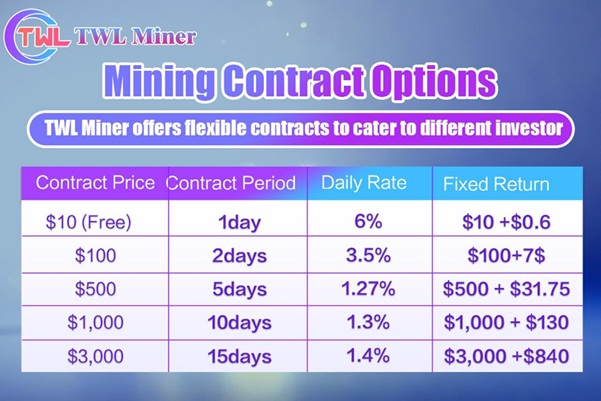
Currently, TWL Miner also offers a variety of mining contract options, such as $100, $500, and $100,000 contracts. Each contract has a unique return on investment (ROI) and a specific contract period.

You can earn more passive income by participating in the following contracts:

You can get the profit the next day after purchasing the contract. When the profit reaches $100, you can choose to withdraw it to your crypto wallet or continue to purchase other contracts.

Investment Guide

  • Investment: $10.00
  • Guaranteed Return: $10.00 plus $0.60 daily bonus

  • Get daily login bonus to smoothly increase your mining rewards.

  • BTC Experience Hashrate

  • Investment: $100.00

  • Guaranteed Return: $100.00 plus $7

  • It is designed for those who desire more powerful mining power and stable profits.

  • BTC Classic Hashrate

  • Investment: $500.00

  • Guaranteed Return: $500.00 plus $31.75

If you are looking to create financial freedom through passive income, TWL Miner offers an exciting opportunity worth exploring. Its potential earnings range from $100 to $1 million per day, and its scalability and innovative technology make it an attractive option for anyone looking to grow their wealth easily. Act now and seize this golden opportunity!

Affiliate Program

TWL Miner now also offers an affiliate program where you can earn money by referring others to the TWL Miner platform. You can start earning money even if you don’t invest. After inviting a certain number of active referrals, you will receive a one-time fixed bonus of up to $12,000. With unlimited referrals, your profit potential is unlimited!

In short if you are looking for ways to increase your passive income, cloud mining is a great option. With a small investment of time, these options can help you “automatically” grow your cryptocurrency wealth. At the very least, they should take less time than any type of active trading. Passive income is the goal of every investor and trader, and with TWL Miner, it is easier than ever to maximize your passive income potential.

If you want to learn more about TWL Miner, visit its official website:

https://twlminer.com

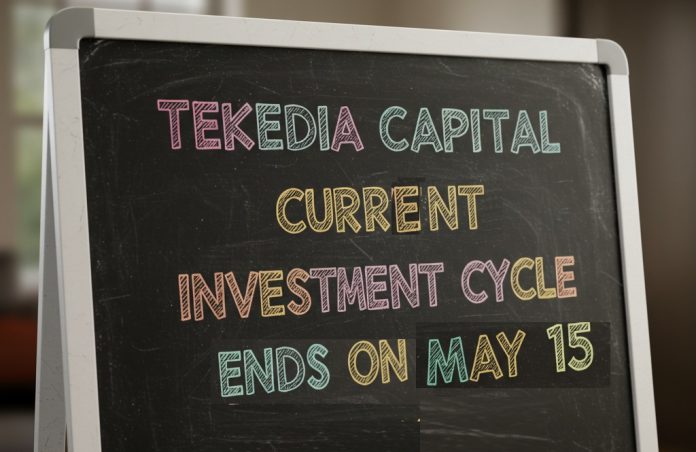
Current Tekedia Investment Cycle Ends May 15 2025; Join Before We Conclude.

0

The video below provides an overview of the 18 companies in the current Tekedia Capital investment cycle. These companies cover biotech, fintech, AI, exchange, real estate, space tech, transportation, cybersecurity, ecommerce, food tech, gaming, robotics, microelectronics, AI-age private equity, etc. The cycle has started and will end on May 15, 2025.  Join us here for access to the dealroom.

The Tekedia Capital Demo Day was held on April 26, and the full video recording of the presentations is now available in the investment dealroom. You will watch them if you join Tekedia Capital.

Go here and register here https://capital.tekedia.com/course/fee/ . We will give you access to the dealroom once that is done.

Tekedia Capital offers a specialty investment vehicle (or investment syndicate) which makes it possible for citizens, groups and organizations to co-invest in innovative startups and young companies in Africa and beyond. Capital from these investing entities are pooled together and then invested in a specific company or companies. We invest in promising global companies irrespective of their locations.

Previously sent to members

The 18 Startups for Tekedia Capital Investment Cycle <p data-wpview-marker=

Tekedia Investment Cycle Begins with 18 Global Startups; Demo Day Apr 2

Greetings! We are very happy to update that the dealroom is now live for Tekedia Capital H1 2025 investment cycle at https://capital.tekedia.com/ . Once logged in with the membership email, the direct link is https://capital.tekedia.com/lesson/active/ . We have 18 great startups in this cycle, and they cover different industries, including biotech, space tech, payment, AI, microelectronics, insurance, private equity, real estate, AI, B2B ecommerce, and more.

Geographically, many global regions are represented. We made a special video for each startup and provided their respective pitch decks. Please keep all the startups confidential until we have completed the round. You can make payment and begin investing immediately. The investment cycle will conclude on May 15 2024, and that is the last date to receive funds; please plan accordingly.

More so, the Demo Day is scheduled on Saturday, April 26; Zoom link is already in the portal when you login. All the startups will be live to present and take your questions.

  • Event: Tekedia Capital Demo Day
  • Date: Saturday, April 26, 2025
  • Time: 4 – 6pm WAT
  • Zoom Link: login here for it

The proceeding will be recorded and available in the portal afterwards.

Have a great moment checking the startups and if you have any questions, please contact us. (If you have forgotten your password, email us for a temporary one or just go here to request a new one https://capital.tekedia.com/setup/ .)

Regards,

Tekedia Capital Team

Jeff Bezos to Sell $4.75 Billion in Amazon Shares

0

Jeff Bezos, the billionaire founder of Amazon and its executive chairman, plans to sell up to 25 million shares of the company over the next year, a move that could yield approximately $4.75 billion at current market prices, according to a regulatory filing disclosed on Friday.

The sale, part of a prearranged trading plan adopted on March 4, 2025, underscores Bezos’ ongoing diversification of his wealth as he channels resources into ventures like Blue Origin and his $10 billion climate and biodiversity fund. The announcement, coming on the heels of Amazon’s strong first-quarter earnings, highlights the company’s financial well-being amid cautious guidance for the current quarter.

Bezos’ decision to offload a significant stake, marks his second major sale since stepping down as CEO in 2021.

The filing with the U.S. Securities and Exchange Commission details Bezos’ intent to sell up to 25 million shares through a trading plan under Rule 10b5-1, designed to prevent insider trading by scheduling transactions in advance. At Amazon’s closing stock price of $189.98 on Friday, the sale would generate roughly $4.75 billion, a figure consistent with estimates from financial analysts.

The plan, set to conclude by May 29, 2026, allows flexibility for Bezos to execute the sales in tranches, potentially mitigating market disruptions. Bezos, who owns approximately 912 million shares—about 8.8% of Amazon’s outstanding stock—remains the company’s largest individual shareholder, even after last year’s sale of $13.4 billion worth of shares.

The timing of the sale aligns with Bezos’ broader financial strategy. Since relinquishing the CEO role to Andy Jassy in 2021, Bezos has focused on Blue Origin, his aerospace company advancing space tourism and lunar missions, and the Bezos Earth Fund, a $10 billion initiative launched in 2020 to combat climate change and protect biodiversity.

Previous share sales have directly funded these endeavors, as well as the Day One Fund, established in 2018 with a $2 billion commitment to support education in low-income communities and address homelessness. Bezos’ relocation to Miami, Florida, in 2023, from Seattle, Washington, also plays a role, as Florida’s lack of state capital gains tax—unlike Washington’s 7% levy—could save him hundreds of millions on this transaction.

The share sale announcement followed Amazon’s first-quarter earnings report on Thursday, which showcased the company’s financial prowess. Amazon posted revenue of $155.7 billion, a 9% increase year-over-year, surpassing analyst expectations. Net income reached $17.1 billion, driven by strong performances in e-commerce, Amazon Web Services (AWS), and emerging AI initiatives. AWS, the cloud computing division, saw a 17% revenue jump, fueled by enterprise demand for AI and data analytics solutions. The company’s focus on operational efficiency, including streamlined logistics and AI-driven inventory management, bolstered profitability, with operating margins exceeding forecasts.

However, Amazon’s guidance for the current quarter tempered enthusiasm, projecting operating income below Wall Street’s estimates. The cautious outlook reflects uncertainties in the global economy, including inflationary pressures and supply chain challenges now compounded by President Donald Trump’s tariffs.

Despite these headwinds, Amazon’s $2 trillion market capitalization and stock performance, ranging from a 52-week low of $151.61 to a high of $242.52, underscore its resilience. The stock’s current price of $189.98 denotes a dip from its peak but remains robust, supported by Amazon’s leadership in e-commerce, cloud computing, and digital advertising.

Bezos’ decision to sell comes at a pivotal moment for Amazon. The company’s e-commerce platform, bolstered by its 200 million Prime members worldwide, drives customer loyalty, with Q1 e-commerce revenue up 8%. AWS remains a growth engine, capturing 31% of the global cloud market, ahead of Microsoft Azure and Google Cloud. Amazon’s investments in AI, including enhancements to Alexa and autonomous delivery systems, position it for future revenue growth, with analysts projecting AI-related revenue to reach $20 billion by 2027.

Bezos’ sale could influence Amazon’s stock in the short term. The influx of 25 million shares, representing 0.24% of the company’s $2 trillion market cap—may exert downward pressure, particularly given recent market volatility. However, historical data shows Amazon’s stock has weathered past Bezos sales, rising from $2.81 in 2003 to $189.98 today, a testament to its long-term strength. Analysts remain divided: bullish forecasts emphasize Amazon’s diversified revenue streams, while bearish views highlight regulatory and competitive risks.

Billionaire Jeff Bezos is about to get even richer. The entrepreneur disclosed in a filing Friday that he plans to sell $4.8 billion in Amazon stock — up to 25 million shares of the company he founded — over a period ending May 29, 2026. The news comes a day after a report revealed that Amazon is bracing for economic uncertainty associated with tariffs imposed by the Trump administration. Bezos, who is Amazon’s top individual shareholder, had over 1 billion shares as of February 2025.