DD
MM
YYYY

PAGES

DD
MM
YYYY

spot_img

PAGES

Home Blog Page 1418

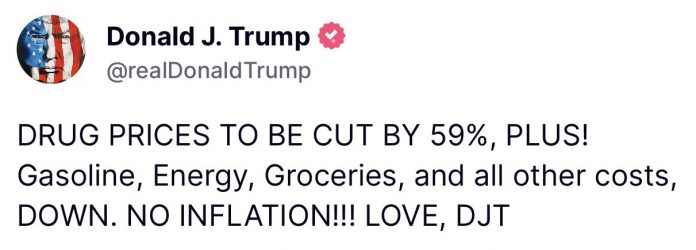
Trump Orders Drugmakers to Cut Prices By 59% Within 30 Days or Face Global Benchmark Rule

0

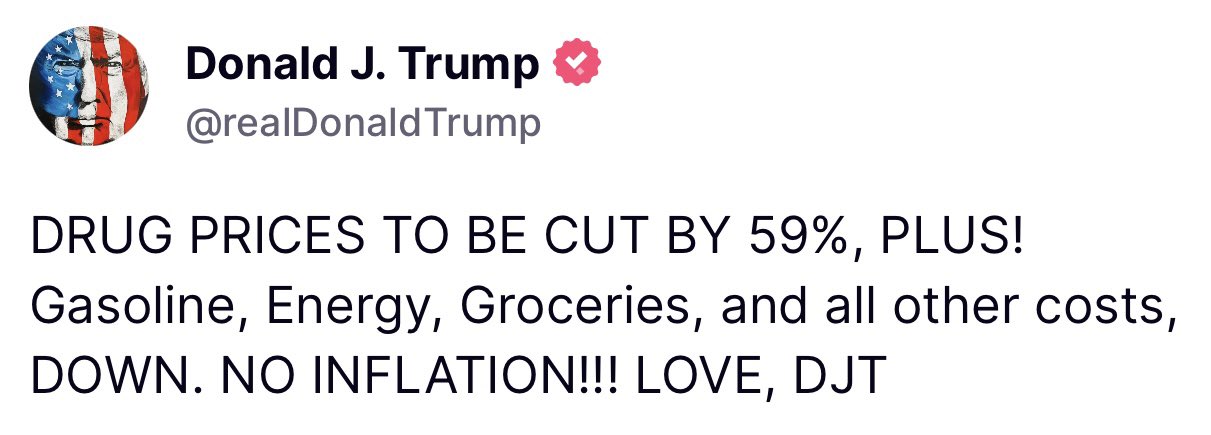
President Donald Trump on Monday signed a sweeping executive order that could shake the foundations of America’s pharmaceutical pricing model, setting a 30-day deadline for drugmakers to cut the cost of prescription drugs  by 59% or face new pricing regulations tied to what foreign governments pay.

The move marks the administration’s most aggressive push yet to tackle what Trump calls “a rigged system” that has forced Americans to pay more than any other country for the same medicines.

At the White House press briefing, Trump said the U.S. will no longer be the pharmaceutical industry’s “piggy bank,” describing the order as a major correction that would “equalize” drug pricing globally.

“We’re all going to pay the same. We’re going to pay what Europe pays,” Trump said, flanked by Health Secretary Robert F. Kennedy Jr., CMS administrator Dr. Mehmet Oz, FDA commissioner Dr. Marty Makary, and NIH director Jay Bhattacharya.

The executive order mandates the Department of Health and Human Services (HHS) to broker new prices for medications. If negotiations with drugmakers fail within 30 days, the administration will implement a new regulation that ties U.S. drug prices to the much lower prices paid by countries in Europe and elsewhere — a controversial model dubbed the “most favored nation” rule.

While the potential savings for Medicare and Medicaid could be substantial, it remains unclear how much of that relief will trickle down to the millions of Americans covered by private insurance, where government leverage over pricing is limited. However, Trump claimed the order would “save taxpayers trillions of dollars” and “reduce healthcare costs by numbers never even thought of before.”
No official analysis was released by the White House on how much the order would save or which drugs would be impacted, though Trump and his advisers suggested the measure could cover high-cost injectables, cancer treatments, and other expensive medications administered under Medicare.

Industry Pushback and Unanswered Questions

The pharmaceutical industry, a powerful lobbying force in Washington, has already begun pushing back. In a statement released on Sunday, Stephen J. Ubl, president and CEO of the Pharmaceutical Research and Manufacturers of America (PhRMA), slammed the plan as a “bad deal” that could harm patients and stifle innovation.

“Importing foreign prices will cut billions of dollars from Medicare with no guarantee that it helps patients or improves their access to medicines,” Ubl said. “It jeopardizes the hundreds of billions our member companies are planning to invest in America, making us more reliant on China for innovative medicines.”

Ubl’s warning echoes the long-standing argument by drugmakers that high U.S. prices are essential to fund the research and development of new drugs — a claim Trump dismissed as hollow.

“Pharmaceutical companies make most of their profits from America,” Trump said on Monday. “That’s not a good thing.”

What remains uncertain is the extent to which the president’s order, if implemented, will hurt the industry’s bottom line. Analysts say that tying drug prices to international benchmarks could deal a serious blow to pharmaceutical firms’ revenue growth, especially since many rely heavily on high-margin sales in the United States to offset lower returns abroad.

The pharmaceutical industry globally is valued at around $1.5 trillion, with U.S.-based companies representing a significant portion of that total. Giants like Pfizer, Merck, Johnson & Johnson, AbbVie, and Eli Lilly have seen massive market capitalizations, with the top five U.S. pharma firms alone collectively worth over $1 trillion as of early 2025. Any disruption to their U.S. pricing model would likely send ripple effects across global financial markets.

Trump’s critics note that the announcement, like many of his previous attempts to take on Big Pharma, may face serious legal and logistical hurdles.

Legal Clouds Above the Executive Orders

Trump’s earlier attempt to implement a “most favored nation” pricing policy during the final stretch of his first term in 2020 was blocked in federal court. At the time, the industry successfully argued that the rule would give foreign governments undue influence over how drugs are priced in the U.S., and a judge halted the plan on procedural grounds. President Joe Biden’s administration later abandoned it.

This time, Trump appears more determined to see it through. He’s also backed by a restructured health leadership team that includes Kennedy, Oz, and Makary — all outspoken about healthcare costs and transparency.

Speaking on Monday, Oz said the HHS will engage directly with pharmaceutical executives over the next 30 days to demand revised pricing based on international benchmarks. If talks break down, the administration will proceed with regulatory changes, bypassing Congress, where multiple bipartisan efforts to lower drug costs have failed.

The legal gray area around whether an executive order can force such sweeping pricing changes, particularly outside of Medicare and Medicaid, remains unresolved. But Trump, banking on public frustration over drug costs, appears willing to test the limits.

Political Capital vs. Corporate Lobbying

Trump’s message was that the U.S. has for too long subsidized cheaper drugs for the rest of the world. He accused pharmaceutical companies of deceptive messaging about R&D costs and vowed not to be swayed by the industry’s campaign contributions.

“For years, they said it was Research and Development Costs,” he wrote Sunday on Truth Social. “And that all of these costs were, and would be, for no reason whatsoever, borne by the ‘suckers’ of America, ALONE.”

“Campaign contributions can do wonders, but not with me, and not with the Republican Party,” Trump added. “We are going to do the right thing.”

The pharmaceutical lobby is one of the most powerful in Washington. According to OpenSecrets, the industry spent over $375 million on lobbying in 2023 alone, more than any other sector, and has consistently ranked among the top donors to both parties.

The potential impact on global drug pricing strategies and U.S. healthcare costs is hard to predict. While Americans pay more for drugs, the savings often go toward innovation that benefits global populations. Many believe that weakening the financial base could slow the pipeline for new treatments.

But Trump’s supporters say the current system is untenable.
NASDAQ Surges In Premarket Following U.S.-China’s 90-day Tariff De-escalation

0
NASDAQ

The NASDAQ’s nearly 4% premarket surge reflects market optimism following the U.S.-China 90-day tariff de-escalation agreement, announced on May 12, 2025. The deal slashes U.S. tariffs on Chinese imports from 145% to 30% and Chinese tariffs on U.S. goods from 125% to 10%, marking a significant thaw in the trade war. This pause, negotiated in Geneva, aims to facilitate further trade talks while easing economic pressures.

Tech-heavy NASDAQ futures led gains, with companies like Nvidia, Amazon, Apple, and Tesla seeing strong premarket rallies, as investors anticipate relief for firms reliant on Chinese supply chains. The S&P 500 and Dow futures also rose, by 3% and 2.4%, respectively. However, the 90-day window introduces uncertainty, as tariffs could revert if no permanent deal is reached.

The U.S.-China 90-day tariff de-escalation agreement, effective May 12, 2025, carries significant implications for global markets, trade dynamics, and political landscapes, while exposing a divide in stakeholder perspectives. The tariff reduction (U.S. from 145% to 30%, China from 125% to 10%) lowers costs for businesses and consumers, driving the NASDAQ’s 4% premarket rally, alongside S&P 500 (3%) and Dow (2.4%) gains. Tech firms like Nvidia and Apple, reliant on Chinese manufacturing, benefit significantly.

Reduced tariffs alleviate supply chain bottlenecks, potentially lowering inflation pressures on goods like electronics and apparel. Emerging markets and commodity exporters tied to Chinese demand (e.g., Australia, Brazil) may see growth, while European markets could stabilize as trade tensions ease.

Uncertainty and Fragility

The 90-day window creates a race to negotiate a lasting deal. Failure could see tariffs snap back, reigniting market volatility. Ongoing U.S.-China tensions over technology, Taiwan, and human rights could derail talks, undermining investor confidence. A stronger Chinese yuan and stabilized U.S. dollar may emerge, but prolonged uncertainty could pressure both.

Lower tariffs reduce prices for imported goods, boosting consumer spending but potentially hurting domestic manufacturers who benefited from protectionism. Eased tariffs support China’s export-driven growth, but structural issues like debt and real estate woes limit long-term gains. The deal may bolster the Biden administration’s image ahead of midterms, but critics could argue it compromises U.S. leverage.

Beijing may use the pause to strengthen domestic industries, reducing reliance on U.S. markets long-term. Tech giants (e.g., Apple, Tesla) and retailers cheer lower costs and improved market access, reflected in the NASDAQ rally. Lower prices on goods like smartphones and clothing are a win, especially amid inflation concerns. Economists and policymakers favoring open markets see this as a step toward de-escalating trade wars, potentially stabilizing global growth.

Countries reliant on Chinese demand or U.S. exports view the truce as a growth catalyst. Industries like steel and textiles, shielded by high tariffs, fear renewed competition from cheaper Chinese imports. U.S. and Chinese hardliners argue the deal weakens their respective positions. In the U.S., critics may claim it rewards China without addressing issues like intellectual property theft or forced technology transfers.

American workers in protected industries worry about job losses if Chinese goods flood markets. Hedge funds and traders anticipating prolonged trade conflict may face losses as markets rally on de-escalation. The agreement reignites debates over globalization’s benefits versus the need to protect local economies. Free-trade proponents see long-term gains, while protectionists warn of dependency on foreign supply chains.

Optimists view the deal as a diplomatic breakthrough, while pessimists see it as a temporary pause in a broader strategic rivalry. The 90-day tariff de-escalation offers immediate economic relief and market enthusiasm, particularly for tech-heavy indices like the NASDAQ, but its temporary nature and the looming threat of renewed tariffs keep uncertainty high.

The divide between pro-deal beneficiaries (corporations, consumers, globalists) and skeptics (domestic industries, hawks, labor) underscores competing priorities—short-term growth versus long-term strategic and economic security. The next 90 days will be critical in determining whether this truce lays the groundwork for lasting stability or merely delays further conflict.

The Ledger’s Discord Hack Has Several Implications

1

On May 11, 2025, Ledger’s Discord server was compromised when a hacker gained access to a contracted moderator’s account. The attacker used a malicious bot to post phishing links in a channel, directing users to a fake website that mimicked a Ledger verification page. The site urged users to enter their 24-word recovery phrases, claiming it was necessary due to a fabricated security flaw. Entering these phrases would grant attackers full access to victims’ crypto wallets. Some users who tried to warn others were muted or banned, potentially delaying Ledger’s response.

Ledger quickly contained the issue by removing the compromised account, deleting the bot, reporting the phishing site, and reviewing channel permissions. The fake website was taken down by Sunday morning. Ledger’s team, via Quintin Boatwright, emphasized that users should never share recovery phrases or connect wallets via Discord links. Additional security measures were implemented to prevent future breaches. It’s unclear if any users lost funds, as the damage couldn’t be immediately assessed.

This incident follows previous scams targeting Ledger users, including fake letters in April 2025 and a 2020 data breach exposing 270,000+ customer details. Phishing attacks, increasingly reliant on social engineering, highlight the need for user vigilance and stronger platform security. Repeated security incidents, including this hack and prior breaches, may undermine confidence in Ledger’s ability to protect users, potentially driving customers to competitors.

Users who fell for the phishing scam and shared recovery phrases likely lost cryptocurrency, with recovery unlikely due to blockchain’s irreversibility. The scale of losses remains unclear. The incident highlights the growing sophistication of social engineering attacks, particularly on platforms like Discord, where trusted accounts can be weaponized to spread drainers. Ledger’s response—tightening permissions and enhancing moderator account security—suggests increased costs and resources for cybersecurity, potentially impacting profitability or product pricing.

Ongoing incidents could attract attention from regulators, especially in jurisdictions with strict crypto and data protection laws, leading to fines or mandatory security audits. The hack underscores the critical need for better user awareness about phishing and wallet security, as human error remains a weak link in crypto ecosystems. Discord’s role as a target for crypto scams may push companies to reconsider reliance on third-party platforms or invest in custom, more secure communication channels.

The hack widens the gap between tech-savvy users who recognize phishing attempts and less experienced ones who fall victim. Newer crypto users, often targeted in such scams, may lose funds due to unfamiliarity with wallet security practices (e.g., never sharing recovery phrases). This creates a two-tiered crypto community: those who navigate risks effectively and those perpetually vulnerable, discouraging broader adoption as scams deter novices.

Repeated incidents like the Ledger hack deepen mistrust between users and crypto hardware/service providers. While Ledger’s core product (hardware wallets) wasn’t directly compromised, the breach of their Discord fuels perceptions of systemic insecurity. Users may split into camps—those loyal to established brands like Ledger despite flaws, and others who shift to decentralized or alternative solutions, fragmenting the market.

Financial losses from the hack disproportionately affect less wealthy users who can’t absorb the hit, while wealthier users may have diversified assets or better recovery options. Phishing scams often exploit those with smaller holdings, exacerbating wealth inequality in crypto. This widens the gap between crypto’s “haves” (who can afford robust security or losses) and “have-nots,” reinforcing crypto as a risky space for retail investors.

The reliance on centralized platforms like Discord for community engagement highlights vulnerabilities that decentralized alternatives (e.g., on-chain forums) might mitigate. The hack may push some users toward fully decentralized ecosystems. A growing ideological split emerges between users favoring convenience of centralized services (despite risks) and purists advocating for decentralization, influencing future platform development.

Incidents like this fuel debates over regulation. Some users and jurisdictions may demand stricter oversight of crypto firms, while others view regulation as stifling innovation. This creates a global divide—regions with heavy regulation may see slower crypto growth, while less regulated areas become hubs for both innovation and scams.

The Ledger hack exemplifies how security breaches amplify existing divides in the crypto world: knowledge gaps, trust issues, economic disparities, and philosophical differences. These divisions could slow mainstream adoption, as potential users hesitate to enter a space perceived as fraught with risk. For Ledger, addressing these requires not just technical fixes but also proactive user education and transparent communication to bridge the trust gap.

Wadephul’s Call for Ceasefire Talks Between Israel and Hamas Seeks to Bridge Humanitarian and Security Concerns

0

German Foreign Minister Johann Wadephul, during his inaugural visit to Israel on May 11, 2025, urged the Israeli government to re-engage in serious ceasefire negotiations with Hamas to address the ongoing conflict in the Gaza Strip. Speaking in Jerusalem alongside Israeli Foreign Minister Gideon Saar, Wadephul expressed doubts about the effectiveness of Israel’s intensified military actions since March 2025, stating, “I am not sure whether all of Israel’s strategic goals can be achieved in this way.”

He emphasized the dire humanitarian situation in Gaza, noting that no aid has reached the region for 70 days, exacerbating the crisis. Wadephul advocated for a ceasefire to ensure permanent humanitarian aid supplies to Gaza’s civilians, while acknowledging Israel’s concerns about aid misuse by Hamas.

He also supported a political solution, endorsing an Arab reconstruction plan involving the Palestinian Authority (PA) to govern Gaza, excluding Hamas, and stressed that Gaza’s reconstruction must be tied to a framework ensuring Hamas cannot threaten Israel. His call aligns with Germany’s longstanding support for a two-state solution and its solidarity with Israel, while prioritizing de-escalation and humanitarian relief.

Wadephul’s call signals a nuanced adjustment in Germany’s traditionally staunch pro-Israel stance. While reaffirming solidarity with Israel, his skepticism about military solutions and emphasis on humanitarian aid reflect growing European concern over the Gaza crisis. This could pressure Israel to reconsider its strategy, especially as Germany is a key EU player and Israel’s second-largest arms supplier after the U.S.

Pressure on Israel: The push for ceasefire talks, coupled with support for an Arab-led reconstruction plan involving the Palestinian Authority (PA), challenges Israel’s current approach of intensifying military operations to dismantle Hamas. Israel may face increased international scrutiny if it resists negotiations, particularly given the reported 70-day aid blackout in Gaza, which has worsened civilian suffering.

Wadephul’s endorsement of a PA-led governance model for Gaza aligns with Arab proposals, notably from Saudi Arabia and Jordan, aiming to marginalize Hamas. This could bolster EU-Arab cooperation on Middle East peace efforts, potentially isolating Hamas further if reconstruction funds are tied to its exclusion. A successful ceasefire could restore aid flows to Gaza, addressing the acute humanitarian crisis. However, Israel’s concerns about Hamas diverting aid for military purposes may complicate negotiations, requiring robust monitoring mechanisms.

The call for talks may encourage other EU nations to echo Germany’s stance, potentially shifting momentum toward diplomacy. However, it risks straining Germany-Israel relations if Israel perceives it as undermining its security priorities. Meanwhile, Hamas may exploit the ceasefire proposal to regroup, as it has in past truces. Israel’s government, under Prime Minister Benjamin Netanyahu, prioritizes dismantling Hamas’s military and governance capabilities, viewing ceasefire talks as potentially allowing Hamas to regroup.

Germany, while supportive of Israel’s security, emphasizes humanitarian costs and a political solution, highlighting a divide over means (military vs. diplomatic) to achieve stability. Israel demands Hamas’s neutralization and guarantees against future attacks, while Hamas seeks to maintain influence in Gaza and leverage ceasefires for survival. Wadephul’s proposal sidesteps Hamas’s role in governance, creating tension with Hamas’s insistence on political relevance.

The U.S. has historically backed Israel’s military approach more robustly, though recent Trump’s administration statements (as of May 2025) show openness to diplomacy. Germany’s proactive push for talks may expose a transatlantic divide, with the EU leaning toward humanitarian and political solutions faster than the U.S. While Germany leads with this initiative, some EU states (e.g., Hungary, Czech Republic) are more unequivocally pro-Israel, while others (e.g., Spain, Ireland) are more critical.

This creates a fragmented EU approach, potentially diluting the impact of Wadephul’s call. The Arab reconstruction plan supported by Wadephul aims to empower the PA and exclude Hamas, aligning with Saudi and Jordanian interests but clashing with Hamas’s goal of retaining control in Gaza. This divide could complicate negotiations if Hamas resists marginalization.

Wadephul’s call for ceasefire talks seeks to bridge humanitarian and security concerns but exposes deep divides between military and diplomatic approaches, as well as competing visions for Gaza’s future governance. The success of this initiative hinges on navigating these fault lines, particularly Israel’s security demands and Hamas’s intransigence.

Tariff Thaw Sparks Global Tech Stock Surge, Treasury Yields Rise, as U.S.-China Call Truce

0

The global market felt ripples of relief as Washington and Beijing reached a breakthrough on Monday, agreeing to pause the bulk of reciprocal tariffs that had upended trade flows, pressured corporate earnings, and rattled investor confidence in recent months.

The immediate response came from the equity markets, and nowhere was the reaction more pronounced than in technology and semiconductor stocks, sectors previously caught in the crossfire of escalating trade tensions.

Chipmakers roared back. U.S. semiconductor leaders like Nvidia and AMD climbed between 4% and 5% in premarket trading. Qualcomm and Broadcom weren’t far behind. Marvell Technology led the early gains, jumping over 7.5%, after the company postponed its investor day last week amid macroeconomic uncertainties that now seem slightly less threatening.

Across the Pacific, Taiwan Semiconductor Manufacturing Co., the world’s largest chip foundry, surged nearly 4% in U.S. premarket hours. European counterparts joined the rally. ASML, a Dutch firm essential to advanced chip manufacturing, rose 4.5%, while Germany’s Infineon Technologies also climbed on the easing of cross-border tensions.

The trade ceasefire follows weekend talks in Switzerland between U.S. Treasury Secretary Scott Bessent and Chinese trade officials—talks Bessent described as “very productive,” crediting the calming setting of Lake Geneva for the progress.

“We have reached an agreement on a 90-day pause and will substantially bring tariff levels down,” Bessent said. “Both sides on the reciprocal tariffs will move their tariffs down 115%.”

The numbers speak volumes. U.S. tariffs on Chinese goods, which previously reached a peak of 145%, are now set to fall to around 30%. China’s tariffs on U.S. goods, formerly 125%, are being reduced to 10%. Some exemptions remain in place—such as the U.S.’s 20% duties on fentanyl-related imports—but the broader effect is unmistakable: a sharp de-escalation that investors had been desperately hoping for.

Relief for Big Tech

The pressure valve was finally released for U.S. tech giants with heavy exposure to China. Apple, still dependent on China for 90% of its iPhone assembly, saw its shares leap more than 7% in early trade. The company had recently warned that tariffs would add nearly $1 billion in costs for the quarter.

Amazon, long entangled in China’s vast production ecosystem through its network of third-party sellers, rose over 8% before markets opened.

Chinese tech firms listed on U.S. exchanges also joined the rally. Alibaba, JD.com, and Baidu saw notable gains, buoyed by signs of stabilization in U.S.-China trade relations and the possibility of renewed investor interest.

“This morning is a huge win for the bulls,” said Daniel Ives, Global Head of Technology Research at Wedbush Securities. “With U.S./China clearly on an accelerated path for a broader deal, we believe new highs for the market and tech stocks are now on the table in 2025.”

Yields Climb, Eyes on Inflation Data

The rally wasn’t confined to equities. U.S. Treasury yields also moved higher, reflecting improved investor sentiment and expectations of firmer economic data. The 10-year yield climbed nearly 6 basis points to 4.433%, while the 2-year yield added 10 basis points to reach 3.996%.

Markets now turn their attention to key inflation readings due this week. Tuesday brings the April Consumer Price Index, while the Producer Price Index and retail sales figures follow on Thursday. Analysts will parse the data for signs of how deeply trade tensions have affected consumer prices, supply chains, and broader economic activity since the U.S. first imposed its “reciprocal” tariff strategy in April.

A Fragile Truce in a High-Stakes Negotiation

While the mood in markets is one of relief, the truce is time-bound. The 90-day pause could pave the way for a broader agreement, or it could merely delay a deeper rupture in the world’s most consequential bilateral trade relationship.

The tech sector’s reaction suggests hope outweighs caution, at least for now. With a potential recalibration in trade policy underway and tariff levels rolling back from triple digits to more conventional ranges, global supply chains—especially for semiconductors and electronics—may yet stabilize heading into the second half of the year.

But beneath the euphoria, hang these questions: Will this deal hold? Can it evolve into something permanent? Or will the world’s two largest economies find themselves back at the negotiating table once the 90-day timer runs out?