DD
MM
YYYY

PAGES

DD
MM
YYYY

spot_img

PAGES

Home Blog Page 1477

Fidelity Bank Plc Achieves Record N385.215bn Pre-Tax Profit in 2024

0

Fidelity Bank Plc has reported a stellar pre-tax profit of N385.215 billion for the 2024 financial year ended December 31, marking a remarkable 210.01% year-on-year (YoY) increase that highlights the resilience and dynamism of Nigeria’s financial sector.

Despite an N13.333 billion windfall tax levied by the government, the bank’s post-tax profit surged by 179.63% to N278.106 billion, a testament to its operational strength in the face of Nigeria’s persistent economic challenges. According to the audited financial statement, gross earnings rose by 87.72% to N1.043 trillion, with core operational income driving approximately 97% of total revenue—a performance that underscores Fidelity’s pivotal role in the country’s banking industry.

The Board of Directors has proposed a final dividend of N1.25k per share, an increase from N0.85k in 2023, payable on April 29, 2025. Combined with an interim dividend of N0.85k already disbursed, this brings the total dividend for 2024 to N2.10k per share, drawn from retained earnings.

Fidelity’s financial performance in 2024 is a microcosm of the broader growth narrative unfolding within Nigeria’s financial industry, which has demonstrated remarkable buoyancy, defying the nation’s economic headwinds.

With inflation averaging 33.5% in 2024, a naira depreciation that eroded purchasing power, and the Central Bank of Nigeria (CBN) hiking interest rates five times to a benchmark of 27.50%, banks have navigated a difficult economic terrain. Yet, Fidelity and its peers have turned these challenges into opportunities, capitalizing on high interest rates to boost loan income, reaping foreign exchange gains from currency adjustments, and leveraging digital platforms to enhance efficiency and fee-based revenue.

The bank’s gross earnings of N1.043 trillion reflect an 87.72% YoY leap, fueled primarily by a 106.85% surge in interest income to N950.588 billion. Interest expenses climbed by 76.11% to N320.818 billion, driven by a 56% rise in costs on customer deposits (N212.7 billion), yet the bank’s interest expense-to-income ratio improved to 33.8% from 39.6% in 2023, widening its interest margin.

This resulted in a net interest income of N629.770 billion, up 127.05% YoY. Credit loss expenses, a persistent concern for Nigerian banks in a risky lending environment, declined by 16.30% to N56.441 billion, with 91.47% (N51.63 billion) linked to loans and advances—73.46% of which were classified under Stage 3 Expected Credit Loss (ECL), indicating significant impairment. Nevertheless, net interest income after credit losses soared by 173.11% to N573.329 billion, bolstered by a net fees and commission income of N70.312 billion.

Fees and commission income grew by 57.97% to N78.355 billion, propelled by letters of credit commissions and fees (N9.47 billion), ATM charges (N6.4 billion), and commissions on travelers’ cheques and foreign bills (N6.9 billion).

The bank’s recent launch of ‘Fidelity Send,’ a MasterCard-powered real-time payment platform, has further enhanced its transaction-based revenue, offering secure and swift transfers while generating a steady cut for Fidelity. Fees and commission expenses, meanwhile, dropped by 31.91% to N8.043 billion, amplifying the net contribution to profits. Foreign exchange revaluation gains, however, fell sharply by 73.43% to N11.716 billion, reflecting the volatility of Nigeria’s forex market post-devaluation.

On the balance sheet, loans and advances to customers expanded by 41.87% to N4.387 trillion, while cash and cash equivalents nearly doubled, rising 94.26% to N707.450 billion. Total assets grew by 41.49% to N8.822 trillion, and customers’ deposits swelled by 47.88% to N5.937 trillion, adding N1.922 trillion in new deposits.

The bank also raised N352.567 billion in debt, reinforcing its liquidity. Shareholders’ funds doubled, surging 105.32% to N897.874 billion, driven by a 133.58% increase in share capital and premium accounts to N305.555 billion. This capital growth positions Fidelity well toward meeting the CBN’s N500 billion minimum capital requirement for commercial banks. On February 7, 2025, the bank announced the successful completion of its public offer and rights issue, with plans to return to the market signaling further ambition.

Fidelity’s earnings structure remained heavily reliant on interest income, which accounted for 91% of total revenue. Loans and advances to customers contributed 66%, though their share declined slightly, while investments in securities rose to 17.19%, with the portfolio expanding to N1.55 trillion—a N733.544 billion increase. This shift highlights Fidelity’s strategic move toward securities as a buffer against lending risks. Earnings per share rose 113.83% to N6.65, reinforcing the bank’s capacity to reward investors.

This performance is not an outlier but part of a broader trend of profitability across Nigeria’s banking sector in 2024, defying economic adversity.

Zenith Bank Plc reported a profit before tax of N1.33 trillion, a 67% YoY increase, with gross earnings up 86% to N3.97 trillion and a total dividend of N4.00 per share (excluding interim payouts). Guaranty Trust Holding Company Plc (GTCO) posted a record N1 trillion profit after tax, joining Zenith as the only bank to cross the trillion-naira threshold, driven by a 207% YoY surge in pre-tax profit to N1.003 trillion in the first half alone.

United Bank for Africa (UBA) Plc recorded a pre-tax profit of N803.7 billion, up 6% YoY, with a post-tax profit of N766.5 billion—an all-time high—on gross earnings of N3.19 trillion, a 54% YoY rise. Ecobank Transnational Incorporated (ETI) announced $2 billion in revenue and $333 million in profit after tax, equivalent to roughly N708.54 billion pre-tax profit at prevailing rates, up 170% YoY. FBN Holdings Plc declared N610.86 billion in pre-tax profit, a 128% YoY gain, while Access Holdings Plc reported N348.9 billion in the first half, a 108.2% increase.

Collectively, these results spotlight the Nigerian financial industry’s ability to thrive amid macroeconomic turbulence. The sector’s total assets crossed N100 trillion in 2023, and 2024’s growth suggests this upward trajectory persists, driven by deposit mobilization and strategic capital raises.

However, stage 3 loan impairments signal asset quality concerns and inflationary pressures could erode consumer purchasing power, dampening loan demand. The CBN’s stringent monetary stance, aimed at taming 33.5% inflation, has raised borrowing costs, potentially squeezing margins if deposit costs climb further.
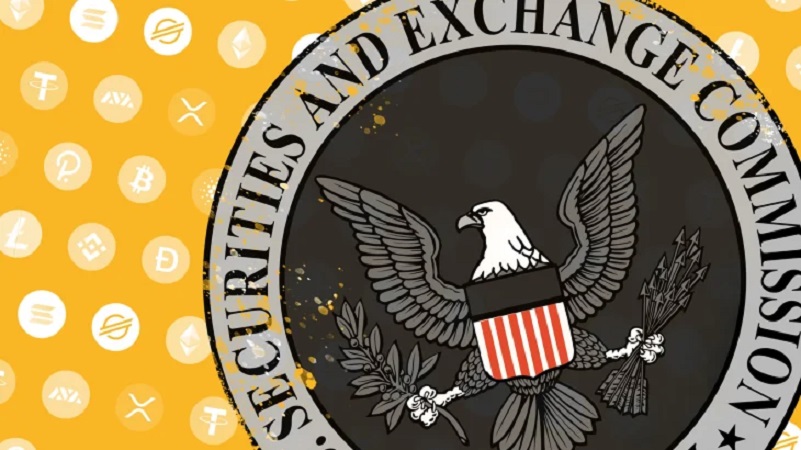

SEC Terminated Investigation on Crypto.com As POTUS Granted Pardons to BitMEX Founders

0

Crypto.com announced that the U.S. SEC had officially terminated its investigation into the exchange. This followed a tumultuous period for Crypto.com, which received a Wells Notice from the SEC in October 2024, signaling potential enforcement action for alleged securities law violations. Crypto.com preemptively sued the SEC, arguing that the regulator’s approach was unjust and unlawful. The company dropped its lawsuit after indications that the incoming Trump administration, which took office in January 2025, would adopt a more crypto-friendly stance, including the appointment of Paul Atkins—a known pro-crypto figure—as SEC Chair, replacing Gary Gensler.

The SEC’s decision to close the case was framed as part of a broader effort to reform its regulatory approach to the crypto industry, not as an admission that the claims lacked merit. Crypto.com’s Chief Legal Officer, Nick Lundgren, hailed this as a victory, citing the firm’s commitment to compliance and its eagerness to work with a potentially more cooperative SEC under new leadership. This resolution aligns with a wave of SEC dismissals of enforcement actions against other crypto firms like Kraken, Consensys, and Cumberland, reported around the same time. It reflects a shift in U.S. regulatory sentiment following Trump’s inauguration, which has been marked by pro-crypto gestures, including pardons and policy adjustments.

Trump Pardons BitMEX Founders

President Donald Trump granted pardons to BitMEX co-founders Arthur Hayes, Benjamin Delo, and Samuel Reed, along with former employee Gregory Dwyer and the operating entity HDR Global Trading. These individuals had pleaded guilty in 2022 to violating the Bank Secrecy Act by failing to implement adequate anti-money laundering (AML) and know-your-customer (KYC) programs at BitMEX. Their sentences—ranging from probation to home confinement—had already been served, but they faced substantial civil fines totaling $30 million from the Commodity Futures Trading Commission (CFTC), alongside a $100 million penalty imposed on BitMEX in 2021.

The pardons, reported by CNBC and confirmed by a White House official, came without a detailed public explanation but fit Trump’s pattern of crypto-friendly actions, such as pardoning Silk Road founder Ross Ulbricht shortly after his January 2025 inauguration. Hayes expressed gratitude on X with a simple “Thank you POTUS,” while Delo called the pardon a “vindication,” arguing that BitMEX and its founders were unfairly targeted under an outdated law for political reasons. The move has been interpreted as a signal of Trump’s intent to bolster the crypto industry, which he courted during his campaign with promises of lighter regulation and a U.S. cryptocurrency reserve.

While the SEC’s closure of the Crypto.com case and Trump’s pardoning of the BitMEX founders occurred around the same time (March 27-28, 2025), they are distinct events driven by different agencies and legal contexts. The SEC operates independently of presidential pardons, which apply only to federal criminal convictions, not civil or regulatory investigations like Crypto.com’s. However, both developments reflect the broader pro-crypto shift under Trump’s administration. The SEC’s retreat from enforcement actions aligns with a thawing of regulatory hostility, possibly influenced by Trump’s appointees and rhetoric, while the BitMEX pardons directly showcase his willingness to intervene in high-profile crypto cases.

For Crypto.com, the SEC’s decision removes a significant legal overhang, potentially boosting its U.S. market expansion, including partnerships like its reported deal with Trump’s Truth Media for ETFs. For BitMEX, the pardons clear the founders’ records, though the exchange’s operational challenges—like its $100 million fine and past regulatory scrutiny—persist. OKX, though not directly mentioned here, faces its own regulatory battle in Thailand (as discussed previously), unaffected by these U.S.-centric events.

Can Cardano Price Recover? ADA Price Dips 27% in 7 Days as Rival Rexas Finance (RXS) Prepares to Nears a 14700% Rally

0

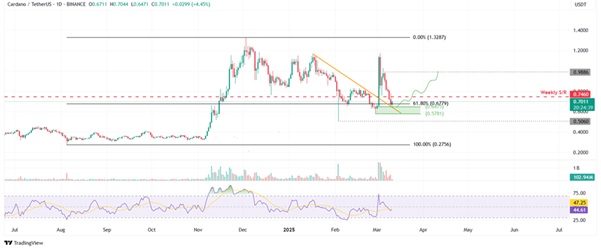
Under an erratic crypto market, Cardano (ADA) has dropped 27% of its value in the past week. At $0.72 right now, ADA is trying to rebound somewhat and shows a 5.33% rise following five straight losing days. As of writing, ADA bounced back slightly after retesting a critical support level at $0.64, a crucial zone that has historically acted as a reversal point. Technical indicators, however, show continuous bearish momentum even with this little comeback. ADA is still declining as seen by the Relative Strength Index (RSI), which at 44 is below the neutral level of 50.  The RSI has to break above 50 if Cardano is to maintain a positive rebound; this would give an urgently needed boost for an increasing trend.

Source: TradingView

On-Chain Metrics Suggest a Possible Recovery for ADA

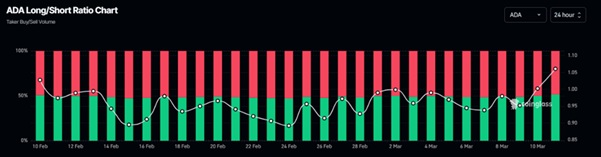
Notwithstanding its challenges, some on-chain indicators point to a probable revival. With a long-to-short ratio of 1.06, ADA marks its highest level in more than a month, according to Coinglass data. A ratio higher than 1.0 indicates that, in spite of recent dips, more traders are betting on a price rise, hence showing a positive attitude.

ADA long-to-short ratio chart. Source: Coinglass

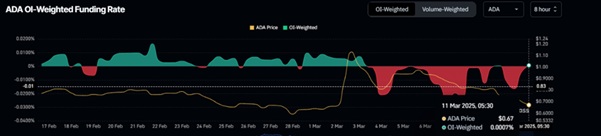
Coinglass’s OI-Weighted Funding Rate also indicates fewer traders expect ADA’s price to keep decreasing, thus strengthening this perspective. Currently standing at 0.0007%, this statistic—based on futures contract yields weighted by Open Interest (OI) rates—showcases a positive number indicating a bullish future. Long traders are paying short traders, so a positive funding rate often indicates fresh confidence in the asset.

Cardano OI-Weighted Funding Rate chart. Source: Coinglass

ADA’s hopeful case is still delicate, though. Should the price fall short of $0.64 and show a daily closing below $0.57, a more severe downturn may be set in motion, guiding ADA toward $0.50 support. Although ADA’s short-term technical view is still unknown, investors are looking elsewhere—especially toward Rexas Finance (RXS), a new high-growth asset outperforming the larger market.

Rexas Finance (RXS) Outshines ADA with a 14,700% Rally Projection

While Cardano struggles, another cryptocurrency is capturing the spotlight—Rexas Finance (RXS). Leading the Real-World Asset (RWA) tokenizing movement, RXS has been fast acquiring popularity as investors swarm the project ahead of its much-awaited release. The RWA tokenization sector is projected to reach $30 trillion, and Rexas Finance is leading this transformation. RXS is closing the distance between conventional banking and blockchain technologies by letting consumers tokenize and exchange real estate, commodities, and other valuable assets.

In this area, RXS is revolutionary since it allows one to fractionalize ownership and improve liquidity. The market’s response has been overwhelmingly positive, producing explosive presale performance. With RXS exploding 567% from its initial presale price of $0.03 to its current price of $0.20, Stage 12—the last presale stage—is 91.28% sold out. One of the most successful crypto presales of 2025, with 56,388,392 RXS tokens sold, has raised $47,278,136.

RXS Rejects VC Funding, Ensuring Sustainable Growth

RXS’s dedication to natural market expansion is one of the main factors inspiring trust among investors.  Rexas Finance has deliberately eschewed venture capital (VC) financing, unlike many crypto companies, depending on them, which usually results in significant post-launch sell-offs. This ensures a community-driven ecosystem, preventing sudden price crashes caused by early investors dumping their holdings. Consequently, real demand drives RXS’s expansion instead of speculation, which makes it more steady and sustainable than other newly developed altcoins. This strategy has reassured investors that RXS will continue increasing even following its official exchange listing.

June 19 Exchange Debut: The Catalyst for RXS’s 14,700% Surge

The biggest upcoming catalyst for RXS’s explosive growth is its official exchange launch on June 19. The project verified that it would be listed on at least three top-tier worldwide exchanges, greatly enhancing its liquidity, availability, and market presence. Analysts project a significant post-launch surge in RXS based on an initial listing price of $0.25.  Given an incredible 14,700% increase, many early investors think RXS might fly as high as $29.40. The increased institutional interest and the growing need for actual asset tokenizing solutions drive this expectation. Many investors are paying attention to Rexas Finance (RXS) as the next major crypto prospect while ADA is still trying to pick up momentum. Should analyst forecasts come true, RXS may become one of the most popular altcoins in 2025, surpassing Cardano in performance.


For more information about Rexas Finance (RXS) visit the links below:

Website: https://rexas.com

Win $1 Million Giveaway: https://bit.ly/Rexas1M

Whitepaper: https://rexas.com/rexas-whitepaper.pdf

Twitter/X: https://x.com/rexasfinance

Telegram: https://t.me/rexasfinance

Nigerian Telecoms Launch Industry Working Group to Shield Infrastructure From Vandalism

0

In a bid to safeguard Nigeria’s telecommunications infrastructure from an onslaught of fiber cuts, equipment theft, and vandalism, the country’s telecom operators have united to form an Industry Working Group dedicated to its protection.

The initiative unveiled following a high-level stakeholder meeting hosted by IHS Nigeria at its Lagos headquarters, underscores the industry’s escalating operational challenges— which contributed to the recent contentious 50% tariff hike aimed at offsetting spiraling costs.

The Working Group, established under the umbrella of the Association of Licensed Telecoms Operators of Nigeria (ALTON), emerged from a gathering of industry leaders, regulators, and law enforcement agencies. According to a statement from the operators, the coalition was forged in recognition of telecommunications as the linchpin of national security, economic growth, and social cohesion—a vital asset now under relentless threat.

The Industry Working Group is tasked with confronting a raft of industry scourges: vandalism and theft of telecom assets, arbitrary shutdowns of base stations, fiber cuts triggered by road construction, and unauthorized access to sites by individuals. To counter these, the group will deploy advanced technology for real-time monitoring and protection, bolster security around telecom installations, and forge partnerships with security and regulatory agencies to clamp down on offenders.

Beyond enforcement, the initiative prioritizes public awareness, with plans for campaigns to sensitize host communities and the broader populace on the need to safeguard these critical assets.

Dapo Otunla, Senior Vice President & Chief Corporate Services Officer of IHS Nigeria, praised the effort as a long-overdue response to a festering crisis.

“The protection of Critical National Information Infrastructure (CNII) has been a critical concern for all industry stakeholders,” Otunla said. “We are experiencing daily losses of assets, which significantly impact on the quality of service delivered to subscribers. Addressing these issues is paramount to sustaining Nigeria’s digital ecosystem and meeting regulatory expectations.”

His remarks lay bare the toll of unchecked vandalism: degraded service quality, mounting repair bills, and a digital ecosystem teetering on the brink.

The Working Group’s formation comes as Nigerian telecom operators grapple with a perfect storm of operational hurdles, with infrastructure damage driving up costs at an alarming rate. Industry insiders point to fiber cuts—sometimes occurring multiple times daily—as a prime culprit, alongside the theft of equipment like generators and copper cables.

These incidents have forced companies to pour billions of naira into repairs and replacements, a burden compounded by soaring fuel prices, currency depreciation, and regulatory fees. This financial strain was a key driver behind the 50% tariff hike approved by the Nigerian Communications Commission (NCC) in early 2025, a move operators defended as essential to their survival but which sparked widespread backlash from consumers facing economic hardship.

The tariff hike, while shoring up operator revenues, has intensified public scrutiny of the industry’s inability to curb infrastructure threats, making the Working Group’s mission all the more urgent.

A Push to Enforce CNII Protections

The initiative also reflects a proactive push by telecom firms to breathe life into the government’s Critical National Information Infrastructure (CNII) policy, which has languished despite high-profile endorsements. In August 2024, President Bola Tinubu signed the ‘Designation and Protection of Critical National Information Infrastructure Order, 2024,’ classifying telecom assets as CNII and criminalizing their willful destruction.

Dr. Bosun Tijani, Minister of Communications, Innovation, and Digital Economy, lauded the gazette as a “significant step” to bolster ICT investments. Yet, it mirrors an earlier, toothless effort: in June 2020, then-Minister Dr. Isa Pantami announced a similar designation by former President Muhammadu Buhari, complete with directives for physical safeguards. That pronouncement failed to halt the daily vandalism plaguing the sector, exposing a persistent enforcement gap the Working Group now seeks to close.

The stakes extend far beyond balance sheets. Nigeria’s $75.6 billion telecom sector is the lifeblood of its digital economy, powering mobile banking, e-commerce, and remote education—sectors pivotal to the nation’s growth ambitions. Yet, infrastructure damage threatens to derail these gains, disrupting connectivity and saddling operators with costs that ripple through the economy.

The recent tariff hike, while a lifeline for telecoms, risks pricing out low-income users, widening the digital divide at a time when broadband penetration remains a national priority under the 2020-2025 National Broadband Plan.

For the Working Group, success could stabilize an industry on edge, curbing losses, improving service reliability, and easing pressure on consumer wallets. Failure, however, could entrench a cycle of rising costs and declining trust, with vandals and thieves holding Nigeria’s digital future hostage.

As AI Scales, Check if you Must Find Another Job

0

Good People, there is no more career in many (professional) agencies. If you are working in advertising production, making images for companies, creating videos for clients, producing marketing materials, etc, I have an alert: FIND ANOTHER JOB. Because those domains will be disintermediated by AI within three years. The likelihood that your company will need just a few of the current employee capacity is certain.

(Sure, that finding a new job could mean re-train or upgrade your skill to survive in the new era. In other words, relearn to be ahead of that AI which is coming after your paycheck.)

Also, if you work in a company where your job is doing most of those things, rethink your career because your company will come after that unit very soon.

A few years ago, I was working in a bank’s IT department, helping to install and assemble computing systems. Quickly, I noticed that one does not even need a degree to do those things as young men in Computer Village Lagos were doing the same thing better. That was when I decided to return back to electronics as the risk on the job (assembling IT systems) was high. I reasoned that in electronics, they would need to go to college, understand calculus and transistors, etc to be in positions to design systems. That has turned out well.

So, do not just wait there without having a strategic career evaluation as AI  penetrates into economies and industrial sectors.

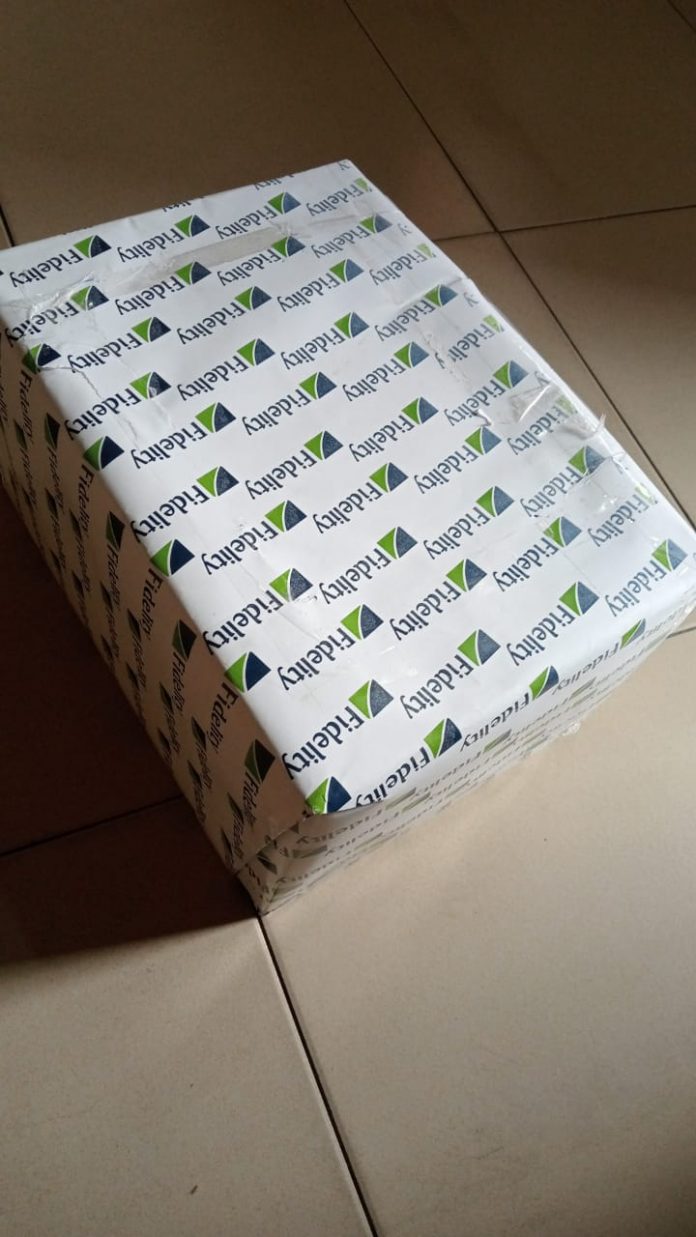
I made the image above with AI. It took me 3 seconds to simply describe what I needed. Before the AI age, I would have needed an extremely  great artist and he would need at least 3-4 days for this quality. I am not sure why a company will need many people in many areas when you can hire AI to do most things!