DD
MM
YYYY

PAGES

DD
MM
YYYY

spot_img

PAGES

Home Blog Page 150

The Convergence of Sports, Technology, and Crypto Betting: A New Era for Fans and Investors

0

Over the past few years, technology has been quietly but completely overhauling the world of sports.

From advanced analytics, to artificial intelligence coaching, to digital fan engagement, to today — crypto-based betting platforms. And perhaps the most interesting development within this seismic shift is the arrival of online sports betting platforms (like Gamdom) built leveraging the power of the blockchain, offering safe, secure, immutable, and frictionless ways for fans to engage with their beloved teams and tournaments. Through incorporating some of the principles of decentralized finance within entertainment, the likes of which we provide, Gamdom is just the latest macro-convergence of tech, fintech, and blockchain.

Crypto-sportsbetting defines the intersection of financial literacy and fandom. Knowing how to bet on a match means understanding theoretical probabilities, asset markets, and the state of the global digital economy. Modern-day platforms have created an environment where becoming a fan of the meta-game is an entire economic ecosystem that transcends geographical barriers. By using cryptocurrency, fans from across the world can watch matches and bet with lower spending time and gas costs.

Technology Reshaping the Sports Experience

The advent of blockchain technology in sports betting is not just showboating — it’s about the advancement of trust. With blockchain technology, bet integrity is guaranteed, transactions are secure, and nothing is editable, once etched on the blockchain. For players and investors, this means clear processes and impartiality — away from fraudulent players and malicious apps that grab high referrals or bonuses in traditional betting.

What’s more, through smart contracts that are based on blockchain, gaming operators can instantly pay the rightful. In short, the crypto-betting industry has catapulted itself to become an emerging trend of the larger fintech revolution screeching through the veins of global finance.

The Business of Sports Meets Decentralized Finance

From a business standpoint, the fusion of sports and crypto creates new sources of revenue. As sports teams venture into fan tokens, NFT collectibles, and blockchain-enabled ticketing processes as solutions to drive more engagement and opportunities to scout for investments at a low cost. As per the latest figures by Statista, the global sports betting industry is forecasted to increase in market value to US$24.77bn by 2030, and with the increasing proportion, crypto betting can drive its increment, with its inherent digital nature and promising demographic to cover its target market.

Brands and leagues are taking note. Partnerships between sports organizations and crypto companies are expanding, from jersey sponsorships to fan engagement campaigns. These collaborations demonstrate how cryptocurrency is transitioning from niche speculation to mainstream financial participation within sports culture.

The Rise of the Crypto-Savvy Fan

The modern sports fan is sophisticated, data-driven, and financially savvy. They analyze player performances and contract stats in the same way they understand blockchain wallets and tokenomics. And this new generation of fans is looking for their platform of choice. Enter crypto betting.

Newer generations, in particular millennials and Gen Z, have been living in a digital payments Web3 world. To these digital natives, crypto seems like a natural extension of digital ecosystems. It’s not only influencing where fans place their bets. It has implications for the economy of fandom itself, as engagement, speculation, and community combine to forge a new digital experience.

Balancing Regulation and Innovation

Yet, this latest digital sports terrain is not without its challenges. Crypto-betting from a legislative standpoint has patchwork regulations all around the world. Some governments are quick to stifle anything that’s new, while others find the latest trends in mobility and finance thrilling. Those in the traditional old sports betting world have to advocate a happy medium that assures its crypto-counterparts’ consumers are taken care of without stomping out its creativity.

New rules for on-the-fly governments will have world leaders decide whether or not the latest and greatest DeFi innovations can square off against the old-school financial legislation we’re all accustomed to. The result will dictate how easy the world of crypto-sports can mold and take its place of power in the next 10 years.

The Path Ahead: A Global Digital Stadium

The most powerful destination of sports gambling and sports lies in interoperability. As blockchain, AI, and digital identity verification advance, we can expect the amalgamation of platforms where fans’ participation will be more than just watching live. They can be expected to watch live games, place bets digitally with cryptocurrencies, trade different NFTs, and also enjoy the digital fan space of teams. The future “digital stadium” can expect so much from fans.


AI and the Future of African Business: From Automation to Innovation

0

Introduction: The Dawn of Africa’s Intelligent Economy

Across the African continent, a quiet revolution is underway. Artificial Intelligence (AI), once viewed as a distant technology for advanced economies, is becoming a strategic driver for growth, innovation, and global competitiveness.

From Lagos to Nairobi, Kigali to Cape Town, startups and established enterprises alike are embracing AI not just to automate routine processes, but to redefine business models, build smarter supply chains, and create inclusive digital ecosystems.

AI represents the next frontier for Africa — a tool not only for efficiency but for empowerment. The continent’s young population, entrepreneurial energy, and fast-growing digital infrastructure make it a uniquely fertile ground for AI-driven transformation.

The Shift from Automation to Innovation

For many African companies, the first wave of AI adoption focused on automation — using machine intelligence to cut costs, improve operations, and handle repetitive tasks. Chatbots replaced call centers, AI-powered software managed inventory, and predictive analytics reduced supply chain risks.

But now, a second wave is emerging: AI as a source of innovation. Businesses are no longer asking “How can AI help us save money?” but rather “How can AI help us create value?”

Beyond Efficiency: AI as a Growth Engine

According to the African Development Bank (AfDB), digital technologies — led by AI — could add $180 billion to Africa’s economy by 2030. This growth won’t come from automation alone; it will come from innovation at scale.

In sectors like agriculture, finance, and healthcare, AI is enabling:

  • Predictive insights that drive smarter resource allocation.
  • Personalized services that expand access to markets.
  • Local problem-solving using global technologies.

This transformation is not top-down — it’s grassroots. African entrepreneurs are using AI to build solutions uniquely suited to the continent’s challenges, from crop disease detection to microloan credit scoring.

The Power of AI Across Key Sectors

AI’s impact in Africa is most visible in sectors where traditional infrastructure has struggled to keep pace with population growth. Let’s explore how the technology is transforming key industries.

1. Agriculture: From Reactive to Predictive Farming

Over 60% of Africa’s labor force works in agriculture, yet productivity remains low. AI-driven tools are changing that reality. Startups like Zenvus (Nigeria) use sensors and AI algorithms to measure soil conditions, detect nutrient deficiencies, and recommend optimal planting times.

Farmers using such tools have reported yield increases of up to 35%, according to local development studies. Drones and satellite imaging further enhance predictive accuracy, allowing smallholder farmers to compete with industrial-scale operations.

2. Financial Services: Inclusion Through Intelligence

In a continent where nearly 350 million adults remain unbanked, AI is extending access to credit and financial services.

Fintech leaders like Flutterwave, Carbon, and Tala use machine learning to assess creditworthiness using non-traditional data — mobile phone usage, social behavior, and purchase history.

The result? Fast, fair, and inclusive lending systems that empower microentrepreneurs, particularly women and youth, who were previously excluded from formal finance.

3. Healthcare: Diagnostics at the Edge

AI is revolutionizing African healthcare by closing the gap between urban hospitals and rural clinics.

Solutions like Ubenwa (Nigeria) use AI to analyze a newborn’s cry to detect early signs of birth asphyxia — a major cause of infant mortality. Similarly, mPharma (Ghana) applies AI to manage pharmaceutical supply chains, ensuring medicine availability and reducing counterfeits.

According to the World Health Organization, AI-enabled diagnostics could increase access to basic healthcare by up to 45% in underserved areas.

The Role of Data and Language in African AI Development

Africa’s data diversity presents both opportunity and challenge. AI models trained on Western datasets often fail to reflect local realities — from dialects to behavioral nuances.

That’s why there’s growing emphasis on localized AI development — building models in Swahili, Yoruba, Amharic, and other African languages to make technology culturally and linguistically inclusive.

In natural language processing (NLP), projects like Masakhane, a pan-African open-source community, are leading the charge. Their work ensures that AI understands and serves African users accurately — whether for education, translation, or business communication.

To support such linguistic inclusion, developers often rely on tools for refining AI-generated content and improving accuracy — for example, text processing systems such as https://overchat.ai/text/ai-paraphrasing-tool, which assist in language clarity and contextual adaptation during local AI model training. Such resources demonstrate how accessible AI utilities can support a broader, multilingual innovation ecosystem.

The Emerging AI Startup Ecosystem in Africa

Africa’s AI revolution is being driven largely by startups — agile, creative teams solving local problems with global ambition.

1. Local Innovation, Global Recognition

  • DataProphet (South Africa) uses AI to optimize manufacturing quality control, helping factories cut defects by up to 50%.
  • DeepRoute (Kenya) develops AI-powered logistics algorithms to reduce fuel waste and delivery delays.
  • Indicina (Nigeria) leverages AI to automate credit scoring, expanding access to SME loans.

These ventures are attracting attention from international investors. In 2024, AI-focused African startups secured over $650 million in funding, according to Partech Africa — a 70% year-over-year increase.

2. The Role of Governments and Partnerships

African governments are increasingly supporting AI ecosystems through national AI strategies and public–private partnerships.

  • Rwanda’s Centre for the Fourth Industrial Revolution collaborates with the World Economic Forum to promote responsible AI governance.
  • Egypt launched the National AI Strategy 2030, aiming to position itself as a regional AI hub.
  • Nigeria’s AI Research Grant Program (2023) funds university-industry collaborations to nurture homegrown talent.

These initiatives reflect a shift toward AI sovereignty — ensuring that Africa doesn’t just consume technology, but creates and governs it.

Challenges: Bridging the Gaps

Despite its potential, AI adoption in Africa faces systemic barriers. Understanding these challenges is essential for sustainable growth.

1. Data Infrastructure and Connectivity

AI requires robust digital infrastructure — yet only 36% of Africans currently have stable internet access. Limited data availability, bandwidth, and energy reliability hinder model deployment, particularly in rural areas.

2. Skills Gap

The continent’s biggest AI challenge is not technology — it’s talent. Africa needs more data scientists, AI engineers, and policy experts to build, deploy, and regulate intelligent systems. Initiatives like Andela, ALX Africa, and Zindi are addressing this gap through AI bootcamps and competitions.

3. Ethical and Governance Concerns

AI systems raise questions about bias, transparency, and privacy. Without strong governance, AI could perpetuate inequality rather than reduce it. This is why frameworks for ethical AI and responsible data use are critical, especially in markets where digital rights remain underdeveloped.

Expert Insight: AI as a Catalyst for Economic Transformation

Dr. Amina Sule, an AI policy advisor at the African Union’s Digital Transformation Office, notes:

“AI will be Africa’s productivity revolution. Just as mobile technology leapfrogged traditional banking through mobile money, AI will allow Africa to leapfrog industrial inefficiencies and build new economies from the ground up.”

Indeed, Africa’s competitive advantage lies not in catching up, but in leapfrogging. By adopting AI strategically, African businesses can bypass legacy systems and move directly into a new age of data-driven growth.

For instance, AI-enabled logistics platforms can optimize transport routes for countries lacking advanced road infrastructure. Similarly, AI marketplaces can connect artisans and farmers directly with global buyers, bypassing intermediaries.

The Future Outlook: Building an AI-Powered Continent

Africa’s AI journey is just beginning, but the trajectory is clear. Over the next decade, expect to see:

  1. Localized AI innovation hubs in Lagos, Nairobi, and Kigali leading continental collaboration.
  2. AI-driven SMEs using automation to scale globally.
  3. Education reform integrating AI literacy into primary and secondary curricula.
  4. Cross-border data frameworks ensuring safe and equitable digital trade.

As more governments and investors recognize the economic and social potential of AI, Africa could become the fastest-growing AI economy in the world — not as a follower, but as a leader of contextual innovation.

Conclusion: From Automation to Africa’s Intelligence Age

Artificial Intelligence is no longer a futuristic concept — it’s the present reality shaping Africa’s next chapter. The continent’s entrepreneurs, policymakers, and innovators are redefining what AI means: not just machines replacing human labor, but intelligence amplifying human creativity.

The story of AI in Africa is not about automation; it’s about innovation born of necessity and ingenuity. With continued investment in education, infrastructure, and ethical governance, AI will empower Africa not just to adapt to the future — but to design it.

Top Crypto to Buy: 4 Best Coins Primed for Life-Changing Profits

0

Next year, 2026, will likely see a crypto environment full of opportunities, with a few coins standing out as having the potential to bring huge, possibly life-changing profits. Those coins are Little Pepe, Dogecoin, Cardano, and Sui. Each of them features a distinct combination of strong fundamentals, innovative technology, and real-world applications that, in turn, attract more people. Whether you are a seasoned crypto investor or just thinking of a small investment, these are the ones you cannot afford to ignore. So, let’s go through them to see which ones might give us that big payoff in the future.

Little Pepe: Meme Vibes with Legit Features

Little Pepe (LILPEPE) is rising fast in the meme coin crowd, but it’s not all jokes; it’s got some real substance under the hood. Running on a Layer-2 chain that integrates seamlessly with EVM, it tackles those annoying high fees head-on, allowing you to zip through transactions quickly and essentially for free. That kind of setup makes it extremely approachable and ready to scale as things intensify. It’s not stopping at memes, either; Little Pepe’s crafting a whole ecosystem that’ll stick around. They’ve already raised over $27.4 million from the presale, with a community that has ballooned to 44,000 holders and more than 39,000 people chatting away on Telegram. People are hooked on the staking perks, where you could see up to 782% APY if you hold tight. Plus, no taxes on buys or sells means trading’s a breeze. They’re even rolling out PEPE’s Pump Pad, a spot to kick off new meme ventures, which amps up Little Pepe’s role in the bigger picture. With low fees, a fair start, and tons of buzz, this one’s poised for significant growth, with a 15x increase by 2026 not out of the question.

Dogecoin: Still Ruling the Meme World with Big Backers

Dogecoin (DOGE) has been the ultimate meme boss for years, and it’s not fading anytime soon. In November 2025, it is valued at approximately $0.18, with a market capitalisation soaring past $27.5 billion. That endless supply and die-hard fans keep it as a go-to for wild rides in the meme space. Daily trading? Often exceeding $2 billion, making it one of the busiest in the industry. On top of that, talk from President Trump about a $2,000 stimulus sparked a frenzy, bumping the price 6% and cranking up the trading vibe. Between that institutional pull and the ongoing hype, Dogecoin’s got the wind at its back for more climbs, potentially the kind that change portfolios by 2026.

Cardano (ADA): Planning to Be Used in Daily Life

At the moment, ADA is trading around $0.59, and its market cap is nearly $21.73 billion. One of the major highlights on the radar is the introduction of the Cardano Card, which allows users to use Apple Pay or Google Pay with ADA, Bitcoin, or stablecoins for fast and easy transactions, as well as earning rewards for staking. It is an important move to use crypto for daily spending and hence, linking Web3 to traditional banking. As Cardano continues to build bridges to real life and secure those partnerships, it’s shaping up to outpace many rivals, possibly delivering those massive wins by 2026 as more people join in.

Sui: The DeFi Up-and-Comer Shining Bright

Sui (SUI) is carving out a spot as a fresh DeFi powerhouse, with recent deals and tweaks putting it on a fast track for growth. We don’t have every detail on its market cap or exact price, but Sui’s focus on big-scale, enterprise-ready blockchain is turning heads. The November 2025 Mysticeti v2 update has accelerated transaction checks, reducing wait times and enhancing overall efficiency. It’s built for handling huge loads securely, which is crucial for DeFi to take off at scale. With that big-money appeal, top-tier scaling, and DeFi edge, Sui’s poised for some major leaps, making it a prime pick for those chasing transformative returns by 2026.

Conclusion: These 4 Coins Could Light Up Crypto’s Future

Hunting for cryptos that might just flip your finances? Little Pepe, Dogecoin, Cardano, and Sui are strong contenders. They’re each claiming their space with killer fundamentals, rising popularity, and fresh ideas that stand out in the crowd.


For more information about Little Pepe (LILPEPE) visit the links below:

Website: https://littlepepe.com

Whitepaper: https://littlepepe.com/whitepaper.pdf

Telegram: https://t.me/littlepepetoken

Twitter/X: https://x.com/littlepepetoken

$777k Giveaway: https://littlepepe.com/777k-giveaway/

Tekedia Capital is excited to announce our investment in Scalar Field

0

Tekedia Capital is excited to announce our investment in Scalar Field. The company is creating a new trading terminal (a modern Bloomberg terminal) from scratch with integrated datasets and the ability to backtest strategies, benchmark portfolios, and do event-driven trading research. With this, users can test any market hypothesis instantly and intelligently.

Remember: that whenever an analyst, trader, or quant looks at a Bloomberg terminal, they are consciously or subconsciously trying to verify a hypothesis, and that process is cumbersome, requiring users to sift through endless screens of data.

Scalar Field is reimagining the trading terminal from the ground up using intelligent agents, enabling users to directly test their hypotheses in real time, cutting through the noise and accelerating decision-making. They’re building a terminal that can run compute-heavy backtests, react to live market shifts, and trigger trades when your signals align. Agents reorganize dashboards, remember your research trail, and chain multi-hop logic, like surfacing trade ideas when ETF flows spike and earnings drop.

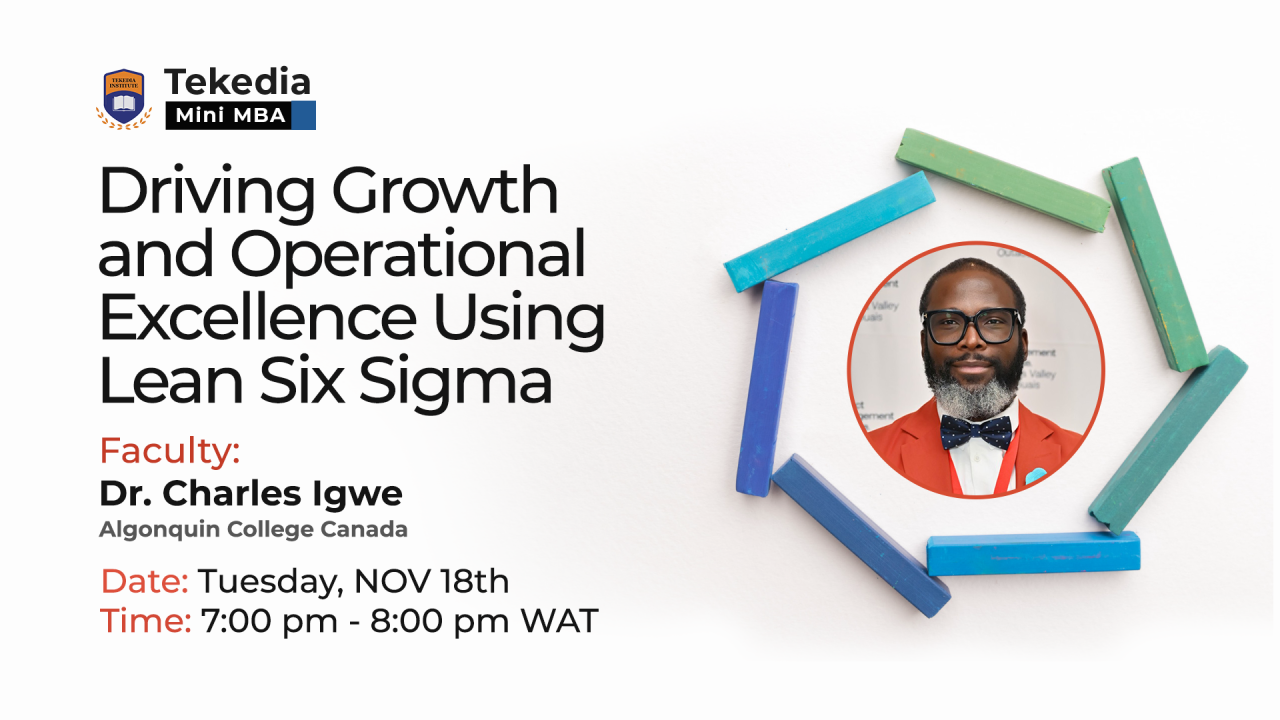
Driving Growth and Operational Excellence Using Lean Six Sigma –Dr. Charles Igwe

0

Come with your calculator and log book because you may need them. Indeed, you will understand the “Measure of Central Tendency” and how you can use lean six sigma to drive business growth and accelerate productivity. Join Dr Charles Igwe as he teaches on the topic – “Driving Growth and Operational Excellence Using Lean Six Sigma” – at Tekedia Mini-MBA Live at 7pm WAT today. Zoom link in the class board.

This is one of the leading courses which our university partners have used extensively (we allow that provided it is for the good of the students). Dr Igwe, a zen-master, created about 160 slide-courseware to explain this zen-stuff.

We are Tekedia Institute, the winner of University of Ilorin U-Inspire Award, the winner of Velocity Mhagic Award, and the winner in the knowledge systems of thousands of young people. We have one product and that is KNOWLEDGE.

Pick your seat and let’s fulfil the cardinal mission encapsulated by University of Nigeria Nsukka: “to restore the dignity of man (and woman)”. Now, it is Lean Six Sigma time from the best school.

Tue, Nov 18| 7pm-8pm WAT | Driving Growth and Operational Excellence Using Lean Six Sigma –Dr. Charles Igwe, Algonquin College Canada | Zoom link