DD
MM
YYYY

PAGES

DD
MM
YYYY

spot_img

PAGES

Home Blog Page 150

Google DeepMind’s New Robotics Gambit: Boston Dynamics’ Former CTO Joins as AI Lab Pushes Toward a ‘Robot OS’

0

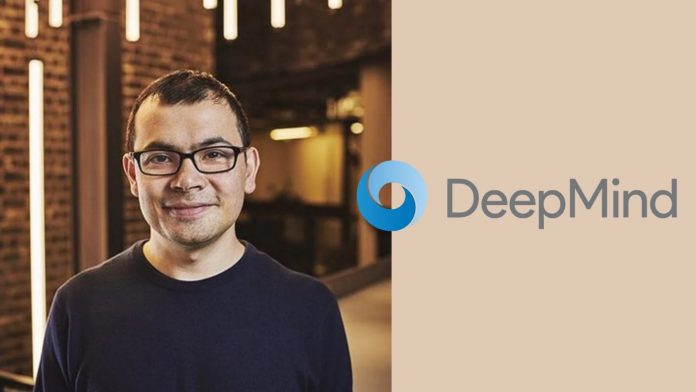
When Google DeepMind quietly brought in Aaron Saunders earlier this month, it wasn’t just another executive hire. It signaled an escalation. Saunders, the engineer who helped give the world its most famous back-flipping, crate-hauling, and occasionally dance-choreographed robots during his years at Boston Dynamics, is now DeepMind’s vice president of hardware engineering. And his arrival suggests the company is no longer content with producing only world-class AI models. It wants machines—real, physical machines—that can use them.

according to Wired, the hire folds directly into CEO Demis Hassabis’ sweeping ambition: to turn Gemini, DeepMind’s flagship model, into something like a robotics equivalent of Android. A base AI system that manufacturers everywhere could load into their humanoids, quadrupeds, warehouse bots, or whatever new chassis emerges next.

“You can sort of think of it as a bit like an Android play […] We want to build an AI system, a Gemini base, that can work almost out-of-the-box, across any body configuration,” Hassabis told WIRED. “Obviously humanoids, but nonhumanoids too.”

For Saunders, this is familiar terrain. Before becoming Boston Dynamics’ CTO in 2021, he led some of the company’s most complex engineering efforts, starting with an amphibious six-legged prototype and rising to VP of engineering in 2018. At Boston Dynamics—now majority-owned by Hyundai Motor Company after passing through SoftBank and, earlier, Alphabet itself—he helped steward the hardware behind the company’s signature creations: four-legged dog-sized robots and humanoids capable of highly precise and visually stunning acrobatics.

DeepMind, for its part, has spent years publishing robotics research rooted in large-scale reinforcement learning, imitation learning, and multimodal perception. But the industry’s recent surge of interest in humanoids has shifted that research from an academic project into something commercial. Hassabis said he’s convinced the field is nearing a tipping point. AI-powered robotics, he said, “is going to have its breakthrough moment in the next couple of years, if I was to predict.”

Outside DeepMind’s walls, the momentum has been unmistakable. In the U.S., startups such as Agility Robotics, Figure AI, 1x, and even Tesla have been racing toward humanoid production. Elon Musk said recently he intends to build a million Tesla Optimus robots over the next decade. In China, meanwhile, companies like Unitree have surged ahead on cost and scale; Unitree, based in Hangzhou, has already overtaken Boston Dynamics as the largest supplier of four-legged robots for industries ranging from construction to manufacturing.

Hassabis admitted Unitree’s progress has impressed him. But the true prize for DeepMind isn’t hardware supremacy—it’s cognitive supremacy.

“I’m most interested in the [AI] brain part of it,” he said, emphasizing Gemini’s multimodal structure.

The model’s ability to see, plan, parse language, and reason across different modalities, he argued, makes it especially suited to controlling robotic systems that need to operate in unpredictable physical environments.

That’s where Saunders’ arrival becomes strategically important. His deep, practical understanding of what real robots can and cannot do—how they behave, where they fail, and what they need at the hardware level—gives DeepMind a bridge from system-level AI to embodied intelligence. If Gemini is to become the Android of robotics, it needs precisely the sort of hardware awareness Saunders spent decades refining.

And the timing is advantageous as the components and expertise required to build legged machines have grown dramatically more accessible in recent years. Startups that once would have needed tens of millions in research grants to assemble a basic prototype can now buy actuators, sensors, and control modules off the shelf. The hardware ceiling is dropping while the software ceiling rises—an alignment that DeepMind sees as an opening.

The company, by hiring Saunders, is believed to be signaling that the next frontier for Gemini isn’t just better reasoning or smoother multimodal alignment, but embodiment. A brain that can live in many bodies, across many environments, and adapt on the fly.

Nothing in robotics ever moves as fast as the hype cycles surrounding it. But DeepMind’s latest move suggests the company sees the window opening—and intends to step through it with both hardware sophistication and AI horsepower in hand.

Brookfield Launches $100bn AI Infrastructure Program With Nvidia and Kuwait Fund

0
Leveraging AI for Startups

Brookfield Asset Management on Wednesday unveiled one of the largest financing initiatives yet for artificial intelligence infrastructure — a sweeping $100 billion program developed in partnership with Nvidia and the Kuwait Investment Authority (KIA).

The announcement lands at a moment when demand for computing power, energy supply, and physical space for AI workloads is rising at a pace that global investors now describe as unprecedented.

The backbone of the initiative is the newly launched Brookfield Artificial Intelligence Infrastructure Fund, which targets $10 billion in equity commitments. Brookfield said the fund has already secured half of that amount, with $5 billion pledged by Brookfield itself, Nvidia, and KIA. With co-investor capital and financing layered on top, the fund is expected to acquire up to $100 billion worth of AI infrastructure assets over time — a portfolio spanning energy facilities, land, hyperscale data centers, and compute capacity.

Brookfield, a heavyweight in global infrastructure and alternative investments, noted that it has already deployed more than €100 billion across the AI value chain, from digital infrastructure to renewable power and semiconductor manufacturing. The new program pushes the company deeper into the heart of an arms race among tech firms, chipmakers, and cloud providers, all scrambling to secure the physical backbone needed for next-generation AI systems.

A rapid surge in AI adoption is intensifying the scramble for these resources. Companies across industries are racing to lock in access to the high-performance computing clusters that train and run large models, and to secure the electricity required to power them. This has created a boom in data center construction, land acquisition, and long-term energy contracting, turning infrastructure — not just chips — into a defining bottleneck for AI development.

Sikander Rashid, Brookfield’s head of AI infrastructure, called the moment “one of the largest infrastructure buildouts in history” and warned that the world will need an estimated $7 trillion in capital over the next decade to keep pace with AI demand. That figure underlines the energy-intensive nature of modern AI models. Training and running them requires enormous volumes of power, far outstripping the capacity built during previous waves of digital expansion.

The fund’s first commitments are already underway. They include a $5 billion framework agreement with Bloom Energy to deploy up to 1 gigawatt of behind-the-meter power solutions for data centers and AI factories — a move aimed at supplementing strained power grids and reducing exposure to energy shortages. Behind-the-meter systems allow operators to generate power on-site, which has become critical for facilities that cannot afford downtime or an unstable supply.

Brookfield has also been moving aggressively in Europe. Earlier this year, it announced plans to invest up to 95 billion Swedish crowns (about $10 billion) in an AI data center campus in Sweden, tapping into the region’s reliable energy supply and cooling advantages. In France, the company committed €20 billion to AI-related projects, including facilities that support cloud providers and advanced compute clusters.

The partnership with Nvidia marks another sign of the chipmaker’s widening role not only as a supplier of GPUs but as a strategic investor shaping the broader AI ecosystem. As the world’s largest designer of AI chips, Nvidia has been pushing into data centers, networking technologies, and infrastructure development to ensure that the companies training large models have the capacity required for its hardware.

The involvement of the Kuwait Investment Authority highlights the growing interest among sovereign wealth funds in the long-term economics of AI infrastructure. These investors, including funds from the Middle East, Europe, and Asia, have been pouring billions into data centers, energy assets, and semiconductor supply chains, viewing AI as a decades-long growth frontier.

Brookfield’s new program amplifies the investment wave sweeping across the sector, underscoring that the AI era is no longer defined solely by algorithmic breakthroughs or frontier models. It is increasingly shaped by an industrial-scale buildout of land, power, and compute.

Meta Ordered to Pay $552m by Spanish Court Over Data Misuse, Faces Broader EU Scrutiny

0

Meta Platforms, the parent company of Facebook and Instagram, has been ordered by a Spanish court to pay 479 million euros ($552 million) to 87 local digital media outlets for unfair competition practices and violations of European Union data protection rules.

The ruling, handed down Thursday by Madrid’s Commercial Court, comes as part of the European Union’s ongoing effort to regulate the activities of large U.S.-based technology firms. Meta has announced that it intends to appeal the decision.

The compensation relates to Meta’s use of personal data for behavioral advertising, which the court concluded gave the company a “significant competitive advantage” in Spain’s online advertising market.

“This is a baseless claim that lacks any evidence of alleged harm and wilfully ignores how the online advertising industry works,” a Meta spokesperson said in a statement sent to Reuters.

“Meta complies with all applicable laws and has provided clear choices, transparent information and given users a range of tools to control their experience on our services,” a company spokesperson said, describing the case as a “baseless claim” that ignores the realities of the online advertising industry.

The case centers on Meta’s legal basis for processing personal data following the introduction of the EU’s General Data Protection Regulation (GDPR) in May 2018. Initially, Meta relied on user consent, but it later switched to “necessity for the performance of a contract” to justify behavioral advertising. Regulators later ruled that this basis was inadequate. In August 2023, Meta reverted to relying on consent.

During the five-year period when Meta shifted its legal justification, the court found that the company earned at least 5.3 billion euros in advertising revenue, which it treated as revenue obtained in violation of GDPR rules. The judgment also noted that Meta’s practices violated Spain’s antitrust law, as the company gained an unfair competitive edge over other online platforms.

Part of Broader EU Regulatory Push

This ruling is part of a wider wave of regulatory enforcement by the European Union against major tech companies. Last year, the European Commission fined Meta nearly 800 million euros for tying its Facebook Marketplace service to Facebook’s main social network and imposing unfair trading conditions on rival classified ad providers. Spain’s government has also targeted Meta over alleged privacy violations, including a mechanism that tracked the web activity of Android users. Prime Minister Pedro Sanchez said a parliamentary committee would investigate the matter further. Meta has pledged to cooperate with Spanish authorities.

A similar complaint is under review in France, signaling that scrutiny of Meta and other large U.S. tech companies is spreading across multiple EU member states. Observers note that these enforcement actions are part of a broader effort to tighten oversight of American tech giants, particularly in areas of data privacy, competition, and the use of behavioral advertising.

The ruling has significant implications for Meta’s European operations, both in terms of immediate financial liabilities and ongoing compliance obligations. The compensation, if upheld, would mark one of the largest fines imposed on Meta in Europe for privacy and competition issues. Analysts say it could also influence how other technology companies approach data processing, consent mechanisms, and online advertising practices in the EU.

U.S. tech companies and EU regulators seem entangled in a regulatory faceoff; its end is not yet in sight. Business leaders such as Tesla CEO Elon Musk have warned that such regulations stifle innovation and economic growth.

Ethereum and Solana Investors Shift Toward Ozak AI After Strong Predictions

0

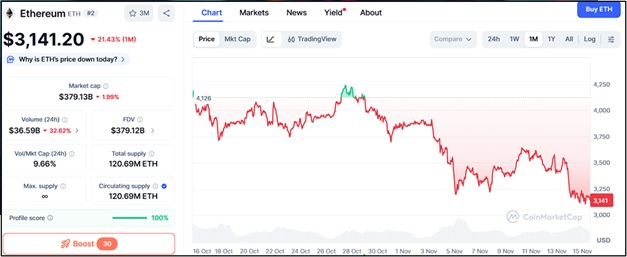
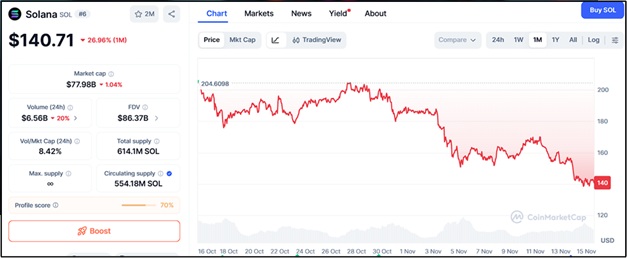
Investor behavior across the market is beginning to shift, as traders who traditionally focused on Ethereum and Solana are gradually exploring new high-upside AI-driven opportunities. Strong predictions surrounding Ozak AI (OZ) have accelerated this movement, especially as the token’s OZ presale growth, ecosystem partnerships, and predictive technology continue outperforming expectations. With ETH consolidating near $3,141 and SOL holding around $140, demand for early-cycle asymmetry is rising quickly, pushing capital toward Ozak AI as the next major breakout candidate.

Ethereum and Ozak AI

Ethereum remains the backbone of decentralized finance; however, price consolidation around $3,141 displays a slowing rhythm that often encourages investors to diversify. Resistance continues forming near the $3,240, $3,380, and $3,520, levels that have repeatedly stalled upward momentum during the last months. Support remains strong at $3,050, $2,920, and $2,810, in which long-time period buyers continuously step in to defend the fashion.

Even with Ethereum’s strong fundamentals, many investors are searching for higher upside plays while ETH moves sideways. Ozak AI is directly benefiting from this shift, as its blend of prediction engines, agent automation, and AI-driven analytics offers earlier exponential potential than Ethereum’s more mature growth curve.

Solana and Ozak AI

Solana maintains one of the most powerful momentum profiles among massive-cap cryptos due to its speed, scalability, and thriving ecosystem. Holding consistent round $140, SOL continues to face resistance close to the $146, $153, and $162, tiers where dealers generally restrict breakout attempts. Support sits near $134, $128, and $120, strengthened via consistent liquidity inflows and high network activity.

Even with its impressive performance this cycle, many traders feel Solana’s upside is becoming more linear. That sentiment shift is pushing investors toward early-stage AI-driven tokens like Ozak AI, which offer a distinctly different growth trajectory fueled by innovation rather than saturation.

Ozak AI Gains Momentum as AI Predictions Drive Investor Rotation

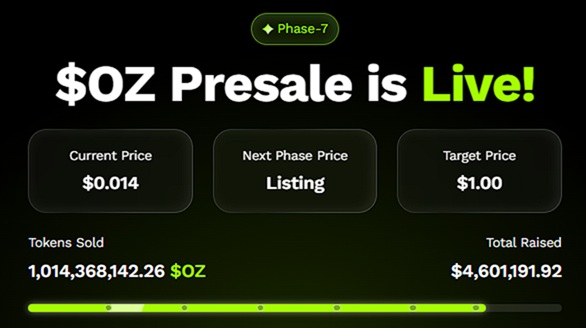
Ozak AI (OZ) is rapidly emerging as the most compelling candidate in the AI–blockchain segment, especially for traders seeking early exposure before mainstream adoption accelerates. Over 1 billion tokens sold and more than $4.5 million raised demonstrate strong conviction from retail and early institutional participants. Partnerships with Perceptron Network, HIVE, and SINT amplify its technological credibility, linking OZ to prediction agents, cross-chain intelligence, and high-speed signal systems.

Rising demand for AI-enhanced trading and market insights is reshaping investor expectations, with Ozak AI positioned at the center of this transformation. Continually improving sentiment, paired with rapidly expanding community presence, is fueling predictions that OZ could outperform several large caps in percentage returns once listings and utility rollouts begin.

Growing rotations from Ethereum and Solana toward Ozak AI signal a significant shift in market behavior. Heightened demand for AI-powered crypto tools and early-phase potential is positioning Ozak AI as one of the most promising breakout tokens of the next cycle, especially for investors seeking accelerated upside beyond the steady growth of major assets.


About Ozak AI

Ozak AI is a blockchain-based crypto venture that offers a technology platform that focuses on predictive AI and advanced records analytics for monetary markets. Through machine learning algorithms and decentralized network technologies, Ozak AI permits real-time, correct, and actionable insights to help crypto fanatics and companies make the precise choices.


For more, visit:

Website: https://ozak.ai/

Telegram: https://t.me/OzakAGI

Twitter: https://x.com/ozakagi

Top 5 Shiba Inu (SHIB) Alternatives Set to Create the Next Wave of Crypto Millionaires

0

The crypto world has always had a soft spot for meme coins, and Little Pepe is leading the charge as a fresh contender. With its Layer 2 blockchain built for speed, security, and near-zero fees, $LILPEPE is capturing attention fast. With the new wave of meme coins, investors who wanted to invest in coins like Shiba Inu are looking at a whole new set of meme coins that have a lot of potential.  These tokens are poised to become the next generation of crypto millionaires, thanks to their strong communities and innovative applications of blockchain technologies. If you didn’t get any of the previous meme trends, now is the moment to be one of the first to find out before the hype shoots up.

Little Pepe (LILPEPE): Froggy Empire Rising

Little Pepe isn’t just another meme coin; it’s a Layer 2 network designed to run faster and cheaper than almost anything else in the market. With $LILPEPE as its backbone, this $0.0022 token offers holders real utility, encompassing staking rewards and governance features. It is a team with great success in past projects involving meme coins, which has made this one very interesting. The offer of the first tokens to the public is already attracting significant attention, and initial holders are buying in large quantities to be on the safe side before it goes public on major exchanges. The CertiK audit, giving Little Pepe a 95.49% security score, adds more confidence for users. No significant vulnerabilities and optimised smart contracts mean traders can engage without fear. Liquidity is being built steadily, and community hype is growing via social campaigns. With zero taxes on trades and strategic marketing, this frog-themed token aims to make waves while protecting investor interests.

Pudgy Penguins (PENGU): Arctic Penguins in the Game

Pudgy Penguins (PENGU) have been having a hard time keeping their trend going lately, but a few analysts still consider that a chance might be hidden in their deepest valley. The token is close to essential support levels, and a rebound from here could heat the demand again. Traders watching PENGU are noting weak volume but also steady accumulation, meaning cautious optimism might pay off if conditions improve. Technical charts indicate that unless PENGU breaks out of its descending pattern, short-term gains will be limited. Nevertheless,these declines provide a chance for investors who are thinking long-term to get in at a cheaper price. The meme element and vibrant social community bring in an unforeseeable but possibly lucrative twist. Keeping a close eye on support zones could make early moves worthwhile.

Floki (FLOKI): A Viking Meme Contender

Floki(FLOKI) is moving within a narrow price range following its recent drops; however, its past performance suggests it can bounce back from lows. Analysts are referring to accumulation zones as locations where buying interest could return; thus, the token might be lifted in the short term. Although volatile, FLOKI continues to have a loyal community, which has been a key factor in the upward trend of meme coins, helping them overcome their technical obstacles.  Advanced analysis tools, such as Bollinger Bands and RSI, indicate that FLOKI is currently in a momentum phase with no clear direction. The tightening of its price range might be a signal for a breakout that is coming.. Investors seeking a Shiba Inu alternative that combines cultural appeal with technical potential may find this token appealing. Its community-driven hype ensures it stays visible in meme coin conversations.

Dogwifhat (WIF): Whales and Waves

Dogwifhat (WIF) is showing signs of bullish reversal after a prolonged consolidation. Technically speaking, the very first signal of a possible power move is coming to light as the prices are consolidating close to major demand zones, the RSI is making a bullish divergence, and the volume is increasing. If the line of resistance is surpassed, the instrument could be propelled to substantial price levels, thus allowing a small group of buyers to benefit. Market data highlights WIF’s vigorous trading activity despite minor daily declines. Narrowing Bollinger Bands signals compression that often precedes sharp moves. For meme coin hunters, WIF is interesting because it blends technical setups with viral potential. Investors who spot early signals could benefit if momentum sustains. Community enthusiasm remains an essential factor in these next-level meme projects.

Pepe (PEPE): Frog’s Encore

Pepe (PEPE) is not what it was in the past – a ridiculous internet meme. Its recent price movement is attributable to a narrowing of the range around the support levels and more buying. The analysts suggest that a move above $0.00000625 may propel the value to $0.00000680, thereby confirming the next bullish wave. PEPE is still quite a handful of shorts and longs on the verge of explosive action, given that the volume is high and the community is energetic. Despite past volatility, Pepe’s market presence is undeniable. Traders eye its structure for hints at the next rally. While record lows serve as an exact measure of risk, the current technical configurations suggest that the price can go up again. Anyone looking to invest in Shiba Inu alternatives will find that Pepe has the best of both worlds, i.e., the popularity of memes and the potential of a chart-based investment, thus making it still a viable option in the meme coin market.

Conclusion: New Era of Meme Wealth

The top five Shiba Inu alternatives, Little Pepe, Pudgy Penguins, Floki, Dogwifhat, and Pepe, offer different angles on meme-driven crypto wealth. Investors are increasingly putting their money in these tokens, which demonstrate a lot of potential on a technological level. Among the strong communities that have innovative Layer 2 solutions, Little Pepe is the one that does everything quickly, safely, and usefully by incorporating viral meme culture.  An early user can enjoy a lot of benefits; however, you need to be exact with your timing and conduct thorough research if you want to make a decent profit. To stay informed about new developments, first-mover opportunities, and daily news, you can visit the Little Pepe presale page and join the community on Telegram. These projects might be the next era of crypto millionaires, so there is no other way to be part of it, except to get in early.


For more information about Little Pepe (LILPEPE) visit the links below:

Website: https://littlepepe.com

Whitepaper: https://littlepepe.com/whitepaper.pdf

Telegram: https://t.me/littlepepetoken

Twitter/X: https://x.com/littlepepetoken

 $777k Giveaway: https://littlepepe.com/777k-giveaway/