DD
MM
YYYY

PAGES

DD
MM
YYYY

spot_img

PAGES

Home Blog Page 1550

The Future of Digital Billing: Trends to Watch in 2025  

0

You are witnessing a significant transformation in digital billing, with artificial intelligence playing a more significant role than ever before. AI-driven billing systems allow businesses to automate complex invoicing, detect errors, and personalize pricing strategies. 

Instead of relying on manual processes, companies can use AI to predict customer behavior, adjust pricing models, and offer tailored billing solutions.  

For businesses using subscription-based models, AI ensures real-time billing adjustments. If a customer upgrades or downgrades their service, AI processes the changes instantly, eliminating the delays that traditional invoicing systems create. 

This shift toward automation allows businesses to manage billing more accurately while reducing the risk of disputes.  

AI also improves fraud detection by analyzing billing data for unusual patterns. If a transaction appears suspicious, AI can flag it before a financial loss occurs. As digital billing evolves, AI-driven solutions will continue streamlining operations and protecting revenue.  

Subscription Flexibility and Custom Pricing Models  

Customers expect more control over their billing options, which means businesses must offer flexible subscription models. 

In 2025, you will see a more significant shift toward customized billing structures that adapt to user needs. Instead of rigid pricing tiers, businesses will offer dynamic pricing, pay-as-you-go models, and hybrid subscription plans.  

For software providers, this means adjusting enterprise pricing for SaaS. Companies are moving away from fixed subscription rates and toward usage-based pricing, where customers pay for precisely what they use. 

This model makes SaaS platforms more accessible to businesses of all sizes, as smaller companies can start with lower costs and scale their spending as their needs grow.  

Enterprise pricing for SaaS is also becoming more predictive. AI and data analytics allow businesses to anticipate customer demand and adjust prices accordingly. 

Instead of setting static prices, SaaS providers are beginning to implement demand-based pricing that reflects real-time market conditions.  

Blockchain for Secure and Transparent Transactions  

Billing transparency is becoming a top priority, and blockchain technology is leading the way. With blockchain-based billing, every transaction is securely recorded in an immutable ledger, reducing the risk of fraud or billing errors. 

For businesses, this means greater security and trust in financial transactions. Customers will have access to verifiable billing records, making resolving disputes easier. 

Smart contracts automatically execute billing agreements and streamline payments by ensuring that transactions are processed without manual intervention.  

As regulatory requirements for digital billing continue to evolve, blockchain will play a key role in ensuring compliance. Businesses that adopt blockchain-based billing early will gain a competitive edge by offering customers secure and tamper-proof transaction records.  

The Growth of Embedded Payments  

You are also seeing a rise in embedded payment solutions, which allow businesses to integrate billing directly into their digital platforms. Instead of redirecting customers to third-party payment processors, embedded payments enable seamless transactions within applications and websites.  

This trend is significant for SaaS companies that want to simplify billing and reduce payment friction. When enterprise pricing for SaaS is integrated with embedded payments, customers can easily manage their subscriptions without leaving the platform.  

Embedded payments also support real-time billing, where customers are charged instantly based on usage. This is particularly valuable for businesses that offer on-demand services, allowing them to monetize their products more effectively.  

Conclusion: Adapting to the Future of Digital Billing  

Digital billing is evolving rapidly, and you must keep up with the latest trends to remain competitive. AI-driven billing, flexible subscription models, blockchain security, and embedded payments are shaping the future of transactions.  

Enterprise pricing for SaaS is moving toward dynamic and predictive models, ensuring that businesses only pay for what they use. Adopting these new strategies can improve customer satisfaction, streamline billing operations, and increase revenue.  

As 2025 approaches, businesses that adopts these trends will gain an advantage in a digital-first economy. If you invest in advanced billing solutions now, you will be prepared for the future of financial transactions.  

Kenyan Logistics Startup Leta Secures $5M to Enhance Logistics Efficiency Across Africa

0

Leta, a Kenyan supply chain and logistics software-as-a-service (SaaS) provider has secured $5 million in seed funding to scale its AI-driven platform designed to help businesses transport goods.

The funding round was led by European Venture Capital firm Speedinvest, one of Europe’s most active early-stage investors, with backing from Google’s Africa Investment Fund and Equator, an Africa-focused climate tech fund.

According to the African Development Bank (AfDB), African businesses face significantly higher transportation costs, paying up to four times the global average, impacting prices for essential goods and contributing to a 75% increase in product costs due to logistics.

Leta wants to change this narrative with its AI-powered platform, by reducing costs and enhancing efficiency for businesses across Africa. The startup’s cloud-based logistics solution is designed to help businesses cut transportation costs and optimize delivery operations. By integrating directly with Enterprise Resource Planning (ERP), Point-of-Sale (POS), and Order Management Systems (OMS), the platform processes live order data including product details, pricing, and stock-keeping units (SKUs)-to determine the most efficient dispatch strategy.

The Al-driven system streamlines fleet management by assigning deliveries to the nearest available vehicles while choosing the most suitable loading method either First-In, First-Out (FIFO) or Last-In, First-Out (LIFO). This eliminates reliance on manual logistics planning, ensuring businesses maximize vehicle capacity while reducing waste and inefficiencies.

Leta also enhances real-time route optimization, automatically identifying problematic roads due to construction, congestion, or security concerns. “Our Al continuously updates route data based on real-time challenges, ensuring that deliveries are both timely and cost-effective,” said founder and CEO Nick Joshi.

The logistics startup also helps businesses reduce fleet sizes without cutting deliveries, lowering fuel consumption and emissions, which explains Equator’s backing. “A company with 70 trucks saves about $30,000 monthly using Leta,” Joshi Claims. “We haven’t started tracking carbon emissions yet, but it is a key goal for this year.

In one of its success stories, Leta helped to improve efficient delivery service for one of the largest bakeries in Kenya, Kenafric Bakery. Before partnering with Leta, Kenafric Bakery faced numerous challenges in its delivery services in Kenya. Today, thanks to Leta’s innovative solutions, they save up to $20,000 in delivery costs every month.

Kenafric Bakery operates a large fleet of over 75 delivery trucks. Previously, these trucks were underutilized due to static delivery routes, often sending trucks out only 40% full. This inefficiency resulted in high delivery costs and reduced profit margins.

With Leta’s technology, Kenafric Bakery now optimizes delivery routes based on customer locations and truck capacities. This has led to reduced delivery times and allowed them to take six trucks off the road, significantly lowering operational costs.

Notably, Leta provides Kenafric Bakery with valuable insights into sales trends through our analytics dashboard. This enables them to forecast future demand effectively. The customer heatmap feature highlights areas with fewer customers, allowing targeted sales efforts and better inventory management.

While Kenafric Bakery previously had tracking devices on its trucks, it lacked comprehensive visibility across its fleet. With Let’s technology, they can now track deliveries in real time and review past routes taken by drivers.

This improved oversight helps monitor driver performance, prevent fuel wastage, and reduce misbehavior. By measuring actual kilometers traveled against expected distances, they can identify inefficiencies and optimize routes further.

The Nairobi-based startup currently powers over 35 major businesses, which includes brands like KFC and Diageo, and local giants like EABL and Gilani, optimizing 10,000+ daily trips across its five markets. Also, it is trusted by Africa’s leading companies such as Kingsmil, Liquor Shack, Shawarma Street Shopzetu, QuickMart, pizza Inn, Nando’s, Chupa Chap, Chicken Inn, Galito’s, Super Cosmetics, and Work It, amongst others.

Since securing its $3 million pre-seed round in 2022, Leta has expanded its presence in Kenya, Nigeria, Uganda, Zambia, and Zimbabwe. Over this period, the company’s deliveries have surged from 500,000 to 4.5 million, while cargo volume has increased from 20,000 tons to 150,000.

The number of vehicles managed on the platform has also risen from 2,000 to 7,400, resulting in a fivefold revenue increase. With fresh capital, Leta plans to further scale its technology and operations, reinforcing its mission to make logistics more cost-effective and sustainable across Africa.

Veteran Investor Who Sold BTC At $109K and Is Now Stocking Up on This Crypto – Hint It’s Not XRP

0

Expert cryptocurrency traders face continuous unpredictability in these markets. A professional market trader made news when he sold Bitcoin at $109K during an all-time high moment while specific trading platforms experienced low market activity. The unpredictable nature of markets allows an opportunity to profit massively through precise investments made at perfect times. Despite XRP’s past success, Remittix (RTX) is set to be the next big boom.

XRP’s Legal Hurdles and Price Momentum

The continuous adoption of XRP occurs despite its legal battle with the Securities and Exchange Commission (SEC) as it keeps its position among the top ten cryptos by market capitalization. The fact this investor favors Remittix over established high-profile alternatives indicates value in unknown yet promising projects that possess distinctive use cases and secure financing channels.

Ripple cannot dismiss the complicated SEC lawsuit which has pursued the company for multiple years. Top cryptocurrency exchanges considered delisting XRP due to the Ripple legal proceedings that contaminated its market potential.

The win of Donald Trump in the 2024 U.S. presidential election received positive crypto reactions from the public although the legal battle with Ripple remains unresolved. Mark Uyeda took over as SEC chair and this resulted in three high-profile lawsuits getting dismissed including a suit against Coinbase but the SEC continues to pursue Ripple legally.

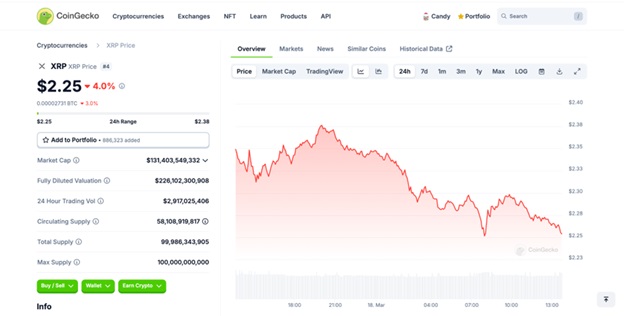
Despite the ongoing regulatory situation XRP continues to progress forward. Currently trading at $2.25,  XRP gained 5.64% throughout the recent week. Fundamental institutional validation arises from major asset management firm Franklin Templeton’s bid to seek regulatory approval for XRP exchange-traded funds (ETFs) because they view opportunities beyond existing challenges.

source: coingecko.com

Seven million XRP addresses have been achieved signifying increased interest from retail users. The market shows signs of bullish sentiment as analysts predict XRP can reach $15 beside major events like whale investment growth and indications about approval for spot XRP ETFs. A substantial whale transaction occurring on Bitfinex demonstrates the increasing interest of whales within the XRP market.

XRP shows potential for market expansion with a positive lawsuit outcome for Ripple but the experienced investor takes into account how ongoing legal challenges might cool the crypto’s price growth. Future XRP growth seems at risk because of delayed litigation processes or unsupportive court decisions.

Remittix Emerges as the Investor’s Crypto of Choice

Experienced market investors choose Remittix (RTX) instead of betting on a token currently involved in legal disputes. Remittix has collected close to $14 million in financial contributions from the sale of 520 million tokens at the token price of $0.0734.

The main focus of XRP lies in international payments whereas Remittix works to optimize and broaden worldwide remittance service operations. Using blockchain technology Remittix operates as a money transfer system which provides expedited service while showing complete transparency at affordable rates.

Remittix presents opportunities in the vast global remittance market which remains difficult to serve adequately according to traditional financial providers. Residents of this profitable yet underserved market segment encourage investment believing Remittix has potential to increase its value through its penetration into the trillion-dollar remittance sector. Hearings from the ongoing token sale indicate broader investor interest beyond this main supporter because multiple parties show readiness to support Remittix growth strategies.

The Potential for Remittix

Similar to XRP, Remittix functions as a payment-focused token which benefits from its new operational structure and reduced regulatory challenges. The present condition of remittance operations creates opportunities for innovative solutions because high fees aside from slow payment processing pervade the system. Remittix’s ability to link with major payment gateways and secure vital business relationships will drive RTX token valuation directly proportional to their actual market deployment.

The rising expectation of XRP-based ETF regulatory approvals indicates how institutional investors seek crypto assets that resolve practical problems. The company’s concentration on remittances as an established economic sector enables Remittix to bypass legal challenges allowing both retail speculators and institutional investors to approach the platform.

Remittix Is The future

A cryptocurrency will establish its success when it successfully transforms outdated financial systems while earning broader market adoption. During the peak of speculative madness in BTC the well-established investor demonstrated his ability to identify actual asset value along with market direction forecasting skills. The shift to Remittix (RTX) represents his conviction that the upcoming market boost will emerge from solving real-world problems instead of remaining trapped in legal uncertainties.

Discover PayFi with Remittix by checking out their presale here:

Website: https://remittix.io/

Socials: https://linktr.ee/remittix

Giveaway: https://gleam.io/FHtn5/250000-remittix-giveaway

Bitcoin Positions as 11th Largest Money Supply Globally

0

Bitcoin’s market capitalization has indeed positioned it as one of the world’s largest currencies when compared to the monetary base of various fiat currencies. Bitcoin was noted as the 11th largest money supply globally, surpassing currencies like the Australian dollar and South Korean won, based on its market cap at that time. However, these rankings can fluctuate with Bitcoin’s price volatility and changes in the circulating supply of traditional currencies. Bitcoin’s market cap continues to grow, often placing it in a similar range depending on the metric used (e.g., comparing it to M0 money supply, which is physical currency plus central bank reserves).

Bitcoin market trends reflect a dynamic landscape shaped by a mix of historical patterns, macroeconomic factors, and recent developments. Bitcoin has experienced significant growth over the years, with its market capitalization currently hovering around $1.5 trillion to $2 trillion, depending on price fluctuations. In 2024, it saw a remarkable rally, climbing over 150% and surpassing $100,000 in December, driven by factors like the approval of spot Bitcoin ETFs in the U.S., the April 2024 halving event (which reduced the supply issuance rate), and optimism around regulatory shifts under a pro-crypto U.S. administration.

However, recent weeks have shown some cooling, with prices retreating from a peak above $108,000 to around $94,000-$96,000, suggesting a potential consolidation phase. Institutional adoption continues to grow, with spot Bitcoin ETFs—like BlackRock’s, which became the fastest-growing ETF in history—drawing in over $35 billion in net inflows in 2024. This has bolstered Bitcoin’s legitimacy as a store of value, often compared to “digital gold.” The halving’s impact lingers, as the reduced issuance of new coins (now at 450 BTC daily from 900) tightens supply, historically a catalyst for price increases in the 12-18 months post-halving—pointing to potential upside into mid-2025.

Analysts project prices could range from $150,000 to $250,000 by year-end 2025, fueled by sustained institutional interest and a possible U.S. strategic Bitcoin reserve, though volatility remains a wildcard. On the flip side, short-term pressures are evident. Profit-taking after the late-2024 surge, coupled with a stronger U.S. dollar and scaled-back expectations for Federal Reserve rate cuts in 2025, has introduced headwinds. Market analysts suggest weak retail demand and heightened volatility, with some indicators showing a bearish tilt in sentiment.

Yet, fundamentals like network security (bolstered by over 18 million miners) and on-chain activity remain robust, supporting the idea that the bull cycle is intact, even if momentum has slowed temporarily. Seasonal trends also play a role—Q1 of U.S. presidential terms often favor risk assets like Bitcoin, potentially setting up a strong start to 2025. However, global liquidity constraints and geopolitical uncertainties could temper gains. The market appears poised for a tug-of-war between bullish catalysts (adoption, supply scarcity) and bearish risks (macro tightening, corrections), with many eyeing a possible retest of $85,000-$90,000 as a key support zone before the next leg up.

While it may still hover around the 10th or 11th spot depending on daily price movements and updates to fiat currency supplies, its exact ranking could shift. For instance, if Bitcoin’s price surges significantly, it could overtake additional currencies like the Russian ruble or even climb higher. The idea of Bitcoin as the “11th largest currency” aligns with sentiment and analyses from sources tracking its growth against fiat systems, though it’s worth noting that comparing a decentralized cryptocurrency to government-issued currencies isn’t always apples-to-apples due to differences in liquidity, usage, and economic function.

Google to Acquire Wiz for $32 Billion, Marking Its Largest Deal Ever

0

Alphabet, the parent company of Google, is set to acquire cloud security startup Wiz for a record-breaking $32 billion to $33 billion, according to sources familiar with the deal.

This acquisition, expected to be officially announced soon, will be the largest in Google’s history, surpassing its $12.5 billion purchase of Motorola Mobility in 2011.

While the agreement has been reached, the acquisition will still require regulatory and other approvals before finalization. As of now, neither Google nor Wiz has issued an official confirmation, although multiple reports confirm the deal is effectively sealed.

Wiz to Operate Independently

Under the deal, Wiz will continue to function as an independent platform, maintaining its compatibility across multiple cloud providers, not just Google Cloud Platform. The acquisition is expected to lead to further expansion of Wiz’s team. Currently, Wiz generates around $700 million in annual recurring revenue (ARR), and the company is projected to reach $1 billion in ARR this year.

Sources have likened the acquisition’s structure to Microsoft’s purchase of LinkedIn, where the acquired company retains significant operational independence while leveraging the parent company’s infrastructure. However, as seen with LinkedIn’s increasing reliance on Microsoft services over time, there is speculation that Wiz could eventually integrate deeper into Google’s ecosystem.

Deal Revived After Previous Breakdown

Negotiations between Google and Wiz have been ongoing for nearly a year, experiencing multiple on-again, off-again phases. The most recent revival of talks occurred this week, with reports suggesting an initial $30 billion offer.

Google Cloud CEO Thomas Kurian has reportedly been leading the charge on the acquisition, with Wiz CEO Assaf Rappaport currently in Israel while Kurian is in Europe. Wiz would fall under Google Cloud’s umbrella, accelerating Google’s expansion into enterprise cloud security.

In 2023, Google initially offered $23 billion for Wiz, but the deal fell through due to concerns over antitrust regulations, Wiz’s independence under Google Cloud, and the valuation. At the time, Wiz had been valued at $12 billion following a $1 billion funding round earlier that year.

Favorable Regulatory Climate?

The regulatory landscape has shifted since the earlier failed negotiations, with a new U.S. administration now in place. Some industry analysts believe this change could lead to a more favorable environment for major tech acquisitions that might have previously faced roadblocks.

Google’s primary motivation behind the deal lies in strengthening two key areas: enterprise cloud services and cybersecurity. Despite its strong presence in the tech sector, Google Cloud continues to lag behind competitors like Amazon Web Services (AWS) and Microsoft Azure. By acquiring Wiz, Google gains a rapidly growing security platform to bolster its enterprise cloud offerings.

The acquisition comes amid Wiz’s rapid business expansion. The company surpassed $500 million in ARR last year and is on track to double that figure in 2024. Following the breakdown of the initial deal with Google, Wiz conducted a secondary sale at a $16 billion valuation and was rumored to be fundraising at an even higher valuation.

During an appearance at Disrupt last year, Wiz CEO Rappaport acknowledged the previous acquisition talks, stating that Wiz had ultimately walked away from the deal—a decision he described as “the toughest ever” but also “the right choice.” Given the significantly higher valuation at which Wiz is now being acquired, it appears that Rappaport’s instincts have paid off financially.

If the deal secures regulatory approval, it will mark a transformative moment for both companies, positioning Google Cloud as a more formidable player in the enterprise cloud security sector while giving Wiz access to Google’s vast resources for further growth.

Google parent Alphabet will acquire cybersecurity company Wiz in a $32 billion cash deal, the companies confirmed Tuesday. The acquisition, if cleared by regulators, would be Alphabet’s biggest on record, with Wiz joining Google’s Cloud business. Talks between the two companies were revived recently, after Wiz walked away from a $23 billion offer from Google last summer amid concerns about regulatory scrutiny. Wiz had cited intentions to explore going public.